

Table of Contents
Overview
In today’s fast-paced software development environment, engineering teams face constant pressure to balance speed with quality. Traditional testing approaches often create bottlenecks, requiring extensive manual script writing and maintenance. Pie emerges as an AI-native quality assurance platform that fundamentally transforms this paradigm by deploying autonomous AI agents that think and test like real users, delivering comprehensive test coverage without the traditional overhead.
Key Features
Pie’s core capabilities center around intelligent automation that adapts to modern development workflows:
Autonomous AI Testing Agents: Advanced AI agents independently explore applications, simulating real user behavior to uncover critical issues before they reach production environments.
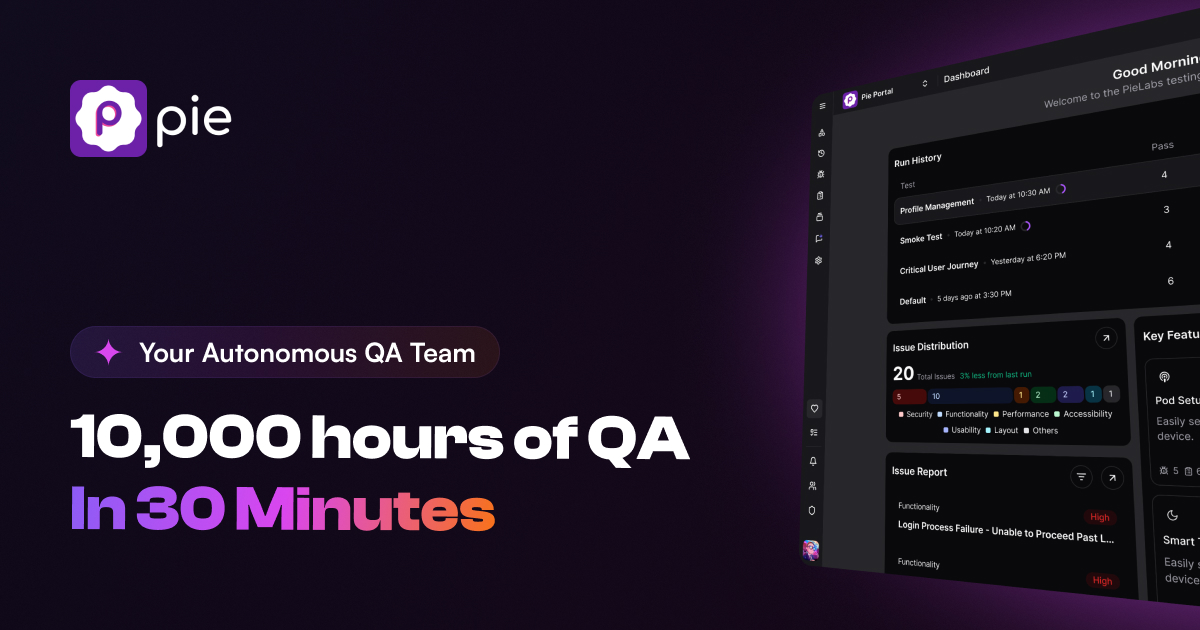
Rapid Coverage Achievement: The platform delivers 80% end-to-end test coverage within 30 minutes of deployment, significantly accelerating the testing process compared to traditional methods.
Zero-Code Testing Approach: Teams can create and execute comprehensive test suites without writing scripts or managing complex code bases, making testing accessible to technical and non-technical team members alike.
Intelligent UI Adaptation: AI agents automatically adjust to user interface changes, eliminating the maintenance burden typically associated with brittle test scripts that break with every UI update.
Natural Language Test Definition: Users can define test scenarios using plain English instructions, such as “test checkout with expired credit card” or “verify admin cannot access user data,” which the AI interprets and executes.
How It Works
Pie operates through an event-driven architecture that deploys sophisticated AI agents directly into web and mobile applications. These agents don’t follow predetermined paths but actively explore applications much like human users would. The system combines this autonomous exploration with user behavior pattern analysis and natural language instructions to generate comprehensive test suites automatically. This approach ensures thorough coverage while requiring minimal human intervention.
Use Cases
The platform addresses multiple critical testing scenarios across the software development lifecycle:
Enterprise-Grade End-to-End Testing: Streamlines complete E2E testing workflows, allowing engineering teams to focus on development rather than test creation and maintenance activities.
Critical User Journey Validation: Ensures essential user flows perform flawlessly before each release, reducing the risk of production issues affecting key business processes.
Zero-Maintenance Regression Testing: Provides truly autonomous regression testing that adapts to application changes without requiring manual test suite updates.
CI/CD Pipeline Integration: Seamlessly integrates into continuous integration and delivery workflows, providing immediate quality feedback with every code commit.
Pros \& Cons
Advantages
Dramatic Time Reduction: Significantly reduces quality assurance cycles by automating test creation, execution, and maintenance processes.
Script-Free Operations: Eliminates the need for writing and maintaining test scripts, freeing valuable engineering resources for core development activities.
Clear Release Decision Framework: Provides objective, data-driven readiness scores that give teams confidence in release decisions.
Enterprise Security Standards: Maintains SOC 2 Type II certification, ensuring robust data protection and security compliance for enterprise environments.
Intelligent Self-Healing: Automatically adapts tests when applications change, maintaining coverage without manual intervention.
Considerations
Modern Application Focus: Optimized for contemporary web applications and may require additional configuration for legacy systems.
Learning Curve: Teams transitioning from traditional testing approaches may need time to adapt to AI-driven workflows.
AI Dependency: Relies on AI decision-making, which may occasionally require human oversight for complex business logic validation.
How Does It Compare?
The AI-powered testing landscape has evolved significantly, with multiple platforms now offering autonomous testing capabilities. Here’s how Pie positions against current competitors:
Versus Traditional Tools: Compared to script-based tools like Selenium and Playwright, Pie eliminates coding requirements and provides automatic maintenance, though traditional tools offer more granular control for complex scenarios.
Versus AI Competitors: Against platforms like Testim, ACCELQ, Applitools, and Katalon, Pie differentiates through its rapid 30-minute coverage achievement and unified natural language interface, while competitors may excel in specific areas like visual testing (Applitools) or enterprise integration (ACCELQ).
Market Position: Pie competes in the growing autonomous testing space alongside Functionize, Mabl, and TestComplete, each offering unique approaches to AI-driven quality assurance. The choice often depends on specific technical requirements, existing toolchain integration needs, and team expertise levels.
Technical Architecture \& Security
Pie employs a modern event-driven architecture using headless browser technology for efficient test execution. The platform supports web applications natively with experimental Android mobile testing capabilities. Security infrastructure includes SOC 2 Type II certification, GDPR compliance, and role-based access control (RBAC) for enterprise-grade data protection.
Integration capabilities span popular CI/CD tools including Jenkins, GitHub Actions, and Azure DevOps, enabling seamless incorporation into existing development workflows.
Final Thoughts
Pie represents a significant advancement in autonomous quality assurance, offering teams a pathway to faster, more reliable testing through AI-powered automation. While the AI testing market has matured with multiple competitive options, Pie’s combination of rapid coverage achievement, natural language interface, and zero-maintenance approach makes it particularly suited for teams seeking to eliminate traditional testing bottlenecks.
The platform’s strength lies in its ability to democratize testing across technical skill levels while maintaining enterprise-grade security and reliability standards. Organizations evaluating Pie should consider their specific testing requirements, existing toolchain compatibility, and team readiness for AI-driven workflows when making adoption decisions.
Success with Pie, as with any AI testing platform, depends on proper implementation, realistic expectations about AI capabilities, and integration with broader quality assurance strategies that may still require human oversight for complex business logic validation.