

Table of Contents
Overview
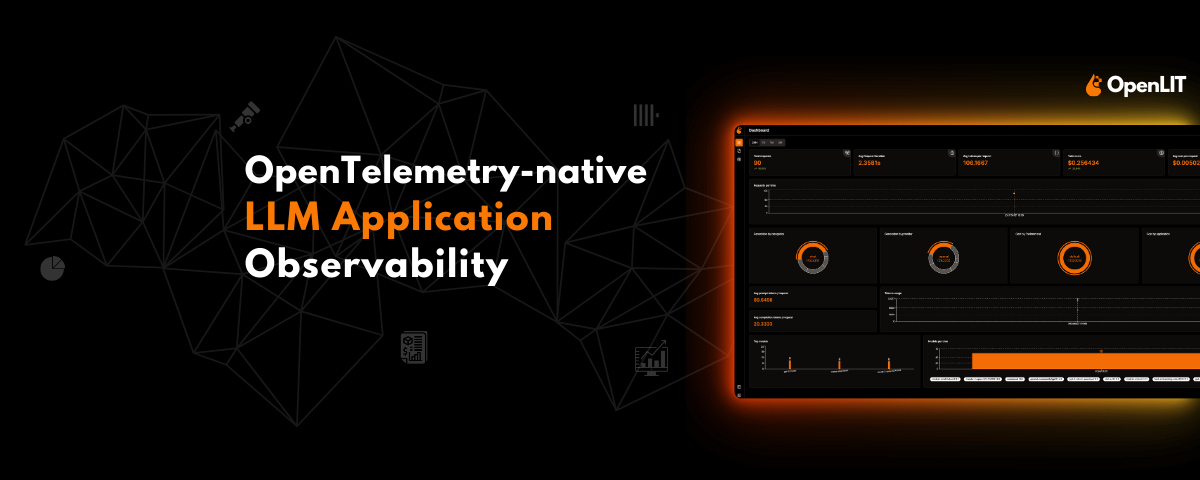
In the rapidly evolving landscape of artificial intelligence, ensuring reliable performance, security, and cost optimization of LLM-powered applications has become critical for production deployments. OpenLIT emerges as a comprehensive, open-source observability platform specifically engineered for AI agents, LLM applications, and generative AI workflows. This OpenTelemetry-native solution provides zero-configuration monitoring across the entire AI stack, including large language models, vector databases, and GPU infrastructure, while offering integrated guardrails, evaluation pipelines, prompt management, and secure credential storage capabilities.
Key Features
OpenLIT delivers enterprise-grade observability capabilities through a comprehensive suite of monitoring and management tools designed for modern AI applications:
- OpenTelemetry-native tracing and monitoring: Comprehensive end-to-end request tracing with span-level monitoring for LLM interactions, providing complete visibility from prompt input through response generation with native OpenTelemetry standard compliance.
- Comprehensive exception handling and debugging: Advanced error tracking with detailed stacktraces, OpenTelemetry integration, and contextual debugging information to rapidly identify and resolve issues in production AI applications.
- Integrated LLM experimentation playground: Side-by-side model comparison capabilities enabling teams to evaluate different LLMs within a unified environment, accelerating model selection and optimization processes.
- Centralized prompt management with version control: Sophisticated prompt repository system featuring versioning, dynamic variable support, and deployment management for consistent prompt handling across development and production environments.
- Enterprise-grade secrets management: Secure, centralized API key and credential storage with access control mechanisms, reducing security risks while simplifying authentication management across AI application infrastructure.
- GPU performance monitoring: Real-time GPU utilization tracking and performance metrics collection for self-hosted model deployments, enabling optimization of compute resource allocation and cost management.
How It Works
OpenLIT’s architecture prioritizes developer experience through minimal configuration requirements while delivering comprehensive observability coverage. Integration requires adding a single line of initialization code – openlit.init() – to Python or TypeScript applications, enabling automatic telemetry collection without additional configuration or code modifications.
Upon integration, OpenLIT automatically instruments supported LLM providers, vector databases, and AI frameworks, capturing detailed performance metrics, request traces, cost tracking, and error information in real-time. The platform’s OpenTelemetry-native architecture ensures compatibility with existing observability infrastructure while providing dedicated dashboards for AI-specific metrics visualization.
The system supports both self-hosted deployments via Docker Compose for complete data control and cloud-based configurations for teams requiring managed infrastructure. Advanced features include automated evaluation pipelines, custom model cost tracking through configuration files, and export capabilities to external observability platforms including Grafana, Elastic, and other OpenTelemetry-compatible systems.
Use Cases
OpenLIT’s versatile architecture addresses diverse AI application monitoring and management requirements across development and production environments:
- Production LLM application monitoring: Comprehensive performance tracking, cost analysis, and reliability monitoring for customer-facing AI applications, enabling proactive optimization and issue resolution.
- AI agent debugging and troubleshooting: Detailed error tracking and performance analysis for complex multi-step AI workflows, reducing mean time to resolution for production incidents.
- Multi-model experimentation and evaluation: Systematic comparison of different LLM providers and configurations, enabling data-driven model selection and performance optimization decisions.
- Enterprise prompt governance: Centralized prompt management with version control, deployment tracking, and security compliance for organizations requiring standardized AI content management.
- Cost optimization and resource management: Detailed usage analytics and cost tracking across models, users, and applications, supporting budget management and resource allocation decisions.
Pros \& Cons
Advantages
- Zero-configuration observability implementation: Single-line integration with automatic instrumentation across 20+ supported AI tools and frameworks, minimizing setup complexity while maximizing coverage.
- OpenTelemetry-native architecture: Standards-based implementation ensuring vendor neutrality, future compatibility, and seamless integration with existing enterprise observability infrastructure.
- Comprehensive self-hosting capabilities: Complete platform control with Docker-based deployment, Apache 2.0 licensing, and extensive documentation supporting security and compliance requirements.
- Unified AI stack monitoring: Integrated monitoring across LLMs, vector databases, and GPU infrastructure through a single platform, reducing operational complexity and tool fragmentation.
Disadvantages
- Technical expertise requirements: Self-hosting and advanced configuration features require familiarity with Docker, OpenTelemetry standards, and observability platform management.
- Limited enterprise support ecosystem: As an open-source project, professional support and managed service options are more limited compared to commercial alternatives with dedicated support teams.
- Interface refinement opportunities: User interface and dashboard aesthetics may require additional polish compared to commercial platforms with dedicated design and user experience teams.
How Does It Compare?
The LLM observability and monitoring landscape has matured significantly throughout 2024-2025, with numerous specialized platforms emerging to address different aspects of AI application management. OpenLIT distinguishes itself through OpenTelemetry-native architecture and comprehensive self-hosting capabilities.
Market-Leading Platforms:
Langfuse dominates the open-source LLM observability space with over 10,800 GitHub stars and the highest download metrics across Python, JavaScript, and Docker distributions. Offering comprehensive tracing, prompt management, and evaluation capabilities, Langfuse excels in production environments requiring detailed analytics and collaborative debugging features. Starting with free self-hosted options and cloud plans from \$59/month, it provides battle-tested reliability for enterprise deployments.
LangSmith by LangChain provides deep integration within the LangChain ecosystem, offering sophisticated debugging, testing, and evaluation tools specifically optimized for LangChain-based applications. With enterprise-grade features and dedicated support, it serves organizations heavily invested in LangChain infrastructure, though it’s less framework-agnostic than alternatives.
Braintrust has emerged as a leading evaluation-focused platform, providing comprehensive AI model assessment, experimentation tracking, and performance optimization tools. Starting at \$25 per user monthly, it excels in research and development environments requiring rigorous model comparison and evaluation workflows.
Specialized Solutions:
Helicone offers streamlined LLM request logging, intelligent caching, and rate limiting capabilities with one-line integration for OpenAI and Anthropic applications. Starting at \$20/month, it provides essential monitoring features with emphasis on cost optimization and request management.
Agenta focuses on open-source LLM evaluation and monitoring with automated testing pipelines and collaborative evaluation workflows. Built on OpenTelemetry standards, it offers similar technical foundations to OpenLIT but with stronger emphasis on evaluation rather than comprehensive observability.
Arize Phoenix specializes in experimental and development-stage LLM application monitoring, providing notebook-first observability with embedded evaluation tools. While powerful for research environments, it lacks the production-grade prompt management and comprehensive usage monitoring features required for enterprise deployments.
Traditional Observability Extensions:
Grafana and Elastic have enhanced their platforms with LLM-specific monitoring capabilities, leveraging OpenTelemetry instrumentation libraries including OpenLIT for comprehensive AI application telemetry. These solutions excel in organizations with existing observability infrastructure but require more configuration compared to dedicated LLM platforms.
OpenLIT’s competitive advantage lies in its unique combination of OpenTelemetry-native architecture, comprehensive self-hosting capabilities, and integrated AI stack monitoring. While lacking the market adoption of Langfuse or the specialized evaluation features of Braintrust, OpenLIT provides exceptional value for teams prioritizing standards-based implementation, complete data control, and unified monitoring across their entire AI infrastructure without vendor lock-in concerns.
Final Thoughts
OpenLIT represents a compelling solution for organizations seeking comprehensive, standards-based observability for their AI applications without sacrificing control or flexibility. Its OpenTelemetry-native architecture and extensive self-hosting capabilities make it particularly valuable for teams prioritizing data sovereignty, vendor neutrality, and integration with existing enterprise infrastructure.
The platform’s strength lies in its comprehensive approach to AI stack monitoring, combining LLM observability, vector database performance tracking, and GPU monitoring within a unified platform. While requiring more technical expertise than managed alternatives and lacking the market adoption of leading competitors, OpenLIT’s commitment to open standards and complete platform control makes it an attractive choice for technically sophisticated teams building production AI applications.