
Table of Contents
Overview
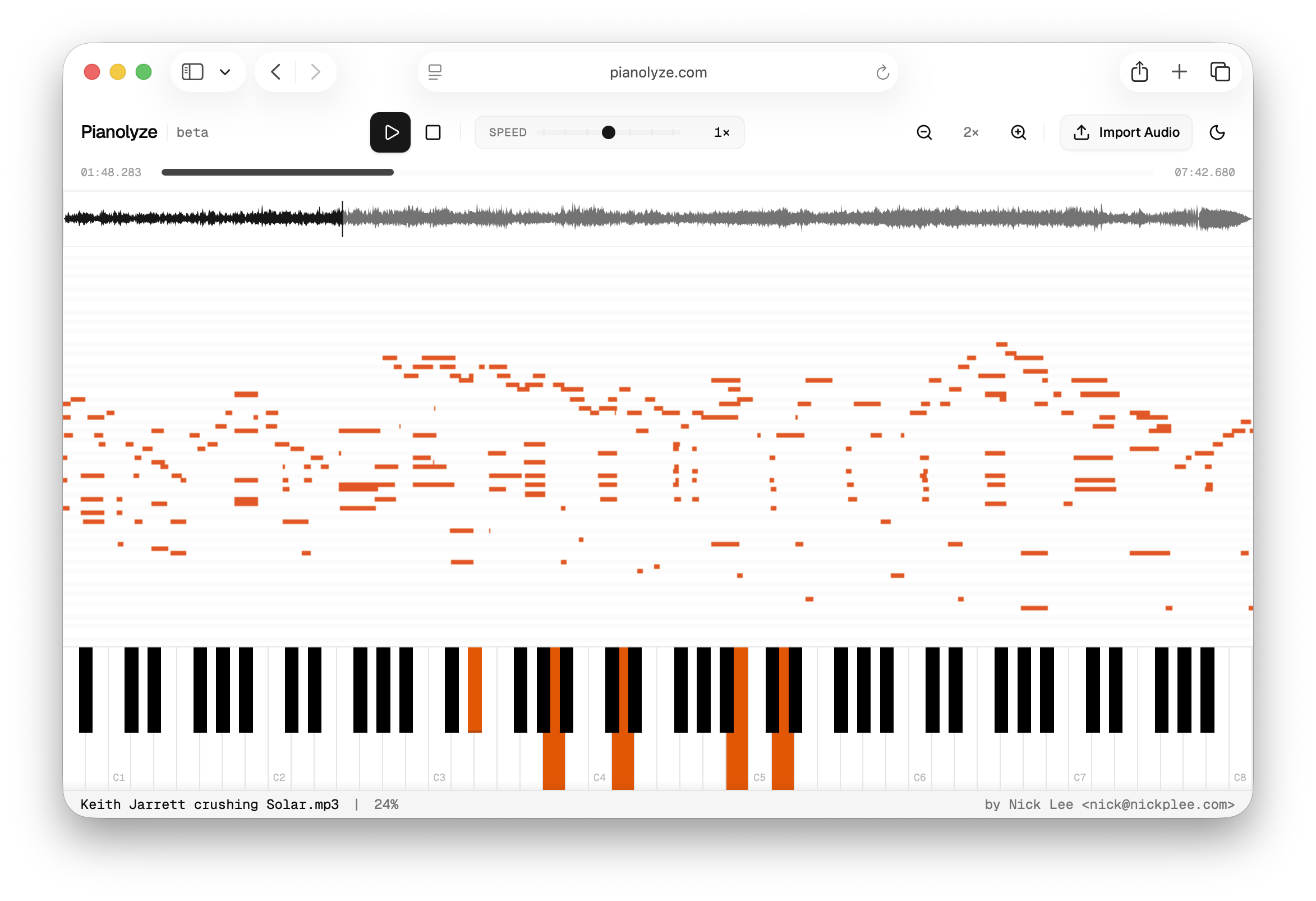
For musicians, transcribing complex piano pieces can be time-consuming and often frustrating. Pianolyze addresses this challenge as an innovative browser-based AI tool that transcribes piano recordings using advanced machine learning technology running entirely client-side. The tool processes MP3, WAV, FLAC, or M4A files through a drag-and-drop interface, displaying notes in real-time on an interactive piano roll. Whether you’re a jazz student analyzing intricate improvisations, a classical pianist studying masterworks, or simply curious about the harmonic choices in recorded performances, Pianolyze provides immediate visual access to piano music transcription without requiring software installation or compromising file privacy.
Built using ONNX Runtime hosting Bytedance’s piano transcription model, Pianolyze employs Web Workers for asynchronous processing and WebGL for piano roll rendering, with all computation occurring locally in your browser. This architecture ensures that audio files never leave your device while delivering transcription capabilities previously available only through desktop applications.
Key Features
Pianolyze delivers functionality specifically designed for musicians and educators studying piano music:
- Instant audio-to-MIDI conversion: Transform piano audio files into visual MIDI data through browser-based AI processing, with transcription beginning immediately upon file upload.
- Real-time interactive piano roll: View notes appearing dynamically on a piano roll interface as the AI processes your recording, providing immediate visual feedback during transcription.
- Playback control tools: Adjust playback speed to study challenging passages at comfortable tempos, and zoom into specific sections to examine note timing, duration, and voicings in detail.
- Complete client-side processing: All AI computation occurs within your browser using locally cached models (approximately 100MB initial download), ensuring audio files remain on your device with no server uploads required.
How It Works
Pianolyze streamlines piano transcription through a straightforward browser-based workflow designed for immediate use:
- Upload your piano recording: Drag and drop any solo piano audio file (MP3, WAV, FLAC, or M4A format) directly into your browser window. The AI model downloads once on first use and caches locally via IndexedDB for subsequent sessions.
- Watch real-time transcription: The system processes audio using Bytedance’s high-resolution piano transcription model, displaying detected notes on the piano roll as analysis progresses, creating an immediate visual representation of the performance.
- Refine your analysis: Use integrated playback controls to slow down tempo without pitch shifting, zoom into specific time ranges to examine note clusters and timing details, and navigate through the transcription to study particular passages of interest.
The underlying technology employs convolutional and transformer neural networks trained on the MAESTRO dataset, enabling the system to detect piano notes, onsets, offsets, and velocity information from polyphonic recordings. This browser-based implementation using Web Audio API and WebGL rendering provides desktop-quality transcription without installation requirements.
Use Cases
Pianolyze serves musicians and educators across multiple learning and analysis scenarios:
- Jazz and classical transcription: Analyze complex improvisations, voicings, and harmonic progressions in jazz recordings, or study the interpretive choices and technical details in classical piano performances without manual transcription.
- Music education and pedagogy: Enable students to visualize recordings for ear training and analysis, help teachers prepare lesson materials from recordings, and support music theory instruction by revealing harmonic structures in real performances.
- Performance analysis: Examine the technical and musical choices of professional pianists by seeing exactly which notes are played, how they’re timed relative to the beat, and how dynamics are applied throughout a performance.
- Harmonic and structural analysis: Study chord voicings, voice leading, harmonic rhythm, and formal structure in piano recordings for composition, arrangement, or academic music analysis purposes.
Pros \& Cons
Advantages
- Browser-based convenience with strong privacy: Operates entirely in modern web browsers (Chrome, Safari, Edge, Firefox) without requiring software downloads, while keeping all audio processing on your device with zero server uploads or data collection.
- Rapid transcription with immediate feedback: Delivers transcription results in real-time as processing occurs, significantly faster than manual transcription and comparable to desktop applications, with the added convenience of working from any computer.
- Valuable educational resource: Provides an accessible entry point for students learning transcription skills, supports ear training by providing visual confirmation, and enables detailed study of professional performances that would otherwise require extensive manual work.
Disadvantages
- Solo piano limitation: The system is optimized specifically for solo piano recordings. Accuracy decreases significantly with accompaniment, multiple instruments, or vocal content, as the model was trained exclusively on solo piano data from the MAESTRO dataset.
- Recording quality dependency: Transcription precision correlates directly with audio quality. Clear, well-recorded performances yield better results than recordings with background noise, room ambience, or compressed audio artifacts. Lower-quality recordings may produce missed notes or false detections.
- No sheet music export: Current version displays piano roll visualization and allows MIDI export but does not generate traditional staff notation or formatted sheet music, requiring additional software for users needing standard notation output.
How Does It Compare?
In November 2025, piano transcription tools fall into three categories: desktop software, cloud-based services, and browser-based applications. Pianolyze occupies a distinctive position in this landscape.
Desktop applications like AnthemScore (starting at \$31 for Lite edition) provide comprehensive transcription with manual editing capabilities, support for multiple instruments, and professional-grade sheet music export. AnthemScore offers greater accuracy tuning and post-transcription editing but requires software installation and financial commitment. Basic Pitch by Spotify, available as both an open-source Python library and web demo, offers free audio-to-MIDI conversion with pitch bend detection but focuses on single instruments and melody lines rather than full polyphonic piano transcription.
Cloud-based platforms like Klangio (subscription-based) and Songscription AI support multi-instrument transcription, YouTube URL input, and professional score export to PDF and MusicXML. These services prioritize output quality and versatility but require account creation, internet connectivity, file uploads, and ongoing subscription costs.
Pianolyze differentiates itself through complete browser-based operation with client-side processing. Unlike AnthemScore, it requires no installation or purchase. Unlike cloud services, files never leave your device, addressing privacy concerns while eliminating upload times. Compared to Basic Pitch, Pianolyze offers a more refined interface specifically optimized for polyphonic piano transcription with interactive playback controls. The tradeoff is piano-only functionality and piano roll visualization rather than traditional notation.
For quick analysis, educational use, privacy-conscious users, or those wanting to try piano transcription without financial or installation commitment, Pianolyze offers significant advantages. For professional transcription requiring traditional notation, multi-instrument support, or extensive manual editing, desktop applications like AnthemScore or subscription services like Klangio may better serve those needs.
Final Thoughts
Pianolyze represents an accessible and privacy-focused approach to piano transcription, leveraging modern browser capabilities to deliver AI-powered analysis without compromising convenience or data security. Its client-side processing architecture, combined with the proven Bytedance piano transcription model, makes sophisticated music analysis available to any musician with a web browser. While the tool focuses exclusively on solo piano and outputs piano roll visualizations rather than traditional sheet music, its combination of immediate accessibility, zero-cost barrier, and robust privacy makes it particularly valuable for students, educators, and musicians exploring transcription for the first time or needing quick analysis of piano recordings. The browser-based approach removes traditional friction points of software installation and file uploading, democratizing access to AI-powered music analysis tools that can meaningfully support musical learning and analysis workflows.
https://pianolyze.com/