
Table of Contents
Overview
In today’s fast-paced business environment, seamless automation is essential for operational efficiency and competitive advantage. Softr Workflows, launched in October 2025, represents a significant advancement in native automation technology. This powerful feature enables development teams and business operators to build sophisticated automations, user interactions, and AI agents directly within the Softr platform, eliminating the need for external third-party tools. Used by over 800,000 teams and trusted by Fortune 500 companies like Google and Universal, Softr now delivers a complete full-stack platform combining app building, data management, and enterprise-grade automation capabilities.
Key Features
Softr Workflows delivers a comprehensive automation experience with capabilities engineered for both simplicity and power.
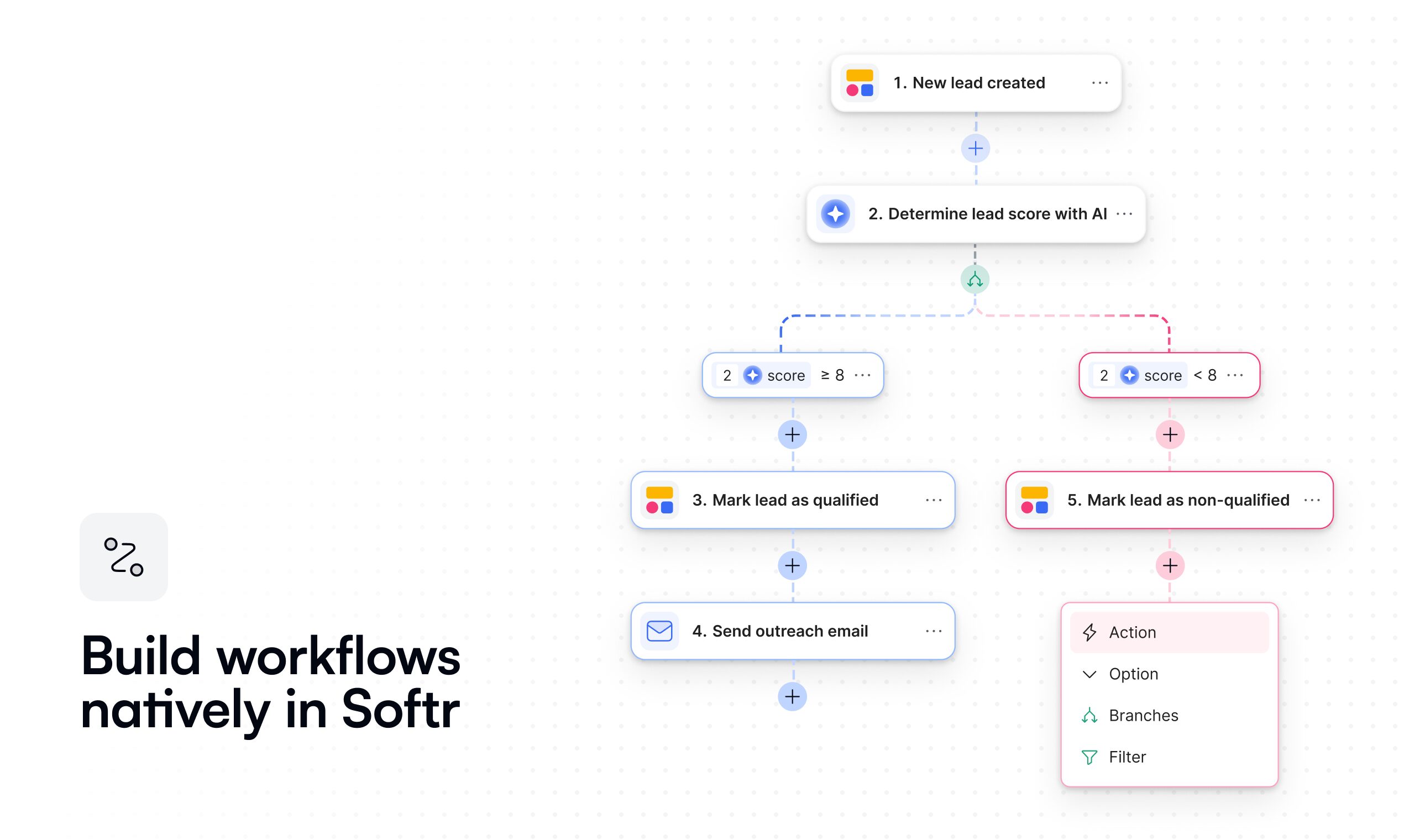
- Visual automation builder: Design intricate automations, user interactions, and AI agents using an intuitive drag-and-drop interface. Build workflows with conditions, filters, branches, loops, and scheduling logic without requiring coding expertise or technical setup complexity.
- Flexible trigger and action system: Define the exact conditions that initiate your workflows through multiple trigger types: database events (record creation, updates, deletion), user actions from Softr app buttons and forms, webhooks from external services, scheduled executions at specific times or intervals, and email received triggers. Chain together unlimited actions that respond dynamically to trigger conditions.
-
AI Co-builder for accelerated workflow creation: Generate workflow templates and automation logic by describing your requirements in plain English. The AI Co-builder translates your workflow concept into a functional automation scaffold, which you can then modify, test, and refine before deploying to production.
-
Native AI agent capabilities: Integrate enterprise AI models including OpenAI and Anthropic directly into workflows to enable intelligent decision-making, content analysis, and autonomous task execution within your automation sequences.
-
Seamless integration ecosystem: Connect Softr applications and databases directly with over 50 pre-built integrations including Airtable, Google Sheets, Gmail, Slack, and external systems via REST API calls, ensuring data flows seamlessly across your entire technology stack without relying on third-party automation platforms.
-
Advanced workflow controls: Access professional-grade automation features including branching logic to handle conditional workflows, looping capabilities for batch operations, custom JavaScript or Python code blocks for specialized logic, wait steps for timing control, and progress indicators to provide users with visual feedback during long-running processes.
How It Works
Building automations with Softr Workflows begins in the Softr Studio. Access the Workflows section from the left sidebar to start creating. You have two approaches: begin from a pre-built template for common use cases such as weekly email digests, AI-powered data enrichment, or automated notifications, or describe your desired automation in natural language and let the AI Co-builder generate a starting workflow. Once your workflow is established, select your trigger event—whether a database change, user action, scheduled time, incoming email, or external webhook. Add your action sequence using the visual builder, incorporating conditions, branches, and logic as needed. The workflow executes automatically when the trigger condition is met. For database-triggered workflows, actions execute immediately after the trigger event. For app-triggered workflows, you can display progress or wait screens that inform users their request is processing, then show confirmation messages upon completion. Deploy instantly to your live Softr applications without downtime.
Use Cases
Softr Workflows enable automation across diverse operational scenarios for modern businesses.
- Automating complex app logic for growing teams: Scale your business operations by automating sophisticated backend processes directly within Softr applications, including user onboarding sequences, real-time data synchronization between systems, automated notifications and alerts, lead routing and assignment, and approval workflows. Eliminate reliance on development teams for routine task automation.
-
No-code workflow orchestration for business teams: Empower non-technical business users to design and deploy enterprise workflows through visual automation. Automate internal process management, customer interaction sequences, document processing, data validation and enrichment tasks, and cross-system synchronization—all through an accessible interface requiring no coding.
-
Intelligent AI-powered business automation: Leverage AI agents within workflows to analyze incoming data, classify information automatically, generate personalized content, summarize lengthy documents and conversations, extract structured data from unstructured content, and make intelligent decisions based on business logic, transforming static workflows into reasoning systems.
-
Real-time data synchronization: Keep multiple business systems synchronized automatically when data changes, eliminating manual data entry, reducing errors, and ensuring consistent information across CRM systems, databases, spreadsheets, project management tools, and communication platforms.
Pros & Cons
Advantages
- Native platform integration: Workflows execute natively within Softr with direct access to your apps and databases, enabling faster response times, superior reliability, and the ability to react instantly to user actions and data changes without external API delays or dependencies.
-
No-code accessibility: The visual builder and AI Co-builder democratize automation, enabling teams without development expertise to design and deploy sophisticated workflows in minutes rather than requiring technical implementation.
-
Enterprise AI capabilities: Integrated OpenAI and Anthropic support enables intelligent automation with reasoning, decision-making, and content generation, moving beyond simple rule-based automation to adaptive, learning workflows.
-
Comprehensive platform: Combines app building, database management, and workflow automation in a single platform, reducing tool switching, simplifying compliance requirements, and providing unified access controls and data governance.
-
Cost-effective with built-in actions: Every Softr pricing plan includes workflow actions, with free-tier users receiving monthly action credits, eliminating the need for separate automation platform subscriptions that can quickly become expensive at scale.
-
Advanced workflow capabilities: Professional-grade features including multi-branch logic, looping, custom code, scheduling, and webhook support rival dedicated automation platforms while maintaining simplicity for basic use cases.
Disadvantages
-
Ecosystem focus: While Softr Workflows excel within the Softr platform, teams using Softr as just one component of a complex multi-platform technology stack may find dedicated automation platforms like Zapier or Make offer broader out-of-the-box integration coverage across hundreds of specialized tools.
-
Learning curve for complex scenarios: Building sophisticated multi-branch workflows with advanced conditional logic requires understanding workflow design principles. Teams accustomed to simpler linear automation may need adjustment time.
-
Execution limits by plan tier: Workflow action allowances vary by subscription plan. High-volume automation requirements may necessitate premium plan tiers, though comprehensive pricing remains competitive.
How Does It Compare?
When evaluating workflow automation solutions, Softr Workflows competes in the broader automation platform market alongside established players including Zapier, Make (formerly Integromat), n8n, Airtable Automations, Monday.com Automations, and Notion Workflows. Each platform serves distinct purposes across the automation spectrum.
Zapier and Make represent general-purpose integration platforms offering integration breadth as their primary value. Zapier connects to over 8,000 applications but with a linear, step-by-step workflow model. Make supports 2,400 applications with more sophisticated branching and custom logic capabilities but requires deeper technical expertise. Both rely on task or operation-based pricing models that scale with automation volume.
n8n, an open-source alternative, emphasizes developer flexibility and self-hosting options, making it ideal for organizations requiring extensive customization, on-premise deployment, or avoiding vendor lock-in. Its learning curve and technical requirements make it less accessible for business users without development backgrounds.
Airtable Automations focuses specifically on database-centric automation within Airtable bases, automatically executing actions when records change or specific conditions are met. While powerful for data management workflows, Airtable Automations remains constrained within the Airtable ecosystem and lacks broader app-building capabilities.
Monday.com Automations provides workflow automation tightly integrated with Monday.com’s project management system, serving teams whose primary workflow originates from project tracking.
Notion Workflows offers AI-first automation focused on content creation, summarization, and knowledge management tasks within Notion workspaces, excelling at text-based intelligence rather than cross-system integration.
Softr Workflows distinguishes itself through multiple competitive advantages: native integration within a full-stack app-building platform enables instant response to user actions and database changes without external latency. Enterprise AI agent capabilities using OpenAI and Anthropic models provide intelligent automation beyond rule-based processes. The visual builder with AI Co-builder assistance maintains accessibility for non-technical users while supporting custom code for power users. Critically, every Softr plan—including the free tier—includes workflow actions, eliminating the per-action costs that make competitors expensive at scale. For teams building applications on Softr, Softr Workflows provides specialized capabilities unavailable in general-purpose automation platforms. For organizations requiring integrations beyond Softr’s ecosystem or building primarily on external platforms, Zapier or Make may better serve broader integration requirements.
Pricing and Accessibility
Softr Workflows is accessible across all pricing tiers, with even the free plan including monthly workflow action credits. The Starter plan ($29/month) provides essential automation capacity, Professional plans ($139-167/month) support growing automation needs with increased limits, and Business plans ($269-323/month) deliver enterprise-scale automation capabilities. Custom Enterprise pricing accommodates specialized requirements and deployment needs for large organizations.
Final Thoughts
Softr Workflows represents a significant evolution in how teams approach business process automation, combining accessibility for non-technical users with professional capabilities for advanced scenarios. Launched in October 2025 and launched to Product Hunt with strong community reception (306+ upvotes), Softr Workflows complete the company’s transformation into a genuine full-stack platform. The native integration of automation capabilities, enterprise AI models, and comprehensive app-building and database management tools creates a compelling alternative to maintaining separate specialized tools for different functions. For teams already building on Softr or evaluating a unified platform solution, Softr Workflows delivers enterprise-grade automation capabilities without requiring external platform dependencies or additional subscription costs. The combination of visual simplicity, AI-assisted workflow creation, and native platform integration positions Softr as an increasingly powerful choice for ambitious business automation projects.