
Table of Contents
Overview
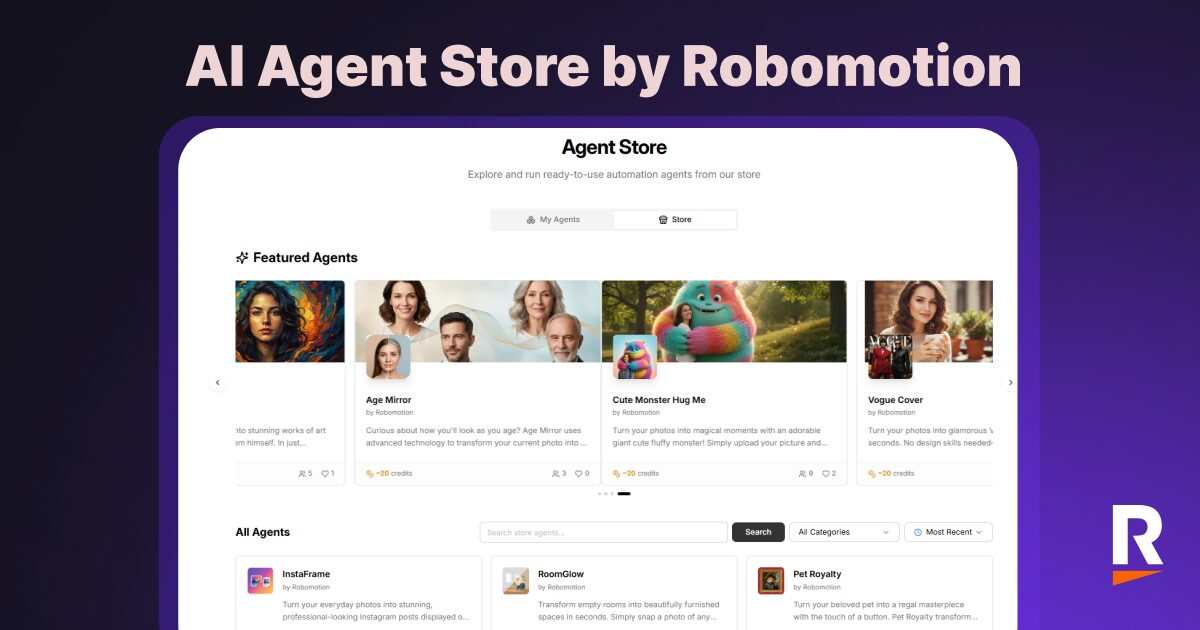
Robomotion’s AI Agent Store represents an evolution of the established Robomotion RPA platform, which serves over 20,000 users across industries including finance, e-commerce, healthcare, and logistics. Launched as an innovative marketplace layer on top of Robomotion’s core automation infrastructure, the AI Agent Store leverages Google’s Agent Development Kit (ADK v1.0.0, launched at Google I/O 2025) to provide a curated collection of AI-powered agents for workflow automation. The Store combines Robomotion’s proven RPA capabilities with modern AI agents, enabling teams to automate complex, intelligent tasks—from email management and data research to content generation and workflow optimization. With new agents added weekly and a thriving community of 5,000+ members, the platform offers both pre-built solutions and the capability to create custom agents, making AI-driven automation accessible to developers and business users alike.
Key Features
The AI Agent Store delivers a comprehensive marketplace experience built on proven automation infrastructure.
- AI Agent Marketplace: Browse and deploy a growing collection of AI agents tailored for specific business functions, from productivity enhancement to creative work and workflow optimization.
- Google ADK Integration: Agents are built on Google’s Agent Development Kit (v1.0.0, stable since May 2025), ensuring modern AI architecture with support for LLM agents, sequential agents, loop agents, and parallel agents alongside sessions, toolkits, and callbacks.
-
Multi-Type Agent Support: Access agents designed for productivity tasks, workflow automation, creative assistance, customer service, scheduling, research synthesis, and complex decision-making across your business processes.
-
Weekly New Agent Releases: The marketplace continuously expands with fresh, innovative agents added every week, ensuring access to emerging capabilities and staying current with AI advancements.
-
Curated and Categorized Discovery: Agents are carefully selected and organized into intuitive categories, enabling quick discovery of the perfect tool for any specific task or workflow.
-
Visual Flow Designer Integration: Create or customize agents using Robomotion’s low-code visual flow editor with drag-and-drop nodes, combining ADK’s powerful concepts with accessible, code-free design.
-
Ready-to-Use Automation: Deploy agents immediately to handle repetitive tasks, manage scheduling, conduct research, generate content, or assist with complex multi-step workflows without additional configuration.
-
Community-Driven Development: Access agents created by Robomotion’s active 5,000+ member community, with both free and paid options, and the ability to publish your own agents through the Agent Publisher program.
How It Works
Getting started with the AI Agent Store integrates seamlessly into existing Robomotion automation workflows or stands alone as an independent solution.
Browse the marketplace and select agents aligned with your specific tasks. Whether you need agents for email management, data research, content generation, customer service automation, or complex workflow orchestration, the Store offers diverse options. Once selected, agents can be deployed directly or customized using the visual flow designer to match your specific business logic and requirements.
Integration into daily routines or existing automations happens through Robomotion’s desktop application, web interface, or API connections. Agents automatically handle repetitive or complex jobs using advanced AI capabilities, freeing your team to focus on strategic activities. The platform’s chat assistant, embedded in the desktop app and accessible via browser, enables easy interaction with deployed agents and real-time monitoring of agent performance.
For advanced users, the visual ADK tool within Robomotion Designer enables designing entire agent systems by combining Robomotion nodes with native ADK concepts. Agents can be versioned for stability and deployed across cloud or on-premises infrastructure, scaling from individual automation to enterprise-wide orchestration.
Use Cases
The versatility of AI agents within Robomotion’s ecosystem serves diverse automation scenarios across industries.
- Intelligent Task Automation: Automate complex tasks combining multiple apps and decision-making logic—processing leads through CRM and email systems, updating data across platforms, or conducting preliminary research without manual intervention.
-
AI-Enhanced Workflow Optimization: Deploy agents that understand business context and make adaptive decisions—prioritizing support tickets by urgency, enriching lead data from multiple sources, or generating personalized customer communications automatically.
-
Research and Intelligence Synthesis: Leverage agents for conducting market research, summarizing customer feedback, analyzing call transcripts, gathering competitive intelligence, or synthesizing information from multiple data sources into actionable insights.
-
Content Generation and Creative Assistance: Use agents for writing assistance, generating content outlines, creating marketing copy, brainstorming campaign ideas, or producing structured documentation like product requirement documents from raw feedback.
-
Customer Service and Support Automation: Deploy agents for auto-responding to support tickets, categorizing issues by complexity, analyzing customer sentiment, managing chatbot conversations, or routing inquiries to appropriate team members.
-
Schedule and Calendar Management: Automate meeting preparation, conduct attendee research, prepare briefing materials, manage recurring scheduling tasks, or handle time-zone-aware appointment coordination across distributed teams.
-
Enterprise-Grade Automation: Implement business process automation across finance, HR, supply chain, and operations, leveraging AI agents for tasks traditionally requiring human decision-making and research capabilities.
Pros & Cons
Advantages
- Built on Industry-Proven Infrastructure: Robomotion’s 20,000+ users and established track record in finance, e-commerce, healthcare, and logistics provide proven reliability for mission-critical automation.
-
Modern AI Architecture: Google’s Agent Development Kit (v1.0.0) ensures agents leverage cutting-edge AI capabilities including multi-agent orchestration, state management, and tool integration rather than outdated automation patterns.
-
Accessible to Non-Developers: Visual flow designer enables business users to create or customize agents without coding, while advanced developers can extend functionality through scripting and custom logic.
-
Continuous Innovation: Weekly new agent releases and active community contribution ensure the marketplace stays current with emerging AI capabilities and expanding use case coverage.
-
Flexible Deployment Options: Deploy agents on cloud infrastructure, on-premises, or hybrid configurations, with desktop, web, and API access points accommodating diverse organizational architectures.
-
Strong Community Support: 5,000+ member Discord community provides peer support, best practices sharing, integrations, and expert guidance accessible to all users.
-
Intelligent Automation, Not Just Task Orchestration: Unlike traditional workflow platforms that connect apps through rigid rules, Robomotion agents apply reasoning and decision-making capabilities suitable for complex, variable tasks.
Disadvantages
-
Dependent on Individual Agent Quality: The marketplace’s effectiveness relies on curators selecting high-quality agents and individual agents performing reliably. Poor agents can create frustration or require extensive troubleshooting.
-
Vendor Lock-In Considerations: Automations built within Robomotion’s ecosystem may require significant effort to migrate to alternative platforms, particularly for complex agent customizations.
-
May Require Robomotion Account: Advanced features, certain integrations, and agent publishing capabilities necessitate a Robomotion account, creating friction for users exploring the marketplace casually without commitment.
-
Enterprise Features Still Developing: While Robomotion serves enterprises, governance features, advanced audit trails, and multi-team collaboration capabilities continue maturing compared to specialized enterprise automation platforms.
-
Learning Curve for Customization: While basic agent deployment is straightforward, creating sophisticated custom agents using ADK concepts or flow designer requires learning platform-specific patterns and best practices.
How Does It Compare?
When evaluating AI-powered automation platforms in 2025, the competitive landscape has expanded significantly beyond traditional RPA solutions. Robomotion’s AI Agent Store operates in a space increasingly contested by mainstream automation platforms and specialized AI agent builders.
Zapier, the market-leading workflow automation platform connecting 8,000+ applications, launched Zapier Agents in September 2025 as a direct response to AI agent demand. Zapier Agents enable AI-powered task execution across the Zapier ecosystem with natural language instructions, agent-to-agent collaboration through calling, and web browsing capabilities. However, Zapier’s strengths lie primarily in app-to-app integration and lightweight automation. Zapier Agents are optimized for straightforward multi-app orchestration rather than complex, reasoning-heavy tasks requiring desktop automation, RPA capabilities, or on-premises deployment. For teams already embedded in Zapier’s ecosystem or seeking simple app connections, Zapier Agents offers efficiency gains. For organizations requiring sophisticated reasoning, desktop automation, or on-premises infrastructure, Robomotion provides superior capabilities.
Make (formerly Integromat) offers Make AI Agents, featuring 3,000+ app integrations, visual workflow design, real-time decision-making with LLM flexibility, and reusable agents across workflows. Make excels at visual, adaptable multi-app automation and attracts users preferring highly visual workflow construction. However, Make lacks native RPA capabilities for desktop automation, inherited system process automation, or on-premises deployment that Robomotion provides. Teams prioritizing pure integration elegance and visual canvas simplicity may prefer Make; teams requiring comprehensive automation including desktop and legacy system automation prefer Robomotion.
Traditional RPA platforms like UiPath and Automation Anywhere focus on enterprise-grade structured task automation with extensive governance and orchestration capabilities. These platforms excel at large-scale process mining, extensive audit trails, and specialized enterprise features. However, traditional RPA platforms are heavyweight, expensive, and increasingly outdated in their AI integration approaches compared to modern agent-driven platforms. They represent the previous generation of automation rather than the emerging AI-native direction represented by Robomotion.
Specialized AI agent builders like GenFuse AI, Beam AI, and Relevance AI focus exclusively on agent creation without deep integration capabilities. These platforms excel at agent reasoning and multi-step task orchestration but lack Robomotion’s connection to diverse applications, desktop automation capabilities, and established user base validation.
Robomotion’s differentiation lies in its combination of established RPA infrastructure (20,000+ users, proven reliability), modern Google ADK-based agent architecture, hybrid deployment flexibility (cloud, on-premises, or hybrid), desktop automation capabilities, and a curated Agent Store built by an experienced team. For organizations requiring sophisticated automation spanning cloud applications, on-premises systems, and desktop tasks with AI reasoning capabilities, Robomotion provides a uniquely comprehensive platform combining proven reliability with emerging AI capabilities.
Pricing and Accessibility
Robomotion offers flexible pricing models accommodating solo practitioners through enterprises. The AI Agent Store provides free-tier access to preview agents and explore marketplace functionality. Paid agents and advanced features operate on transparent, scalable pricing without hidden costs. Existing Robomotion customers access the Agent Store as part of their platform subscription, while new users can start with free trials to evaluate functionality before purchasing.
Final Thoughts
Robomotion’s AI Agent Store represents a mature approach to AI-driven automation, building on a foundation of 20,000+ proven users and a thriving 5,000+ member community rather than pursuing revolutionary positioning. By embracing Google’s stable Agent Development Kit and integrating it with established RPA capabilities, Robomotion positions itself between lightweight app-integration platforms (Zapier, Make) and heavy enterprise RPA solutions (UiPath, Automation Anywhere).
For organizations seeking genuinely intelligent automation combining cloud apps, on-premises systems, and desktop automation—coupled with modern AI reasoning capabilities—Robomotion delivers comprehensive value. The continuously expanding marketplace, active community support, and flexible deployment options make it an attractive platform for teams ready to move beyond simple workflow connections toward sophisticated, intelligent automation.
The key consideration: evaluate your automation needs across the spectrum from simple app integration to complex desktop automation to intelligent decision-making. If your requirements span multiple categories, Robomotion’s comprehensive approach provides compelling advantages. If your needs are narrowly focused on app integration (Zapier/Make) or pure agent reasoning (GenFuse/Beam), specialized alternatives may suffice. For balanced, production-proven intelligent automation, Robomotion’s AI Agent Store merits serious consideration.