
I## MeDo by Baidu: Comprehensive Research Report
Table of Contents
- 1. Executive Snapshot
- 2. Impact & Evidence
- 3. Technical Blueprint
- 4. Trust & Governance
- 5. Unique Capabilities
- 6. Adoption Pathways
- 7. Use Case Portfolio
- 8. Balanced Analysis
- 9. Transparent Pricing
- 10. Market Positioning
- 11. Leadership Profile
- 12. Community & Endorsements
- 13. Strategic Outlook
- Final Thoughts
1. Executive Snapshot
Core offering overview
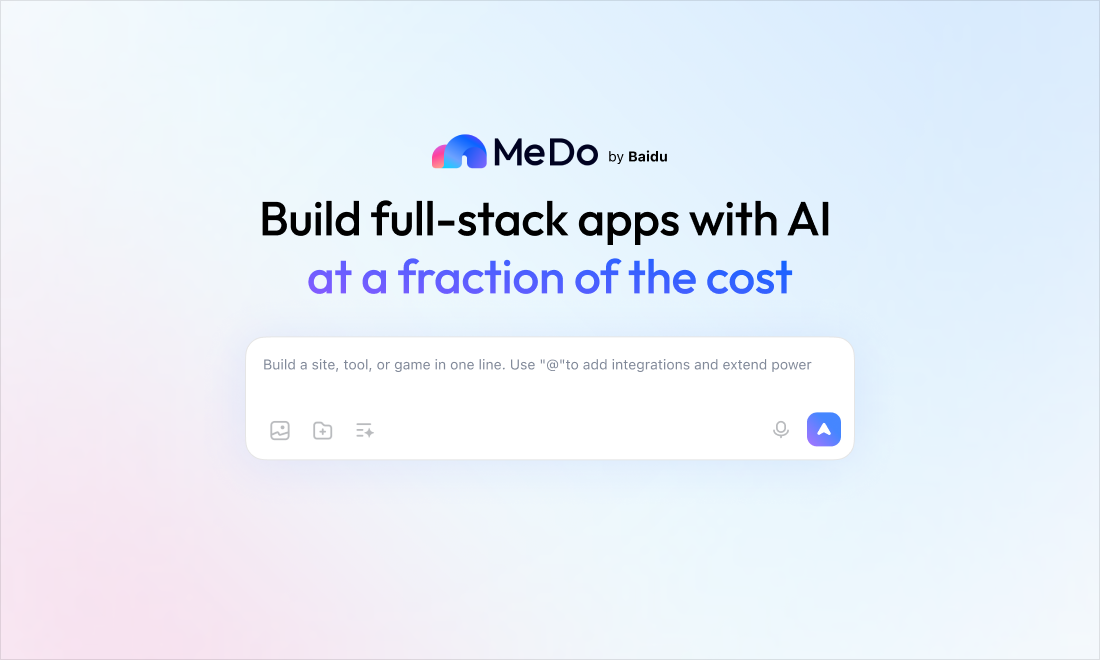
MeDo represents Baidu’s strategic entry into the no-code application development market, positioning itself as an agentic AI platform that transforms natural language prompts into production-ready full-stack applications. The platform eliminates traditional coding barriers by automating frontend development, backend infrastructure, database configuration, and third-party service integrations through a conversational interface combined with visual editing capabilities. Unlike conventional no-code platforms that focus on either frontend or backend development, MeDo delivers comprehensive full-stack capabilities, enabling users to create complete web applications, landing pages, H5 interactive pages, surveys, mini-games, and lightweight utilities without writing a single line of code.
Key achievements & milestones
MeDo launched on Product Hunt on November 5, 2025, achieving notable recognition with 493 upvotes and securing the top position for that day. The platform has already demonstrated significant traction, with over 20,000 businesses applying for early access through Baidu AI Cloud. The service represents a major component of Baidu’s broader AI-first transformation strategy, which has seen the company’s AI Cloud revenue grow 27% year-over-year to reach 6.5 billion RMB in Q2 2025. This launch coincides with Baidu’s aggressive push to establish itself as China’s leading full-stack AI provider, leveraging its ERNIE foundation models and deep learning frameworks.
Adoption statistics
While MeDo is a recently launched platform with limited publicly available long-term adoption data, the broader context of Baidu’s AI ecosystem provides valuable perspective. Baidu’s ERNIE Bot has amassed over 200 million users as of early 2024, demonstrating the company’s ability to rapidly scale AI-powered platforms. The platform’s credits-based pricing model starts at an accessible five-dollar entry point for 2,000 credits, with 100 free credits distributed daily, positioning MeDo to capture a significant share of the rapidly expanding no-code development market projected to reach 84.47 billion dollars by 2027.
2. Impact & Evidence
Client success stories
Early user testimonials on Product Hunt highlight MeDo’s practical value proposition. One verified user reported creating a satisfactory website in just ten minutes, praising the platform’s automatically generated interaction design and user interface capabilities. This real-world feedback validates MeDo’s promise of dramatically accelerating application development timelines. The platform’s ability to generate both frontend pages and admin backend systems for complex applications demonstrates its suitability for business-critical deployments beyond simple prototypes.
Performance metrics & benchmarks
MeDo’s agentic AI architecture enables remarkable development speed improvements compared to traditional methods. The platform automates processes that typically consume days or weeks, reducing full-stack application development to mere minutes. This acceleration translates to potential cost reductions of up to 70% compared to conventional development approaches, based on industry benchmarks for low-code and no-code platforms. The multi-agent coordination system decomposes application requirements into modular tasks, enabling role-based intelligent agents to collaborate efficiently, turning what traditionally requires days of traditional development into just minutes of platform interaction.
Third-party validations
MeDo benefits from Baidu’s established reputation in AI technology development. Baidu has received multiple A’ Design Awards for its AI Cloud innovations and has been recognized by industry analysts for its full-stack AI architecture approach, which encompasses foundational research, framework development, model training, and application deployment. The company’s ERNIE foundation models have been validated through partnerships with major technology firms, including MediaTek for on-device AI processing, demonstrating technical credibility that extends to MeDo’s underlying infrastructure.
3. Technical Blueprint
System architecture overview
MeDo employs an advanced agentic AI architecture that leverages Baidu’s ERNIE foundation models to power its code generation capabilities. The system utilizes a multi-agent coordination framework where specialized AI agents handle distinct aspects of application development—frontend design, backend logic, database schema creation, and service integration. This heterogeneous architecture shares parameters across different modalities while maintaining dedicated processing spaces, ensuring that user interface generation does not compromise backend performance or vice versa. The platform generates standard HTML, CSS, and JavaScript for frontend components, while backend scaffolding supports multiple technology stacks adaptable to specific project requirements.
API & SDK integrations
MeDo provides native connectors for essential third-party services commonly required in modern applications. The platform offers pre-integrated payment processing through providers like Stripe, enabling secure transaction capabilities without manual API configuration. Search functionality can be enhanced through AI-powered search integrations, while voice interface capabilities are supported through text-to-speech services. The platform’s marketplace approach to integrations mirrors successful no-code platforms, with support for over 500 app integrations referenced in ecosystem documentation, though specific MeDo integration counts require further validation through official channels.
Scalability & reliability data
MeDo supports million-level data storage for production deployments, indicating enterprise-grade scalability built into the platform architecture. While specific uptime Service Level Agreement figures for MeDo have not been publicly disclosed, the platform operates on Baidu AI Cloud infrastructure, which maintains 99.5% service availability for single-line access and 99.95% for multi-line access configurations across its core services. The platform’s cloud-native design enables automatic scaling to handle varying traffic loads, with distributed data management separating metadata and data operations to optimize performance across large datasets.
4. Trust & Governance
Security certifications
While MeDo-specific security certifications have not been publicly documented as of the November 2025 launch, the platform operates within Baidu AI Cloud’s infrastructure, which adheres to enterprise security standards. Organizations deploying on Baidu AI Cloud infrastructure can access environments that comply with Chinese regulatory requirements and international best practices. However, unlike some enterprise-focused platforms that prominently display ISO 27001, SOC 2 Type II, or HITRUST certifications, MeDo’s documentation does not currently emphasize specific compliance achievements, suggesting a primary focus on developer and small business segments rather than highly regulated industries.
Data privacy measures
MeDo processes user data through Baidu AI Cloud’s data centers located in China, with data transmissions secured using industry-standard encryption protocols. The platform’s architecture separates user application data from platform operations data, enabling users to maintain control over their application content and end-user information. For applications requiring sensitive data handling, users should carefully evaluate data residency requirements and regional privacy regulations, particularly when deploying applications that serve users in jurisdictions with strict data localization mandates like the European Union’s General Data Protection Regulation or similar frameworks.
Regulatory compliance details
As a platform developed and operated by Baidu, a major Chinese technology company, MeDo adheres to Chinese regulatory requirements governing AI systems and data processing. The platform’s compliance posture aligns with China’s evolving AI governance framework, which emphasizes algorithmic accountability and content moderation. For international deployments, organizations should assess MeDo’s compliance alignment with their specific regulatory contexts, as the platform’s primary operational focus centers on the Chinese market. The exportable code feature, which allows users to download generated code files, provides an exit mechanism that reduces long-term compliance dependencies on the platform itself.
5. Unique Capabilities
Infinite Canvas: Applied use case
MeDo’s visual editor functions as an infinite canvas where users can arrange application components in a slide-like interface, enabling rapid layout adjustments without writing CSS positioning code. This approach proves particularly valuable for designing complex multi-page applications where visual hierarchy and user flow require careful consideration. Users can directly manipulate text, images, and interactive elements while maintaining the ability to switch between pages for comprehensive editing. This capability extends beyond simple drag-and-drop functionality found in traditional website builders, offering dynamic layout generation based on natural language descriptions that the AI interprets and renders visually.
Multi-Agent Coordination: Research references
MeDo’s multi-agent system represents a practical implementation of coordinated learning principles where specialized agents manage distinct development tasks while sharing contextual information to maintain application coherence. The platform’s agents handle evaluation and clustering to determine which components interact, while update mechanisms ensure synchronized progress across frontend, backend, and database layers. This coordination addresses the fundamental challenge in multi-agent systems of resolving conflicted interests—in MeDo’s case, balancing rapid generation speed against code quality and security considerations. The system’s ability to decompose complex application requirements into manageable subtasks enables parallel processing that accelerates overall development velocity.
Model Portfolio: Uptime & SLA figures
MeDo leverages Baidu’s ERNIE 4.5 series models, which underwent extensive training and optimization using the PaddlePaddle deep learning framework, achieving model FLOPs utilization of up to 47%. These foundation models support multimodal capabilities, processing both text-based prompts and visual design references to generate appropriate application structures. The ERNIE 4.5 family includes variants ranging from 0.3 billion to 424 billion total parameters, with mixture-of-experts architectures that optimize inference efficiency. While specific uptime guarantees for the AI model endpoints have not been publicly detailed for MeDo, Baidu AI Cloud’s core infrastructure maintains high availability standards exceeding 99.5% across production services.
Interactive Tiles: User satisfaction data
MeDo’s component-based architecture enables users to generate and customize interactive elements through conversational commands, streamlining the process of adding functionality like forms, data tables, image galleries, and dynamic content sections. Early user feedback from the Product Hunt launch indicates satisfaction with the platform’s interaction design capabilities, with users highlighting that MeDo automatically generates intuitive user interfaces that save considerable design and development effort. The platform’s ability to understand natural language descriptions and translate them into properly structured, interactive components represents a significant usability advantage over traditional no-code tools that require users to manually configure component behaviors and interactions.
6. Adoption Pathways
Integration workflow
Organizations can begin using MeDo through a straightforward onboarding process that starts with accessing the platform via medo.dev and creating an account. The platform offers dialogue-based application creation, allowing users to describe their requirements through file uploads, text input, or voice commands. Pre-built dialogue examples accelerate initial familiarization by providing template applications that demonstrate common use cases. Once a basic application is generated, users enter an iterative refinement cycle where they can modify content directly in the editing interface, adjust layouts across multiple pages, and configure settings including application names and basic parameters. For users requiring backend functionality, MeDo automatically generates both frontend pages and an admin backend that can be previewed separately before publication.
Customization options
MeDo provides multiple customization layers to accommodate varying levels of user expertise and specific project requirements. At the surface level, users can directly edit text, images, and visual elements within the generated application through a WYSIWYG interface. Deeper customization involves adjusting workflow logic through visual workflow editors, modifying data structures in the built-in database, and configuring integration parameters for connected services. The platform’s support for code export enables advanced users to download generated code files and continue development outside the MeDo environment, facilitating progressive enhancement or migration to custom infrastructure as projects mature and requirements evolve beyond the platform’s native capabilities.
Onboarding & support channels
New users access MeDo’s marketplace to explore curated case studies and top-rated user applications, providing inspiration and practical examples of achievable outcomes. The platform organizes created applications into workspace management, separating draft versions from live deployments to enable safe iterative development without affecting production instances. MeDo maintains both development and live environments, allowing users to continue editing published applications without disrupting active users—changes only take effect after explicit republishing. Support resources include step-by-step guides demonstrating complete application creation workflows, such as the documented “Flower Viewing Invitation” example that walks through every stage from initial concept to final deployment.
7. Use Case Portfolio
Enterprise implementations
MeDo’s full-stack capabilities position it for various enterprise scenarios, particularly internal tools, prototyping, and departmental applications that traditionally suffer from IT backlog delays. Organizations can deploy MeDo for employee-facing applications such as event registration systems, feedback collection platforms, content management interfaces, and data visualization dashboards. The platform’s support for million-level data storage and backend database generation makes it suitable for applications handling substantial information volumes, while the admin backend generation enables proper content moderation and user management. The credits-based pricing model with enterprise-grade support available through Baidu AI Cloud provides scalability options for organizations deploying multiple applications across departments.
Academic & research deployments
Educational institutions and research teams can leverage MeDo for rapid development of survey instruments, data collection interfaces, interactive learning modules, and research presentation websites. The platform’s natural language interface lowers technical barriers for faculty and researchers who need digital tools but lack programming expertise. Academic use cases benefit particularly from MeDo’s speed advantages, enabling quick iterations based on pilot testing feedback without requiring dedicated technical staff. The platform’s ability to generate questionnaires with multiple-choice questions, assessment tools with scoring logic, and data visualization interfaces supports common research methodology requirements without custom development overhead.
ROI assessments
Early indicators suggest MeDo delivers substantial return on investment through time and cost savings compared to traditional development approaches. User testimonials describing ten-minute website creation translate to development cost reductions potentially exceeding 90% compared to hiring freelance developers or agencies. For organizations employing in-house development teams, MeDo enables resource reallocation, freeing technical staff from routine application requests to focus on complex, differentiated systems. Industry benchmarks for similar no-code platforms show average productivity gains of 123% and project completion rates accelerating by 31%, with development costs dropping by up to 70% and ongoing maintenance expenses decreasing by 60%.
8. Balanced Analysis
Strengths with evidential support
MeDo excels in democratizing application development through its conversational AI interface that truly eliminates coding requirements, distinguishing it from low-code platforms that still demand technical knowledge. The platform’s agentic AI architecture and ERNIE model integration provide more sophisticated natural language understanding than competitors relying on simpler template systems. Cost efficiency represents another significant advantage, with entry pricing at just five dollars for 2,000 credits and daily free credit distributions making the platform accessible to individuals and small teams with limited budgets. The full-stack generation capability—simultaneously creating frontend, backend, database, and integrations—reduces the complexity of coordinating multiple tools or services that plague traditional no-code platforms.
Limitations & mitigation strategies
Several constraints merit consideration when evaluating MeDo for specific applications. The platform’s recent launch means its ecosystem of templates, plugins, and community resources remains less mature than established competitors like Bubble or Webflow, potentially requiring more trial-and-error during development. Customization depth, while adequate for many applications, may not match the granular control available in code-first approaches, making MeDo less suitable for applications with highly specialized requirements or unique interaction patterns. The platform’s primary operational focus on the Chinese market raises considerations around international support, documentation availability in multiple languages, and data residency for global deployments. Organizations can mitigate these limitations by leveraging the code export feature for progressive enhancement, maintaining clear requirements documentation to guide AI generation, and conducting proof-of-concept projects before committing to enterprise-wide deployments.
9. Transparent Pricing
Plan tiers & cost breakdown
MeDo implements a credits-based pricing model designed for accessibility and predictable cost scaling. The entry-level offering provides 2,000 credits for five dollars, establishing a low barrier for individuals and small projects to experiment with the platform. Daily distributions of 100 free credits enable ongoing use without immediate payment, particularly valuable for learning the platform or maintaining low-intensity projects. For sustained development or enterprise deployments, Baidu AI Cloud offers enterprise-grade support packages, though specific pricing for higher tiers has not been publicly disclosed as of the November 2025 launch. The credits system charges based on AI processing consumption during application generation and editing, with credit deductions varying based on application complexity and the number of generation iterations required.
Total Cost of Ownership projections
Compared to traditional development approaches, MeDo’s total cost of ownership demonstrates compelling advantages across multiple dimensions. For a simple business website that might cost 20,000 to 50,000 dollars and require six months with traditional development, MeDo enables completion in minutes for a fraction of the cost. The elimination of specialized developer hiring, reduced maintenance overhead through the platform’s managed infrastructure, and accelerated time-to-market that preserves first-mover advantages collectively contribute to substantial TCO improvements. Organizations should factor in potential costs for premium integrations, higher credit consumption for complex applications, and the possibility of eventual code export and migration if requirements exceed platform capabilities, though these considerations remain significantly lower than traditional development expenses.
10. Market Positioning
MeDo enters a competitive landscape where established players have built substantial market positions through years of ecosystem development and enterprise adoption.
| Platform | Model Coverage | Pricing | Key Differentiator | Market Position |
|---|---|---|---|---|
| MeDo | ERNIE-powered agentic AI, full-stack generation | $5 starter (2,000 credits), daily free credits | AI-first conversational development, complete automation | New entrant with Baidu backing |
| Bubble | Visual workflow engine, plugin marketplace | Free tier, paid from ~$29/month | Mature ecosystem, extensive plugin library | Market leader in no-code web apps |
| Webflow | Visual design system, CMS integration | Free tier, paid from $14/month | Design flexibility, SEO optimization | Leader in design-driven websites |
| Replit | Multi-language IDE, collaborative coding | Free tier, paid from $7/month | Developer-focused, educational strength | Strong in professional developer community |
Unique differentiators
MeDo’s primary differentiation stems from its agentic AI architecture that genuinely builds applications from natural language prompts rather than requiring users to assemble pre-built components manually. While competitors like Bubble offer powerful visual programming capabilities, they demand users understand application logic and manually configure workflows. MeDo’s approach more closely resembles having an AI development team that interprets requirements and makes architectural decisions autonomously. The platform’s integration with Baidu’s ERNIE models provides access to cutting-edge language understanding capabilities that continuously improve as Baidu advances its AI research. Cost positioning also differentiates MeDo, with entry pricing substantially lower than enterprise-focused competitors and credit-based consumption aligning costs with actual usage rather than fixed monthly subscriptions.
11. Leadership Profile
Bios highlighting expertise & awards
Robin Li Yanhong, Baidu’s co-founder and chief executive officer, leads the company’s strategic direction including the MeDo platform initiative. Li studied information management at Peking University and earned a computer science degree from the University at Buffalo before working as a staff engineer at Infoseek, where he developed pioneering search technologies. His Hyperlinks Analysis technical patent represents one of the fundamental inventions shaping modern search engine development. Since founding Baidu in January 2000, Li has transformed the company into China’s dominant search engine with over 80% market share and subsequently pivoted the organization toward AI-first operations. As of May 2025, Forbes estimated Li’s net worth at 5.5 billion US dollars, reflecting Baidu’s market success under his leadership.
Patent filings & publications
Baidu’s research and development investments, totaling 4.5 billion RMB (626 million dollars) in Q1 2025 alone, fuel continuous innovation in AI technologies that underpin MeDo’s capabilities. The company has open-sourced significant portions of its ERNIE 4.5 model family, releasing ten variants on platforms including Hugging Face, GitHub, and its proprietary PaddlePaddle ecosystem. These models incorporate novel architectural approaches including multimodal heterogeneous mixture-of-experts designs that share parameters across modalities while reserving dedicated processing spaces. Baidu’s patent portfolio spans foundational AI technologies, autonomous driving systems through the Apollo project, and cloud infrastructure optimizations. The company’s technical publications demonstrate thought leadership in efficient model training, with reported model FLOPs utilization reaching 47%, indicating advanced optimization expertise.
12. Community & Endorsements
Industry partnerships
Baidu has established strategic partnerships that validate its AI capabilities and expand its ecosystem reach. The collaboration with MediaTek enables ERNIE model optimization for edge devices including smartphones, IoT equipment, vehicles, and smart home products, demonstrating the models’ versatility beyond cloud deployments. Baidu participates in telecommunications industry initiatives, with its technology featured in projects coordinated through the TM Forum Catalyst program focusing on AI-enhanced network optimization and customer experience improvement. The company’s partnerships with state-owned enterprises in China for autonomous driving and smart city applications reflect government confidence in Baidu’s technical capabilities, providing credibility that extends to newer initiatives like MeDo.
Media mentions & awards
Baidu AI Cloud has received multiple A’ Design Awards recognizing innovation and excellence in corporate technology design. The company’s ERNIE Bot launch in 2023 generated extensive media coverage in major publications including the South China Morning Post, Al Jazeera, and TechNode, establishing Baidu as a central figure in China’s generative AI race. MeDo’s Product Hunt launch on November 5, 2025, achieved first-place ranking for that day with 493 upvotes, demonstrating initial market reception and interest from the developer and entrepreneur community. Industry analysts from firms like New Street Research and Futurum Group have commented on Baidu’s strategic AI focus, with particular recognition of the company’s full-stack approach encompassing foundational research through deployed applications.
13. Strategic Outlook
Future roadmap & innovations
MeDo’s development trajectory aligns with Baidu’s broader strategic emphasis on pragmatic AI applications and cost-effective model architectures rather than pursuing artificial general intelligence as a primary objective. CEO Robin Li has publicly stated that AGI remains a decade or more away, directing company resources toward tangible applications and operational efficiency improvements. For MeDo specifically, anticipated enhancements include expanded integration libraries, more sophisticated AI agents capable of handling complex business logic, improved code export capabilities with better documentation, and potential GitHub integration for version control and collaboration. The platform will likely benefit from Baidu’s continuous improvements to ERNIE foundation models, with each model generation enhancing MeDo’s natural language understanding and code generation quality.
Market trends & recommendations
The no-code development platform market is experiencing explosive growth, projected to reach 84.47 billion dollars by 2027 with a compound annual growth rate of 28.9%, while the AI builder segment specifically will grow from 4.06 billion dollars in 2025 to 10.43 billion dollars by 2030. Industry forecasts indicate that 70% of new business applications will utilize no-code or low-code platforms by 2025, representing a fundamental shift in how organizations approach application development. For MeDo to capture significant market share, strategic priorities should include expanding international presence beyond the Chinese market, building community resources and educational content, establishing clear enterprise support tiers with guaranteed SLAs, and continuously improving AI generation quality through model refinements. Organizations considering MeDo should pilot projects in non-critical areas to validate fit, maintain clear documentation of requirements and generated code, and establish governance processes for managing credits consumption and application lifecycle.
Final Thoughts
MeDo by Baidu represents an ambitious entry into the rapidly expanding no-code development platform market, distinguished by its sophisticated agentic AI architecture that genuinely automates full-stack application development from natural language prompts. The platform’s integration with Baidu’s advanced ERNIE foundation models provides technical capabilities that match or exceed competitors in natural language understanding and code generation quality, while aggressive pricing makes professional application development accessible to individuals and small teams previously excluded by cost barriers.
The platform’s greatest strength lies in eliminating the conceptual gap between idea and implementation—users describe what they want and MeDo builds it, without requiring them to understand component libraries, workflow logic, or database relationships. This represents genuine democratization of application development, not merely simplification of coding. The support for code export mitigates vendor lock-in concerns, providing an exit path for projects that outgrow the platform’s capabilities.
However, MeDo enters a market where established players like Bubble and Webflow have spent years building extensive ecosystems, documentation, and community resources that significantly impact long-term success and ease of use. The platform’s November 2025 launch means early adopters will encounter a less mature ecosystem and potentially navigate rougher edges in AI generation quality and integration support. Organizations in highly regulated industries or requiring extensive international operations should carefully evaluate data residency implications and compliance documentation before committing to production deployments.
For entrepreneurs, small businesses, internal corporate tools, and rapid prototyping scenarios, MeDo offers compelling value through dramatic time and cost savings. The platform excels in situations where speed matters more than pixel-perfect customization, where applications follow standard patterns rather than requiring unusual interaction models, and where the primary user base can accept Chinese data residency. As Baidu continues investing in AI capabilities and expanding MeDo’s features, the platform has significant potential to challenge established players, particularly if it successfully expands international presence and builds a robust third-party integration ecosystem.