
Table of Contents
Overview
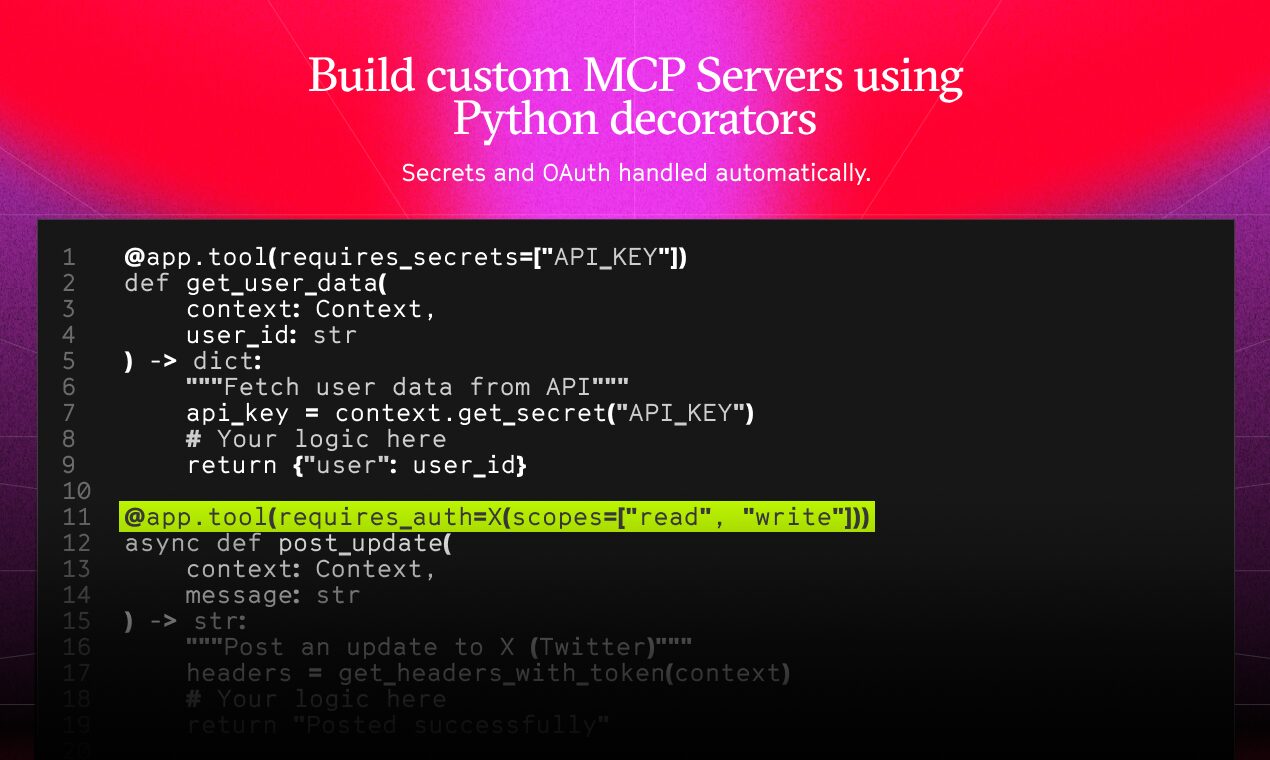
Arcade’s Secure MCP Framework addresses a specific challenge in AI development: creating secure Model Context Protocol (MCP) servers without duplicating authentication and security infrastructure. Rather than treating MCP servers as stateless tools, Arcade provides a Python framework that bakes security, authentication, and deployment capabilities directly into the server. This approach enables developers to focus on business logic while the framework handles the operational security layer—authentication, secret management, and integration with AI clients like Claude, Cursor, and LangGraph.
Key Features
Arcade MCP delivers focused functionality for secure MCP server development:
- Built-in Authentication and Authorization: Implements OAuth-based authentication patterns and role-based access control directly in the framework, eliminating the need to add security layers separately.
- Python-based Framework: Leverages Python’s simplicity and ecosystem to build MCP servers with minimal boilerplate, enabling rapid development while maintaining clean, maintainable code.
-
Pre-built Tool Integrations: Provides ready-to-use integrations with common external services (Gmail, Slack, Postgres, etc.), reducing development time from custom API wiring to simple configuration.
-
Direct Client Integration: Works seamlessly with Claude, Cursor, VS Code, and LangGraph through standard MCP protocol, enabling immediate deployment across multiple AI platforms.
-
Production-Ready Deployment: Handles the operational aspects of MCP servers including secret management, secure token handling, and deployment from local development to production infrastructure.
-
Open-source Foundation: Available as open-source code with Apache 2.0 license, providing transparency and community contribution opportunities while Arcade offers hosted managed services as a commercial option.
How It Works
The Arcade MCP Framework streamlines server development through a three-stage process. First, developers define their server using Arcade’s Python API, decorating business logic functions with tool descriptors that describe what the MCP server exposes. Second, Arcade’s framework layer wraps this business logic with security infrastructure—handling authentication, validating credentials, and enforcing permissions. Third, the developer deploys the server to an MCP-compatible client (Claude Desktop, Cursor, VS Code, or LangGraph) using Arcade’s configuration commands, which handle the connection setup.
Internally, Arcade’s framework provides several operational capabilities: it manages secure credential storage and rotation, implements token validation for external service access (Gmail, Slack, Postgres), and provides audit logging for compliance requirements. The framework abstracts away the complexity of MCP protocol handling while exposing a clean Python API for business logic.
Use Cases
Arcade MCP addresses specific scenarios where MCP server security and integration are primary concerns:
- Secure AI Agent Integration with Databases: Connect Claude or Cursor to internal databases (Postgres, MongoDB, etc.) for autonomous database operations while maintaining authentication, access control, and audit trails at the protocol level.
-
Internal Tool Access via AI: Expose internal APIs and custom tools to Claude or other AI agents through a secure MCP server without rebuilding authentication infrastructure for each tool.
-
Building Secure Multi-Tenant AI Services: Deploy MCP servers that serve multiple customers or organizations with proper isolation, role-based access control, and tenant-specific credential management.
-
Research and Development with Production-Grade Security: Quickly prototype AI agent architectures with proper security patterns rather than building security infrastructure after initial prototyping.
Pros & Cons
Advantages
Arcade MCP offers meaningful benefits for production-grade MCP deployments:
- Security-first design: Authentication, credential management, and access control are integrated into the framework rather than requiring manual implementation, reducing security vulnerabilities from the start.
-
Rapid development: Pre-built integrations and framework abstractions eliminate boilerplate code, accelerating time from concept to working MCP server.
-
Production-ready: Handles operational requirements including secret rotation, audit logging, and secure token management, enabling direct production deployment without additional infrastructure work.
-
Developer ergonomics: Python-based API with clear abstractions and comprehensive documentation make the framework accessible to developers with varying expertise levels.
Disadvantages
While effective for its specific focus, Arcade MCP has meaningful limitations:
- MCP protocol focus: Designed exclusively for MCP server development. Organizations requiring broader AI orchestration, multi-agent coordination, or complex workflow management should evaluate more comprehensive frameworks.
-
Python-only implementation: Framework is exclusively Python-based. Organizations using other languages (TypeScript, Go, etc.) require alternative solutions.
-
Learning curve for MCP concepts: Developers unfamiliar with Model Context Protocol or OAuth-based authentication patterns may require initial onboarding before effective use.
-
Managed service dependency: While open-source core is available, advanced features and full integration with Arcade’s managed services require their platform.
How Does It Compare?
The MCP framework landscape includes tools serving different purposes and levels of abstraction.
LangChain represents a different category focused on AI orchestration and multi-agent workflows. LangChain emphasizes chaining prompts, managing conversation memory, and orchestrating complex agent interactions across multiple LLM providers. Unlike Arcade’s focus on MCP server infrastructure, LangChain operates at the orchestration layer—deciding which tools to call and how to chain their results. These tools complement rather than compete: Arcade builds the secure MCP servers that expose tools, while LangChain orchestrates how AI agents use those tools.
Semantic Kernel by Microsoft provides a framework for embedding AI into applications through a plugin architecture and skill composition. Like LangChain, Semantic Kernel focuses on application-level AI integration rather than the MCP protocol infrastructure layer. Semantic Kernel supports multiple languages (C#, Python, Java) and emphasizes enterprise-grade observability and responsible AI patterns. Organizations using Semantic Kernel would still need Arcade or similar MCP server infrastructure to securely expose external tools to their Semantic Kernel agents.
Google Vertex AI Agent Builder addresses MCP from the infrastructure perspective but through managed services rather than framework development. Vertex AI handles MCP server hosting, scaling, and enterprise security controls (authentication, audit logging, identity provider integration) as a managed service. Unlike Arcade’s framework approach where developers build and deploy servers, Vertex AI abstracts the deployment layer entirely—developers define agents and tools through Vertex’s API while Google manages MCP infrastructure. This creates a trade-off: Vertex AI provides more managed infrastructure but with Google Cloud platform dependency and different operational models.
Anthropic’s Native MCP Support (available in Claude API and Claude Desktop) provides the MCP client-side implementation. Arcade’s MCP Framework complements Anthropic’s implementations by providing the server-side infrastructure layer—the framework that developers use to build the MCP servers that Claude and other MCP clients connect to.
Arcade’s specific positioning centers on production-ready MCP server development with built-in security. Where LangChain and Semantic Kernel focus on orchestration (using tools), Arcade focuses on infrastructure (exposing tools securely). Where Vertex AI provides managed MCP infrastructure, Arcade provides the framework for developers to build and deploy MCP servers themselves. For organizations building secure MCP servers with Python, Arcade addresses specific infrastructure challenges that other frameworks don’t directly solve.
Final Thoughts
Arcade’s Secure MCP Framework addresses a practical gap in MCP development: enabling developers to build secure, production-ready MCP servers without reimplementing authentication and operational security infrastructure. For teams building AI agents that require secure database access, internal tool exposure, or multi-tenant deployments, Arcade provides an opinionated framework that handles these requirements automatically.
The framework works best for organizations building internal MCP servers, research teams deploying AI agents to internal infrastructure, and developers prioritizing security and operational readiness. Organizations focused primarily on orchestration logic or multi-agent coordination should evaluate LangChain or Semantic Kernel alongside or instead of Arcade.
For development teams seeking a production-grade foundation for MCP server development with security built in, Arcade MCP merits serious consideration as a framework that eliminates common infrastructure challenges and accelerates secure deployment.