Table of Contents
Overview
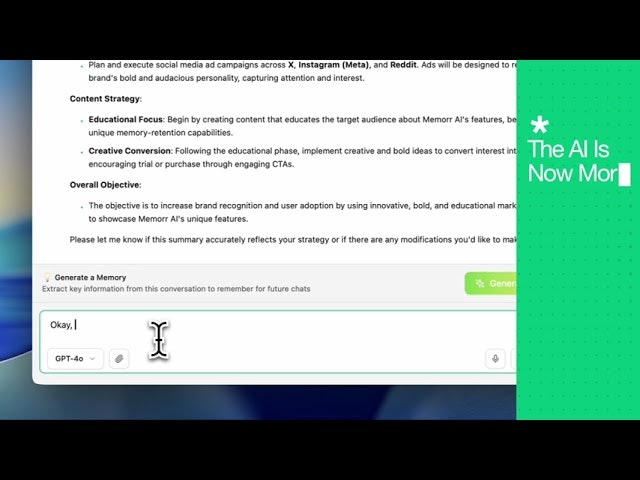
Do you experience frustration when AI conversations lose context during extended dialogues? Are you tired of repeatedly reexplaining crucial details to ChatGPT, Claude, or Gemini, only to have the AI forget essential information mid-conversation? You’re not alone—this represents a genuine productivity pain point for professionals and complex-task users. Memorr.ai provides an elegant solution: a desktop application for Mac and Windows that implements intelligent persistent memory management for AI conversations across multiple sessions. Unlike subscription-based alternatives, Memorr operates through a one-time $89 payment for lifetime access, eliminating recurring monthly costs while ensuring your AI maintains complete context throughout extended projects.
Key Features
Memorr.ai combines persistent memory with cross-platform AI support in a sophisticated desktop interface:
- Persistent Memory Across Sessions: Automatically maintains complete conversation context across multiple sessions and days, ensuring your AI remembers previous discussions, decisions, and evolving project details without manual re-explanation.
- Multi-Agent Unified Interface: Chat seamlessly with GPT-4, Claude (Opus/Sonnet/Haiku), Gemini, and other AI models within a single application, with persistent memory maintained consistently across all agents without fragmentation.
- One-Time Lifetime License: A single $89 payment grants permanent software access with included updates and support for one year, eliminating recurring subscription fees and providing genuine long-term value—approximately 40-60% cost savings compared to ChatGPT Plus annual expenses.
- Visual Memory Canvas: An infinite organizational canvas enables flexible contextualization and memory management, allowing you to visually structure, annotate, and refine how your AI maintains conversation context.
- Optimized Dual-Panel Layout: A deliberately asymmetrical interface allocates 30% screen space for active chat and 70% for the memory canvas, enabling simultaneous conversation and context management for sophisticated workflows.
- Local Data Privacy Architecture: All conversations, memories, and contextual data remain stored locally on your device—Memorr never transmits conversation content to external servers, ensuring complete privacy and data ownership.
- Bring-Your-Own-API-Keys (BYOK): Users authenticate directly through their own API keys to OpenAI, Anthropic, Google, and other providers, maintaining cost control, privacy, and immediate access to newly released models without Memorr intermediation.
How It Works
Memorr operates through an integrated workflow designed for seamless AI collaboration:
Setup Your AI Credentials: Provide your own API keys from OpenAI, Anthropic, Google, or other AI providers. Memorr connects directly to these services without acting as an intermediary, ensuring your interactions flow directly to the AI provider.
Start Your Conversation: Begin chatting with your selected AI model within Memorr’s interface. As you converse, the application simultaneously manages conversation context in the background. Automatic
Memory Management: Memorr automatically extracts, contextualizes, and organizes key information from your conversation, populating the memory canvas with relevant details, decisions, and project context.
Visual Context Organization: Actively engage with the memory canvas—editing memories, adding annotations, linking related concepts, and structuring context exactly as you envision your AI should understand the project.
Switch Models Seamlessly: Change between AI providers (from GPT-4 to Claude to Gemini) while maintaining your comprehensive context, enabling agent-specific strengths while preserving conversation continuity.
Export and Archive: Export your conversations and memories as JSON or Markdown files for archival, sharing, or integration with other workflows, maintaining permanent records of your AI collaborations.
Use Cases
Memorr.ai serves diverse scenarios where AI collaboration benefits from persistent context:
- Extended Research Projects: Academics and researchers can conduct multi-week investigations with AI, maintaining complete context about sources, findings, contradictions, and evolving theses without constant re-explanation or context resets.
- Sophisticated Product Development: Product teams collaborating with multiple AI models can maintain consistent understanding of requirements, design iterations, user stories, and technical specifications across numerous consultation sessions.
- Long-Form Creative Writing: Writers and content creators can develop multi-chapter projects where AI assists continuously while maintaining awareness of character development, plot elements, thematic consistency, and stylistic preferences across extended writing sessions.
- Complex Problem-Solving: Engineers and architects can tackle intricate technical challenges across multiple conversation sessions, with AI retaining understanding of constraints, attempted solutions, architectural decisions, and design rationale.
- Personal Knowledge Building: Intellectually ambitious individuals can maintain a continuously evolving personal knowledge base where AI conversations compound into increasingly sophisticated understanding rather than resetting with each session.
- Multi-Model AI Collaboration: Users can leverage different AI strengths—GPT-4 for technical writing, Claude for creative conceptualization, Gemini for research—while maintaining consistent project context across agent transitions.
Pros & Cons
Advantages
- Lifetime Ownership Model: A single $89 payment grants permanent ownership of the software with indefinite use rights, eliminating subscription lock-in and providing genuine long-term value for consistent users.
- Context Preservation: Eliminates the frustrating experience of AI losing essential project context, enabling genuinely continuous collaboration rather than fragmented sessions.
- Multi-Model Flexibility: Support for GPT-4, Claude variants, Gemini, and other providers within a single interface enables strategic use of different AI strengths while maintaining consolidated context.
- Complete Data Ownership: Local storage architecture ensures your conversations, memories, and interactions remain entirely under your control without cloud dependency or privacy concerns.
- Cost Efficiency: Dramatically reduces long-term AI engagement costs, particularly for users maintaining continuous, sophisticated AI collaboration—40-60% savings versus ChatGPT Plus over extended periods.
Disadvantages
- Desktop-Only Availability: Current implementation provides no web browser interface or mobile applications, limiting access to users working exclusively on Mac or Windows computers.
- Upfront Financial Commitment: The $89 one-time purchase presents initial cost friction compared to free or low-cost subscription options, despite superior long-term economics.
- Requires API Key Management: Users must independently obtain and manage API keys from AI providers, introducing administrative overhead for those preferring service convenience.
- Best Value for Heavy Users: Full economic advantage requires consistent, sophisticated AI engagement; casual users may find the upfront investment less justified.
- Limited Device Proliferation: The two-device limit for a single lifetime license may constrain users maintaining multiple active work environments.
How Does It Compare?
Memorr.ai occupies a distinctive market position within the AI collaboration ecosystem, each competing solution serving different user priorities and economic models.
ChatGPT Plus ($20/month, approximately $240 annually) remains OpenAI’s primary premium offering, providing priority access to GPT-5, advanced voice capabilities, and exclusive features like Sora video generation and Custom GPT creation. However, ChatGPT Plus suffers from inherent context window limitations—conversations reset between sessions, and switching to alternative models (Claude or Gemini) requires entirely separate applications. Long-term ChatGPT Plus users spending $240+ annually accumulate costs that exceed Memorr’s $89 lifetime license within approximately five months.
Notion AI (integrated into $20/user/month Business plan, minimum for AI access) functions as workspace documentation AI rather than conversational memory management. While Notion’s AI assists with writing, database queries, and workspace organization, it doesn’t specifically solve the persistent conversation context problem that defines Memorr’s core solution. Notion AI requires Business tier subscription ($240+ annually per user), lacks cross-AI-provider integration, and remains inherently tied to Notion’s document structure rather than designed for extended AI dialogue.
Alpaca (free, open-source Ollama client) enables local execution of open-source language models without cloud dependencies or API costs. However, Alpaca specializes in local model orchestration rather than persistent conversation memory—users manage memory structure manually or through external tools. Alpaca serves technical users comfortable with local model management; it doesn’t provide the persistent memory canvas that Memorr emphasizes.
Claude (Anthropic’s conversational AI interface) offers sophisticated conversation capabilities but remains subject to identical context reset issues as ChatGPT—conversations conclude and context resets between sessions. While Claude’s 200,000-token context window within individual sessions exceeds most competitors, Memorr specifically addresses the multi-session persistence gap that Claude doesn’t solve.
Memorr’s distinctive positioning emerges through three elements: persistent memory explicitly designed for multi-session AI collaboration, unified interface across multiple AI providers (solving provider fragmentation), and lifetime ownership through one-time payment (eliminating subscription recurrence). While individual competitors excel in specific dimensions (Claude’s conversation quality, ChatGPT Plus’s feature breadth, Alpaca’s local model support), Memorr alone combines persistent cross-session memory with multi-provider integration through ownership-based economics.
Final Thoughts
Memorr.ai addresses a legitimate frustration inherent to current AI applications: context loss across sessions and provider fragmentation during extended projects. Its combination of persistent memory management, multi-model support, local privacy architecture, and lifetime ownership economics creates genuine appeal for professionals and engaged users conducting sophisticated, extended AI collaboration.
The one-time $89 investment proves compelling specifically for users maintaining continuous AI engagement—researchers managing multi-week projects, product teams conducting ongoing consultations, creative professionals developing long-form works. For such users, Memorr’s cost structure becomes substantially more economical than annual ChatGPT Plus expenses ($240) or Notion AI subscriptions ($240+ per user annually).
However, casual or occasional AI users may find the upfront payment less justified, and the desktop-only limitation excludes mobile-first workflows. For your specific requirements, evaluating whether you engage in the extended, multi-session AI collaboration that justifies Memorr’s core value proposition remains essential.
https://www.memorr.ai/