
Table of Contents
Overview
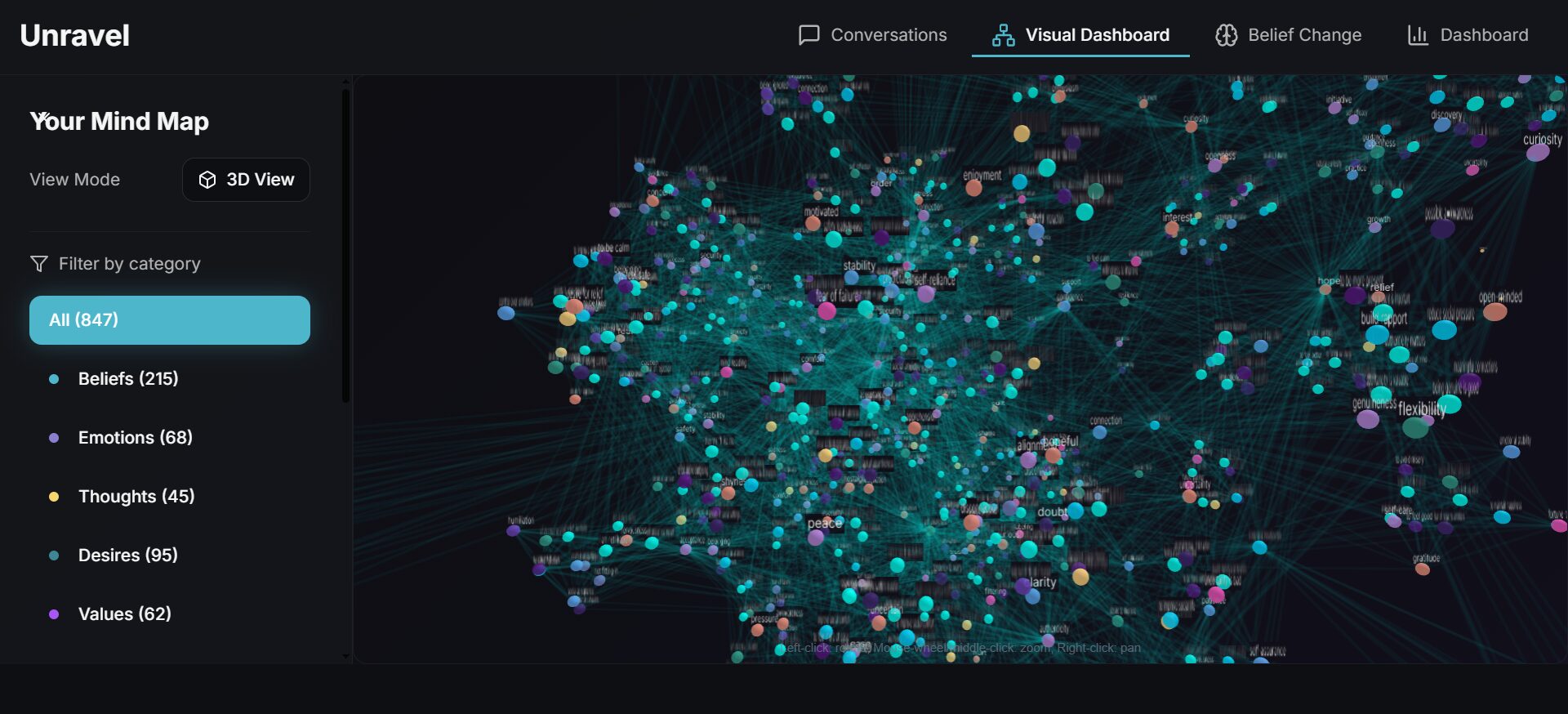
Imagine visualizing your own mind, watching your thoughts, beliefs, and desires form a living, breathing network right before your eyes. Unravel, launched on Product Hunt in November 2025, is an AI-driven introspection tool that promises precisely this: a dynamic visual map of your inner world that grows as you speak or type. It’s designed to help you uncover complex patterns, understand what truly drives your thoughts and behaviors, and ultimately gain clarity through cognitive visualization for personal growth and self-discovery.
Key Features
Unravel offers a suite of capabilities designed for profound self-exploration and understanding through AI-powered visualization.
Automatic Mind Mapping from Speech or Text: Simply talk or type, and the AI instantly translates your input into a structured, visual mind map representing your internal landscape without manual effort.
Visual Network of Thoughts, Beliefs, and Desires: See your mental architecture laid out as an interconnected web, revealing relationships between core ideas, emotions, and feelings that shape your worldview.
Real-Time Map Growth: The diagram evolves dynamically as you continue to speak or type, reflecting your thought process in real-time and showing how ideas connect as they emerge.
Pattern Identification: The system helps you uncover recurring themes, limiting beliefs, cognitive biases, or thought loops that might be influencing your behavior or holding you back from personal goals.
Cognitive Restructuring Guidance: Once patterns are identified, the tool offers frameworks and guidance to help you consciously examine and potentially reshape your thinking patterns.
Living Diagram that Evolves: Unlike static mind maps, this visualization is a dynamic, organic representation of your mind that changes and grows with your insights over time.
Self-Discovery Interface: An intuitive and engaging platform designed to facilitate deeper introspection and personal understanding through conversational interaction with AI.
Thought Relationship Visualization: Clearly illustrates how different thoughts, emotions, and beliefs interconnect, providing holistic view of your mental architecture and decision-making patterns.
Branching Node Structure: Ideas, emotions, and beliefs are represented as interconnected nodes that branch from one another, showing dependencies and influences between different aspects of thinking.
Color Coding Capability: Branches can be color-coded to mark and highlight important information, emotional valence, or thematic categories for easier pattern recognition.
How It Works
Unravel’s sophisticated AI transforms your spoken words or typed text into a tangible representation of your cognitive landscape through an automated multi-step process.
First, users begin by speaking naturally or typing freely about their thoughts, feelings, experiences, or beliefs through the interface. There’s no need for structured input—just express yourself as you would to yourself or a trusted confidant.
As you communicate, the AI actively processes your input in real-time, employing natural language processing to listen for key concepts, emotional undertones, and underlying connections between ideas. The system analyzes not just what you say, but how concepts relate to one another.
The AI then automatically identifies significant concepts and the relationships between them, discerning how one idea influences, contradicts, supports, or derives from another, mapping the logical and emotional architecture of your thinking.
Based on the identified concepts and relationships, the system instantly begins building a visual network diagram, illustrating your mental landscape through interconnected nodes representing different thoughts, beliefs, emotions, and desires.
The map isn’t static—it updates dynamically and grows as you continue your conversation, adding new nodes and connections in real-time. This creates living document that mirrors your evolving thought process as you explore topics.
Users can then interact with this evolving map, visually identifying recurring patterns through node clustering, core beliefs represented by central nodes with many connections, and potential limiting thought processes revealed through negative loops or contradictory belief structures.
Finally, once patterns are pinpointed, the system can suggest various cognitive restructuring approaches, empowering users to challenge unhelpful thinking patterns, reframe limiting beliefs, and develop more constructive mental frameworks.
Use Cases
Unravel’s versatile AI-powered visualization opens possibilities for personal growth, mental exploration, and cognitive understanding across various applications.
Self-Therapy and Personal Development: A powerful aid for individuals looking to understand themselves better and embark on journeys of self-improvement by making subconscious patterns visible and addressable.
Cognitive Behavioral Pattern Recognition: Ideal for identifying and understanding cognitive patterns that drive behavior, similar to principles used in Cognitive Behavioral Therapy (CBT) but in self-guided format.
Belief System Analysis: Helps users visualize and analyze their core belief systems, understanding their origins, interconnections, impacts on decision-making, and potential contradictions that create internal conflict.
Mental Health Exploration: Provides safe and structured environment to explore complex thoughts and feelings related to mental well-being, anxiety triggers, mood patterns, and emotional responses.
Creative Thinking Enhancement: By visualizing connections between seemingly unrelated ideas, it can stimulate new perspectives, foster creative breakthroughs, and reveal unexpected insights.
Decision-Making Clarity: Helps map out factors, emotions, beliefs, and values influencing important decisions, leading to greater clarity about motivations and potential outcomes.
Life Coaching Support: A valuable resource for coaches and their clients to visualize progress, identify mental roadblocks or limiting beliefs, clarify goals, and track cognitive shifts over time.
Journaling Alternative: Offers dynamic, visual, and interactive alternative to traditional written journaling, especially appealing for those who prefer speaking over writing or think better verbally.
Subconscious Pattern Discovery: Aids in bringing subconscious thoughts and patterns to the forefront of consciousness, making them easier to examine, understand, and address through visualization.
Emotional Processing: Helps externalize and make sense of complex emotional experiences by mapping how feelings relate to specific thoughts, events, or belief systems.
Values Clarification: Uncovers what truly matters by revealing patterns in desires, motivations, and decisions, helping align actions with authentic values.
Relationship Pattern Analysis: Identifies recurring patterns in interpersonal relationships, attachment styles, communication tendencies, and relational dynamics.
Pricing
Unravel pricing and business model information is not publicly specified as of November 2025 Product Hunt launch.
Access Model: The tool is accessible through unravelmind.vercel.app web interface. As a newly launched product, specific pricing tiers, subscription models, or freemium structures have not been publicly disclosed.
Potential Models: Common approaches for similar AI-powered personal development tools include free tier with limited usage (number of sessions, map saves), premium subscription for unlimited mapping sessions and advanced features, or one-time purchase for lifetime access.
Note: Users interested in Unravel should visit the official website for current pricing information and access options. As an early-stage product launched in November 2025, the monetization strategy may still be evolving based on user feedback and product development trajectory.
Pros and Cons
Understanding both advantages and considerations provides clarity for evaluating Unravel’s potential value for personal growth journeys.
Advantages
Novel Visualization Approach: Offers truly unique and intuitive way to visualize complex internal thought processes that are typically abstract and difficult to examine objectively.
Automatic Processing from Speech or Text: Eliminates manual effort of traditional mind mapping, making self-exploration more accessible by simply talking or typing thoughts naturally.
Real-Time Mapping: Provides immediate visual feedback, allowing dynamic interaction with thoughts as they form, creating flow state of exploration rather than retrospective analysis.
Pattern Discovery Capabilities: Specifically designed to help users identify and understand recurring cognitive patterns, limiting beliefs, and thought loops that might not be visible through traditional reflection.
Accessible Self-Exploration Tool: Lowers barrier to entry for deep self-analysis, making introspection more approachable for people who find traditional journaling or therapy intimidating.
Visual Learning Support: Particularly beneficial for visual thinkers who process information better through spatial representations than linear text.
Non-Judgmental Space: AI provides neutral, non-judgmental environment for exploring thoughts without fear of external evaluation.
Disadvantages
Effectiveness Depends on Self-Awareness and Honesty: The depth of insight gained is directly proportional to user’s willingness to be open, honest, and vulnerable with themselves during the process.
AI Interpretation Accuracy Unclear: The fidelity and nuance of AI’s understanding of complex human emotions, subtle meanings, and contextual factors can be a concern, potentially leading to oversimplification.
Privacy Concerns with Thought Data: Users might have legitimate reservations about sharing intimate thoughts, beliefs, and emotional patterns with AI system, raising questions about data storage, security, and potential misuse.
Language Limitations Likely: As with many advanced AI speech and NLP tools, initial versions are often limited to single language (typically English), limiting accessibility for non-English speakers.
Therapeutic Value Unproven: While potentially beneficial for self-exploration and awareness, its efficacy as direct therapeutic intervention has not been clinically validated or proven through research studies.
Lack of Human Guidance: Unlike working with therapist or coach, Unravel lacks human wisdom, empathy, and professional expertise to guide deeper healing or provide clinical interventions when needed.
Potential for Overthinking: For some users, constant visualization and pattern analysis might lead to excessive self-analysis or rumination rather than productive insight.
Limited Established Track Record: As a newly launched product (November 2025), there are limited user testimonials, long-term effectiveness data, or proven success stories to evaluate its impact.
How Does It Compare?
The personal growth, cognitive tool, and mind mapping landscape features diverse solutions serving various self-exploration and organization needs. Understanding Unravel’s unique positioning requires examining specific competitors.
Miro
Miro provides versatile online collaborative whiteboard platform with mind mapping capabilities, brainstorming templates, and real-time team collaboration features. Used primarily for project planning, visual thinking, team workshops, and design thinking sessions. Pricing starts at free tier with limitations, Plus plan at \$8 per month, and Business plans for teams.
Unravel differentiates through speech-to-visualization automation for cognitive mapping versus Miro’s manual creation requiring deliberate input of each node and connection. While Miro excels for collaborative professional work, team brainstorming, and structured project planning, Unravel focuses on personal introspection, automatic pattern discovery in thoughts and beliefs, and solo self-exploration. Miro serves teams needing collaborative visual workspace, whereas Unravel targets individuals seeking cognitive self-understanding through conversational AI interaction.
Notion
Notion delivers all-in-one workspace combining notes, databases, wikis, calendars, and project management. Supports various content types including text, tables, boards, galleries, and embedded media. Popular for personal knowledge management, journaling, goal tracking, and productivity systems. Pricing includes free personal plan, Plus at \$10 per month, and Business plans.
Unravel distinguishes itself through real-time visual network generation from speech versus Notion’s text-based manual documentation approach. While Notion excels for structured information organization, long-form writing, database creation, and productivity workflows, Unravel provides conversational cognitive exploration with automatic pattern identification. Notion appeals to users wanting comprehensive organization system, while Unravel serves those seeking visual self-discovery through spoken thoughts converted to interconnected mind maps revealing subconscious patterns.
MindMap AI
MindMap AI offers AI-powered mind map generation from text, PDF, audio, video, and image inputs with Copilot Chat assistance. Features include multiple export formats (PNG, SVG, PDF, CSV, Markdown), presentation mode, and collaborative editing. Pricing includes free plan (100 monthly AI credits), Premium at \$3.74 per month annually, supporting comprehensive content-to-mindmap conversion.
Both tools employ AI for mind mapping, but serve different primary purposes. MindMap AI focuses on summarizing external content (documents, lectures, meetings) into organized visual structures for learning and productivity. Unravel emphasizes internal cognitive exploration, mapping user’s own thoughts, beliefs, and emotions for self-discovery and pattern recognition. MindMap AI excels for students, professionals, and learners digesting information from various sources. Unravel targets individuals seeking psychological insight and self-awareness through conversational AI interaction revealing cognitive patterns.
Xmind AI
Xmind provides established mind mapping software with AI-powered generation from single-click prompts. Features include extensive template library, cross-platform access (Web, Windows, Mac, iOS, Android), brainstorming mode, presentation mode, and Gantt charts for project management. Subscription pricing for premium features unlocks advanced capabilities.
Xmind AI and Unravel differ fundamentally in application focus. Xmind AI serves productivity, project planning, study note organization, and structured information mapping with professional polish and extensive customization. Unravel prioritizes cognitive self-exploration, automatic relationship discovery between thoughts and beliefs, and real-time conversational interaction for personal psychology understanding. Xmind appeals to professionals, students, and planners needing versatile mind mapping tool. Unravel attracts individuals interested in psychological self-awareness through spoken introspection visualized as evolving network.
Mapify
Mapify converts YouTube videos, PDFs, documents, URLs, audio, and images into structured mind maps using AI. Features include chat with content capability, timestamp navigation for videos, web-powered AI search, cross-platform access, and multiple export formats. Free tier available with premium plans scaling based on usage. Trusted by over 5 million users.
Mapify and Unravel both leverage AI for mind mapping but serve contrasting needs. Mapify transforms external educational and informational content into digestible visual summaries for learning efficiency and content comprehension. Unravel transforms internal thoughts and self-reflection into cognitive maps for psychological insight and pattern discovery. Mapify excels for students, researchers, and professionals processing large volumes of information. Unravel serves individuals prioritizing introspection, self-therapy, and understanding their own belief systems through conversational exploration.
ivvi Notes
ivvi Notes offers revolutionary Speech-to-Map technology converting audio recordings or dictated speech into visual mind maps in real-time. Designed specifically for educational settings, lectures, and verbal content capture. Features include automatic transcription, synchronized notes to branches, color coding, and image integration. Targets visual learners and students needing lecture capture solutions.
Both tools feature speech-to-mind-map capability, but with different focuses. ivvi Notes targets educational content capture from external sources (lectures, meetings, presentations) for note-taking and study purposes. Unravel focuses on internal cognitive exploration, mapping personal thoughts, beliefs, and emotions for self-awareness and psychological pattern recognition. ivvi Notes serves students and professionals capturing external information, while Unravel serves individuals seeking self-understanding through introspective conversation with AI.
Reflectly
Reflectly provides AI-powered journaling app combining mood tracking, daily prompts, meditation, and positive psychology principles. Uses AI to analyze entries and offer personalized prompts tailored to moods. Features include emoji-based mood logging, visual trend graphs, PDF export, inspirational quotes, and CBT-inspired reflection guidance. Free plan available with premium features in subscription tiers.
Unravel and Reflectly both employ AI for self-exploration but through different modalities. Reflectly emphasizes guided journaling with text-based entries, mood tracking with emoji selection, and reviewing historical emotional patterns through graphs and trends. Unravel provides real-time visual network mapping of thoughts and beliefs through conversational interface, revealing interconnections and cognitive structures dynamically. Reflectly excels for consistent daily mood journaling and gratitude practice. Unravel targets deeper cognitive architecture exploration and belief system analysis through visual network representation revealing subconscious patterns.
Headspace
Headspace delivers mindfulness and meditation app with guided meditations, sleep sounds, breathing exercises, and mental health content. Features include structured meditation courses, mindful movement exercises, focus music, and sleepcasts. Subscription-based with courses for stress, anxiety, sleep, and focus. Emphasizes present-moment awareness and mindfulness practice.
Headspace and Unravel address mental well-being through fundamentally different approaches. Headspace provides guided meditation and mindfulness exercises for stress reduction, present-moment awareness, and emotional regulation through breathing and awareness practices. Unravel offers cognitive exploration and pattern visualization for understanding belief structures, thought relationships, and subconscious patterns through AI-powered conversation. Headspace suits users seeking meditation practice and stress management techniques. Unravel appeals to those interested in psychological self-analysis and cognitive pattern discovery through visual mapping of thought networks.
Calm
Calm offers comprehensive mental wellness app featuring guided meditations, sleep stories narrated by celebrities, breathing exercises, masterclasses, and music for relaxation. Subscription includes anxiety reduction programs, stress management techniques, and mindfulness exercises. Known for high-quality audio content and soothing user experience design.
Similar to Headspace comparison, Calm focuses on relaxation, meditation, and present-moment mindfulness rather than cognitive pattern analysis. While Calm provides content-driven approach to mental wellness through audio guidance and structured programs, Unravel enables active exploration of thought patterns through conversational AI and visual mapping. Calm serves users seeking guided relaxation and stress relief. Unravel targets individuals interested in understanding cognitive architecture and belief systems through introspective visualization.
Traditional Therapy
Traditional psychotherapy involves working with licensed mental health professionals (psychologists, therapists, counselors) through talk therapy sessions. Approaches include Cognitive Behavioral Therapy (CBT), psychodynamic therapy, humanistic therapy, and various evidence-based modalities. Provides professional diagnosis, treatment plans, and therapeutic interventions for mental health conditions.
Unravel cannot replace traditional therapy but may serve as complementary self-exploration tool. Traditional therapy offers human empathy, clinical expertise, professional judgment, ethical standards, crisis intervention, and evidence-based treatment protocols that AI tools cannot provide. Therapy addresses diagnosed mental health conditions with appropriate interventions, while Unravel facilitates self-guided exploration for personal growth. Traditional therapy suits individuals needing professional mental health treatment, while Unravel serves as accessible self-reflection tool for those interested in understanding their thought patterns outside clinical context.
Key Differentiators
Unravel’s unique positioning centers on several distinctive capabilities. Speech-to-visual-network automation converts natural conversation into dynamic cognitive maps without manual node creation or deliberate structuring required by traditional mind mapping tools.
Real-time network evolution shows thoughts emerging and connecting live as user speaks, creating interactive exploration experience versus retrospective journaling or static mapping. Cognitive pattern identification specifically designed to reveal recurring themes, limiting beliefs, and subconscious thought structures through AI analysis of relationships between nodes.
Belief system visualization makes abstract mental architecture tangible and examinable through spatial representation of how thoughts, emotions, and beliefs interconnect and influence one another. Conversational interface enables exploration through natural speech or typing versus guided prompts, predetermined templates, or structured input formats.
For educational content summarization and note-taking, MindMap AI, Mapify, or ivvi Notes provide superior solutions. For daily mood tracking and guided journaling practice, Reflectly offers structured approach. For meditation and mindfulness, Headspace and Calm deliver comprehensive audio-guided content. For clinical mental health treatment, traditional therapy with licensed professionals remains essential.
However, for individuals seeking to visualize and understand their own cognitive architecture, explore belief systems through conversational AI interaction, discover subconscious patterns in thinking, and gain psychological self-awareness through dynamic, evolving visual networks generated from natural speech or text, Unravel presents novel approach bridging conversational interface with cognitive visualization for accessible self-exploration.
Final Thoughts
Unravel presents an exciting frontier in personal development and cognitive self-understanding tools. By transforming the abstract landscape of our minds into tangible, evolving visual networks through AI-powered analysis of natural conversation, it offers unique approach to self-discovery that bridges technology and introspection.
The tool’s ability to automatically generate interconnected maps of thoughts, beliefs, and emotions from spoken or typed input lowers the barrier to entry for deep self-exploration, making cognitive pattern recognition accessible to individuals without psychology training or therapy background. The real-time, dynamic nature of the visualization creates engaging exploration experience that traditional journaling or static mind mapping cannot match.
However, as a newly launched product in November 2025, Unravel’s effectiveness, user satisfaction, and long-term impact remain to be proven through broader adoption and user feedback. Important considerations include privacy implications of sharing intimate thoughts with AI systems, the accuracy and nuance of AI interpretation of complex human psychology, and the tool’s appropriate positioning as self-exploration aid rather than substitute for professional mental health treatment when needed.
For individuals curious about their thought patterns, interested in cognitive self-awareness, comfortable with technology-mediated introspection, and seeking accessible tool for personal growth exploration, Unravel offers intriguing option worth exploring. Its novel approach to visualizing mental architecture may provide valuable insights, reveal hidden patterns, and facilitate deeper self-understanding for those willing to engage openly and honestly with the conversational AI interface. As with any personal development tool, results will ultimately depend on user commitment, self-awareness, and willingness to examine and challenge their own thinking patterns revealed through the visual network representations.