
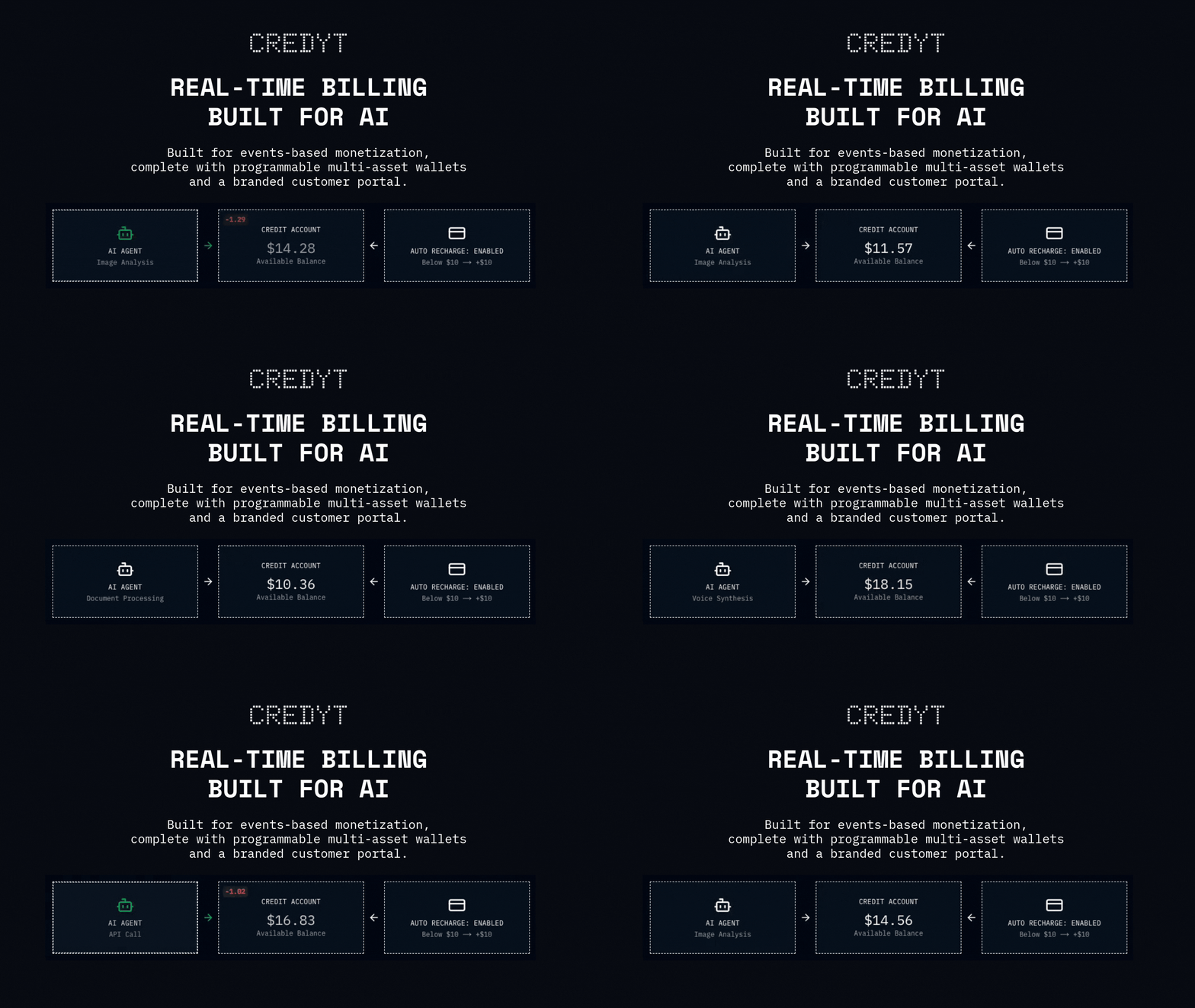

Table of Contents
Overview
AI application developers face a fundamental monetization challenge: while building sophisticated products powered by language models, computer vision, or agent systems proves increasingly accessible, implementing billing infrastructure that matches the usage-based nature of AI workloads remains complex and time-consuming. Traditional subscription billing tools designed for flat monthly fees struggle with real-time consumption tracking, prepaid credit systems, and the variable cost structures inherent to AI services. Credyt addresses this gap as a purpose-built wallet-native monetization engine specifically designed for AI applications. The platform enables developers to implement OpenAI-style billing experiences—where customers pre-fund credit wallets, usage depletes balances in real-time, and automatic recharge prevents service interruption—without months of custom development. By handling credit accounts, consumption tracking, multi-currency support, and automated billing logic through simple API integration, Credyt allows teams to focus engineering resources on product differentiation rather than billing infrastructure, compressing the path from concept to monetization from months to days.
Key Features
Usage-Based Billing Engine: Define granular pricing for any AI service metric including API calls, tokens generated, compute time consumed, images created, or custom outcome-based units. The system charges customers as usage occurs rather than waiting for monthly billing cycles, matching cost recognition with revenue realization for improved cash flow and margin protection.
Wallet-Native Architecture: Every customer receives a programmable multi-asset wallet supporting balances in multiple currencies or custom units like tokens, credits, GPU hours, or minutes. This prepaid model shifts payment risk from vendor to customer, eliminating the revenue loss from failed post-usage charges that plague traditional billing.
Real-Time Balance Management: Credit deductions occur instantly as customers consume services, with live balance visibility preventing surprise overages or service interruptions. The atomic transaction processing ensures accuracy even at millions of events per second, eliminating race conditions or double-billing issues.
Automatic Recharge and Top-Ups: Customers configure threshold-based auto-recharge that automatically replenishes credits when balances fall below defined levels, ensuring uninterrupted service without manual intervention. Manual top-up options via Stripe integration provide flexibility for users preferring control over automatic payments.
Multi-Currency Support: Accept payments globally by allowing customers to fund wallets using their local currency, reducing friction for international expansion. The platform handles currency conversion and maintains appropriate accounting across different monetary units.
Flexible Pricing Configuration: Implement dimensional pricing models that vary rates based on product attributes—different costs for different AI models, time-of-day pricing, volume tiers with graduation, or outcome-based charges. Configuration-driven pricing means testing new strategies without code deployments.
Comprehensive Usage Analytics: Track consumption patterns, identify high-value customers, spot unusual usage indicating potential fraud or abuse, and analyze profitability at product, customer, or feature levels. Real-time dashboards provide visibility into both revenue and cost events.
Customer Billing Portal: Provide customers with branded self-service interface displaying live balance, detailed usage breakdowns, top-up capabilities, and spending history. This hosted solution eliminates frontend development requirements while delivering the polished experience users expect from AI platforms.
Promotional Credit Management: Grant free or bonus credits with configurable expiration dates to run limited-time campaigns, reward loyal customers, or enable trial experiences. The wallet API handles promotional credit logic including expiry automation and rollover rules.
Profitability Tracking: Correlate revenue events with underlying cost events to calculate per-customer, per-product, or per-workflow margins in real-time. Identify where pricing generates healthy margins versus where costs exceed revenue, enabling data-driven pricing refinement.
Hybrid Integration Mode: Deploy alongside existing billing systems rather than requiring complete replacement, allowing gradual migration or coexistence with legacy invoice-based billing for different customer segments or product lines.
How It Works
Credyt operates through straightforward API integration designed for rapid deployment. Begin by creating a Credyt account and obtaining test mode API credentials that provide completely isolated sandbox environment for experimentation. Define your pricing structure by creating meters that track specific usage events—for example, “chat_completed” events that consume credits based on input and output token counts, AI model selected, or conversation complexity. Configure pricing rules specifying how many credits each event type costs, whether rates should tier based on volume, and what currency units (dollars, tokens, custom credits) apply. When customers sign up for your service, create corresponding Credyt customer records through API calls. Each customer automatically receives a wallet capable of holding balances across multiple asset types. Customers fund wallets through the hosted billing portal, which processes payments via Stripe and immediately credits their account balance. As customers use your AI application, your backend sends usage events to Credyt’s API with relevant metadata like customer identifier, event type, and dimensional attributes that affect pricing. Credyt’s rating engine instantly calculates credit consumption based on your pricing configuration and atomically deducts the amount from the customer’s wallet balance. If balance falls below configured threshold, automatic recharge triggers if enabled, processing payment and replenishing credits without service disruption. Throughout this process, both you and your customers maintain real-time visibility: you see aggregated usage and revenue through analytics dashboards while customers view live balances and consumption details through their billing portal. The append-only ledger architecture creates permanent audit trails of every credit movement—top-ups, consumption, expirations, refunds—ensuring financial accuracy and regulatory compliance. When ready for production, simply swap test API credentials for live credentials and the identical system processes real customer payments and usage. The entire implementation requires minimal frontend work since Credyt hosts customer-facing billing interfaces, allowing engineering teams to focus on core product development rather than building and maintaining complex billing UI components.
Use Cases
Credyt serves AI businesses across diverse monetization models and scales:
AI SaaS Application Billing: Charge customers for using AI-powered software based on actual consumption rather than fixed subscriptions. Whether offering writing assistants, image generators, data analysis tools, or conversational AI, track usage at granular levels and bill proportionally.
AI Agent Platforms: Monetize autonomous agents that perform tasks on behalf of users. Track agent actions, successful task completions, API calls made, or outcomes achieved, charging based on value delivered rather than infrastructure consumed.
AI Marketplace and Platform Billing: Operate multi-sided platforms hosting various AI tools or services, tracking usage across multiple products and vendors. Credyt manages credit flow between platform operators, tool providers, and end users with transparent settlement.
Microtransaction-Based Services: Build applications centered on frequent small transactions—single image generations, short text outputs, one-off data transformations—where traditional payment processing fees would eliminate margins. Prepaid credits enable profitable microtransaction economics.
Developer API Monetization: Offer AI capabilities through APIs charged per call, token, or outcome. Implement tiered pricing, volume discounts, and free allowances without building custom metering infrastructure.
Replacing Complex Stripe Configurations: Teams struggling with Stripe’s usage-based billing complexity—which charges customers after billing periods end rather than prepaid—can migrate to Credyt’s wallet model for better cash flow and reduced payment failure risk.
Rapid MVP and Hackathon Monetization: Developers at hackathons or launching MVPs need monetization without multi-week billing infrastructure projects. Credyt provides production-ready billing in hours, allowing immediate customer validation.
Hybrid Subscription Plus Usage Models: Combine base subscription fees with consumption-based charges for usage beyond included allowances. Credyt integrates with existing subscription billing or handles both components natively.
Pros \& Cons
Advantages
Dramatically Faster Time-to-Market: Credyt compresses billing implementation from months of custom development to days or weeks of integration work, enabling faster monetization and customer feedback cycles critical for startups.
Prepaid Model Improves Cash Flow: Collecting payment before delivering compute or AI services eliminates the working capital drain of funding infrastructure costs while waiting for post-usage invoicing. Failed payment risk shifts from vendor to customer.
Purpose-Built for AI Economics: Unlike general billing platforms adapted for AI, Credyt’s architecture specifically addresses token-based pricing, real-time consumption, variable compute costs, and outcome-based monetization patterns native to AI applications.
True Real-Time Billing: Usage tracking and charge deduction occur instantly rather than batched for end-of-period billing. This prevents bill shock for customers and provides immediate revenue recognition for businesses.
Familiar User Experience: The credit wallet model mirrors how customers interact with OpenAI, Anthropic, and other major AI platforms, reducing learning curves and adoption friction compared to novel billing patterns.
Comprehensive Analytics: Built-in profitability tracking correlating revenue and costs at granular levels provides financial intelligence impossible with platforms treating billing and cost as separate systems.
Reduced Payment Failure Risk: Prepaid credits eliminate the involuntary churn from failed charges that plague subscription businesses, since services only operate while funded balances exist.
Developer-Friendly Integration: Well-documented APIs, clear data models, and test mode isolation make technical implementation straightforward for engineering teams without specialized billing expertise.
Disadvantages
Requires Customer Behavior Change: Users accustomed to postpaid subscription models must adapt to prepaying and monitoring balances. Some customer segments resist prepaid models, perceiving them as less convenient than automatic monthly charges.
Early-Stage Product Maturity: As a relatively new platform, Credyt lacks the extensive integration ecosystem, mature feature set, and long operational track record of established billing providers. Early adopters accept beta-period risks around feature gaps and stability.
Limited Public Pricing Transparency: Detailed pricing tiers, transaction fees, and feature limits require direct contact with Credyt team rather than publicly disclosed standardized plans, creating friction in evaluation and budgeting processes.
Prepaid Model Constraints: The wallet architecture optimizes for prepaid consumption but handles traditional subscription or postpaid invoicing less naturally. Businesses wanting pure subscription billing may find other platforms more appropriate.
Integration Investment Required: While faster than building custom systems, Credyt still requires engineering effort for API integration, event instrumentation, and potentially adjusting product architecture to track billable usage correctly.
Potential Customer Education Burden: Novel users unfamiliar with credit-based billing may need explanation and support around how wallets work, why prepayment is required, and how to manage balances effectively.
How Does It Compare?
Credyt enters a competitive landscape with platforms addressing AI billing from different architectural philosophies:
Specialized AI Billing Platforms
Flexprice: Open-source usage-based billing platform purpose-built for AI workloads with wallet management, credit ledgers, expiries, and top-ups. Flexprice offers self-hostable deployment within customer VPCs, appealing to teams requiring complete data control or avoiding vendor lock-in. The platform powers billions of usage events with API-first architecture integrating with any payment gateway through unified ledger system. Compared to Credyt, Flexprice provides greater infrastructure control through open-source transparency and self-hosting options, while Credyt offers fully managed service reducing operational overhead. Organizations with strong platform engineering teams and specific compliance requirements may prefer Flexprice’s self-hosted approach, while startups prioritizing speed and managed service favor Credyt’s turnkey solution.
Schematic: Handles usage-based and credit-based pricing with built-in entitlement management, credit balance tracking, and evolving pricing logic as products grow. Schematic integrates pricing controls directly into product logic rather than solely backend billing, enabling runtime entitlement decisions based on credit availability. While sharing credit-based focus with Credyt, Schematic emphasizes feature gating and entitlement enforcement alongside billing, positioning it for teams needing tight coupling between product access control and monetization.
Metronome: Developer-centric usage billing platform handling multi-dimensional, high-volume usage across complex enterprise contracts. Metronome decouples metering from pricing, allowing pricing iteration without rewriting data pipelines, and serves large AI infrastructure companies with sophisticated billing requirements. The platform offers superior enterprise credibility and handles both self-serve and contract-heavy motions. However, Metronome requires significant implementation effort and engineering involvement, lacks surrounding finance/RevOps workflows like contract ingestion, and focuses on infrastructure-centric use cases. Credyt targets faster deployment for standard AI SaaS scenarios rather than complex enterprise infrastructure deals.
Traditional Billing Platforms with AI Features
Stripe Billing with Credits: In February 2025, Stripe introduced native billing credits functionality enabling prepaid usage-based billing where customers purchase credits upfront that decrement based on consumption. This directly addresses AI billing patterns and integrates with Stripe’s established payment infrastructure. However, implementing sophisticated credit-based billing with Stripe still requires significant configuration complexity. Stripe’s credits feature provides flexible foundation but demands custom development for wallet UI, usage metering integration, and business logic around top-ups and expirations. Credyt differentiates through specialized wallet-native architecture, pre-built customer billing portal, and AI-specific features like profitability tracking that Stripe requires custom development to replicate. Teams deeply invested in Stripe ecosystem may prefer extending their existing integration, while those seeking specialized AI billing with faster implementation choose Credyt.
Chargebee: Mature subscription management platform recently pivoting toward “Better Billing” for the AI era, partnering with AI companies like DeepL and Zapier. Chargebee offers extensive integrations, solid dunning management, global tax compliance, and combines subscription management with usage-based add-ons. The platform excels at hybrid pricing for traditional SaaS companies adding AI features to existing subscription products. However, Chargebee’s architecture centers on subscription invoicing with usage as secondary component rather than wallet-first prepaid consumption. For businesses primarily selling subscriptions with AI usage add-ons, Chargebee’s maturity and integration breadth provide advantages. For AI-native products where consumption-based billing is primary monetization model, Credyt’s specialized architecture better matches requirements.
Zuora: Enterprise-grade subscription management heavyweight with AI forecasting tools predicting revenue outcomes and enabling scenario modeling. Zuora offers advanced subscription orchestration, built-in compliance automation, and enterprise-scale integrations. The platform serves large organizations with complex subscription businesses but was designed for traditional recurring revenue models. Adding sophisticated usage-based or credit-based billing to Zuora requires heavy customization and professional services. Credyt provides more natural fit for consumption-heavy AI businesses without enterprise contract requirements.
Development-Focused Billing Solutions
LedgerUp: AI-powered contract-to-cash platform specifically built for hybrid subscription plus usage models, particularly in B2B SaaS. LedgerUp’s AI assistant Ari ingests complex contracts, extracts pricing terms, configures billing rules, and generates invoices blending subscription and usage charges. The platform excels at enterprise deal complexity, proactive usage alerts, multi-entity support, and predictive cash flow analytics. However, LedgerUp targets finance and RevOps teams managing sophisticated enterprise contracts rather than engineering teams implementing developer-facing billing. Credyt serves technical teams implementing API-first billing for product-led growth versus LedgerUp’s focus on sales-led enterprise contract automation.
Alguna, Orb, Togai, Paid, Zenskar: Emerging specialized billing platforms for AI companies offering different approaches to usage-based billing, real-time metering, and flexible pricing models. These platforms compete in the same “AI-native billing” category as Credyt with varying emphasis on developer experience, enterprise features, pricing flexibility, or specific AI workload patterns. Direct feature-by-feature comparison requires evaluation of specific use cases, but all represent modern alternatives to legacy platforms like Chargebee and Maxio for AI-focused businesses.
Key Differentiators
What distinguishes Credyt from this landscape is its wallet-native architecture combined with rapid implementation focus. While Stripe Credits provides flexible primitives requiring custom assembly and Chargebee adapts subscription billing for usage add-ons, Credyt delivers purpose-built wallet system with pre-built customer portal and AI-specific features out-of-box. Compared to enterprise platforms like LedgerUp or Zuora, Credyt prioritizes developer self-service and product-led implementation over contract management and finance workflows. Versus open-source alternatives like Flexprice, Credyt trades infrastructure control for managed service convenience. For AI application developers wanting prepaid credit-based billing operational within days rather than months, Credyt’s specialized focus and turnkey delivery create meaningful differentiation from platforms requiring heavier customization or broader in scope.
Platform Availability and Pricing
Credyt launched publicly with Product Hunt presence in late 2024/early 2025, positioning itself within the emerging category of AI-native billing infrastructure. The company maintains active presence through website, documentation, and LinkedIn, indicating ongoing product development and customer acquisition.
Usage-Based Pricing Model: Credyt charges \$1 per Monthly Active Wallet (MAW), where active wallets are customer accounts with activity during the month. This simple, transparent pricing scales linearly with customer base growth.
No Upfront Costs: The platform has zero setup fees, fixed monthly minimums, or long-term commitments, removing financial barriers to initial adoption and experimentation.
Free Credits for New Users: New accounts receive introductory credits enabling immediate testing and evaluation without payment information, lowering friction for developer exploration.
10 Free MAWs Monthly: Every account includes 10 free monthly active wallets, allowing small-scale operations or development projects to use Credyt at zero cost indefinitely.
Zero Processing Markup: Credyt passes payment service provider fees directly through to customers without adding markup. All payment processing costs from Stripe or other PSPs flow through at exact cost, with Credyt revenue derived solely from per-wallet pricing.
Test Mode: Free isolated sandbox environment with separate API credentials allowing unlimited testing, development, and validation before processing real customer payments.
Detailed feature allocations, transaction volume limits, support tiers, and enterprise pricing require direct contact with Credyt team, following common SaaS practice for early-stage specialized infrastructure.
Final Thoughts
Credyt addresses a genuine pain point that AI application developers encounter repeatedly: the disproportionate engineering investment required to implement billing infrastructure relative to core product development. While building AI capabilities becomes increasingly accessible through improved models and frameworks, implementing sophisticated usage-based billing with prepaid credits, real-time consumption tracking, and polished customer experiences traditionally requires months of development effort that distracts from product differentiation.
The wallet-native architecture represents the platform’s core insight: prepaid credit systems aren’t merely payment preferences but fundamental architectural decisions affecting cash flow, payment risk, user experience, and technical implementation. By making wallets the foundational primitive rather than bolting credits onto subscription infrastructure designed for monthly invoicing, Credyt creates more natural fit for AI economics where variable compute costs and consumption-based pricing dominate.
The platform’s value proposition resonates most strongly for AI-native businesses where usage-based billing isn’t supplementary feature but primary monetization model. Startups launching image generators, LLM API services, autonomous agent platforms, or data processing tools benefit from days-to-monetization versus months of custom development. The familiar OpenAI-style credit experience reduces customer adoption friction while prepaid model improves cash flow and eliminates failed payment churn.
However, suitability depends heavily on business model and growth stage. Traditional SaaS companies adding AI features to subscription products may find Chargebee’s subscription-first approach with usage add-ons more natural fit than Credyt’s wallet-first orientation. Enterprise sales-led businesses managing complex contracts benefit more from LedgerUp’s contract intelligence than Credyt’s developer self-service focus. Organizations requiring complete infrastructure control for compliance reasons should evaluate Flexprice’s open-source self-hosted alternative.
The platform’s early-stage maturity presents realistic considerations. Limited integration ecosystem, evolving feature set, and less extensive operational track record compared to established providers mean early adopters trade mature stability for specialized capabilities and rapid implementation. Teams comfortable with early-stage tooling and capable of providing feedback to shape product development will find this acceptable; risk-averse enterprises requiring extensive validation should consider waiting for expanded production deployment.
For AI founders and engineering teams currently wrestling with billing implementation, Credyt offers compelling proposition: shift engineering focus from infrastructure plumbing to product innovation by leveraging specialized billing infrastructure that understands AI economics natively. The transparent usage-based pricing, generous free tier, and test mode enable low-risk evaluation of whether wallet-native architecture matches your monetization strategy. As AI application market matures and consumption-based pricing becomes increasingly standard, specialized billing infrastructure purpose-built for these patterns provides genuine competitive advantage over adapting tools designed for different business models.