
Table of Contents
Overview
As AI-generated content becomes increasingly sophisticated and difficult to distinguish from human writing, organizations across education, publishing, and business sectors require reliable verification methods. The AI content detection market in 2025 offers numerous solutions claiming high accuracy rates, typically ranging from 80% to 99%+ depending on testing conditions. These tools analyze text using various machine learning algorithms to identify linguistic patterns, statistical anomalies, and stylistic characteristics common in content generated by large language models like ChatGPT, Claude, and Gemini. While no detector achieves perfect accuracy, leading platforms provide valuable screening capabilities for educators checking assignments, publishers verifying submissions, and organizations enforcing content authenticity policies.
The detection landscape has matured significantly since 2023, with established platforms improving methodologies while new entrants introduce specialized features. However, users must understand that AI detection remains probabilistic rather than definitive, with ongoing challenges from adversarial techniques, model evolution, and legitimate concerns about false positives affecting non-native English speakers and certain writing styles.
Key Features
Modern AI detection platforms typically offer several core capabilities:
Multi-Model Detection: Leading detectors are trained to recognize output from diverse language models including GPT-3.5, GPT-4, GPT-4o, Claude (all versions), Gemini, and other popular generators. This broad coverage ensures effectiveness regardless of which tool created the content.
Statistical and Linguistic Analysis: Detection algorithms analyze multiple text features including perplexity (predictability to AI models), burstiness (variation in sentence structure and length), vocabulary consistency, coherence patterns, and stylistic uniformity. Advanced systems combine multiple detection methodologies for improved accuracy.
Instant Results with Scoring: Most platforms deliver analysis within seconds, providing overall AI likelihood scores typically presented as percentages. Many tools also generate sentence-level or paragraph-level breakdowns, highlighting specific sections flagged as potentially AI-generated with color-coded confidence indicators.
Document Upload Support: Beyond copy-paste functionality, many detectors accept file uploads in formats including PDF, Word (.docx), PowerPoint (.pptx), and plain text (.txt), accommodating various workflow needs.
Bulk Scanning Capabilities: Enterprise-focused platforms enable batch processing of multiple documents simultaneously, essential for educators reviewing numerous assignments or publishers screening submissions.
Plagiarism Integration: Several leading detectors combine AI content identification with plagiarism checking, providing comprehensive originality assessment in unified reports.
Browser Extensions and API Access: Integration options including Chrome extensions and API endpoints enable seamless incorporation into existing workflows, content management systems, and educational platforms.
Multilingual Support: Advanced detectors extend beyond English to support dozens or even 100+ languages, addressing global content verification needs.
How It Works
AI detection systems operate through multi-stage analysis processes:
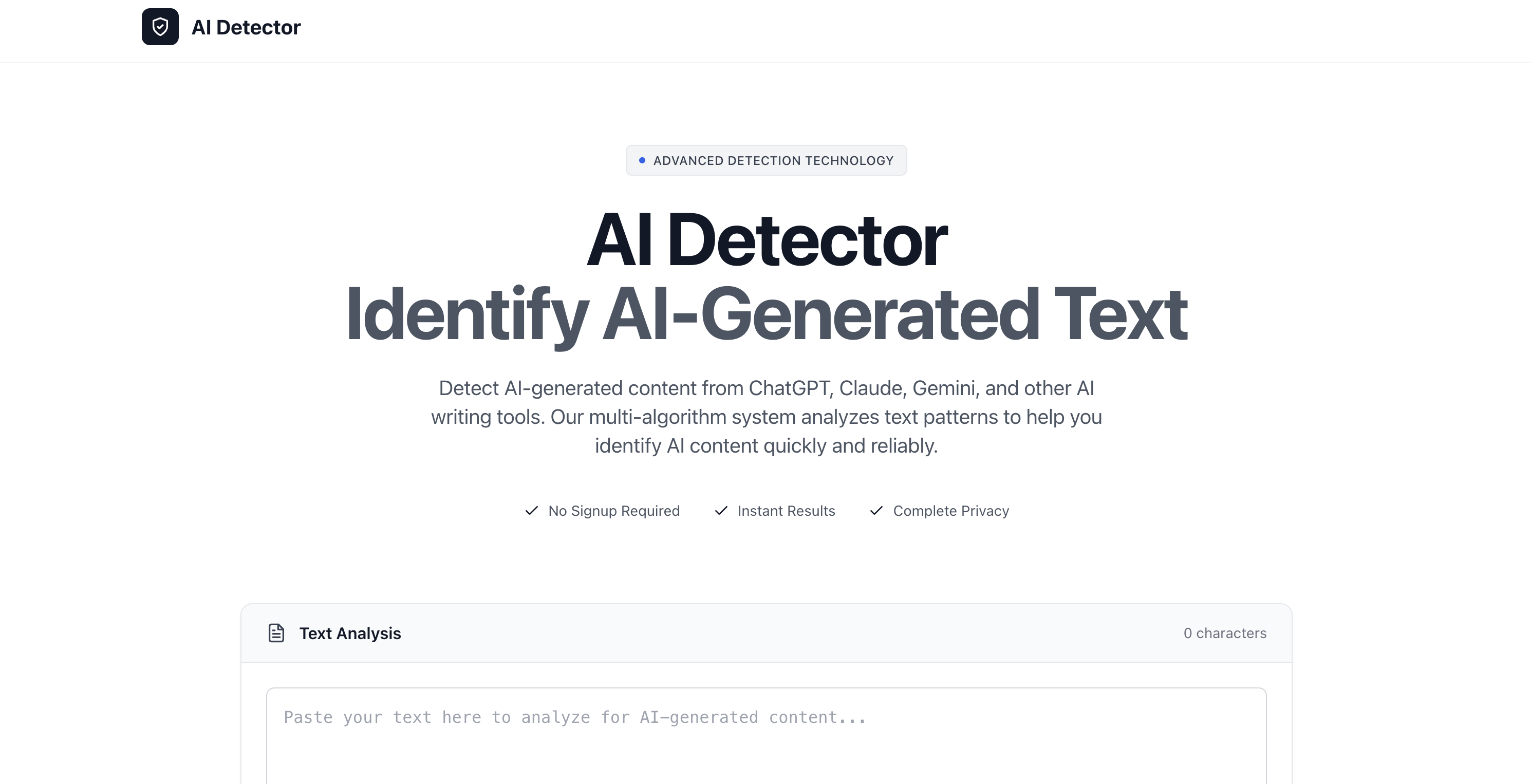
Users access detection platforms through web interfaces, browser extensions, or API integrations. Content submission occurs via copy-paste, direct typing, document upload, or URL scanning for web-published content.
Once submitted, the backend processing pipeline activates. The text undergoes preprocessing including tokenization, normalization, and feature extraction. Multiple machine learning models trained on large corpuses of human-written and AI-generated text analyze the input simultaneously.
Detection algorithms evaluate numerous linguistic and statistical features. Perplexity analysis measures how surprising the word choices appear to language models—human writing typically exhibits higher perplexity due to less predictable phrasing. Burstiness detection examines sentence length variation, as AI often generates more uniform structures. Coherence and logical flow patterns are assessed, with AI sometimes producing text that seems fluent but lacks deep reasoning connections. Vocabulary diversity, error patterns, formatting consistency, and domain-specific knowledge depth receive scrutiny.
The system aggregates these multi-model analyses through ensemble methods, weighting different detection approaches based on text type and length. A final confidence score emerges, typically represented as a percentage likelihood of AI authorship.
Results display through visual interfaces showing overall scores alongside granular breakdowns. Color-coded highlighting (often green for likely human, red/yellow for likely AI) indicates suspicious regions. Many platforms provide sentence-level confidence scores, allowing users to identify specific passages requiring closer examination.
Use Cases
AI detection tools serve diverse stakeholders across multiple sectors:
Academic Integrity: Educators from K-12 through university levels use detectors to screen student essays, research papers, homework assignments, and thesis submissions for AI-generated content. This helps maintain academic honesty while identifying students who may require additional guidance on proper AI tool usage versus original thinking.
Publishing and Editorial Review: Newspapers, magazines, journals, and online publishers screen submitted articles, blog posts, and manuscripts to verify human authorship. This protects publication credibility and ensures adherence to editorial standards regarding AI-assisted content disclosure.
Content Marketing and SEO: Digital marketing agencies and in-house teams verify that outsourced content, freelancer submissions, and internally produced materials meet quality standards and authenticity requirements. This addresses concerns about AI-generated content potentially affecting search engine rankings or brand authenticity.
Hiring and Recruitment: HR departments screen job applications, cover letters, and writing samples to identify candidates using AI assistance without disclosure, ensuring evaluation based on genuine candidate capabilities.
Legal and Compliance: Law firms verify that legal documents, briefs, contracts, and correspondence are genuinely authored by attorneys rather than AI-generated drafts potentially containing hallucinated case law or inaccuracies.
Internal Policy Enforcement: Organizations with policies restricting or requiring disclosure of AI-assisted work use detection tools to audit reports, communications, documentation, and strategic materials for compliance.
Self-Check for Writers: Content creators scan their own work before submission to clients or publishers, verifying that human-edited AI drafts now read authentically or checking that writing assistance tools haven’t inadvertently flagged their original work.
Pros and Cons
Advantages
AI detection tools provide several valuable benefits when used appropriately:
Rapid screening capability enables processing thousands of documents in minutes, dramatically accelerating review workflows compared to manual assessment. This scalability proves essential for educators reviewing entire classes or publishers handling high submission volumes.
Data-driven analysis removes subjective bias from initial authenticity screening. Rather than relying on reviewer intuition about writing quality, detectors provide quantified metrics based on objective linguistic patterns.
The deterrent effect of known detection discourages academic dishonesty and policy violations. When students or employees know submissions undergo AI screening, they’re more likely to produce original work or properly disclose AI assistance.
Continuous improvement through machine learning allows leading platforms to adapt as language models evolve. Training on new AI model outputs and edge cases progressively enhances accuracy over time.
Many platforms offer free tiers or generous trial periods, making basic detection accessible to individual educators, students, and small organizations without budget allocations.
Disadvantages
AI detection technology faces inherent limitations users must understand:
No detector achieves 100% accuracy. False positives incorrectly flag human writing as AI-generated, potentially penalizing innocent students or writers. False negatives miss actual AI content, particularly when sophisticated prompting or post-editing obscures AI fingerprints. Published accuracy rates (often 95-99%+) represent controlled test conditions and may not reflect real-world performance across diverse content types.
Non-native English speakers face disproportionate false positive rates. AI detectors can misidentify grammatically simple or formulaic writing as machine-generated, unfairly flagging multilingual writers whose English follows learned patterns rather than native intuition.
Adversarial techniques enable evasion. Users employing humanization tools, strategic prompt engineering, heavy manual editing, or AI-to-AI paraphrasing can reduce detectability. This creates an arms race between detection and evasion technologies.
Limited free tiers restrict practical utility. Most platforms impose word count limits, daily scan quotas, or feature restrictions on free accounts, requiring paid subscriptions for serious use.
Over-reliance risks replacing human judgment. Detectors provide probabilistic indicators, not definitive proof. Educators or managers treating scores as absolute verdicts without considering context, student explanations, or writing samples may commit unjust accusations.
Training data bias affects reliability. Detectors trained primarily on English academic writing may underperform on creative fiction, technical documentation, business communications, or non-English content.
Privacy concerns arise when uploading potentially sensitive documents to third-party platforms, particularly in educational or corporate contexts with confidentiality requirements.
How Does It Compare?
The AI detection market in 2025 includes numerous established platforms with distinct positioning:
Leading Accuracy-Focused Detectors
GPTZero: Widely regarded as the most accurate AI detector with 99%+ accuracy in independent testing. Developed specifically for educators, GPTZero employs transparent methodology based on perplexity and burstiness analysis. Features include Deep Scan for sentence-level detection, plagiarism checking, browser extensions for Chrome, and batch processing for educators. Named #1 Best AI Software Product of 2025 by G2. Free basic tier available; paid plans start at \$8.33/month. GPTZero excels in educational settings with straightforward, reliable results and strong institutional adoption.
Winston AI: Claims 99.98% detection accuracy with particularly strong performance on subtle AI-generated text. Offers AI detection, plagiarism checking, readability scoring, and recently added AI image detection capabilities. Provides detailed sentence-by-sentence breakdowns and supports bulk document scanning. Free 14-day trial with 2,000 credits; paid plans from \$12/month for 80,000 credits. Winston AI targets publishers and professional content teams requiring high-confidence verification with comprehensive reporting.
Originality.AI: SEO agency favorite combining AI detection with plagiarism checking and team collaboration tools. Particularly strong for identifying AI content in marketing copy, blog posts, and web content. Features include fact-checking capabilities, readability metrics, and team management dashboards. Free for 750 words; paid plans start at \$12.95/month or \$30 one-time purchase for 3,000 credits. Originality.AI suits content marketing teams and digital agencies managing high volumes of outsourced content.
Specialized and Feature-Rich Platforms
Copyleaks: Offers strong multilingual AI detection supporting 30+ languages with particular strength in educational integrations. Features include LMS compatibility, paraphrasing detection, source code checking for programming assignments, and comprehensive reporting. Free limited use; paid plans from \$7.99/month. Copyleaks appeals to international institutions and organizations requiring multilingual verification.
Writer.com AI Content Detector: Enterprise-focused platform combining detection with governance features for team content policies. Supports up to 5,000 words free; paid plans from \$29/month integrate with Writer’s broader content intelligence suite. Suits large organizations needing detection within established content management workflows.
AI Detector Pro: Includes keyword density analysis, originality scoring, tone checking, and AI Eraser feature suggesting alternative wordings for flagged sections. Integrates with Microsoft Word and planned Google Docs compatibility. Free tier with limited scans; paid from \$13.99/month. AI Detector Pro targets marketing professionals requiring detection combined with content optimization insights.
BrandWell AI (formerly Content at Scale): SEO-specific detector analyzing word predictability, sentence variance, and other signals aligned with Google quality guidelines. Designed for content marketers worried about AI content penalties. Free trial with 2,500-character limit; paid from \$249/month for comprehensive SEO suite including AI detection. BrandWell AI serves SEO agencies prioritizing search performance alongside authenticity.
Accessible Free Options
ZeroGPT: Popular free detector with no signup requirement offering sentence-by-sentence breakdowns and probability scoring. Provides accessible entry point for casual users. Completely free with optional upgrades. ZeroGPT suits students and individuals needing quick verification without subscriptions.
Smodin AI Detector: Claims 99% accuracy on human content and 91% on ChatGPT-generated text. Supports 100+ languages with comprehensive reporting. Free basic use with premium upgrades from approximately \$15/month annual subscription. Smodin balances accessibility with multilingual capability.
QuillBot AI Detector: Simple, student-friendly detector integrating with QuillBot’s rewriting and paraphrasing tools. Free for texts under 1,200 words without account requirement. Independent testing shows approximately 80% accuracy. QuillBot works well for students self-checking work before submission despite lower accuracy than premium alternatives.
Sapling AI Detector: Lightweight browser-based tool strong for multilingual teams and quick checks. Completely free with no registration. Offers writing suggestions alongside detection. Sapling suits quick verification needs without comprehensive reporting requirements.
SEO.ai AI Detector: Free standalone detector supporting up to 25,000 characters with claimed 98%+ accuracy across GPT-3, GPT-4, Gemini, and Bard. No login required for instant scanning. SEO.ai provides generous free tier for SEO professionals.
Dual-Function Tools
Undetectable AI: Unique platform offering both detection mode and rewriting capabilities to “humanize” AI content. Free for 10,000 words; paid from \$5/month (annual) or \$19/month. Addresses both verification and evasion use cases, though raises ethical questions about circumventing detection.
PlagiarismCheck.org (TraceGPT): Combines AI detection with traditional plagiarism checking and authorship verification. Features Chrome and Google Docs extensions for workflow integration. Paid from \$2.99/month. Suits academic users wanting unified originality assessment.
Open Source and Developer Tools
Hugging Face: Provides open-source, transparent, and customizable detection models allowing technical users to examine underlying algorithms and fine-tune for specific use cases. Completely free. Hugging Face serves developers and researchers requiring programmatic access and model transparency.
Key Differentiators Across Platforms
Platforms differentiate through accuracy claims (ranging 80-99%+), detection methodologies (single-model versus ensemble approaches), additional features (plagiarism, SEO metrics, readability), language support (English-only versus 100+ languages), pricing models (freemium, subscription, pay-per-scan), integration options (standalone web apps versus API/extension), user interface design (simple versus feature-rich dashboards), and target audiences (students versus enterprises).
No single “best” detector exists universally. GPTZero and Winston AI lead in raw accuracy for English content. Originality.AI excels for SEO and marketing teams. Copyleaks dominates multilingual and educational integrations. Free options like ZeroGPT and Smodin provide adequate accuracy for casual use. Organizations should select based on specific requirements including language needs, budget, accuracy thresholds, integration requirements, and use case contexts.
Pricing and Availability
AI detection platforms employ varied pricing models reflecting different business strategies:
Free Tiers: Most major platforms offer free access with limitations. Common restrictions include word count caps (500-5,000 words), daily scan limits (3-10 documents), feature restrictions (basic detection only, no plagiarism or API access), and mandatory account creation. Free tiers suit individual users with occasional verification needs.
Subscription Plans: Paid tiers typically range from \$5-30/month for individuals, \$50-250/month for teams and enterprises. Subscriptions usually include higher word count limits (50,000-500,000 words monthly), unlimited daily scans, advanced features (plagiarism, bulk processing, API access), priority support, and team management capabilities.
Credit-Based Models: Platforms like Originality.AI offer pay-per-scan options where users purchase credit packs (\$30 for 3,000 credits) providing flexible usage without recurring subscriptions. One credit typically scans 100 words.
Educational Discounts: Many platforms provide reduced pricing or extended free tiers for verified educators and educational institutions, recognizing the critical role in academic integrity.
Enterprise Licensing: Custom pricing for large organizations includes unlimited scanning, dedicated account management, SLA guarantees, custom integrations, on-premises deployment options, and white-label capabilities.
Availability spans web-based platforms accessible through modern browsers, mobile apps (limited), browser extensions (Chrome, Edge, Firefox), API endpoints for programmatic integration, and LMS plugins (Canvas, Blackboard, Moodle). Most detectors require internet connectivity for cloud-based processing, though some experimental on-device models exist.
Final Thoughts
AI content detection in 2025 represents a maturing but imperfect technology addressing genuine needs across education, publishing, and corporate sectors. Leading platforms like GPTZero, Winston AI, and Originality.AI demonstrate substantial accuracy improvements over early-generation tools, providing valuable screening capabilities when used responsibly.
However, users must approach detection results as probabilistic indicators requiring human judgment rather than definitive proof. The technology works best as one component of comprehensive authenticity assessment including writing sample comparison, interview-based verification, process observation, and contextual evaluation.
For educators, AI detectors serve as deterrents and screening tools but should never alone determine academic integrity violations. False positive risks demand giving students opportunities to explain their work and demonstrate understanding through verbal discussion or revision processes.
For publishers and organizations, detectors help enforce content policies and verify submissions but require clear communication with contributors about AI usage expectations, disclosure requirements, and verification procedures.
The ongoing evolution of both language models and detection technology creates a moving target. Regular updates to detection algorithms, testing across diverse content types, awareness of evasion techniques, and realistic expectations about accuracy limitations remain essential.
Ultimately, AI detection tools are most valuable when integrated thoughtfully into broader quality assurance and integrity frameworks that recognize technology’s supportive role while preserving human oversight, contextual judgment, and educational approaches addressing the legitimate place of AI assistance in modern writing workflows.