
Table of Contents
Overview
The rapid integration of artificial intelligence into business workflows presents transformative opportunities alongside significant security and connectivity challenges. As organizations deploy AI agents capable of interacting with enterprise systems, a critical question emerges: How can these powerful AI systems securely connect to existing business tools and local resources without compromising data integrity or introducing vulnerabilities?
The Model Context Protocol, developed by Anthropic and released as an open standard in 2024, addresses this challenge by providing a standardized way for Large Language Models and AI agents to connect with external data sources and tools. However, MCP implementation introduces novel security risks that demand specialized infrastructure. MCPTotal represents a new generation of middleware solution designed specifically to bridge this gap, offering instant, zero-configuration deployment of secure MCP servers, comprehensive security controls, and seamless integration with over 100 business tools while providing enterprise-grade governance and observability.
Key Features
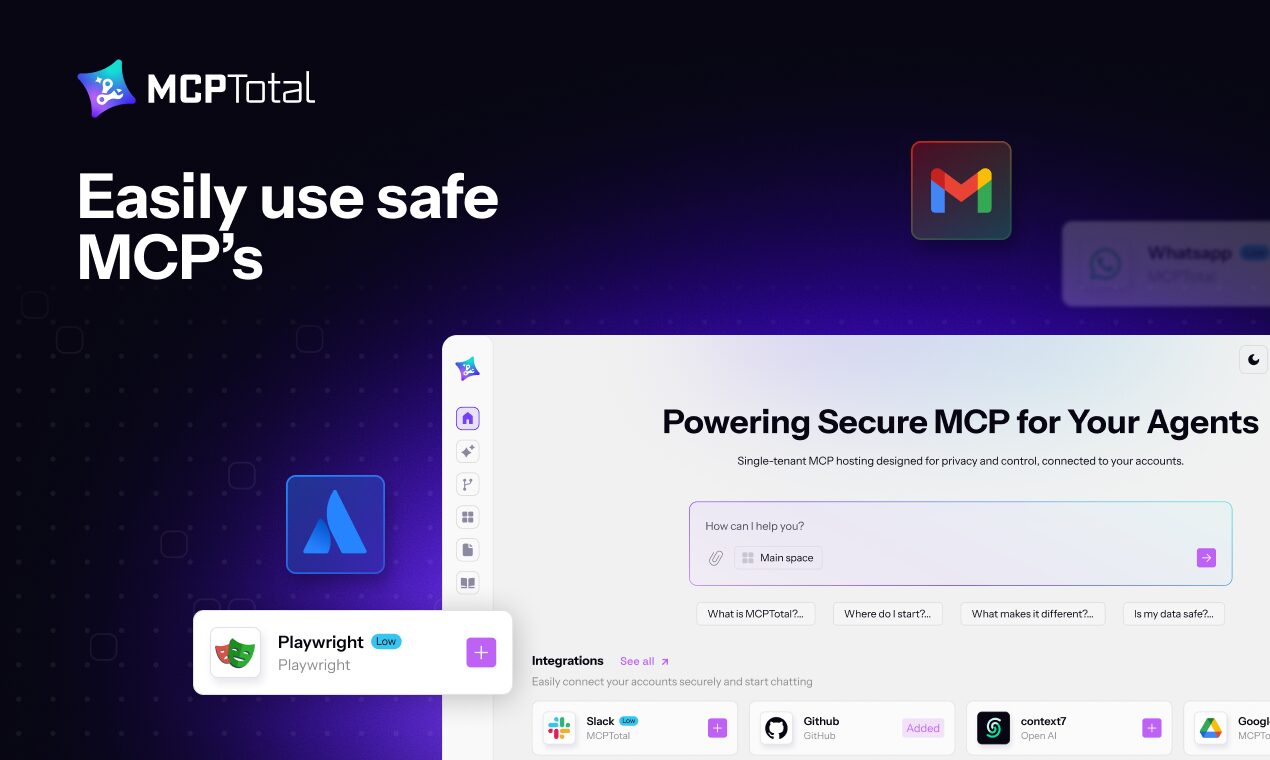
MCPTotal provides a comprehensive platform for secure MCP deployment and management through four core components:
Zero-Configuration Server Deployment: Deploy secure MCP servers in minutes without complex setup processes or extensive IT overhead. The platform automates infrastructure provisioning, containerization, and security configuration that would typically require weeks of custom development. MCPTotal’s vetted catalog contains hundreds of pre-reviewed MCP servers that have passed rigorous security assessments to eliminate malicious risks.
Secure Hub for Business Tool Connectivity: Connect AI agents to an extensive ecosystem of over 100 business tools through a centralized, security-hardened environment. The hub architecture provides unified authentication through Single Sign-On and SAML integration, centralized credential vaulting to eliminate API key sprawl, and role-based access controls that determine which users and agents can access specific tools. This eliminates the need for employees to manually handle API keys while maintaining strict security boundaries.
Traffic Monitoring and Governance Gateway: Gain real-time visibility into all MCP traffic through an AI-native firewall that monitors interactions and enforces policies dynamically. The gateway architecture intercepts JSON-RPC communication between MCP clients and servers, validates server authorization and behavior, analyzes operations for security issues, and generates comprehensive audit logs for every MCP interaction. This provides the observability foundation necessary for compliance and security oversight.
Desktop Application for Local Environment Integration: Extend AI capabilities to local desktop environments through a dedicated application that connects AI models directly to local tools, files, and resources. The desktop app addresses a critical security gap that browser-only solutions cannot solve, as MCP servers frequently run on developer workstations. MCPTotal’s desktop-first approach provides security teams with visibility and governance over local MCP usage while maintaining developer productivity.
How It Works
MCPTotal functions as sophisticated middleware that securely orchestrates communication between AI agents and diverse local or cloud-based tools through a multi-layered architecture.
The platform employs a hub-and-gateway model. The hub component provides centralized hosting for MCP servers in secure, sandboxed container environments with docker-in-docker architecture ensuring filesystem isolation between servers. Each MCP server runs in its own process with encrypted storage via EBS. The hub includes automated security review through static code analysis and runtime monitoring to detect malicious behavioral activities such as data exfiltration.
The gateway component acts as a security control plane between MCP clients like Claude Desktop or Cursor and MCP servers. When an AI agent needs to interact with an external service or data source, MCPTotal intercepts the instruction, validates the request against established security policies, routes it securely to the appropriate tool through the standardized MCP protocol, and relays responses back to the AI agent while maintaining comprehensive logging.
Security implementation operates across multiple layers. Authentication schemes include OAuth 2.0 support following recent additions to the MCP standard, HTTP header-based authentication with enrolled keys, and URL-based secrets for clients without custom header support. The platform implements guardrails against prompt injection attacks, tool poisoning attempts, and data exfiltration by analyzing both inbound requests and outbound responses. Rate limiting prevents denial-of-service attacks, while content filters identify and mask sensitive data like Social Security numbers before transmission.
Governance capabilities enable organizations to set policies around MCP usage, control which users and agents can access specific servers and tools, block dangerous commands or entire MCP servers, trigger alerts and notifications based on suspicious activity, and populate real-time dashboards for comprehensive observability. The system employs Endpoint Detection and Response scanning to identify unauthorized Shadow MCP usage across the organization.
Use Cases
MCPTotal addresses specific enterprise scenarios where secure AI agent deployment requires robust infrastructure:
Connecting Claude to Internal APIs: Enable AI agents to access and interact with proprietary internal APIs while maintaining authentication boundaries and audit trails. Organizations can extend Claude’s capabilities to query customer databases, update CRM records, or trigger internal workflows without exposing credentials or creating security gaps. The centralized credential vaulting ensures API keys remain protected while agents gain necessary access.
Managing Enterprise AI Tool Access: Provide a unified platform for governing how different AI models and agents access various business tools across distributed teams. Security leaders gain full visibility into which agents are using which tools, when access occurs, and what data flows through these connections. Role-based access controls ensure developers in different departments only access appropriate tools, while compliance teams receive comprehensive audit logs demonstrating adherence to data handling policies.
Securely Running Local Desktop Agents: Deploy and manage AI agents operating within local networks or on individual workstations while ensuring sensitive data remains within organizational control. The desktop application allows developers to connect local MCP servers to AI clients with enterprise security policies automatically enforced. This addresses the critical challenge of Shadow MCP, where employees install and run MCP servers without security team awareness or governance.
Automated Customer Support Systems: Build AI-powered support agents that securely access customer databases, billing systems, server logs, knowledge bases, and ticketing platforms through standardized MCP connections. The AI can look up customer accounts, verify payment status, update subscriptions, and reply to inquiries while every action appears in immutable audit logs for quality assurance and compliance review.
Development Workflow Integration: Connect AI coding assistants to GitHub repositories, issue trackers, documentation systems, and deployment pipelines with granular permissions. Developers gain AI assistance for reviewing pull requests, managing issues, analyzing code changes, and updating documentation while security teams maintain visibility and control over which repositories and operations the AI can access.
Pros and Cons
Advantages
Addresses Critical Security Gap in AI Agent Deployment: MCPTotal directly confronts the fundamental challenge of securely connecting AI to business systems, a problem that traditional security products cannot solve because they lack visibility into MCP traffic. The platform implements defenses against the 13 identified MCP security vulnerabilities including prompt injection, tool poisoning, supply-chain attacks, and malicious MCP servers reported in the wild as of 2025.
Rapid Deployment and Usability: The zero-configuration approach dramatically reduces implementation time from weeks to minutes. Organizations can deploy vetted MCP servers through one-click installation without writing infrastructure code, configuring containers, or managing authentication systems. This accessibility enables all employees to use MCP immediately through a simple interface while security teams maintain control through built-in policy enforcement and auditing.
Comprehensive Governance and Observability: End-to-end tracing captures every MCP interaction with fully traceable audit logs suitable for compliance requirements. Real-time dashboards provide visibility into usage patterns, security alerts, and system health. Configurable rules enable automated responses to security events including alerts, human approval requirements, quarantine, or blocking. This observability foundation proves essential as MCP adoption scales across the organization.
Multi-Environment Coverage: The platform operates consistently across desktop, browser, and cloud environments including self-hosted deployments. This flexibility addresses the reality that MCP servers run in diverse locations from developer workstations to cloud infrastructure, requiring unified governance regardless of deployment model.
Disadvantages
Platform Specificity to MCP Ecosystem: MCPTotal’s capabilities focus specifically on organizations implementing Model Context Protocol, particularly those using MCP-compatible AI clients like Anthropic Claude Desktop, Cursor, and other tools supporting the standard. Organizations not using MCP or those with different AI integration approaches may not benefit from the platform’s specialized features. However, as MCP gains adoption as an industry standard, this limitation narrows.
Relatively New Platform: MCPTotal launched publicly in October 2025, meaning long-term operational track records and extensive community feedback remain limited compared to established enterprise software. Organizations with stringent vendor evaluation requirements should conduct pilot testing to validate capabilities and assess roadmap maturity.
Requires Understanding of MCP Concepts: While the platform simplifies deployment, administrators benefit from understanding Model Context Protocol fundamentals, including the distinction between MCP clients, servers, tools, resources, and prompts. Organizations should invest in training security and development teams on MCP architecture to fully leverage governance capabilities.
Pricing Transparency: Detailed enterprise pricing structures beyond the free launch offering have not been publicly disclosed. Organizations planning large-scale deployments should engage directly with MCPTotal for cost projections based on usage patterns, number of users, and required features.
How Does It Compare?
The MCP security and governance landscape has evolved rapidly through 2025 as organizations recognize that implementing Model Context Protocol requires specialized infrastructure beyond the protocol specification itself. Understanding where MCPTotal fits requires examining the diverse categories of solutions addressing MCP deployment, security, and integration challenges.
Enterprise MCP Security and Governance Platforms
MCP Manager
MCP Manager positions itself as the comprehensive enterprise platform for securing, deploying, and monitoring MCP ecosystems. The platform organizes capabilities into three areas: deployment enabling code-free MCP server deployment in highly secure formats including customer-owned infrastructure; observability providing end-to-end traceable monitoring with logging, dashboards, and alerts; and security delivering proactive and runtime protections against MCP-based threats.
Security implementation focuses on addressing the complete MCP threat landscape. The platform provides protection against prompt injection through attack vector blocking before requests reach MCP clients, tool poisoning detection by inspecting MCP server responses for malicious instructions, rug pull protection using AI-powered risk analysis to prevent unauthorized post-approval configuration changes, and anti-mimicry features detecting tool calls that could confuse clients into calling wrong tools.
Governance capabilities include granular role-based access controls determining which users and agents can access specific MCP servers and tools, SSO integration with SAML support, SCIM support for user provisioning, comprehensive MCP server and tool admin center, configurable custom rules for alerts and responses, and server rate limiting to mitigate denial-of-service attacks.
Observability features deliver end-to-end fully traceable logging of all MCP traffic, real-time reporting and customizable dashboards, abnormal behavior monitoring across network patterns, and feature-type filters for granular control over allowed server and client capabilities.
Compared to MCPTotal, MCP Manager provides more extensive security feature depth including advanced threat protections like rug pull detection and anti-mimicry, more sophisticated access controls with SCIM integration, and deeper customization through rule engines. MCPTotal emphasizes ease of deployment and usability for rapid adoption, while MCP Manager targets organizations requiring comprehensive security features and willing to invest in more complex configuration.
MintMCP
MintMCP emerged as a leading alternative in the MCP gateway space with SOC2 Type II certification, positioning itself as the optimal solution for production MCP deployment. The platform revolutionizes deployment by transforming local STDIO-based MCP servers into production-ready services with automatic OAuth protection in minutes rather than weeks.
Key technical differentiators include one-click deployment for STDIO-based MCP servers with instant hosting and configuration, automatic OAuth wrapping adding SSO and SAML authentication to any local MCP server without code changes, real-time monitoring tracking every MCP interaction and configuration change, multi-region support with data residency controls for global compliance, and universal AI agent compatibility supporting ChatGPT through Developer Mode or Hosted MCP, Claude, Copilot, Cursor, and custom tools.
Security architecture addresses critical vulnerabilities through layered defense including input validation before tool execution, secrets detection in inputs and outputs, real-time blocking of risky operations, complete audit trails for every operation, and OAuth 2.0 and SAML integration eliminating credential exposure. The platform reports typical gateway latency under 10 milliseconds, preserving performance while adding security controls.
MintMCP’s Virtual MCP architecture enables logical endpoints combining multiple MCP servers with curated tool sets, providing flexibility in how tools are organized and presented to AI agents. The central MCP registry integrates with growing sets of pre-built servers including Snowflake, Elasticsearch, Gmail, and GitHub while connecting to the broader community-maintained MCP registry.
Performance claims include 10-12 times overall performance improvements compared to Node.js-based MCP servers on traditional infrastructure when using Bun runtime support, with 14 times faster startup times and up to 4 times better execution performance. The gateway architecture preserves these advantages through optimized infrastructure and minimal latency overhead.
Compared to MCPTotal, MintMCP emphasizes SOC2 compliance certification, automatic OAuth protection capabilities, and multi-region deployment infrastructure. MCPTotal provides more extensive business tool connectivity through its 100-plus application catalog and includes desktop EDR scanning for Shadow MCP detection. Both platforms address enterprise requirements but with different emphasis on compliance certification versus connectivity breadth.
Lasso Security
Lasso Security provides an open-source MCP gateway approach focusing on configuration and lifecycle management of MCP servers alongside sensitive information sanitization in MCP messages. As an open-source solution, Lasso offers transparency and customization opportunities for organizations with development resources to adapt the gateway to specific requirements.
The open-source nature appeals to organizations preferring community-driven development and avoiding vendor lock-in, though this approach requires internal expertise to deploy, maintain, and extend the platform compared to commercial offerings with dedicated support.
Composio
Composio delivers MCP gateway capabilities with strong emphasis on granular access control, comprehensive audit logging, and centralized secret management. The platform enforces detailed policies controlling which tools and methods are accessible to which agents, tracks every agent action in immutable audit trails providing visibility for compliance and security reviews, and stores all secrets, API keys, and OAuth tokens centrally.
This focus on access control and secret management makes Composio particularly suitable for organizations with complex permission requirements and strict credential management policies, though it may involve steeper configuration compared to platforms emphasizing deployment simplicity.
CData
CData positions its managed MCP platform around enterprise AI agent development with real-time data access and no-code integration capabilities. The platform claims connectivity to over 300 data sources and business applications, extending beyond typical MCP server offerings.
Key differentiators include the breadth of pre-built connectors spanning databases, SaaS applications, and enterprise systems, no-code configuration reducing technical barriers for business users, and managed infrastructure eliminating operational overhead. The platform targets organizations prioritizing data connectivity breadth over specialized security features, complementing rather than directly competing with security-focused gateways.
Framework Integration Solutions
LangChain and LangChain MCP Adapters
LangChain has established itself as the dominant framework for building LLM applications, offering powerful abstractions for chains, agents, and memory management. The introduction of MCP support fundamentally changed LangChain’s positioning in the MCP landscape.
In February 2025, LangChain released langchain-mcp-adapters, an official library providing seamless integration between LangChain and MCP servers. The library introduces the MultiServerMCPClient class enabling connections to multiple MCP endpoints simultaneously, automatic conversion of MCP tools into LangChain Tool objects, connection pooling and load balancing, and hybrid model integration supporting both function-calling for OpenAI or Anthropic tools and MCP for everything else.
This integration creates powerful synergies. LangChain handles complex orchestration logic including chains, agents, and memory management, while MCP provides standardized access to a growing ecosystem of tools. Developers can build sophisticated multi-step workflows where agents use MCP servers to query databases, access enterprise systems, and invoke external APIs without writing custom integrations.
In December 2025, LangSmith added native MCP support. Every deployed agent on LangSmith now exposes MCP endpoints, enabling LangChain agents to act as both MCP clients consuming tools and MCP servers providing capabilities to other systems. This bidirectional capability positions LangChain as a central orchestration layer in complex MCP deployments.
Compared to MCPTotal, LangChain with MCP adapters provides deep integration for Python and TypeScript development workflows, sophisticated agent orchestration capabilities beyond simple tool invocation, and the ability to combine MCP with LangChain’s extensive ecosystem of integrations. However, LangChain requires development expertise and custom code, whereas MCPTotal offers zero-code deployment through a managed platform. Organizations with strong development teams may prefer LangChain’s flexibility, while those prioritizing rapid deployment and security governance benefit from MCPTotal’s infrastructure-focused approach.
LangGraph and Multi-Agent Workflows
LangGraph extends LangChain with graph-based framework support for complex agent workflows. With MCP integration through the adapter library, LangGraph enables sophisticated multi-agent systems where different agents consume different MCP servers, coordinate through shared state, and collaborate on complex tasks.
This capability proves valuable for enterprise scenarios requiring multiple specialized agents each accessing different tools through MCP, though it requires architectural sophistication beyond typical MCP deployments.
Cloud Platform MCP Support
Azure API Center
Microsoft has integrated MCP support into Azure API Center, positioning it as a private MCP registry for enterprise deployments. The integration enables Logic Apps connectors, Azure Functions, and LangChain agents to be exposed as MCP servers, providing a bridge between Microsoft’s existing enterprise integration ecosystem and the emerging MCP standard.
For organizations invested in Azure infrastructure, this native integration provides seamless MCP adoption within existing tooling. However, it lacks the specialized security features and multi-platform support of dedicated MCP gateway solutions like MCPTotal.
Google Cloud Reference Architecture
Google released a reference architecture for securing MCP servers on Google Cloud Platform in September 2025, demonstrating enterprise interest in MCP security patterns. The architecture employs a centralized MCP proxy using Google Identity Platform for authentication, Model Armor for message inspection against prompt injections and sensitive data, and Secret Manager for credential storage.
This reference architecture provides guidance for organizations building custom MCP infrastructure on GCP rather than an off-the-shelf solution. It requires significant implementation effort compared to platforms like MCPTotal that provide these capabilities as managed services.
Specialized Security Tools
MCP Guardian
MCP Guardian implements middleware security through integrated modules addressing authentication, access control, request logging, rate limiting, and WAF scanning. This defense-in-depth approach provides coordinated protection through multi-layered security mechanisms tailored to MCP deployment characteristics.
The middleware architecture positions MCP Guardian as a component within broader security infrastructure rather than a complete platform, suitable for organizations assembling custom security stacks from specialized components.
MCPSafetyScanner
MCPSafetyScanner represents a proactive security auditing tool specifically designed to assess MCP server security. As the first agentic tool for this purpose, it automatically determines adversarial samples given an MCP server’s tools and resources, searches for related vulnerabilities and remediations, and generates detailed security reports.
This addresses a critical gap in the MCP security lifecycle by enabling organizations to assess third-party MCP servers before deployment, complementing runtime security provided by gateways like MCPTotal.
MCPTotal’s Competitive Position
MCPTotal occupies a strategic position addressing the intersection of rapid deployment, comprehensive security, and enterprise governance for MCP implementations.
Against enterprise security platforms like MCP Manager and MintMCP, MCPTotal differentiates through its emphasis on ease of use and rapid adoption. The zero-configuration deployment and free launch tier lower barriers to entry, enabling organizations to implement MCP security quickly without extensive planning or configuration. The 100-plus business tool catalog provides immediate connectivity breadth. The desktop application with EDR scanning specifically addresses Shadow MCP detection, a capability not universally available in competing platforms.
Compared to framework integration solutions like LangChain and LangGraph, MCPTotal provides infrastructure rather than development libraries. Organizations with strong engineering teams may prefer LangChain’s flexibility and deep integration capabilities, while those seeking managed infrastructure with security guarantees benefit from MCPTotal’s platform approach. The two solutions complement each other, as LangChain applications can consume MCP servers deployed and secured through MCPTotal.
Against cloud platform native offerings from Azure and Google, MCPTotal delivers platform independence and specialized MCP focus. Organizations operating across multiple clouds or seeking best-of-breed MCP infrastructure benefit from MCPTotal’s cross-platform approach rather than cloud-specific implementations.
The platform particularly suits organizations in several scenarios: those rapidly adopting MCP without extensive security infrastructure already in place, teams prioritizing developer productivity alongside security governance, enterprises requiring visibility into Shadow MCP usage across desktop environments, and organizations needing comprehensive business tool connectivity through a single integration point.
MCPTotal’s launch timing in October 2025 positions it during the critical growth phase of MCP adoption. As the protocol gains industry acceptance following Anthropic’s promotion and community contribution to the open-source specification, demand for specialized infrastructure addressing security, governance, and operational concerns intensifies. MCPTotal provides a turnkey solution to this emerging need, competing on ease of deployment and comprehensive feature coverage rather than deep specialization in individual areas.
Final Thoughts
MCPTotal represents a timely and focused solution addressing the critical infrastructure gap organizations face when deploying Model Context Protocol at enterprise scale. The platform directly confronts the security, governance, and operational challenges that make MCP adoption risky without specialized middleware, delivering capabilities that transform experimental AI agent deployments into production-ready systems.
The combination of zero-configuration deployment, comprehensive security controls, extensive business tool connectivity, and desktop-focused governance addresses genuine organizational needs. MCPTotal’s emphasis on usability through one-click server deployment and curated catalogs lowers adoption barriers, while features like centralized credential vaulting, comprehensive audit logging, and real-time traffic monitoring satisfy security team requirements.
The platform particularly excels in several areas. The desktop application with Endpoint Detection and Response scanning addresses the critical problem of Shadow MCP that browser-only solutions cannot solve, providing visibility into local MCP server usage across developer workstations. The hub architecture with automatic security review of MCP servers through static analysis and runtime monitoring reduces supply-chain risks. The gateway’s implementation of guardrails against prompt injection, tool poisoning, and data exfiltration directly mitigates the documented MCP security vulnerabilities identified in academic research and real-world incidents.
Organizations should carefully evaluate MCPTotal against specific requirements and alternative approaches. Companies with strong development teams and existing infrastructure may prefer implementing MCP security using frameworks like LangChain with custom gateway development, trading managed platform simplicity for maximum flexibility. Enterprises requiring SOC2 Type II certification specifically should consider MintMCP’s certified infrastructure. Organizations needing maximum security feature depth including rug pull protection and advanced threat detection may benefit from MCP Manager’s comprehensive capabilities despite greater configuration complexity.
The platform’s October 2025 launch date means limited long-term operational history and community feedback compared to established enterprise software. Organizations should conduct pilot testing to validate performance claims, assess security effectiveness against their specific threat models, and verify that the business tool catalog includes critical integrations for their workflows. Pricing discussions with MCPTotal for production deployments should clarify cost structures, support commitments, and roadmap priorities.
However, for organizations confronting the fundamental challenge of securely deploying AI agents with access to business systems, MCPTotal delivers a legitimate solution purpose-built for this specific problem. The platform recognizes that MCP adoption introduces security risks that traditional solutions cannot address because they lack visibility into MCP traffic, and it provides specialized infrastructure bridging this gap.
As Model Context Protocol continues gaining adoption as the standardized interface connecting AI models with external systems, specialized platforms like MCPTotal addressing security, governance, and operational concerns become essential infrastructure components. The protocol’s potential as a universal interface for AI tool connectivity creates parallel demand for universal infrastructure securing that connectivity at enterprise scale. MCPTotal positions itself to serve this emerging need through a platform balancing ease of deployment, comprehensive security, and practical operational requirements.
For organizations serious about enabling AI agent capabilities safely while maintaining security and governance standards, MCPTotal represents a viable solution worthy of evaluation alongside alternative approaches including framework-based implementations, cloud-native offerings, and competing specialized platforms. The optimal choice depends on specific organizational priorities regarding deployment speed, security feature depth, compliance requirements, and technical team capabilities.