
Table of Contents
Overview
Vectorly is an AI-powered platform transforming interactive websites into reusable APIs and MCP (Model Context Protocol) servers launched publicly December 2025. Rather than relying on fragile HTML scrapers or expensive computer-vision browser agents, Vectorly records user interactions with websites, analyzes network traffic and JavaScript to reverse-engineer hidden backend APIs, and repackages them as reliable, reproducible routines. The platform emphasizes “zero runtime token costs”—once APIs are discovered and converted to routines, they execute without consuming LLM tokens unlike browser agents requiring continuous model inference for each interaction.
Available through beta access with pricing not yet specified (likely usage-based or SaaS subscription for console and marketplace), Vectorly targets developers building data pipelines, integrating internal tools, and automating complex single-page applications (SPAs) where traditional scrapers fail. The emphasis on publishing workflows to a marketplace enables community sharing of discovered API endpoints—once one developer unlocks a website’s API structure, others instantly reuse the pattern without repeating reverse-engineering work.
Key Features
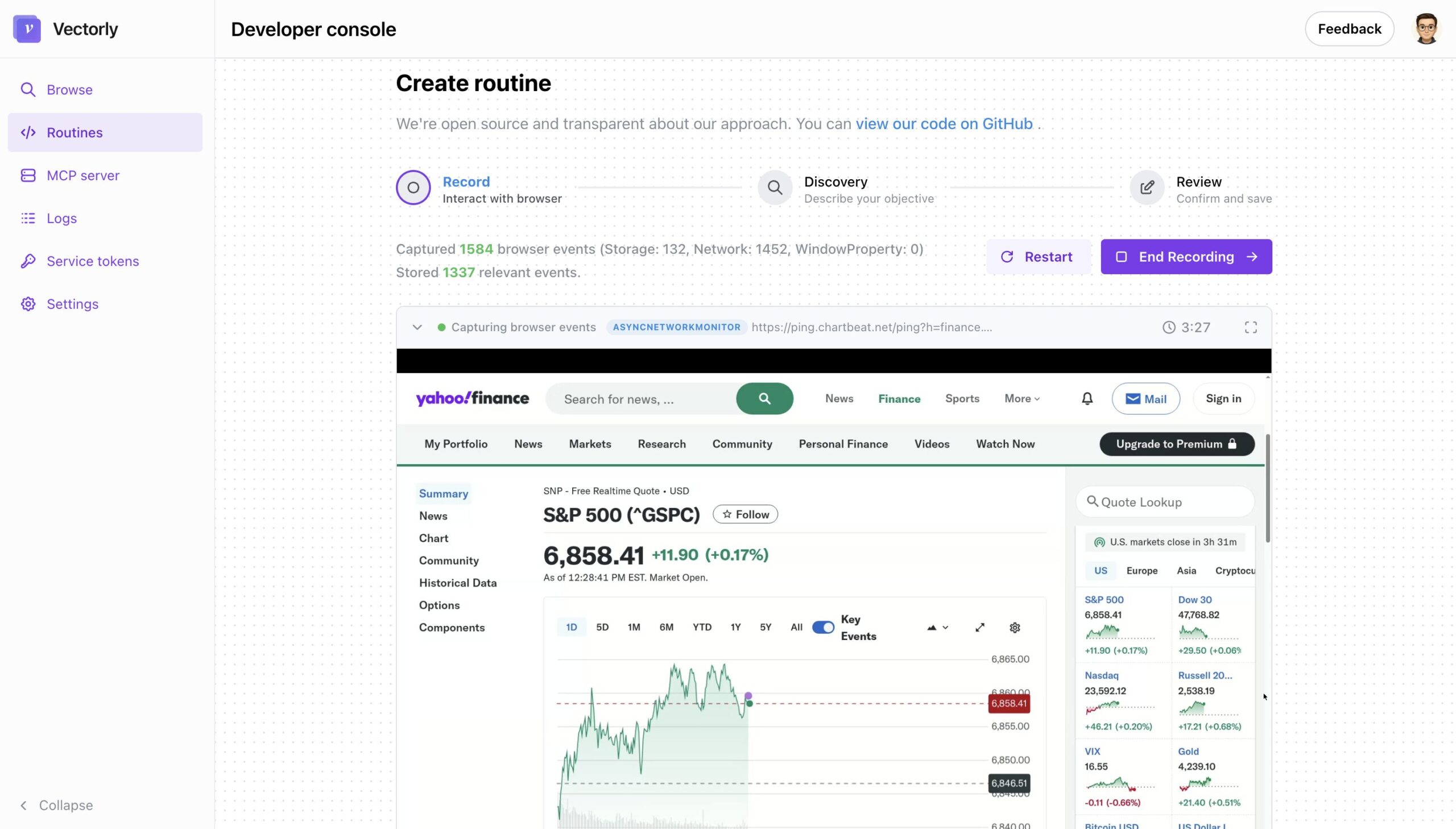
Click-to-API Conversion: Users interact naturally with website in browser (clicking, searching, scrolling). Vectorly captures network traffic, cookies, browser storage, and JavaScript bundles while recording clicks. AI analyzes captured assets reverse-engineering hidden backend API endpoints powering UI actions and repackages them as callable routines.
Zero Runtime Token Costs: Unlike browser agents executing at inference time (consuming LLM tokens for every action), Vectorly-discovered APIs execute directly without LLM involvement after initial discovery. Recurring executions free of token cost dramatically reducing operational expenses for repeated tasks.
Marketplace for Shared Workflows: Developers publish discovered routines to marketplace enabling others to run identical workflows instantly without repeating reverse-engineering effort. Community sharing accelerates routine availability across common websites.
MCP (Model Context Protocol) Support: Routines expose as MCP tools enabling Claude, other LLM agents, and AI applications consuming Vectorly workflows as first-class capabilities. MCP integration enables AI agents treating Vectorly routines as native tools without wrapper code.
REST API Endpoints: Routines also expose as REST API endpoints enabling direct HTTP calls from code, making integration with applications simple without requiring MCP infrastructure.
Browser-Based Recording Console: Web-based interface enables natural interaction with websites while Vectorly records everything. No coding required—users click, search, and explore while platform captures patterns.
Network Traffic Analysis: Captures all HTTP requests, headers, cookies, authentication tokens, and response data enabling inference of API patterns traditional scrapers cannot access.
JavaScript and Storage Inspection: Analyzes JavaScript bundles, localStorage, sessionStorage, and indexedDB understanding how sites store state and manage authentication enabling robust automation.
Routine Publishing and Versioning: Routines versioned and published to marketplace enabling semantic versioning, dependency management, and rollback if routine breaks.
Open-Source Components: Web Hacker (reverse engineering framework) published open-source enabling community contributions and transparency into underlying reverse-engineering logic.
How It Works
Access Vectorly Console and begin interacting with target website naturally—navigate pages, perform searches, click buttons, scroll content. While you interact, Vectorly captures network traffic, cookies, JavaScript, storage, and click patterns. After recording workflow, describe what you need (data extraction, API behavior replication). Vectorly AI analyzes all captured assets inferring underlying API structure and required parameters. Platform generates “routine”—structured automation recipe combining browser steps with direct API calls. Publish routine to marketplace or call via REST API or MCP. Subsequent executions call discovered APIs directly without token consumption.
Use Cases
Turning Internal Tools into APIs: Organizations with legacy internal applications lacking public APIs can record user workflows converting them into API endpoints enabling programmatic access without modifying internal systems.
Scraping Complex Single-Page Applications: SPAs rendering content via JavaScript after page load defeat traditional scrapers. Vectorly captures JavaScript execution and resulting network calls enabling scraping dynamic content.
Building Reliable Data Pipelines: Teams managing recurring data extraction from websites use Vectorly-discovered APIs instead of fragile scheduled scrapers breaking when UIs change.
Creating MCP Servers for Claude and AI Agents: Developers integrate Vectorly routines as MCP tools enabling Claude to access website data as first-class capabilities for agentic workflows.
Multi-Step Workflow Automation: Complex workflows requiring searching, filtering, pagination, and data extraction across multiple pages captured as single reusable routine.
Pros \& Cons
Advantages
Much Faster than Browser Agents: Discovered APIs execute instantly versus browser agents simulating user actions step-by-step. Speed advantage dramatic for high-frequency automations.
Dramatically Cheaper than LLM-Driven Automation: Zero runtime token costs for routine execution versus browser agents consuming tokens per action. Cost advantage compounds with usage scale.
More Stable than HTML Scrapers: Reverse-engineered APIs stable when websites change UI but maintain backend API contracts. Traditional HTML scrapers break immediately with UI modifications.
Community Sharing Accelerates Development: Marketplace enables leveraging other developers’ reverse-engineering work avoiding duplicate effort discovering same API patterns.
Transparent Automation Logic: Generated routines explicit in browser steps and API calls versus opaque browser agent reasoning enabling debugging and modification.
MCP Integration Enables AI Native Usage: Claude and other LLM agents natively consume Vectorly routines as tools without wrapper code enabling seamless integration.
Disadvantages
Limited to Sites with Exposable Endpoints: Vectorly requires websites exposing backend APIs via network requests. Purely server-side rendered sites without AJAX endpoints cannot be reverse-engineered.
Complex Site Structures Can Prove Difficult: Sites with sophisticated anti-scraping measures, complex authentication flows, or obfuscated API contracts may resist reverse-engineering defeating “simple recording” promise.
Early-Stage Platform Risk: December 2025 launch means unproven reliability at scale, unknown marketplace quality/quantity, untested edge cases in reverse-engineering logic.
Marketplace Dependency for Common Workflows: Platform value depends on community publishing useful routines. Early adoption may encounter sparse marketplace coverage limiting immediate utility.
Lack of Human-in-the-Loop Control: Once routine recorded and deployed, minimal ability to intervene if automation fails mid-workflow versus browser agents enabling step-by-step guidance.
Reverse-Engineering Accuracy Uncertain: Correctly inferring API semantics from network traffic complex; platform may misinterpret optional parameters, required headers, or authentication flows.
How Does It Compare?
Vectorly vs Browserbase
Browserbase is cloud browser platform providing scalable browser infrastructure, stealth capabilities, and integration with automation frameworks (Playwright, Puppeteer, Selenium).
Architecture:
- Vectorly: API discovery and routine generation
- Browserbase: Managed browser infrastructure and pooling
Token Costs:
- Vectorly: Zero runtime token costs for discovered APIs
- Browserbase: Token costs for LLM-driven browser agents
Approach:
- Vectorly: Reverse-engineer APIs then execute directly
- Browserbase: Provide browser infrastructure for agent automation
Use Case:
- Vectorly: API discovery and routine sharing
- Browserbase: Browser agent deployment and scaling
Integration:
- Vectorly: MCP, REST API
- Browserbase: Framework-native (Playwright, Puppeteer)
When to Choose Vectorly: For discovering hidden APIs and executing at zero token cost.
When to Choose Browserbase: For scalable browser infrastructure running agents on discovered patterns.
Vectorly vs Apify
Apify is web scraping and automation platform offering 2000+ pre-built scrapers (“Actors”), visual workflow builder, and scalable cloud execution.
Approach:
- Vectorly: Record interactions to discover APIs
- Apify: Code or configure scrapers for specific websites
Pre-Built Solutions:
- Vectorly: Marketplace-driven community routines
- Apify: 2000+ official Apify Actors plus community actors
Customization:
- Vectorly: Visual recording; AI discovers patterns
- Apify: Code-based (JavaScript) or visual builder
API Discovery:
- Vectorly: Automatic reverse-engineering
- Apify: Manual scraper development
Use Cases:
- Vectorly: General-purpose website API discovery
- Apify: Specific website scraping with pre-built templates
When to Choose Vectorly: For discovering APIs from arbitrary websites without coding.
When to Choose Apify: For leveraging pre-built scrapers or building custom scrapers.
Vectorly vs Browse.ai
Browse.ai is visual workflow automation platform recording user interactions and replaying them for document extraction, monitoring, and automation.
Recording Approach:
- Vectorly: Records for API reverse-engineering
- Browse.ai: Records for direct replay automation
Execution Model:
- Vectorly: Executes discovered APIs
- Browse.ai: Replays recorded interactions via browser
Token Costs:
- Vectorly: Zero for API execution
- Browse.ai: Token cost for LLM-driven monitoring and extraction
Marketplace:
- Vectorly: API routines
- Browse.ai: Automation templates
Scalability:
- Vectorly: Scales via direct API calls
- Browse.ai: Scales via distributed browser replay
When to Choose Vectorly: For API discovery and zero-cost execution.
When to Choose Browse.ai: For visual workflow recording and replay.
Vectorly vs MultiOn
MultiOn is web AI agent platform enabling natural language web automation through Chrome extension and API.
Control Model:
- Vectorly: Discovered APIs (deterministic execution)
- MultiOn: Natural language agent (model-driven execution)
Token Usage:
- Vectorly: Zero for routine execution
- MultiOn: Token cost per agent action
Determinism:
- Vectorly: Fully deterministic API calls
- MultiOn: Probabilistic agent behavior
Ease of Use:
- Vectorly: Record interactions
- MultiOn: Describe actions naturally
Cost Structure:
- Vectorly: Discovery cost then free execution
- MultiOn: Per-execution token cost
When to Choose Vectorly: For deterministic API-driven automation with zero runtime cost.
When to Choose MultiOn: For flexible natural language agent automation.
Vectorly vs Puppeteer/Playwright
Puppeteer/Playwright are open-source browser automation frameworks enabling code-based web interaction and scraping.
Abstraction Level:
- Vectorly: High-level API discovery and routines
- Puppeteer/Playwright: Low-level browser control via code
API Discovery:
- Vectorly: Automatic via AI analysis
- Puppeteer/Playwright: Manual code-based
Ease of Use:
- Vectorly: Visual recording
- Puppeteer/Playwright: Code required
Community Sharing:
- Vectorly: Marketplace-enabled routine sharing
- Puppeteer/Playwright: Manual code sharing
Cost:
- Vectorly: Zero runtime tokens
- Puppeteer/Playwright: Self-hosted (infrastructure cost)
When to Choose Vectorly: For visual recording and API discovery.
When to Choose Puppeteer/Playwright: For direct code control and self-hosted automation.
Final Thoughts
Vectorly represents intelligent evolution addressing persistent web automation problem: traditional scrapers brittle (break with UI changes), browser agents expensive (token consumption per action), manual API integration time-consuming. By automating API discovery through network analysis and JavaScript inspection, Vectorly enables “record once, execute many” pattern—users record interaction once, platform reverse-engineers underlying APIs, subsequent executions run direct API calls at zero token cost.
The December 2025 launch with emphasis on marketplace and community sharing recognizes that many websites followed similar architectural patterns—once one developer unlocks an API’s structure, pattern becomes reusable across teams. The MCP integration enables Claude and AI agents consuming Vectorly routines as native capabilities without wrapper infrastructure.
However, dependency on website API exposure limits applicability. Purely server-side rendered sites without AJAX endpoints resist reverse-engineering defeating use case. Early-stage marketplace may lack coverage of niche websites making immediate utility limited. Accuracy of API inference from network traffic remains unproven at scale.
For developers building data pipelines from websites with hidden APIs, automating complex SPAs, or integrating AI agents with web data, Vectorly provides compelling infrastructure automating discovery then enabling zero-cost execution. For teams requiring pre-built solutions (Apify), browser agent flexibility (MultiOn), or low-level control (Puppeteer), alternatives provide better fit.
The positioning distinctly addresses API discovery gap—websites increasingly expose backend APIs via frontend JavaScript but developers unaware of API patterns resort to scraping. Vectorly automates the detective work discovering hidden APIs then packaging them for reuse, transforming web integration from fragile scraping toward API-first architecture with zero runtime cost.
https://console.vectorly.app/routines/new