
Table of Contents
Overview
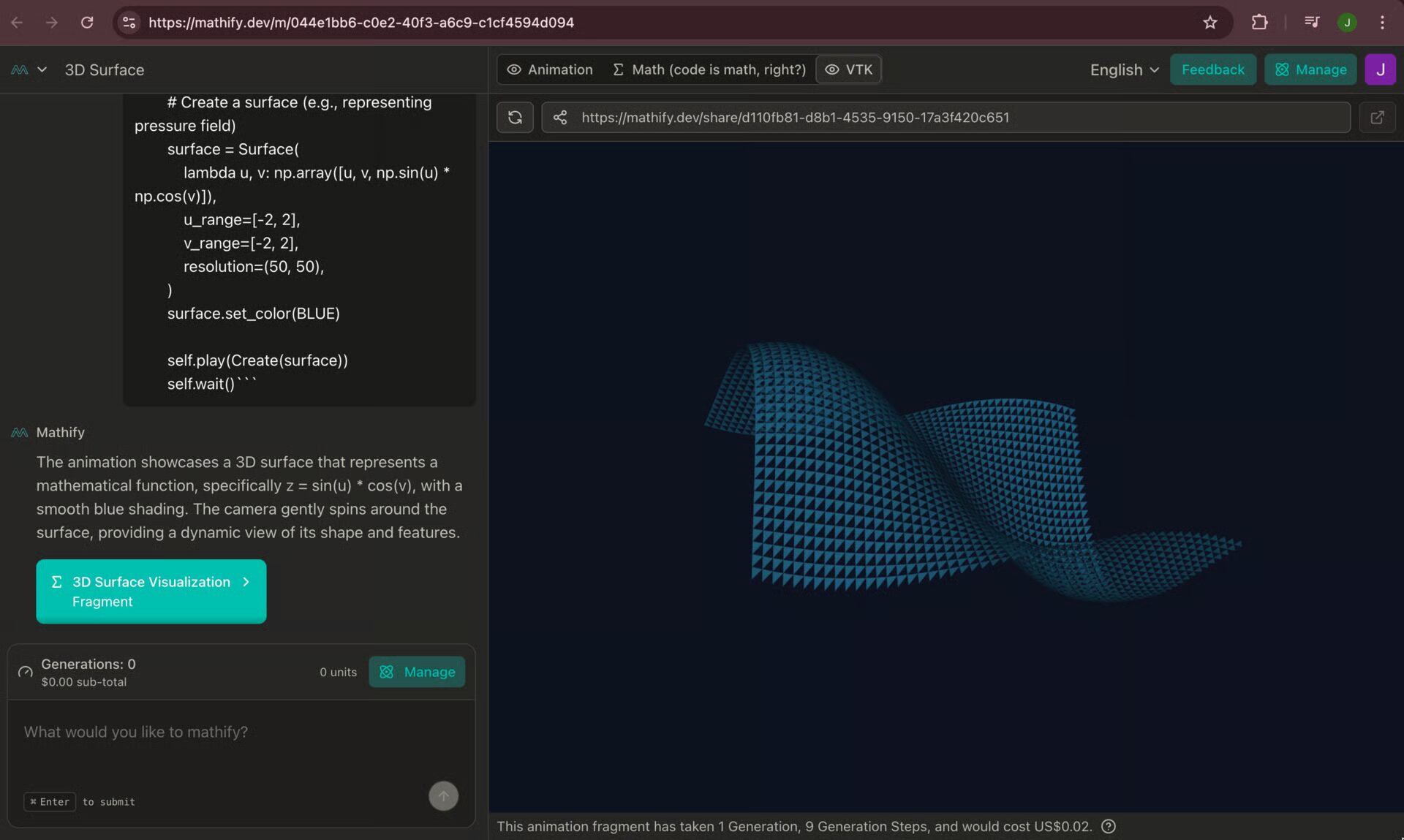
ManimVTK is an open-source superset of Manim (Mathematical Animation Engine) launched publicly December 2025 extending the popular mathematical animation library with VTK (Visualization Toolkit) export enabling interactive exploration of geometric scenes. Rather than rendering Manim scenes exclusively to video files, ManimVTK exports underlying 3D geometry and mathematical objects into VTK-compatible formats enabling interactive rotation, inspection, zooming, and (soon) parameter manipulation of complex mathematical visualizations. Developed by José Cruz as fork of Manim Community Edition with significant GitHub Copilot assistance, ManimVTK represents paradigm shift from “animation as final output” toward “animation as data exploration starting point”—transforming educational and scientific visualization from passive viewing toward active inquiry.
Available completely free through open-source PyPI package (pip install manimvtk) and GitHub repository, ManimVTK specifically targets mathematics educators, physics teachers, scientific visualization professionals, researchers, and students seeking interactive exploration of complex geometric concepts. December 2025 Product Hunt launch (86+ upvotes) and strong Reddit reception validate market demand. The emphasis on preserving Manim syntax (no learning curve for existing users) while adding VTK export capabilities represents backward-compatible architecture enabling seamless adoption.
Key Features
Manim Animation Engine Superset: Complete Manim functionality preserved—all existing Manim code works unchanged. Mathematical objects (planes, spheres, lines, parametric surfaces, vectors, transformations) created normally then exported interactively via additional VTK pipeline. No syntax changes or new API burden.
VTK Export Pipeline: Automatically converts Manim mobjects (mathematical objects) into VTK-compatible polydata format exportable as .vtp files or direct browser-viewable formats. Geometry, meshes, surfaces, and point clouds all supported. VTK.js enables web-based interactive viewing without software installation.
Interactive 3D Exploration: Exported scenes viewable in browser enabling rotation, zooming, panning of mathematical objects. Inspect complex geometry from any angle revealing structure invisible in fixed 2D video. Particularly valuable for understanding 3D mathematical concepts.
Parameter Control and Sliders: Foundation for interactive parameter manipulation (coming soon)—enable users adjusting variables (angles, coefficients, functions) and observing real-time visual changes. Transforms static visualizations into exploratory parameter spaces.
Pause and Resume Animations: Coming soon—enable pausing animations at any frame, rotating/inspecting frozen geometry, then resuming. Bridges video animation and static 3D exploration enabling both temporal and spatial analysis.
Multi-Format Support: Export parametric surfaces, spheres, meshes, trigonometric shapes, 3D objects with full color, lighting, and material preservation. Supports complex geometric constructs beyond simple primitives.
Web-Based Viewer Integration: Leverage VTK.js for browser-native visualization without requiring desktop VTK installation. Shareable links enable colleagues/students exploring visualizations without software dependencies.
Seamless Manim Integration: No rewriting existing Manim code required—simply add VTK export alongside normal video rendering. Existing animations automatically become interactive objects.
Mathematical Object Fidelity: Preserve mathematical properties, coordinate systems, and geometric relationships during export ensuring interactive visualizations maintain mathematical accuracy.
Color and Style Preservation: Visual attributes (colors, textures, opacity, materials) transferred to VTK format maintaining aesthetic quality through export process.
How It Works
Create mathematical animation normally using Manim syntax—animate planes, spheres, surfaces, functions, transformations. At render time, additionally call ManimVTK export functionality. System converts Manim mobjects to VTK polydata preserving geometry. Export as .vtp files or web-viewable format. Open exported file in VTK viewer (desktop software) or browser (via VTK.js web viewer). Interact with 3D objects: rotate, zoom, inspect. (Coming soon) Adjust parameters via sliders observing real-time visual changes. (Coming soon) Pause animations at key frames for detailed exploration.
Use Cases
Interactive Math and Physics Education: Replace static diagrams and video lectures with explorable 3D objects. Students understand 3D geometry intuitively through direct manipulation rather than passive 2D viewing.
Scientific Research Visualization: Researchers visualize complex geometric relationships, parametric surfaces, molecular structures, mathematical functions interactively. Explore solution spaces and parameter dependencies not visible in fixed animations.
Creating Explorable 3D Models for Presentations: Present mathematical concepts with interactive models enabling audience members asking “what if?” questions and exploring variations immediately during presentations.
Debugging Complex Geometric Animations: Developers complex Manim scenes inspect geometry interactively identifying errors or unexpected properties missed in video output.
Parameter Space Exploration: With coming slider support, explore how mathematical objects change with parameter variation—critical for understanding functions, transformations, and system dynamics.
Educational Content Creation: Educators build interactive supplements to textbooks, lectures, and problem sets enabling deeper engagement and intuition-building through exploration.
Pros \& Cons
Advantages
Unlocks New Interactive Learning Possibilities: Transforms educational mathematics from passive video consumption to active geometric exploration. Research demonstrates interactive learning dramatically improves retention and intuition.
Builds on Popular Manim Library: Manim widely adopted in mathematical education (3Blue1Brown’s Grant Sanderson creator, extensive YouTube audience). Superset approach means existing Manim knowledge/code immediately valuable.
No Breaking Changes: Existing Manim animations work unchanged—ManimVTK purely additive. Low migration cost for switching between standard video rendering and interactive export.
Open-Source and Free: MIT or similar licensing enables community contributions, modifications, and deployment without vendor lock-in. Educational institutions can modify for specialized needs.
Bridges Animation and Static Visualization: Combines best aspects of video (temporal narrative, smooth transitions) with static 3D exploration (spatial understanding, detailed inspection).
Disadvantages
Niche Audience Requires Dual Knowledge: Effective usage requires understanding both Manim (mathematical animation) and VTK (scientific visualization). Steep combined learning curve limits adoption to technical users—non-technical educators unable easily adopting.
Interactive Animation Still in Development: Core feature (pausing/resuming animations interactively) incomplete. Current version offers static geometry exploration only—animations not yet directly interactive.
VTK Knowledge Barrier: While ManimVTK abstracts some complexity, customizing visualizations, lighting, rendering settings requires VTK understanding beyond standard Manim.
Browser Compatibility and Performance: Web-based viewing via VTK.js works well for moderate-sized geometries; extremely complex models or high-resolution meshes may struggle in browsers.
Limited Real-Time Parameter Sliders: Promised parameter manipulation not yet implemented. Users cannot yet adjust coefficients/variables seeing live visual changes—core interactive learning feature delayed.
Unclear Long-Term Maintenance: December 2025 launch by individual developer creates sustainability concerns. Community support and long-term viability unproven.
How Does It Compare?
ManimVTK vs Manim (Standard Video Output)
Manim is the foundational Mathematical Animation Engine creating stunning animations of mathematical concepts through programmatic visualization specification.
Output:
- ManimVTK: Interactive 3D objects (VTK export) plus video
- Manim: Video files exclusively
Interactivity:
- ManimVTK: Full 3D exploration (rotate, zoom, inspect)
- Manim: Static video playback only
Use Case:
- ManimVTK: Education, exploration, parameter study
- Manim: Content creation, final presentations
Learning Required:
- ManimVTK: Manim + VTK concepts
- Manim: Manim only
When to Choose ManimVTK: For interactive learning and geometric exploration.
When to Choose Manim: For finished animations and video content.
ManimVTK vs Plotly
Plotly is interactive data visualization library creating web-based 3D plots, scatter plots, and charts with zooming, rotating, hovering capabilities.
Purpose:
- ManimVTK: Mathematical animation and geometry exploration
- Plotly: Data visualization and statistical analysis
Data Type:
- ManimVTK: Mathematical objects and geometric shapes
- Plotly: Numerical data and statistical distributions
Animation:
- ManimVTK: Temporal animation of geometry with interactivity
- Plotly: Static 3D plots with interactive hovering
Learning Curve:
- ManimVTK: Moderate (Manim knowledge required)
- Plotly: Low (data-centric, intuitive API)
Customization:
- ManimVTK: Mathematical objects control appearance
- Plotly: High customization of axes, colors, markers
When to Choose ManimVTK: For mathematical object exploration.
When to Choose Plotly: For data visualization and statistical analysis.
ManimVTK vs Mayavi
Mayavi is interactive 3D plotting and data visualization library built on VTK for scientific computing providing programmatic 3D visualization capabilities.
Primary Focus:
- ManimVTK: Mathematical animation turned interactive
- Mayavi: Scientific data visualization
Data Input:
- ManimVTK: Manim animation objects
- Mayavi: NumPy arrays and scientific datasets
Interactivity:
- ManimVTK: Passive exploration of pre-animated geometry
- Mayavi: Direct manipulation of visualization parameters
Learning Curve:
- ManimVTK: Requires Manim knowledge
- Mayavi: Requires NumPy and VTK understanding
Animation:
- ManimVTK: Temporal animation with exploration
- Mayavi: Static visualization only
Use Case:
- ManimVTK: Mathematics education
- Mayavi: Scientific computing and research
When to Choose ManimVTK: For educational mathematical animations.
When to Choose Mayavi: For scientific data visualization.
ManimVTK vs ParaView
ParaView is comprehensive open-source scientific visualization application for analyzing extremely large datasets with advanced features for HPC computing and research.
Scale:
- ManimVTK: Small to moderate mathematical objects
- ParaView: Massive datasets and scientific simulations
Complexity:
- ManimVTK: Mathematical objects and animation
- ParaView: Complex scientific workflows and pipelines
Deployment:
- ManimVTK: Lightweight, browser-based
- ParaView: Desktop application or server deployment
Use Case:
- ManimVTK: Education and exploration
- ParaView: Enterprise scientific research
Expertise Required:
- ManimVTK: Mathematical and animation knowledge
- ParaView: Advanced scientific visualization expertise
When to Choose ManimVTK: For educational mathematical visualizations.
When to Choose ParaView: For large-scale scientific data analysis.
Final Thoughts
ManimVTK represents pragmatic response to persistent educational problem: mathematical concepts taught through beautiful animations yet remain passive learning experiences. Students watch stunning videos understanding aesthetics but struggling grasping geometric intuition. Interactive exploration—rotating, zooming, manipulating parameters—builds genuine spatial understanding impossible through video alone.
The December 2025 launch as Manim superset demonstrates architectural wisdom. Rather than creating new competing animation library, ManimVTK preserves existing Manim ecosystem enabling effortless adoption. Existing animations automatically become interactive objects without code changes—powerful network effect. The combination of animation (temporal narrative) and static 3D exploration (spatial understanding) creates unique learning tool unavailable elsewhere.
However, December 2025 early-stage status creates adoption risks. Interactive parameter sliders—core feature enabling exploration—not yet implemented. Niche audience requiring dual Manim and VTK knowledge limits adoption. Individual developer sustainability questionable. Browser performance limitations for complex geometries. Community adoption and long-term maintenance unproven.
For mathematics educators, physics teachers, scientific visualization professionals, and students seeking to transform mathematical animations into interactive exploration tools, ManimVTK provides compelling open-source infrastructure. The combination of Manim preservation, VTK integration, and vision of interactive parameter manipulation creates unique position unavailable from competitors.
The positioning distinctly addresses the “passive learning problem”—educational animations beautiful yet pedagogically limited without interactivity. ManimVTK transforms static content into explorable spaces enabling genuine intuition-building through geometric manipulation and parameter exploration fundamentally shifting educational mathematics from consumption toward discovery.