Table of Contents
Overview
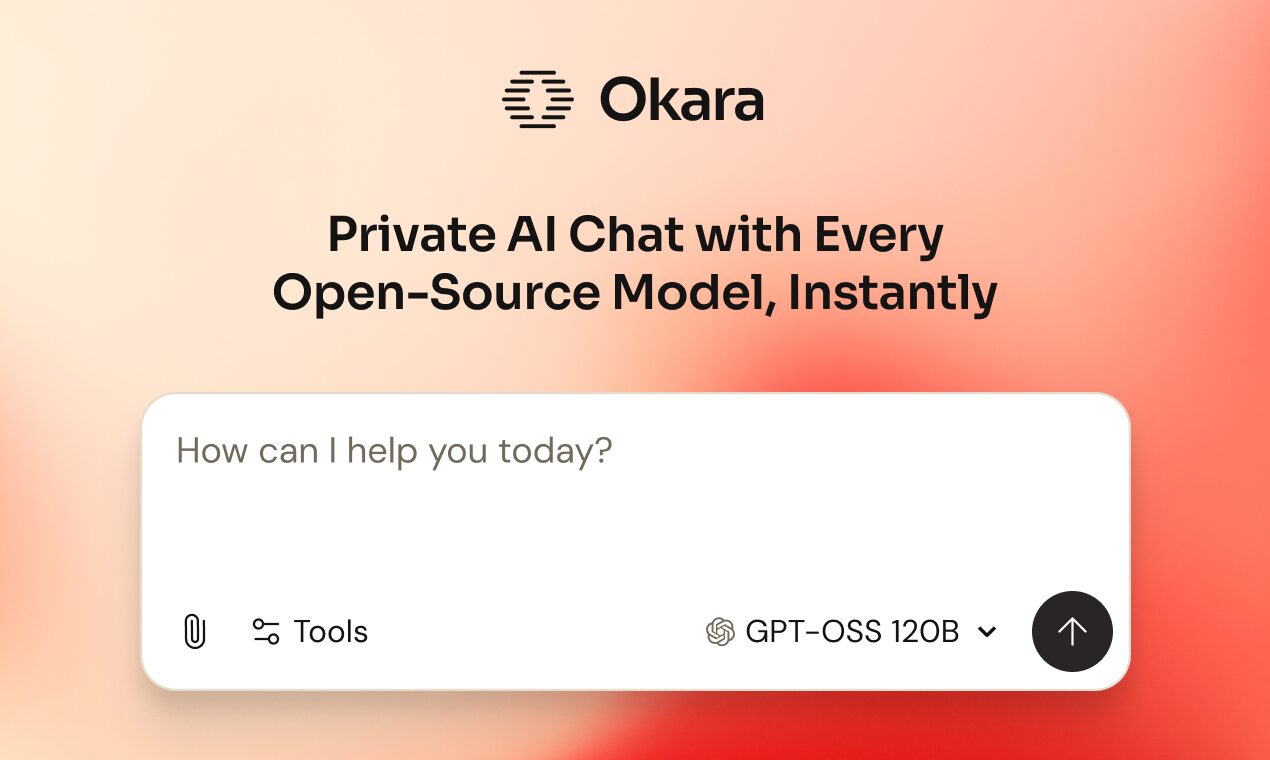
Okara is a privacy-first AI platform that provides instant access to 30+ open-source AI models through a single encrypted interface. The platform addresses the infrastructure challenges of running large open-source models like Kimi and DeepSeek, which require significant computational resources impractical for local deployment. Okara hosts these models on private servers, enabling users to leverage advanced AI capabilities without GPU setup or DevOps complexity while maintaining data privacy through end-to-end encryption.
Key Features
- Access to 30+ Open-Source Models: Includes Llama 3.3, Qwen 2.5, DeepSeek V3.2, Mistral, GLM 4.6, Kimi K2, and other leading open-source text and image models
- Encryption and Privacy: End-to-end encryption with AES-256, client-side key generation, and zero data used for AI training
- Team Collaboration: Shared workspaces with unified memory, context preservation across model switches, and role-based access controls
- Integrated Search Tools: Real-time search across Google, Reddit, X (Twitter), and YouTube directly within chat interface
- Multimodal Capabilities: File analysis for PDFs, spreadsheets, images, and JSON files up to 5MB; image generation with Stable Diffusion 3.5 Large and Qwen Image
- Model Switching: Seamless transition between models mid-conversation without losing context or conversation history
- Self-Hosted Infrastructure: All models privately hosted to ensure data never leaves controlled environment
How It Works
Users access Okara through a web interface where they can select from 30+ open-source models. The platform eliminates infrastructure barriers by hosting models on private servers with encrypted APIs. Users can switch between models instantly, search the web and social platforms within chats, analyze files, and generate images. Team workspaces enable collaborative projects with shared context and memory. Data is encrypted at rest and decrypted client-side using user-controlled keys, ensuring complete privacy.
Use Cases
- Research and Development: Access powerful open-source models without local GPU infrastructure for experimentation and development
- Privacy-Sensitive Workflows: Legal, medical, financial, and government professionals who require confidential AI assistance
- Content Creation: Writers, journalists, and researchers who need creative and analytical assistance while protecting drafts and sources
- Team Collaboration: Organizations needing multiple AI models in one place with secure data handling and shared context
- General AI Tasks: Users who want to leverage open-source models without hardware investment or complex setup
Pros \& Cons
Advantages
- No Hardware Needed: Eliminates requirement for local GPUs or complex infrastructure setup
- Model Variety: 30+ open-source models including text generators and image models in one platform
- Privacy-Focused: End-to-end encryption, user-controlled decryption keys, and no data used for training
- Integrated Tools: Built-in search across web and social platforms, file analysis, and image generation
- Cost-Effective: Single subscription replaces multiple AI tool subscriptions
- Unified Memory: Context preserved across model switches and conversations
Disadvantages
- Reliance on Their Cloud: Despite privacy measures, still dependent on Okara’s infrastructure and uptime
- Model Availability: Limited to open-source models; lacks access to proprietary models like GPT-4 or Claude
- Platform Maturity: Relatively new platform with limited long-term reliability data
- Learning Curve: May be complex for casual users unfamiliar with open-source model ecosystem
- Pricing Transparency: Enterprise pricing requires custom negotiation
How Does It Compare?
Hugging Face
- Key Features: Model Hub with 500,000+ models, Spaces for app deployment, Datasets library, Transformers library, Inference API
- Strengths: Massive model variety, strong community contributions, open-source focus, excellent for research and experimentation, flexible deployment options
- Limitations: Requires technical expertise for full utilization, infrastructure setup needed for large models, variable support quality, primarily self-service
- Differentiation: Hugging Face is a comprehensive platform for model discovery, training, and deployment with extensive community resources; Okara provides ready-to-use hosted models with privacy focus and simplified interface for immediate productivity
Replicate
- Key Features: Cloud platform for running open-source models, API access to ML models, automatic scaling, version management, pay-per-use pricing
- Strengths: Easy API integration, no infrastructure management, supports custom models, flexible pricing, good for prototyping
- Limitations: Can become expensive with heavy usage, limited privacy guarantees, primarily focused on inference rather than collaborative features
- Differentiation: Replicate offers pay-per-use API access to models; Okara provides subscription-based private workspace with team collaboration and integrated search tools
OpenRouter
- Key Features: Unified API for multiple AI models, access to both open and closed-source models, usage-based pricing, model routing
- Strengths: Broad model access including proprietary models, simple API integration, competitive pricing, good for developers
- Limitations: Less focus on privacy, no built-in team collaboration, requires technical integration, limited search and file analysis tools
- Differentiation: OpenRouter is API-focused with mixed open/closed models; Okara is workspace-focused with privacy guarantees and integrated productivity tools
Together AI
- Key Features: GPU cluster platform for open-source models, high-performance inference, fine-tuning capabilities, pay-per-token pricing
- Strengths: Excellent performance, supports large models, flexible deployment, good for AI-native companies
- Limitations: Primarily infrastructure-focused, requires technical expertise, less emphasis on privacy features, no built-in search integration
- Differentiation: Together AI provides infrastructure and APIs; Okara delivers complete workspace with privacy, encryption, and team features
Final Thoughts
Okara successfully addresses a critical gap in the AI tooling landscape by making powerful open-source models accessible without infrastructure complexity while maintaining strong privacy guarantees. The platform’s unified approach—combining model access, search integration, file analysis, and team collaboration in an encrypted environment—creates significant value for privacy-conscious professionals and organizations.
The recent shift to exclusively open-source models (November 2025) reinforces Okara’s commitment to transparency and community-driven AI. This positions the platform as an attractive alternative to proprietary AI services for users prioritizing data sovereignty and model transparency.
For professionals handling sensitive information, researchers requiring model flexibility, and teams seeking collaborative AI workflows without privacy compromises, Okara offers a compelling solution. While the platform’s reliance on its own infrastructure and limited model selection compared to broader marketplaces may be considerations, the integrated privacy features and simplified workflow justify the approach.
The freemium model allows adequate evaluation, though heavy users will quickly need the Pro plan. As the platform matures, expanded model offerings and enhanced enterprise features would strengthen its competitive position. Okara is best suited for users who value privacy, need multiple model access, and want to avoid infrastructure management overhead.