
Table of Contents
Overview
Sliq is an AI-powered data cleaning platform designed for engineers, data analysts, and scientists who need to transform messy, unstructured datasets into analysis-ready formats rapidly. The platform automates error detection, missing value imputation, schema standardization, and format correction, enabling teams to compress data preparation timelines from days or hours to minutes. Built on distributed computing infrastructure (PySpark, TensorFlow, Dask/Ray), Sliq handles enterprise-scale datasets while maintaining privacy through local processing and VPC deployment options.
Key Features
- Context-Aware Cleaning Engine: Domain-specific natural language processing models trained on finance, healthcare, retail, and other industries to interpret data semantics and auto-correct discipline-specific formats
- Semantic Repair Technology: Patented algorithm combining transfer learning and probabilistic graph networks to resolve ambiguities (e.g., inferring “NY” equals “New York” in addresses)
- Distributed Processing Architecture: Parallel computing leveraging Dask and Ray to clean gigabyte-scale datasets in minutes; 10x faster processing than single-threaded tools
- Schema Intelligence: Automatically detects and repairs schema drift, handling date format changes, column type inconsistencies, and structural evolution with probabilistic pattern matching
- Missing Value Imputation: Context-aware algorithms fill gaps based on similar records, temporal patterns, and statistical relationships rather than simple mean/median replacement
- Duplicate Detection and Merging: Fuzzy matching identifies duplicate records across the dataset even with slight variations in formatting or spelling
- Data Quality Reports: Comprehensive analysis with error classification (nulls, duplicates, outliers) and severity scoring for prioritization
- Python/SDK Integration: Direct API access enables embedding Sliq into existing data pipelines and ETL workflows; custom Python functions extend capabilities
- Privacy and Compliance: SOC 2 compliance, local data processing option, and VPC deployment ensure sensitive data never leaves your infrastructure
How It Works
Users upload datasets in formats like CSV, JSON, Parquet, or directly from SQL sources. Sliq analyzes the structure using statistical and NLP-based methods to understand data semantics. The platform identifies errors including nulls, format inconsistencies, type mismatches, and duplicates. Based on data context (column headers, metadata, domain-specific rules), it applies domain-appropriate corrections and imputation. For complex anomalies, it uses semantic repair to infer correct values. Finally, it exports cleaned data in the format of choice, generates a comprehensive quality report, and optionally integrates with downstream tools via API.
Use Cases
- Machine Learning Pipeline Preparation: Clean and standardize training data, handle missing values intelligently, and remove duplicates before model training
- Business Intelligence Report Preparation: Standardize sales data with mixed currency formats, fix date inconsistencies, and merge duplicate customer records before analysis
- Database Migration: Transform legacy database exports into modern schema formats, resolving type mismatches and filling historical data gaps
- Clinical Research Data Curation: Impute missing patient records, standardize medical codes across different coding systems, and validate data quality for regulatory compliance
- Analytics Acceleration: Eliminate manual Excel-based cleaning work, compressing analytics project timelines by 60-70%
- Data Lake Ingestion: Standardize diverse data sources before loading into data lake, ensuring consistent structure and quality across all ingested datasets
Pros \& Cons
Advantages
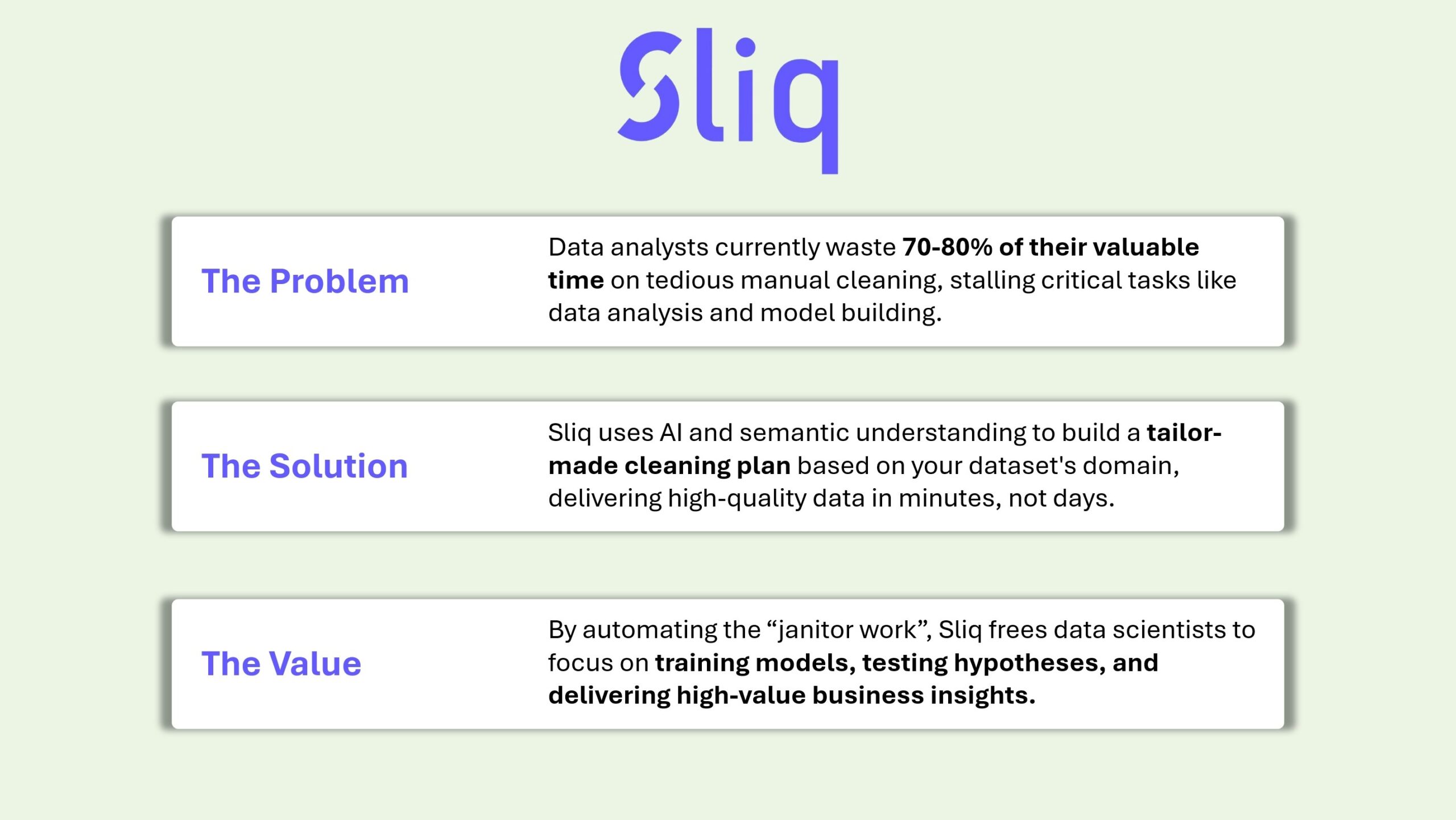
- Saves Hours of Manual Work: Developers spend 60-70% of project time fixing data; Sliq eliminates this bottleneck with automation
- Fast Processing: Handles datasets up to 100GB; processes 1M+ rows in under 3 minutes on standard cloud instances
- No Manual Rule-Writing: Unlike OpenRefine or custom Python scripts, Sliq requires no manual configuration; learns from data automatically
- Domain-Aware Corrections: Understands industry-specific formats (financial, medical, retail), producing better results than generic tools
- Privacy-First: Local processing option and VPC deployment protect sensitive data; SOC 2 compliance certifications available
- Enterprise-Grade: Designed for production use with reliability, scalability, and compliance guarantees
Disadvantages
- May Require Verification: For highly complex or niche data anomalies, AI suggestions may not capture all edge cases; human verification recommended
- Limited Text Support: Current version focuses on tabular and semi-structured data; NLP-based text cleaning is still in development
- Pricing Model Complexity: Tiered by compute hours and dataset volume; final costs depend on usage patterns and require calculation
- Learning Curve: While designed for engineers and analysts, optimal use requires understanding of data types, schema concepts, and domain knowledge
- Early Stage: Relatively new platform; long-term roadmap and stability still being established
How Does It Compare?
OpenRefine (Manual)
- Key Features: Free, open-source data cleaning and transformation tool with clustering for duplicate detection, faceting for exploration
- Strengths: Free and completely open-source, excellent for learning data cleaning concepts, active community support
- Limitations: Entirely manual process with no AI assistance, steep learning curve for regex and GREL language, single-threaded so slow on large datasets, requires constant user intervention
- Differentiation: OpenRefine is manual and free; Sliq is AI-automated and cloud-scalable
Alteryx
- Key Features: End-to-end analytics platform with comprehensive data preparation, advanced analytics, ML capabilities, 80+ connectors, full ETL functionality
- Strengths: Mature platform with extensive integrations, powerful for complex transformations, strong predictive analytics, workflow automation and scheduling
- Limitations: Very high cost (\$5,000+/year), steep learning curve, more than needed if cleaning is primary concern, enterprise-focused pricing
- Differentiation: Alteryx is a comprehensive analytics suite; Sliq specializes exclusively in data cleaning and quality
Trifacta (Now Part of Alteryx)
- Key Features: Visual drag-and-drop data preparation interface, automated pattern recognition, collaborative features, visual transformation suggestions
- Strengths: Intuitive visual interface, good for exploratory cleaning, collaborative teamwork capabilities, pattern recognition reduces manual work
- Limitations: Slower than Sliq on large datasets, visual interface can become cluttered with complex workflows, limited automation compared to Sliq, higher pricing tier (\$10,000+)
- Differentiation: Trifacta emphasizes visual drag-and-drop interface; Sliq provides automated AI-driven cleaning with API integration
DataRobot
- Key Features: Automated machine learning platform with built-in data preprocessing, advanced cleaning algorithms, integration with analytics tools
- Strengths: Enterprise-grade ML platform, excellent for end-to-end ML pipelines, automated insights generation alongside cleaning
- Limitations: Overkill if cleaning is primary need, very expensive enterprise pricing, focused on ML rather than general analytics, complex setup
- Differentiation: DataRobot provides automated ML with data cleaning as component; Sliq focuses purely on cleaning excellence
Zoho DataPrep
- Key Features: Cloud-based data cleaning with AI suggestions, pre-analysis tools, tight integration with Zoho ecosystem
- Strengths: Affordable for Zoho users, good AI suggestions, easy integration within Zoho platform, simple interface
- Limitations: Limited to Zoho ecosystem, smaller feature set than standalone tools, less powerful than Sliq for complex scenarios
- Differentiation: Zoho DataPrep is Zoho-ecosystem focused; Sliq is platform-agnostic and more powerful
Final Thoughts
Sliq successfully addresses the critical data preparation bottleneck that has plagued analytics and ML projects for decades. The platform’s strength lies in its exclusive focus on data cleaning excellence, combining domain-aware AI with distributed computing to deliver genuinely fast results. The semantic repair technology and context-aware imputation represent genuine innovation beyond generic tools like OpenRefine.
For engineering teams, data analysts, and organizations managing complex data pipelines, Sliq offers compelling value. The ability to compress cleaning timelines from hours or days to minutes directly impacts time-to-insight and project velocity. The privacy-first architecture makes it suitable for regulated industries where data sovereignty is critical.
The pricing transparency issue (requiring contact for exact costs) and current limitations with unstructured text data are worth considering. However, for structured and semi-structured tabular data—the most common data preparation scenario—Sliq delivers professional-grade automation that justifies investment.
For teams currently spending 60-70% of analytics project time on manual Excel-based cleaning, Sliq offers rapid ROI through accelerated timelines and reduced manual labor. The platform is particularly valuable for organizations handling multi-source data integration, database migrations, and machine learning pipeline preparation where data quality directly impacts model performance.
https://sliqdata.com/