
Table of Contents
Overview
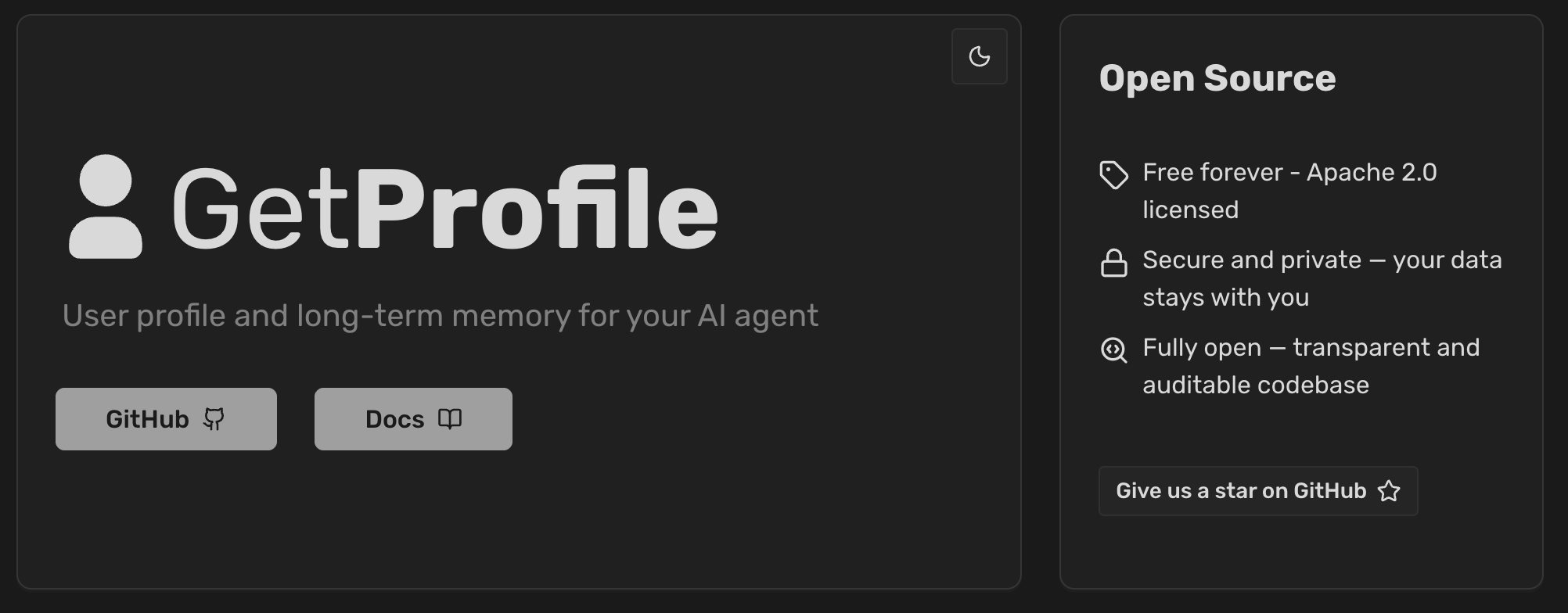
In the rapidly evolving landscape of AI development, the ability for agents to remember and learn from past interactions is paramount. However, managing this “memory” often comes with privacy concerns and a lack of structured data. Enter GetProfile, a solution designed to provide robust user profiles and long-term memory for AI agents. Unlike generic memory solutions that simply store raw text, GetProfile intelligently extracts and structures crucial information, offering a privacy-first approach to building more intelligent and personalized AI experiences.
Important Clarification: GetProfile offers both a self-hosted open-source version and a cloud-hosted service. The official website is https://www.getprofile.org/, which provides access to both deployment options.
Key Features
- Natural Language Summaries: GetProfile doesn’t just store data; it synthesizes it. The system generates concise, human-readable summaries of user interactions, making it easier to understand the context of past conversations and reducing prompt noise by 40-60% compared to raw message history.
- Typed Traits with Confidence Scores: Beyond simple recall, GetProfile identifies and categorizes specific user traits (e.g., preferences, interests, expertise level) and assigns a confidence score to each, indicating the certainty of the AI’s understanding. This enables more predictable and auditable AI behavior.
- Memory Importance Ranking: Not all memories are created equal. GetProfile intelligently ranks memories based on their relevance and importance using a 0.1-1.0 scoring system, ensuring that the most critical information is readily accessible while preventing context window pollution.
- PostgreSQL Support: Built with flexibility in mind, GetProfile leverages the power and reliability of PostgreSQL databases for secure and efficient storage of structured user profiles, enabling standard tooling for queries, backups, and management.
- Drop-in LLM Proxy: GetProfile operates as an OpenAI-compatible proxy that automatically enriches prompts with user profile data. Simply change your base URL and add headers—no changes to existing application code required.
- Custom Trait Schemas: Developers can define custom trait schemas via JSON configuration, controlling exactly what user traits matter for their application, how they should be extracted, and how they get injected into prompts.
- Streaming Support: The platform supports Server-Sent Events (SSE) passthrough for low-latency interactions, ensuring minimal impact on response times.
How It Works
GetProfile operates by acting as a middleware proxy between your application and LLM provider. When a request passes through:
- Capture: The proxy intercepts conversations between users and your AI, extracting interaction data
- Extract: Advanced natural language processing analyzes conversational data to identify distinct traits, summarize conversations, and assign importance levels to memories
- Inject: Relevant context from the structured profile is automatically added as a system message to each prompt
- Update: Profiles evolve dynamically as new interactions occur, with intelligent merging of new insights and background updates to ensure your AI agents always have current understanding
The entire process adds sub-100ms latency during LLM request enrichment, with asynchronous updates ensuring responsive interactions.
Use Cases
GetProfile is an invaluable tool for a variety of AI development scenarios:
- AI Developers Building Memory-Aware Chatbots: Enhance chatbots with the ability to recall past conversations, user preferences, and specific details, leading to more personalized and engaging user experiences without rewriting prompt logic across your application.
- Personal AI Assistants: Create AI assistants that truly understand their users, remembering routines, preferences, and goals to provide proactive and tailored support across multiple conversation sessions.
- Data Privacy–Sensitive Systems: For applications where user data privacy is a top priority, GetProfile’s self-hosted nature ensures that sensitive information remains under your direct control within your VPC, adhering to strict privacy regulations like GDPR and HIPAA.
- SaaS Product Personalization: Enrich CRM and analytics tools with real personality insights, improving content strategy and user engagement through structured profile data.
- Game Development: Create dynamic player and character profiles that adapt to user behavior, enhancing gameplay and engagement through personalized experiences.
Pros \& Cons
Advantages
- Privacy-Focused: As a self-hosted solution, GetProfile gives you complete control over your user data, significantly enhancing privacy and security. All data stays within your infrastructure with no long-term storage of raw inputs.
- Structured Data: Moves beyond simple text blobs to provide organized, typed traits and ranked memories, making AI decision-making more efficient, accurate, and auditable.
- Easy Integration: Drop-in proxy model allows integration by simply changing base URLs and headers in existing OpenAI-compatible code, reducing implementation time from weeks to minutes.
- Open Source: Apache 2.0 licensed codebase allows full customization, auditing, and transparency. Free forever for self-hosting with no vendor lock-in.
- Scalable Architecture: Docker/PostgreSQL stack supports horizontal scaling for enterprise workloads, with asynchronous updates ensuring performance.
Disadvantages
- Requires Self-Hosting: Users are responsible for setting up and maintaining their own server environment, including Docker deployment and PostgreSQL administration.
- Database Management: Requires familiarity with PostgreSQL database administration for optimal performance, data integrity, and backup strategies.
- Extraction Quality Dependency: The quality of extracted traits and summaries depends on the upstream LLM model and prompt configuration, requiring tuning for optimal results.
- Limited Cloud Maturity: While a cloud offering is planned and has waitlist signup, self-hosting remains the primary experience today, which may challenge non-technical users.
- Infrastructure Overhead: For smaller applications, running a dedicated PostgreSQL instance and proxy service may introduce unnecessary complexity compared to simpler vector database solutions.
How Does It Compare?
vs. Vector Databases (Pinecone, Weaviate, Qdrant)
Vector Database Approach: Excel at similarity searches across unstructured embeddings, enabling semantic retrieval based on vector proximity. They store high-dimensional vector representations of text, images, and other data types.
GetProfile Differentiation: While vector databases are optimized for similarity search, GetProfile focuses on extractive AI that distills interactions into structured, query-optimized profiles. Instead of storing raw embeddings, it provides typed traits with confidence scores and importance-ranked memories, reducing prompt noise by 40-60%.
Key Distinction: Vector databases are general-purpose similarity search engines; GetProfile is a specialized memory layer designed specifically for user profiling and long-term AI memory with structured extraction.
Use Case Fit: Choose vector databases when you need flexible semantic search across diverse document types. Choose GetProfile when you need structured user profiles with predictable trait extraction for personalization.
vs. LangChain Memory Modules
LangChain Approach: Offers various memory abstractions including ConversationBufferMemory, ConversationSummaryMemory, and VectorStoreMemory, providing flexible ways to manage conversation history within the LangChain ecosystem.
GetProfile Differentiation: LangChain memory modules are designed as components within LangChain applications, requiring integration into your codebase. GetProfile operates as a standalone proxy that works with any OpenAI-compatible application, regardless of framework.
Key Distinction: LangChain memory is framework-specific and requires code-level integration; GetProfile is framework-agnostic and provides drop-in compatibility. GetProfile’s confidence-scored trait extraction and importance ranking are not standard features in LangChain’s basic memory modules.
Use Case Fit: Use LangChain memory when building within the LangChain ecosystem and needing tight integration with LangChain’s agent frameworks. Use GetProfile when you want memory capabilities without framework lock-in or when working with existing applications.
vs. MemGPT
MemGPT Approach: Implements virtual context management inspired by operating system memory hierarchies, enabling LLMs to manage unlimited context through intelligent paging between fast and slow memory.
GetProfile Differentiation: MemGPT focuses on extending context windows through hierarchical memory management within the LLM interaction loop. GetProfile focuses on extracting structured user profiles and traits that persist across sessions.
Key Distinction: MemGPT solves the problem of limited context windows; GetProfile solves the problem of stateless LLMs and lack of user understanding. They address different aspects of memory management.
Use Case Fit: Use MemGPT when you need to process extremely long documents or conversations that exceed standard context limits. Use GetProfile when you need persistent user profiles and structured memory across multiple conversation sessions.
vs. Custom In-House Solutions
Custom Solution Approach: Building bespoke memory systems tailored to specific application needs, requiring development of data ingestion, model selection, trait extraction, profile management, and injection logic.
GetProfile Differentiation: GetProfile provides instant deployment with a few API calls versus weeks or months of development and iteration. It includes built-in LLM-powered analysis, automatic confidence scoring, data merging logic, and a ready-to-use dashboard.
Key Distinction: Custom solutions offer maximum flexibility but require significant development and maintenance overhead. GetProfile provides 80% of common memory management needs out-of-the-box with open-source extensibility for the remaining 20%.
Cost Comparison: GetProfile’s open-source version eliminates licensing costs, while building in-house requires substantial upfront investment plus ongoing maintenance. The managed cloud option (when available) will likely offer predictable usage-based pricing.
Final Thoughts
For AI developers seeking to build more intelligent, personalized, and privacy-conscious applications, GetProfile presents a powerful and flexible solution. Its ability to transform raw interaction data into structured user profiles, coupled with its self-hosted architecture, addresses key challenges in AI memory management. By offering typed traits, importance rankings, and natural language summaries, GetProfile empowers developers to create AI agents that truly learn and adapt, all while maintaining complete control over sensitive user data.
Expert Perspective: GetProfile occupies a valuable niche between simple vector database implementations and complex custom memory systems. Its proxy architecture significantly reduces integration friction, making it accessible for teams with existing OpenAI-compatible applications. However, organizations should evaluate their technical capabilities for self-hosting and consider the extraction quality dependency on upstream LLMs.
Implementation Recommendation: Start with the open-source self-hosted version for development and testing. Leverage the custom trait schemas to define exactly what user attributes matter for your use case. Monitor confidence scores to filter low-certainty traits, and use importance ranking to prevent context window pollution. For production deployments, ensure proper PostgreSQL tuning and backup strategies. Non-technical teams should join the cloud waitlist or allocate resources for DevOps support.
Competitive Positioning: GetProfile’s unique combination of structured extraction, confidence scoring, and proxy architecture distinguishes it from both generic vector databases and framework-specific memory modules. While it may not replace specialized solutions for extreme-scale similarity search or OS-level context management, it provides an optimal balance of ease-of-use, data control, and intelligent memory for user-centric AI applications.