
Table of Contents
- ConnectMachine: Comprehensive Platform Analysis
- 1. Executive Snapshot
- Core Offering Overview
- Key Achievements and Milestones
- Adoption Statistics
- 2. Impact and Evidence
- Client Success Stories
- Performance Metrics and Benchmarks
- Third-Party Validations
- 3. Technical Blueprint
- System Architecture Overview
- API and SDK Integrations
- Scalability and Reliability Data
- 4. Trust and Governance
- Security Certifications
- Data Privacy Measures
- Regulatory Compliance Details
- 5. Unique Capabilities
- Voice Query Agent: Applied Use Case
- Agentic Recall: Research References
- AI-Powered Contact Enrichment: Automation Details
- Private Network Visibility: Silent Signals Feature
- 6. Adoption Pathways
- Integration Workflow
- Customization Options
- Onboarding and Support Channels
- 7. Use Case Portfolio
- Enterprise Implementations
- Academic and Research Deployments
- ROI Assessments
- 8. Balanced Analysis
- Strengths with Evidential Support
- Limitations and Mitigation Strategies
- 9. Transparent Pricing
- Plan Tiers and Cost Breakdown
- Total Cost of Ownership Projections
- 10. Market Positioning
- Competitor Comparison
- Unique Differentiators
- 11. Leadership Profile
- Bios Highlighting Expertise and Awards
- Patent Filings and Publications
- 12. Community and Endorsements
- Industry Partnerships
- Media Mentions and Awards
- 13. Strategic Outlook
- Future Roadmap and Innovations
- Market Trends and Recommendations
- Final Thoughts
ConnectMachine: Comprehensive Platform Analysis
1. Executive Snapshot
Core Offering Overview
ConnectMachine represents a paradigm shift in professional networking technology, positioning itself as a privacy-first AI Agent for contact management and digital business card creation. Launched in 2025 and headquartered in the United States, the platform distinguishes itself from conventional digital business card solutions through its integration of agentic artificial intelligence capabilities that transform passive contact storage into active network intelligence. Unlike traditional social networking platforms that prioritize engagement metrics and algorithmic feeds, ConnectMachine operates as what its founders describe as a “personal network concierge,” eliminating social noise in favor of intentional, curated connections.
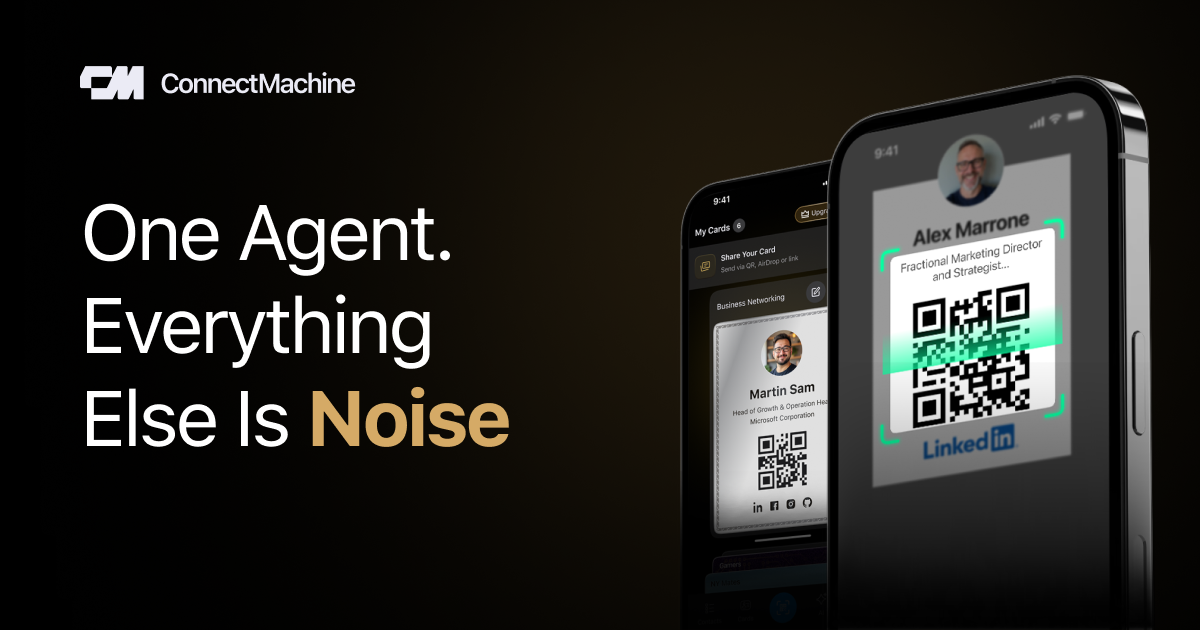
The platform serves high-net-worth individuals, executives, and professionals who value discretion and precision in their networking activities. Available on both iOS through the Apple App Store and Android via Google Play, ConnectMachine enables users to create multiple custom digital business cards tailored to different professional contexts, query their network using natural language voice commands, and leverage autonomous AI agents to enrich contact profiles and manage meeting logistics. This approach fundamentally redefines contact management from a static repository to a dynamic intelligence layer that remembers who users met, when interactions occurred, and why relationships matter.
Key Achievements and Milestones
Since its 2025 launch, ConnectMachine has achieved several notable adoption milestones. The platform has attracted over ten thousand professionals across seventeen countries, demonstrating international appeal despite its recent market entry. The company reports thousands of smart cards shared monthly, indicating active user engagement with core platform functionality. In December 2025, ConnectMachine executed a Product Hunt launch that generated significant attention within the tech community, though public review volume remains modest compared to established competitors like Popl and HiHello.
The founding team brings technical depth to the platform’s development. Vinod Tahelyani serves as Co-founder and Head of Engineering, bringing software development expertise to the product architecture. Mudit Singh co-founded the company with a stated belief that valuable relationships are built quietly with context rather than through broadcast social media. Jay Singh serves as Board Member and Advisor, also holding the position of Co-Founder and Chief Customer Officer at LambdaTest, a cloud-based testing platform.
The platform has achieved operational availability across major mobile ecosystems with native applications, Apple Wallet integration for lock-screen accessibility, and comprehensive privacy infrastructure including encrypted messaging channels and role-based access controls. Documentation resources are available through docs.connectmachine.ai, and customer support channels operate via hi@connectmachine.ai.
Adoption Statistics
ConnectMachine operates within a rapidly expanding digital business card market projected to grow from USD 178.5 million in 2024 to USD 381.7 million by 2033, representing a compound annual growth rate of 8.81 percent. More aggressive market research projections estimate values reaching USD 389.3 billion by 2032 when accounting for broader enterprise adoption scenarios. This growth is driven by increasing environmental consciousness, widespread mobile technology proliferation, and the integration of multimedia elements that paper cards cannot support.
Current industry data reveals that thirty-seven percent of businesses have already transitioned to digital business card solutions, signaling mainstream acceptance. Enterprise users represent the fastest-growing segment with a 16.2 percent CAGR, as organizations recognize cost savings, improved lead management efficiency, and enhanced brand consistency. The Android platform dominates with 44.5 percent revenue share due to its open NFC APIs and extensive installed base, though iOS users demonstrate higher average revenue per user at $101 versus $38 for Android.
ConnectMachine’s adoption trajectory positions it as a luxury-focused entrant targeting the premium segment of this expanding market. While competitors like Popl serve 2.5 million users and HiHello serves two million users from Fortune 500 companies, ConnectMachine’s focused approach on the “silent elite” and privacy-conscious professionals represents a differentiated market strategy prioritizing quality over raw user volume.
2. Impact and Evidence
Client Success Stories
Public client testimonials and enterprise case studies for ConnectMachine remain limited compared to established competitors, reflecting the platform’s recent launch timeline. Available user feedback highlights the platform’s distinctive approach to networking. One Instagram testimonial captures the core value proposition: “I don’t collect contacts. I build connections. With ConnectMachine, my network actually remembers who I met, where we connected, and when to follow up.”
The platform has received validation on software review platforms, earning a 4.1 out of 5 rating on Slashdot and appearing in directories like GetApp and SourceForge as a recognized contact management solution. ProductHunt launch engagement in December 2025 generated community discussion, with co-founders actively responding to user questions about privacy architecture, AI agent capabilities, and competitive positioning.
Industry observers note ConnectMachine’s unique positioning in solving what they describe as the “contact management paradox”—the reality that most professionals collect extensive networks but lack meaningful context or recall capability. Traditional contact management systems and even sophisticated CRM platforms function as passive databases requiring manual data entry and organization. ConnectMachine’s AI agent approach addresses this friction by autonomously categorizing contacts, enriching profiles with publicly available information, and enabling conversational queries that surface relevant connections based on temporal, spatial, and relational context.
Performance Metrics and Benchmarks
Digital business card platforms deliver measurable business outcomes that justify their adoption over traditional paper alternatives. Industry research demonstrates that seventy-two percent of paper business card recipients rarely or never use the cards they receive, representing substantial lost networking investment. In contrast, digital cards integrated with CRM systems achieve a sixty-three percent increase in lead management efficiency, and recipients become sixteen percent more likely to convert to customers compared to those receiving paper cards.
Cost analysis reveals compelling economics. Organizations spend an average of $64.23 per employee annually on paper business cards, meaning a one-hundred-person company invests approximately $6,500 and a five-hundred-person company spends over $32,000 on physical cards that are frequently lost or discarded. Digital business card subscriptions cost approximately $48 per employee per year, delivering at least twenty-six percent cost savings before accounting for improved conversion rates and workflow automation benefits.
From an operational efficiency perspective, digital platforms eliminate manual data entry bottlenecks that plague traditional networking. Automated CRM integration ensures that leads captured at events flow immediately into sales pipelines without human intervention. Follow-up automations triggered by contact exchanges accelerate response times, which industry data correlates with higher conversion rates. Organizations report substantial time savings in onboarding and offboarding processes, as digital cards can be issued, updated, or revoked within minutes compared to days or weeks for ordering and distributing physical inventory.
ConnectMachine’s specific performance metrics remain proprietary, though the platform’s architectural focus on AI-powered enrichment and voice-activated queries suggests potential advantages in time-to-value for users seeking actionable network intelligence rather than simple contact storage. The voice query capability enables hands-free network exploration—a workflow innovation not offered by competitors—while the agentic recall system addresses the common challenge of remembering contextual details from conference interactions or multi-stakeholder meetings.
Third-Party Validations
The digital business card category has received validation from multiple market research organizations. IMARC Group, Market Research Future, and Mordor Intelligence all project substantial market expansion driven by sustainability trends, technological advancement, and enterprise digital transformation initiatives. The Total Addressable Market for digital business cards is estimated at approximately USD 4.5 billion by 2028, encompassing enterprise, SME, and individual consumer segments across SaaS subscriptions, licensing, and value-added services.
Independent technology analysts have recognized the broader trend toward agentic AI systems in professional workflows. Contact center implementations demonstrate how autonomous agents can achieve high resolution rates, maintain contextual awareness across channels, and deliver predictive insights—capabilities that parallel ConnectMachine’s approach to contact management. The evolution from passive data stores to intelligent agents represents what industry observers describe as a fundamental shift in how professionals interact with business software.
Security and compliance frameworks provide important validation signals for enterprise adoption. Competitors like Popl and HiHello have achieved SOC 2 Type II certification and maintain GDPR compliance, establishing baseline expectations for data protection in the category. ConnectMachine’s privacy policy documents encryption protocols including TLS/SSL for data in transit and encryption for data at rest, role-based access controls, multi-factor authentication support, and network security measures including firewalls and intrusion detection systems. However, public documentation of formal SOC 2 Type II or ISO 27001 certification was not identified during research, representing a potential validation gap for enterprise prospects.
G2, a leading software review platform, serves as an important validation source for digital business card platforms. Popl maintains over 5,300 reviews with a 4.6 average rating and holds recognition as an Enterprise Leader, Momentum Leader, and performer in Best Relationships and Best Usability categories. HiHello similarly maintains strong ratings across review platforms. ConnectMachine’s newer market presence means it has not yet accumulated comparable review volume, though early ratings on platforms like Slashdot and user testimonials on social media channels suggest positive reception among early adopters who value its privacy-first positioning.
3. Technical Blueprint
System Architecture Overview
ConnectMachine employs a multi-layered technical architecture combining mobile applications, cloud infrastructure, artificial intelligence engines, and integration frameworks. The platform’s mobile applications for iOS and Android provide the primary user interface, enabling card creation, QR code and AirDrop sharing, contact scanning, and voice query input. These applications synchronize with cloud-based backend systems that host user data, execute AI processing workflows, and coordinate across devices.
The AI Agent layer represents the platform’s most distinctive architectural component. This subsystem processes natural language queries submitted through voice or text input, interpreting user intent and executing structured searches against the contact database. The voice query system supports conversational interactions such as “Who did I meet at Dreamforce?” or “What is the preferred coffee shop among my San Francisco circle?” The natural language processing engine parses these queries, identifies relevant entities such as events, locations, and relationship categories, then retrieves matching contacts with contextual metadata.
Contact enrichment automation operates continuously, pulling publicly available information from professional networks, company websites, and social platforms to supplement user-provided contact details. Machine learning algorithms categorize contacts into segments based on interaction history, meeting locations, topics discussed, and organizational affiliations. This autonomous categorization eliminates manual tagging work while ensuring that network intelligence remains current.
The AI concierge functionality integrates with calendar systems to manage meeting preferences, location selection, and scheduling optimization. Users can configure default meeting parameters—such as preferred time windows, venue preferences, and meeting duration—which the agent applies when coordinating connection requests or suggesting optimal times for follow-ups.
API and SDK Integrations
Public documentation regarding ConnectMachine’s API availability and third-party integration capabilities remains limited compared to established competitors. Industry-standard digital business card platforms typically offer integration with major CRM systems including Salesforce, HubSpot, and Microsoft Dynamics, enabling automatic lead synchronization and bi-directional data flow. Competitors like Popl support over 5,000 application integrations through platforms like Zapier, allowing connectivity with email marketing tools, project management software, and communication platforms.
ConnectMachine emphasizes an “export-only contact book with zero APIs or external sharing” philosophy according to LinkedIn company descriptions, suggesting a deliberate architectural choice to prioritize data privacy and user control over ecosystem connectivity. This approach aligns with the platform’s luxury positioning and privacy-first value proposition, though it may create friction for enterprise customers requiring CRM workflow integration.
The platform does offer documented integration with digital wallet ecosystems, specifically Apple Wallet and Google Wallet, enabling lock-screen card access and instant sharing capabilities. This integration allows users to add their ConnectMachine cards to native mobile wallet applications, providing frictionless access during networking interactions without requiring app unlocking or navigation.
For contact data portability, industry-standard digital business card platforms support vCard and CSV export formats, enabling users to extract their networks for backup or migration to other systems. ConnectMachine’s emphasis on export-only data architecture suggests similar portability features, though specific technical specifications regarding export formats and schema documentation were not identified in public materials.
Scalability and Reliability Data
Formal Service Level Agreement documentation, uptime statistics, and performance benchmarks for ConnectMachine’s infrastructure were not publicly available at the time of research. Industry-standard SaaS platforms targeting enterprise customers typically guarantee 99.9 percent uptime, implement redundant infrastructure across multiple geographic regions, and provide status page transparency regarding service availability.
The platform’s cloud architecture must support several performance-sensitive operations. Voice query processing requires real-time transcription, natural language understanding, database search, and result ranking, ideally completing within two to three seconds to maintain conversational flow. Contact enrichment automation operates as background processing but must scale efficiently as user networks grow from hundreds to thousands of contacts. Push notification delivery for silent signals and connection requests requires low-latency infrastructure integrated with Apple Push Notification Service and Firebase Cloud Messaging.
Data residency and geographic distribution represent important considerations for international expansion, particularly given stringent data protection regulations in jurisdictions like the European Union. Competitors in the space typically leverage major cloud infrastructure providers—Amazon Web Services, Microsoft Azure, or Google Cloud Platform—that offer regional data centers and compliance frameworks supporting GDPR, CCPA, and other privacy regulations.
Mobile application performance directly impacts user experience and retention. App store reviews for competitors frequently mention factors like app load times, QR code scanning reliability, and offline functionality. ConnectMachine’s emphasis on Apple Wallet integration provides important offline fallback capability, allowing users to share cards even when network connectivity is unavailable—a critical requirement for conference environments with congested Wi-Fi.
4. Trust and Governance
Security Certifications
ConnectMachine’s published Privacy Policy outlines comprehensive security practices including industry-standard encryption protocols, access controls, and organizational safeguards. The platform implements TLS/SSL encryption to protect data in transit and encrypts sensitive data at rest using industry-standard methodologies. Authentication mechanisms include support for strong authentication methods and multi-factor authentication where appropriate, reducing account compromise risk.
Network security infrastructure encompasses firewalls, intrusion detection systems, and other protective measures designed to prevent unauthorized access and identify potential threats. The platform maintains an incident response plan to address security breaches promptly, though specific breach notification timelines and procedures beyond those required by regulation were not detailed in public documentation.
However, formal third-party security certifications that enterprise buyers typically require—specifically SOC 2 Type II attestation and ISO 27001 certification—were not identified in public materials, trust center documentation, or compliance disclosures available during research. This represents a material gap compared to direct competitors Popl and HiHello, both of which prominently feature SOC 2 Type II certification and GDPR compliance documentation in their enterprise marketing materials.
SOC 2 Type II certification, conducted by independent CPA firms following American Institute of Certified Public Accountants standards, validates that service providers maintain appropriate controls across security, availability, processing integrity, confidentiality, and privacy domains over a specified period. This certification process involves rigorous assessment of policies, procedures, and technical controls, providing important assurance for enterprise customers managing sensitive contact data.
Data Privacy Measures
ConnectMachine’s privacy architecture emphasizes user control and minimal data exposure. The platform’s “privacy-first” design philosophy manifests in several architectural decisions. Unlike social networking platforms that monetize user data through advertising or third-party sharing, ConnectMachine operates without public feeds, follower relationships, or algorithmic content promotion. The export-only contact book architecture ensures that users retain ownership of their network data without platform lock-in.
Proximity detection for the “Silent Signal” feature employs privacy-preserving techniques. The system uses location services to detect nearby ConnectMachine users who have opted into this functionality, but processes proximity determination through ephemeral on-device processing or server-side relays designed not to create persistent location history. Importantly, users never see who is nearby—they can only send silent connection requests that recipients may acknowledge or ignore, preserving anonymity until both parties consent to connection.
Messaging functionality implements end-to-end encryption between verified users, with the system design emphasizing that messages are not automatically backed up unless users explicitly choose to export conversations. The absence of screenshot prevention or message expiration features common in highly secure messaging platforms suggests a balanced approach prioritizing usability over maximum security constraints.
Contact enrichment automation raises privacy considerations given its reliance on publicly available data sources. The platform’s approach involves scanning professional networks, company websites, and social platforms to supplement contact profiles with relevant information. This automation benefits users by eliminating manual data entry but requires careful implementation to respect data usage policies of source platforms and comply with regulations like GDPR that grant individuals rights over their personal information.
Regulatory Compliance Details
ConnectMachine operates in a complex regulatory environment shaped by data protection laws across multiple jurisdictions. The platform’s Privacy Policy indicates awareness of major frameworks, though specific compliance certifications vary in their documentation transparency.
GDPR compliance requirements apply to any organization processing personal data of European Union residents, regardless of where the organization is headquartered. Core obligations include lawful basis for processing, data minimization, purpose limitation, individual rights including access and erasure, breach notification within seventy-two hours, and appointment of a Data Protection Officer for organizations processing substantial volumes of personal data. ConnectMachine’s encryption practices, access controls, and export functionality align with GDPR’s security requirements and data portability rights, though formal certification programs beyond self-attestation were not identified.
California Consumer Privacy Act and its successor California Privacy Rights Act establish similar frameworks for California residents, granting rights to know what personal information is collected, delete personal information, opt out of sale or sharing, and correct inaccurate information. The platform’s export-only architecture and absence of third-party data sharing inherently satisfy several CCPA requirements, though formal compliance documentation was not publicly available.
Industry-specific regulations may apply depending on user constituencies. Healthcare organizations subject to HIPAA must ensure that any platform handling Protected Health Information meets stringent technical, physical, and administrative safeguards. Financial services firms must comply with regulations like Gramm-Leach-Bliley Act and various state and federal consumer protection laws. Educational institutions face FERPA requirements regarding student information. While ConnectMachine’s contact management focus means it may not directly store regulated data categories, enterprise deployments require clear documentation of compliance capabilities to satisfy institutional risk management frameworks.
5. Unique Capabilities
Voice Query Agent: Applied Use Case
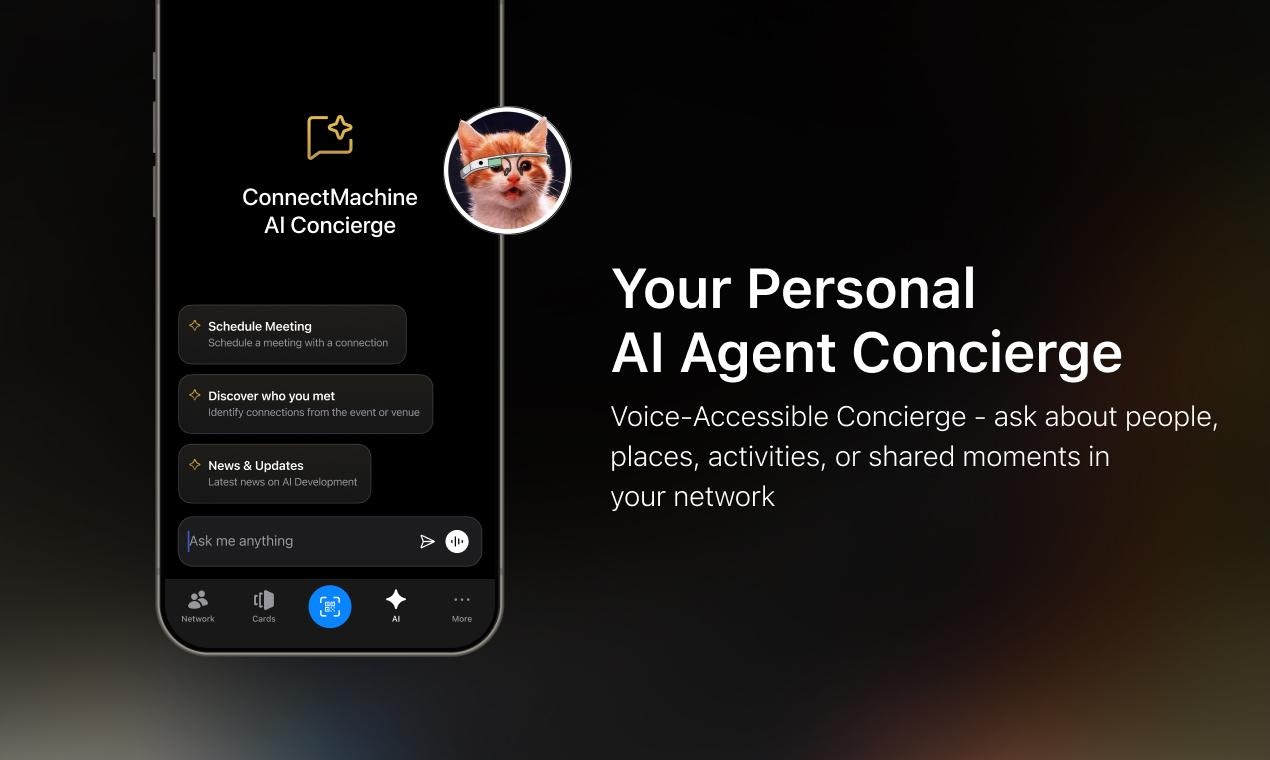
ConnectMachine’s Voice Query Agent represents the platform’s most significant functional differentiation from competitors. This capability transforms contact databases from passive repositories requiring manual search into conversational interfaces that respond to natural language queries. Users hold the voice input button and speak questions like “List people I met at KubeCon and why the meetings mattered” or “Who from Microsoft did I meet last month?” The system processes these queries, interprets intent, identifies relevant contacts, and returns structured responses with contextual metadata.
The practical application of this capability addresses several pain points inherent in traditional contact management. After attending conferences or multi-day events where professionals exchange dozens or hundreds of cards, the ability to query “Who did I meet at Dreamforce last week?” provides immediate recall that would otherwise require tedious manual list review. Similarly, preparing for meetings with organizations benefits from queries like “Show me everyone I know at Google” or “Find connections who work in fintech.”
The voice interface enables hands-free operation, allowing queries while driving, walking between meetings, or multitasking. This mode of interaction aligns with broader trends in conversational AI and voice-first interfaces that reduce cognitive load by eliminating the need to navigate complex menu hierarchies or remember specific field names for search filters.
The technical architecture underlying this capability combines several AI subsystems. Speech-to-text transcription converts audio input to text, requiring high accuracy to correctly interpret names, company names, and domain-specific terminology. Natural language understanding parses query structure, identifying entities such as events, time periods, organizations, and relationship types. Query execution translates natural language intent into database searches against the contact repository, potentially combining multiple filters and ranking results by relevance. Response generation structures search results in human-readable format, possibly including summary statistics or key insights.
Agentic Recall: Research References
The platform’s “agentic recall” capability extends beyond simple contact storage to maintain rich contextual metadata about each relationship. The system remembers who users met, when interactions occurred, where meetings took place, what topics were discussed, and why relationships matter. This contextual intelligence transforms contact management from an administrative task into strategic network intelligence.
The architecture supporting agentic recall involves several data collection and synthesis mechanisms. When users scan business cards or exchange contacts via QR code or NFC tap, the system captures not only contact information but also temporal and spatial metadata—the date, time, and location of the exchange. Users can augment these automated captures with notes, tags, or voice memos that provide additional context about conversation topics, mutual connections, or follow-up commitments.
Machine learning algorithms analyze this accumulated data to identify patterns and relationships. The system might recognize that a user frequently meets contacts at specific venues, enabling queries like “What is the preferred coffee shop among my San Francisco circle?” Temporal analysis identifies relationship recency, highlighting contacts with whom the user hasn’t interacted recently but who may be valuable to re-engage. Organizational affiliation tracking enables queries about all connections at a specific company or within a particular industry.
The practical value of agentic recall becomes evident in scenarios like fundraising, where entrepreneurs benefit from understanding exactly who in their network knows potential investors, or sales prospecting, where business development professionals can identify warm introduction paths to target accounts. Job seekers can query their network for connections at companies they’re pursuing, while event planners can identify which attendees share common interests or backgrounds that suggest productive introductions.
Research literature on enterprise knowledge management and personal information management systems validates the importance of context-aware information retrieval. Studies demonstrate that human memory operates through associative networks triggered by contextual cues, and that effective personal information management systems must mirror this associative structure rather than imposing rigid hierarchical taxonomies. ConnectMachine’s approach of allowing natural language queries based on temporal, spatial, and semantic context aligns with cognitive science research on human information seeking behavior.
AI-Powered Contact Enrichment: Automation Details
Contact enrichment automation addresses a persistent friction point in professional networking: the gap between the minimal information initially exchanged and the comprehensive profile data needed for strategic relationship management. When professionals exchange business cards, they typically share only name, title, organization, email, and phone number. Understanding someone’s background, expertise, shared connections, or career trajectory requires time-consuming manual research across LinkedIn, company websites, news articles, and other sources.
ConnectMachine automates this enrichment process through continuous background processing that pulls publicly available information to supplement contact profiles. The system scans professional networking platforms to retrieve education history, previous roles, skills, endorsements, and mutual connections. Company website research yields organizational context such as company size, funding stage, recent news, and product offerings. Social media profiles might reveal interests, affiliations, or content that provides conversation starters or common ground.
This enrichment operates autonomously without user intervention, ensuring that contact profiles remain current even as individuals change roles, join new organizations, or update their public professional profiles. Users benefit from always having access to up-to-date information without manual maintenance burden. The frequency and depth of enrichment likely balance currency requirements against API rate limits and infrastructure costs.
Data quality represents a critical consideration for contact enrichment systems. Automated enrichment must implement entity resolution algorithms to ensure that information pulled from public sources accurately matches the intended individual rather than someone with the same or similar name. Confidence scoring helps the system determine when automated enrichment is reliable versus when human validation is needed. Compliance with terms of service for data source platforms ensures sustainable operation.
The enrichment capability delivers several business outcomes. Sales professionals benefit from comprehensive prospect profiles that inform personalized outreach. Recruiters gain candidate background that accelerates screening. Investors can quickly assess entrepreneur backgrounds and company traction. Conference attendees can prepare for meetings by reviewing enriched profiles of scheduled connections.
Private Network Visibility: Silent Signals Feature
ConnectMachine’s “Private Network Visibility” feature introduces an innovative approach to proximity-based networking that prioritizes consent and discretion over broadcast discovery. Unlike location-based social applications that show all nearby users, ConnectMachine enables users to send “silent signals”—private connection requests to people within their proximity or inner circle—without revealing who is nearby until both parties consent to connect.
The technical implementation uses location services with privacy-preserving architecture. When users opt into this feature, their device periodically communicates anonymized presence signals that enable proximity detection without creating persistent location history or revealing identity. If another ConnectMachine user within proximity has overlapping network connections or shared interests, the system might suggest sending a silent signal, but the recipient only receives an abstract notification that someone nearby wishes to connect, not who that person is.
This design respects several privacy principles simultaneously. First, users never see who is nearby, preventing unwanted surveillance or stalking scenarios that plague some location-based social applications. Second, recipients can ignore silent signals without creating social awkwardness or hurt feelings, since senders don’t know whether their signal was ignored or simply not seen. Third, the ephemeral nature of signals means there’s no permanent record of who was present at specific locations and times.
The business application of silent signals addresses networking scenarios where proximity suggests potential value but social norms prevent direct approach. At industry conferences, silent signals allow attendees to identify when relevant contacts are nearby without the awkwardness of tracking their movements. In coworking spaces, the feature enables serendipitous connections with others working nearby without violating unwritten rules about interrupting focused work. For investors and entrepreneurs, silent signals can facilitate connections at startup events without the uncomfortable dynamics of cold approaching potential investors.
6. Adoption Pathways
Integration Workflow
ConnectMachine’s adoption process emphasizes simplicity and minimal friction, reflecting the platform’s focus on elite professionals who value efficiency. New users download the mobile application from the Apple App Store or Google Play Store, create an account using email or social authentication, and immediately begin creating custom digital business cards. The card creation interface prompts users to input core contact information—name, title, organization, email, phone, social profiles—and allows customization of which fields appear on each virtual card.
The platform’s support for multiple virtual cards enables role-specific identity presentation. A startup founder might create separate cards for investor meetings, customer interactions, speaking engagements, and personal connections, sharing only relevant information in each context. This segmentation addresses a common pain point where traditional business cards force a single identity presentation regardless of audience.
Apple Wallet integration provides important onboarding value by enabling lock-screen card access without requiring app unlock. Users add their primary ConnectMachine card to Apple Wallet, making it instantly accessible for QR code sharing during networking interactions. This integration eliminates the awkward delay of finding the app, unlocking the phone, and navigating to the share screen while someone waits to scan.
Voice query onboarding guides users through setting up their AI agent preferences. Initial setup includes configuring meeting preferences—preferred days and times, typical meeting duration, default venues—that the AI concierge uses when managing connection requests or suggesting follow-ups. Users also train the system on their network organization preferences by confirming or correcting automated contact categorizations, which improves accuracy over time through reinforcement learning.
For team deployments, enterprise adoption requires administrator accounts that can create, edit, and manage cards in bulk. Centralized dashboards enable brand consistency enforcement while allowing individual team members to personalize certain fields. User provisioning integrations with identity providers like Okta or Azure Active Directory streamline employee onboarding and offboarding, ensuring that access is granted and revoked in alignment with HR systems.
Customization Options
ConnectMachine’s customization capabilities focus on functional flexibility rather than aesthetic design controls, contrasting with competitors like HiHello that emphasize visual customization. Users create multiple virtual cards with field-level control over what information each card displays. This granular permission system means that an investor networking card might show LinkedIn and email but hide phone number, while a customer-facing card might show phone and website but hide personal social profiles.
Card templates help users maintain consistency across their card portfolio while still allowing per-card customization. Color schemes and background options provide basic aesthetic control, though the platform’s minimalist design philosophy emphasizes content over decoration. This approach aligns with luxury branding principles that favor restraint and sophistication over elaborate visual ornamentation.
Contact categorization customization allows users to define personal taxonomy for organizing their network. While the AI agent autonomously categorizes contacts into segments, users can create custom categories reflecting their specific networking needs—for example, “Series A Investors,” “SaaS Founders,” “Conference Speakers,” or “Alumni Network.” The system learns from manual recategorizations and applies these learnings to future automated contact sorting.
Voice query customization includes setting preferred language and dialect for speech recognition accuracy. Users can train the system on frequently used terminology, nicknames, or abbreviations unique to their professional context. For example, an automotive industry professional might teach the system that “OEM” refers to original equipment manufacturers or that “JD Power” refers to the customer satisfaction research firm.
Meeting preference customization enables detailed specification of scheduling constraints and location preferences. Users can set default meeting lengths, buffer times between meetings, preferred venues by city, and blackout periods. The AI concierge applies these preferences when suggesting meeting times or responding to connection requests, reducing back-and-forth scheduling coordination.
Onboarding and Support Channels
ConnectMachine’s onboarding experience emphasizes immediate value delivery through progressive disclosure of advanced features. New users can create their first digital card and share it within minutes, establishing core functionality before exploring AI agent capabilities or advanced privacy controls. In-app tutorials and contextual help provide just-in-time guidance when users encounter new features, reducing the cognitive load of comprehensive upfront training.
Documentation resources available through docs.connectmachine.ai provide detailed guidance on platform functionality, privacy architecture, troubleshooting, and best practices. This documentation serves both end users seeking feature explanations and enterprise administrators managing team deployments. FAQ sections address common questions about data security, export capabilities, and integration options.
Customer support operates through email at hi@connectmachine.ai, providing a direct communication channel with the team. As a newer platform, ConnectMachine’s support infrastructure likely operates with smaller volume than established competitors, potentially enabling more personalized assistance but raising questions about response time scalability as the user base grows. Competitors like Popl offer twenty-four-seven global support, setting customer expectations for round-the-clock availability that may challenge smaller operations.
Community resources including social media channels on LinkedIn, Instagram, and potentially dedicated Slack or Discord communities provide peer support and product update communications. These channels enable users to share best practices, provide feedback on feature requests, and stay informed about platform developments. For a platform targeting elite professionals, curated community experiences that emphasize quality over quantity align with broader brand positioning.
Enterprise onboarding for team deployments typically involves dedicated customer success management that guides large organizations through implementation. This includes requirements discovery to understand organizational use cases, technical integration planning for CRM or identity provider connections, training session delivery for administrators and end users, and ongoing optimization to maximize adoption and ROI.
7. Use Case Portfolio
Enterprise Implementations
Digital business card platforms deliver strategic value for enterprises through brand consistency, lead management efficiency, cost reduction, and employee productivity enhancement. ConnectMachine’s enterprise value proposition centers on providing executives and business development professionals with intelligent networking tools that transform passive contact collection into active relationship intelligence.
Large professional services firms benefit from ensuring that every client-facing employee presents consistent brand identity through standardized digital business cards. Marketing teams create approved card templates incorporating corporate branding, color schemes, and messaging hierarchy. Individual professionals customize within these templates by adding their specific contact information, credentials, and department. This centralized approach ensures brand consistency while respecting individual professional identity.
Sales organizations leverage digital business cards as the first step in pipeline generation. When sales representatives meet prospects at trade shows, conferences, or customer visits, instant card sharing captures lead information directly into CRM systems without manual data entry. Follow-up automations trigger immediately, delivering personalized emails or scheduling calendar holds for next-step conversations. Analytics dashboards show which sales representatives are most active at events, which events generate the highest-quality leads, and how networking activity correlates with closed revenue.
Executive teams value privacy-focused networking tools that enable high-level relationship management without social media exposure. C-suite executives, board members, and senior partners often maintain extensive networks but prefer discretion over public relationship broadcasting. ConnectMachine’s no-feed architecture and silent signal capabilities align with this discretion requirement while still providing AI-powered recall when executives need to quickly understand relationship context before important meetings.
Investment firms use intelligent contact management for dealflow tracking and portfolio company support. Venture capital and private equity professionals meet hundreds of entrepreneurs, service providers, and co-investors annually. The ability to query “Show me all Series A founders I met in Q3” or “Find portfolio companies that need CFO candidates” transforms contact databases into strategic relationship assets. Contact enrichment ensures that entrepreneur profiles automatically update as their companies raise funding, hire executives, or achieve product milestones.
Academic and Research Deployments
While ConnectMachine’s current positioning emphasizes business networking, academic and research use cases present opportunities for institutional deployment. University career services centers could deploy the platform to help students and alumni maintain professional networks developed through internships, conferences, and networking events. The voice query capability particularly benefits students who accumulate numerous contacts during career fairs but struggle to organize and maintain these relationships.
Research collaborators across institutions benefit from maintaining detailed records of conference interactions, including which colleagues they met, which papers were discussed, and which potential collaboration opportunities emerged. The agentic recall feature helps researchers remember who expressed interest in specific research topics, facilitating outreach when relevant papers are published or grant opportunities arise.
Academic conference organizers could leverage proximity-based silent signals to facilitate attendee networking without requiring explicit booth visits or scheduled meetups. Researchers with common interests could receive subtle notifications that relevant colleagues are nearby, enabling serendipitous conversations that often yield productive collaborations.
University advancement and alumni relations teams manage extensive networks of donors, alumni, and institutional partners. Intelligent contact management helps development officers remember details about previous interactions, donation history, and personal interests that inform fundraising strategy. The export-only architecture provides important data sovereignty for educational institutions concerned about maintaining control over sensitive donor information.
ROI Assessments
Return on investment analysis for digital business card adoption combines quantifiable cost savings with operational efficiency improvements and revenue impact. The financial case begins with direct cost comparison: organizations spending $64.23 per employee annually on paper business cards versus approximately $48 per employee for digital subscriptions achieve immediate twenty-six percent savings before accounting for quality improvements.
Indirect cost savings from eliminated waste exceed direct printing costs. Paper business cards become outdated when employees change roles, get promoted, or update contact information, forcing disposal of existing inventory and reprint costs. Digital cards update instantaneously across all previously shared connections, eliminating reprint waste entirely. For organizations with twenty percent annual employee turnover or role changes, this flexibility compounds savings substantially.
Lead conversion improvements provide revenue-side ROI justification. Industry research demonstrates that digital business card recipients convert sixteen percent more frequently than paper card recipients, attributed to several factors including reduced friction in adding contacts, automatic CRM integration enabling faster follow-up, and enriched profiles providing sales representatives better context for personalized outreach. For sales organizations where each closed deal generates substantial revenue, even modest percentage improvements in conversion rates justify technology investment.
Time savings from automation translate to capacity expansion without headcount increases. Sales representatives spend an average of five to ten hours monthly on administrative tasks including manual contact data entry, calendar coordination, and relationship context research. Digital platforms with CRM integration, automated follow-ups, and intelligent enrichment reclaim this time for high-value customer interactions. For a sales team of twenty representatives, recovering eight hours monthly per person yields 160 hours of additional selling capacity—equivalent to one full-time employee.
Analytics capabilities enable data-driven optimization of networking investments. Organizations spending substantial budgets on conference attendance, trade show participation, and event sponsorships can track which events generate the highest-quality leads, which representatives excel at networking, and how networking activity correlates with pipeline growth. This measurement enables strategic resource allocation toward highest-ROI activities while deprioritizing low-performing events.
For ConnectMachine specifically, the AI agent capabilities provide additional ROI dimensions. Voice query functionality saves time compared to manual contact database searching, potentially delivering minutes of time savings per query multiplied by daily query frequency. Agentic recall reduces meeting preparation time by automatically surfacing relevant context about upcoming interactions. Contact enrichment eliminates hours of pre-meeting research that professionals otherwise conduct manually before important conversations.
8. Balanced Analysis
Strengths with Evidential Support
ConnectMachine’s primary competitive advantage lies in its AI Agent architecture, specifically the voice query and agentic recall capabilities that no direct competitor currently offers. The ability to interact with contact databases through natural language represents a fundamental paradigm shift from search-box interfaces that require users to remember field names and construct filter logic. Voice queries like “Who did I meet at Dreamforce?” or “Find connections who work in fintech” provide conversational interfaces that mirror human memory recall patterns rather than imposing database query syntax.
The privacy-first design philosophy differentiates ConnectMachine in an increasingly surveillance-conscious market. Unlike LinkedIn and similar social networking platforms that monetize user data through advertising and algorithmic engagement manipulation, ConnectMachine eliminates feeds, posts, and public profiles entirely. The export-only contact book architecture ensures users maintain data sovereignty without platform lock-in. For executive users, high-net-worth individuals, and professionals in sensitive industries, this privacy positioning provides substantial value beyond functional features.
Luxury brand positioning targets an underserved market segment. While competitors like Popl and HiHello pursue mass-market adoption, ConnectMachine explicitly markets to “the silent elite” and “professionals who value discretion and precision.” This positioning enables premium pricing strategies, reduces customer acquisition costs through targeted marketing, and builds community cohesion among users who share values around intentional connection over social noise.
The multiple virtual cards feature addresses a real pain point in professional identity management. Professionals who operate in multiple capacities—for example, a venture capitalist who also sits on nonprofit boards and advises startups—benefit from role-specific identity presentation. Traditional business cards force a single identity expression regardless of context, often leading professionals to carry multiple physical cards or settle for generic presentations that lack context relevance.
Mobile-first architecture with Apple Wallet integration delivers superior user experience compared to web-based solutions. Lock-screen card access eliminates the friction of app unlocking and navigation, reducing card sharing from a multi-step process to a single swipe. This efficiency particularly matters in high-velocity networking environments like conferences where seconds of delay create social awkwardness.
Limitations and Mitigation Strategies
ConnectMachine’s newer market presence creates several adoption barriers compared to established competitors. Popl serves over 2.5 million users and counts sixty percent of Fortune 500 companies as clients, while HiHello serves two million users from organizations like Google and Deloitte. ConnectMachine’s ten thousand users across seventeen countries represents respectable early traction but creates network effects disadvantages. Digital business cards deliver maximum value when both parties use the same platform, enabling rich feature interactions beyond simple contact exchange.
The platform’s limited public documentation of enterprise security certifications represents a significant constraint for large organization adoption. Enterprise buyers, particularly in regulated industries like financial services, healthcare, and government, require SOC 2 Type II attestation, ISO 27001 certification, or equivalent third-party validation of security controls. While ConnectMachine’s privacy policy documents appropriate encryption, access controls, and security practices, the absence of formal certification documentation creates procurement friction and may exclude the platform from consideration during enterprise software evaluation processes.
Pricing transparency gaps create uncertainty for potential customers evaluating total cost of ownership. While the platform offers free and premium tiers, detailed pricing information including per-user costs, volume discounts, enterprise licensing models, and feature tier comparisons were not comprehensively documented in public materials. Competitors provide clear pricing calculators and detailed tier comparisons, reducing evaluation friction. ConnectMachine’s luxury positioning might justify premium pricing, but opacity creates barriers to purchase decision-making.
The “export-only, zero API” architecture philosophy, while supporting data sovereignty, limits ecosystem connectivity that enterprise customers increasingly expect. Modern SaaS platforms operate as nodes in broader technology stacks, with integrations enabling workflow automation across CRM, marketing automation, project management, and communication tools. ConnectMachine’s emphasis on privacy over connectivity may resonate with individual users but creates deployment challenges for organizations seeking to integrate networking data into existing business processes.
Contact enrichment capabilities raise potential compliance and ethical considerations. Automatically pulling publicly available information to supplement contact profiles benefits users through reduced manual work, but organizations must ensure compliance with data protection regulations and respect platform terms of service. GDPR grants individuals rights over their personal information even when that information is publicly available, potentially requiring consent frameworks or purpose limitation documentation that ConnectMachine’s automated approach might need to address more explicitly.
Mitigation strategies for these limitations include pursuing SOC 2 Type II certification through reputable auditing firms, a process typically requiring six to twelve months but providing essential enterprise credibility. Developing formal CRM integration partnerships—initially with major platforms like Salesforce and HubSpot—would balance privacy values against enterprise workflow needs. Publishing transparent pricing documentation, even if using “starting at” language with enterprise custom pricing, reduces evaluation friction. Expanding documentation resources including video tutorials, customer success case studies, and technical architecture whitepapers would accelerate enterprise evaluation processes.
9. Transparent Pricing
Plan Tiers and Cost Breakdown
ConnectMachine offers a freemium pricing model with two documented tiers: Free and Premium. The Free plan provides foundational functionality including access to basic smart cards, essential AI features, and Apple Wallet integration for lock-screen access. This entry tier enables users to create digital business cards, share them via QR code or digital wallet, and experience core platform functionality without financial commitment.
The Premium tier expands capabilities to include smart cards with expiry dates—enabling time-bound sharing for events or temporary engagements—unlimited access to AI features without usage caps, secure encrypted messaging functionality, enhanced citations in AI responses, access to advanced analytics dashboards showing engagement metrics, and priority notifications and updates. The pricing structure offers both monthly and annual billing options, with annual subscriptions providing a twenty percent discount equivalent to receiving twelve months for the price of ten.
Specific monthly pricing was not definitively documented in public materials, though industry context suggests positioning likely ranges from fifteen to thirty dollars monthly for individual premium subscriptions based on competitor benchmarking. Popl’s Pro tier costs $7.99 monthly or $6.49 with annual billing, while Pro+ costs $14.99 monthly or $11.99 annually. HiHello’s pricing similarly positions individual plans in the eight to twenty dollar monthly range with team pricing scaling based on user count.
Enterprise and team pricing follows custom pricing models common in B2B SaaS, with costs determined by user count, feature requirements, support service levels, and contract duration. Organizations typically negotiate volume discounts, multi-year commitments, and customization fees for white-label deployments or specialized integrations. The absence of public enterprise pricing documentation suggests that ConnectMachine handles large organization deals through direct sales conversations rather than self-service procurement.
Total Cost of Ownership Projections
Total cost of ownership analysis must account for direct subscription fees, implementation costs, training and change management, integration development, and ongoing administration. For individual professionals, TCO closely mirrors subscription costs with minimal additional overhead. A solo entrepreneur paying hypothetically twenty dollars monthly for premium features incurs two hundred forty dollars annually—substantially less than traditional business card printing, networking event tickets, or CRM subscription costs.
Team deployments introduce additional cost dimensions. For a sales organization deploying ConnectMachine to twenty account executives, direct subscription costs at an assumed forty dollars per user per month total nine thousand six hundred dollars annually. Implementation costs including initial setup, admin training, and CRM integration configuration might add two thousand to five thousand dollars depending on complexity. Ongoing administration—managing user provisioning, updating card templates, reviewing analytics—requires several hours monthly from operations or sales operations staff.
However, cost-benefit analysis must account for offsetting savings and revenue improvements. Eliminating paper business card spending saves over one thousand dollars annually for a twenty-person team. Time savings from automated contact capture and CRM integration reclaim hundreds of hours annually that sales representatives can redirect toward customer interactions. Lead conversion improvements of even five percent generate substantial incremental revenue that dwarfs platform costs for organizations with high average contract values.
Compared to traditional contact management workflows, digital business card platforms deliver compelling economics. Manual contact data entry consumes five to ten minutes per contact for sales representatives who diligently transcribe information from paper cards and add notes. Organizations capturing fifty contacts monthly per representative spend over sixteen hours monthly across a twenty-person team on data entry alone. At fully loaded cost of one hundred dollars per hour for sales talent, this represents nineteen thousand dollars monthly or over two hundred thousand dollars annually in unproductive time.
10. Market Positioning
Competitor Comparison
The digital business card market features several established players with distinct positioning strategies. Popl dominates in user base and enterprise penetration with over 2.5 million users, sixty percent Fortune 500 client representation, and 5,300-plus G2 reviews averaging 4.6 out of 5 stars. The platform emphasizes lead capture and CRM automation for sales-driven organizations, offering physical NFC products, AI-powered lead scanning, and integrations with over 5,000 applications through Zapier. Pricing ranges from $7.99 to $14.99 monthly with team and enterprise custom pricing.
HiHello positions as a Professional Presence Platform serving two million users from organizations like Google and Deloitte. The platform emphasizes design sophistication, brand consistency, and compliance-ready architecture. Key differentiators include superior visual customization controls, robust email signature and virtual background generators, and HR system integrations with platforms like Workday and Okta. HiHello holds SOC 2 Type II certification and maintains GDPR compliance documentation prominently in enterprise materials.
Blinq offers team management capabilities, centralized dashboards for administrators, and analytics tools focused on engagement tracking. The platform provides cross-platform compatibility across iOS, Android, and web interfaces while maintaining competitive pricing and straightforward feature sets appealing to mid-market organizations.
Tapni emphasizes customization depth with highly flexible card designs, NFC plus QR code dual functionality, and business-focused features including automated onboarding through directory integrations and sophisticated analytics for measuring event ROI and rewarding top performers.
ConnectMachine differentiates through AI agent capabilities unavailable from competitors. The voice query interface enabling natural language network exploration represents unique functionality, as does agentic recall that remembers contextual details about relationships. The privacy-first architecture eliminating social feeds and public profiles positions the platform for executives and professionals prioritizing discretion. The luxury brand positioning targeting “the silent elite” contrasts with mass-market strategies pursued by competitors.
Comparative Analysis Table
| Feature Dimension | ConnectMachine | Popl | HiHello |
|---|---|---|---|
| User Base | 10,000+ | 2.5M+ | 2M+ |
| Founded | 2025 | 2020 | 2018 |
| Core Differentiation | AI voice queries, agentic recall | Lead capture, event ROI | Design sophistication, compliance |
| Privacy Focus | Extreme (no feeds, export-only) | Standard | Standard |
| Voice Interface | Yes (unique) | No | No |
| Physical NFC Products | Unknown | Yes | No |
| CRM Integrations | Limited documentation | Salesforce, HubSpot, 5,000+ apps | Salesforce, HubSpot, Microsoft |
| SOC 2 Type II | Not documented | Yes | Yes |
| G2 Reviews | Insufficient data | 5,300+ (4.6/5) | Substantial positive |
| Target Market | Elite professionals, executives | Sales teams, enterprises | Brand-conscious professionals |
| Monthly Pricing | ~$15-30 (estimated) | $7.99-14.99 | $8-20 (estimated) |
Unique Differentiators
ConnectMachine’s AI Agent architecture represents its most defensible competitive moat. Voice query functionality enabling questions like “Who did I meet at Dreamforce?” or “What is the preferred coffee shop among my San Francisco circle?” delivers user experience innovation that competitors cannot easily replicate without substantial AI engineering investment. The natural language processing pipeline, entity recognition, semantic search, and result ranking constitute complex technical infrastructure requiring months of development and training data accumulation.
Agentic recall capabilities transform contact management from administrative overhead to strategic intelligence. While competitors offer contact notes fields and manual tagging, ConnectMachine’s autonomous capture of contextual metadata—when and where meetings occurred, what topics were discussed, why relationships matter—eliminates user burden while delivering superior recall. The machine learning systems that analyze relationship patterns, identify important connections, and surface relevant context represent sophisticated engineering that creates switching costs once users have accumulated substantial relationship intelligence.
Privacy architecture as product strategy rather than compliance checkbox distinguishes ConnectMachine’s positioning. The elimination of social feeds, public profiles, and algorithmic engagement mechanisms represents a philosophical stance that resonates with professionals fatigued by social media’s attention economy dynamics. Export-only data architecture provides genuine user control rather than rhetoric, addressing increasing concern about platform lock-in and data portability.
Luxury brand positioning enables premium pricing and selective growth strategy. By explicitly targeting “the silent elite” rather than pursuing mass adoption, ConnectMachine can maintain product sophistication, personalized customer support, and community curation that would be economically infeasible at multi-million user scale. This positioning attracts customers who value exclusivity, discretion, and quality over network effects and feature quantity.
Silent signal proximity networking introduces innovation in consent-based connection discovery. Unlike location-based social apps that broadcast user presence or enable unwanted approaches, ConnectMachine’s ephemeral, permission-based architecture enables serendipitous connections while respecting privacy boundaries. This technical and product design innovation could attract adoption in physical spaces where proximity suggests potential relationship value but social norms prevent direct approach.
11. Leadership Profile
Bios Highlighting Expertise and Awards
Vinod Tahelyani serves as Co-founder and Head of Engineering at ConnectMachine, bringing technical leadership to the platform’s development. His LinkedIn profile describes him as “AI x Design” with expertise in building usable software while maintaining business context awareness. Tahelyani’s engineering philosophy emphasizes user experience and product quality, noting an “allergy to mediocrity” that suggests high standards for technical execution. His background spans software architecture, artificial intelligence integration, and design thinking—a combination critical for building conversational AI interfaces that balance technical sophistication with usability.
Mudit Singh co-founded ConnectMachine with a stated belief that “the most valuable relationships are built quietly with context.” This philosophy directly manifests in the platform’s privacy-first design and emphasis on meaningful connection over broadcast social media. Singh’s ProductHunt commentary emphasizes intentional networking and discretion as core values, positioning ConnectMachine as counter-cultural to engagement-maximizing social platforms.
Jay Singh serves as Board Member and Advisor to ConnectMachine while holding the position of Co-Founder and Chief Customer Officer at LambdaTest, a cloud-based testing orchestration and execution platform. His role at LambdaTest since May 2017 involves building secure and reliable infrastructure to empower software developers and testers globally. Previous entrepreneurial experience includes founding VisualMojos Technologies, a creative design company, and BusinessMojos Services, which was acquired by DAMO Consulting in 2016. Singh’s background in enterprise SaaS go-to-market strategy and customer success management brings commercial expertise to complement technical capabilities.
The founding team’s combined backgrounds span AI engineering, product design, enterprise software sales, and startup scaling—a skill set alignment well-suited to building and commercializing intelligent networking software. However, public documentation of formal awards, patents, industry recognition, or academic credentials was limited during research, representing an opportunity for the team to build credibility through thought leadership, conference speaking, patent filing, and industry award pursuit as the platform matures.
Patent Filings and Publications
Intellectual property strategy represents an important competitive consideration for AI-powered platforms. Patent protection for novel AI architectures, user interface innovations, or privacy-preserving networking protocols could provide defensive moats against competitor replication. Search efforts did not identify public patent filings associated with ConnectMachine, Vinod Tahelyani, Mudit Singh, or Jay Singh in United States Patent and Trademark Office or European Patent Office databases.
The absence of patent filings may reflect the platform’s early stage, where engineering resources prioritize product development over IP protection. Alternatively, the founding team may pursue trade secret protection for proprietary algorithms rather than patent disclosure, or may view rapid iteration as more valuable than patent portfolio development in fast-moving AI markets where technologies evolve faster than patent prosecution timelines.
Academic publications or technical blog posts authored by the founding team could establish thought leadership and technical credibility. Engineers and entrepreneurs increasingly build personal brands through conference speaking, technical writing, and open-source contribution. While Vinod Tahelyani’s LinkedIn profile suggests design and engineering expertise, public technical publications or open-source contributions were not extensively documented during research.
For enterprise customers evaluating platform stability and innovation trajectory, leadership team credentials including patents, publications, previous exits, and industry recognition provide important signals. As ConnectMachine scales, investing in intellectual property protection, technical content marketing, and thought leadership development would strengthen competitive positioning and enterprise buyer confidence.
12. Community and Endorsements
Industry Partnerships
Strategic partnerships amplify platform capabilities, expand market reach, and provide third-party validation. Ecosystem partnerships in the digital business card space typically span several categories: CRM platform integrations enabling automatic lead synchronization, event management platform partnerships facilitating large-scale deployment at conferences, professional association endorsements providing credibility within specific industries, and enterprise software vendor alliances embedding digital card functionality within broader collaboration suites.
Public documentation of formal industry partnerships for ConnectMachine was limited during research. The platform’s integration with Apple Wallet and Google Wallet represents technical partnerships enabling core functionality, though these integrations leverage publicly available APIs rather than formal business development relationships. For CRM integration—a critical enterprise requirement—explicit partnership documentation with Salesforce, HubSpot, Microsoft Dynamics, or other major platforms was not identified, contrasting with competitors that prominently feature verified integration badges and partnership tier statuses.
Building strategic partnerships represents an important growth lever as the platform matures. Formal partnership with enterprise CRM vendors would provide technical validation, co-marketing opportunities, and potential for bundled go-to-market strategies. Integration with event management platforms like Cvent or Eventbrite could enable conference organizers to recommend ConnectMachine to attendees, creating high-velocity user acquisition during event registration. Professional associations in industries like venture capital, executive search, consulting, or real estate could endorse the platform for members, providing trust signals that accelerate adoption within specific professional communities.
Media Mentions and Awards
Media coverage and industry awards provide third-party validation and amplify market awareness. Early-stage platforms typically generate attention through startup publication coverage, ProductHunt launches, and industry influencer endorsements before graduating to mainstream technology press coverage and formal industry award recognition.
ConnectMachine’s December 2025 ProductHunt launch generated community engagement and discussion, serving as the platform’s primary public launch event. ProductHunt functions as an important distribution channel for consumer technology startups, providing early adopter exposure and initial user acquisition. The platform’s appearance in software directories including Slashdot, GetApp, SourceForge, and ToolsifyAI indicates baseline market awareness and SEO presence.
However, coverage in mainstream technology publications like TechCrunch, VentureBeat, The Verge, or Wired was not identified during research. Industry trade publications focused on enterprise software, sales technology, or professional networking represent important validation channels as the platform pursues enterprise market expansion. Coverage in prestigious business publications like Harvard Business Review, Forbes, or Fortune would establish credibility with executive target audiences.
Formal industry awards provide structured validation and competitive benchmarking. Relevant award programs include G2 category leadership recognition, Stevie Awards for sales and customer service, Webby Awards for mobile applications, Fast Company’s Most Innovative Companies, and Red Herring’s Top 100 startups. Competitors like Popl prominently feature G2 awards including Enterprise Leader, Momentum Leader, and Best Usability badges that appear in marketing materials and sales presentations.
As ConnectMachine builds market presence, proactive media relations, award submission strategies, and influencer partnership programs would accelerate brand recognition and enterprise credibility. The platform’s unique AI agent positioning provides compelling narratives for technology journalists covering artificial intelligence applications, while the privacy-first architecture resonates with growing concerns about surveillance capitalism and platform data exploitation.
13. Strategic Outlook
Future Roadmap and Innovations
While ConnectMachine has not published a formal public product roadmap, industry trends and platform architecture suggest several probable evolution directions. The AI agent capabilities that differentiate the platform create foundations for increasingly sophisticated intelligence features. Multi-turn conversational queries could enable complex relationship exploration through back-and-forth dialogue rather than single-query interactions. For example, a user might ask “Who do I know in fintech?” followed by “Which of them raised funding recently?” and “Introduce me to their CFOs,” with the agent maintaining conversation context across queries.
Predictive networking suggestions represent a natural extension of agentic recall. Machine learning analysis of relationship patterns could identify valuable connections that users haven’t yet made, proactively suggesting warm introduction paths based on mutual interests, geographic proximity, or professional complementarity. The system might notify a user that two of their contacts who don’t know each other but have complementary expertise are both attending the same upcoming conference, facilitating valuable introductions.
Advanced sentiment analysis and relationship health scoring could help professionals maintain their networks proactively. By analyzing interaction frequency, response times, and engagement patterns, the AI agent could identify relationships showing signs of drift and suggest re-engagement actions before connections become stale. This capability would transform contact management from reactive lookup to proactive relationship cultivation.
Integration ecosystem expansion would address enterprise adoption requirements. Native CRM connectors for Salesforce, HubSpot, Microsoft Dynamics, and Pipedrive would enable bi-directional data synchronization that maintains platform privacy principles while supporting business workflow needs. Calendar system integrations beyond basic meeting scheduling could enable intelligent double-booking prevention, travel time calculation, and meeting location optimization based on participant locations.
Voice interface sophistication will likely evolve as conversational AI technology advances. Support for multiple languages and dialects would enable international expansion, while improved context understanding would make interactions more natural. Integration with smart assistants like Siri, Google Assistant, or Alexa could enable voice queries without opening the ConnectMachine application, further reducing friction.
Enterprise-grade administration capabilities will become essential for large organization deployment. Role-based access controls, audit logging for compliance purposes, usage analytics for ROI demonstration, and bulk user provisioning through SCIM protocol integration represent table-stakes features for enterprise software. White-label customization enabling organizations to brand the platform as their own internal networking tool could unlock additional market segments.
Market Trends and Recommendations
The digital business card market operates within several broader technology trends that shape strategic opportunities and competitive dynamics. The rise of agentic AI systems represents the most significant macro trend affecting ConnectMachine’s positioning. Across industries, software is evolving from passive tools that respond to explicit user commands toward autonomous agents that proactively complete tasks, anticipate needs, and make decisions within defined parameters. This shift from “tool” to “agent” paradigm aligns precisely with ConnectMachine’s architecture and creates opportunities for continued differentiation as competitors struggle to retrofit agent capabilities into tool-centric platforms.
Privacy regulations and consumer sentiment continue moving toward data minimization and user control. GDPR, CCPA, and emerging regulations in jurisdictions worldwide grant individuals increasing rights over their personal information while imposing obligations on organizations that collect and process data. ConnectMachine’s privacy-first architecture and export-only data model position the platform favorably as regulatory pressure intensifies. However, compliance demonstration through formal certifications becomes more critical as these frameworks mature.
Voice interface adoption accelerates as natural language processing accuracy improves and smart speaker penetration expands. Consumer comfort with voice interaction has increased substantially through Siri, Alexa, Google Assistant, and similar systems. Professional software increasingly incorporates voice capabilities, though most implementations remain limited to simple commands rather than complex queries. ConnectMachine’s sophisticated voice query architecture positions it ahead of this adoption curve, though user education and expectation management remain important as voice interfaces still frustrate users when misunderstanding queries.
Enterprise digital transformation initiatives continue prioritizing workflow automation, data integration, and employee productivity enhancement. Organizations seek to eliminate manual data entry, reduce context switching between applications, and surface intelligence buried in disconnected systems. Digital business card platforms that serve as isolated contact repositories miss this broader transformation opportunity. Platforms that function as intelligent networking layers integrated with CRM, calendar, communication, and collaboration tools align with enterprise architecture visions.
The creator economy and personal brand building movements drive individual professionals to invest in tools that amplify their professional presence and networking effectiveness. Entrepreneurs, consultants, freelancers, and knowledge workers increasingly operate as personal brands requiring sophisticated tools previously accessible only to large organizations. ConnectMachine’s individual tier pricing and sophisticated intelligence features serve this market segment well, though education about value proposition beyond simple contact storage remains important.
Strategic recommendations for ConnectMachine’s continued growth include:
Pursue formal security certifications aggressively. SOC 2 Type II attestation represents the most critical near-term priority for enterprise market credibility. Engage a reputable auditing firm and implement necessary controls to achieve certification within twelve months.
Develop native CRM integrations with major platforms. Direct integrations with Salesforce and HubSpot would address enterprise workflow requirements while maintaining privacy principles through user-controlled data synchronization. Position these integrations as “privacy-preserving” alternatives to competitors’ more permissive data sharing approaches.
Invest in content marketing and thought leadership. The founding team should establish expertise through conference speaking, technical blog posts, podcast appearances, and industry publication contributions. Topics like agentic AI, privacy-preserving networking, and executive relationship management align with platform positioning and target audience interests.
Build customer success case studies systematically. Document quantifiable outcomes for early enterprise customers including time savings, lead conversion improvements, and user adoption metrics. Video testimonials from recognizable executives or companies provide powerful social proof for enterprise sales processes.
Expand voice interface capabilities strategically. Multi-turn conversations, smart assistant integration, and proactive suggestions represent high-value enhancements to core differentiation. Publish benchmarks demonstrating voice query accuracy and response time to build user confidence in the technology.
Clarify pricing transparency while maintaining premium positioning. Publish detailed tier comparisons, enterprise starting prices, and ROI calculators that help prospects justify budget allocation. Premium pricing is defensible given unique capabilities, but opacity creates unnecessary evaluation friction.
Develop industry-specific marketing campaigns. Venture capital, executive search, commercial real estate, and professional services represent high-value segments with acute networking needs. Industry-specific messaging, feature demonstrations, and case studies would accelerate adoption within these communities.
Explore strategic partnership opportunities. Event management platforms, professional associations, executive education programs, and coworking space operators represent partnership channels that could drive user acquisition efficiently. Bundled offerings or endorsed member benefits reduce individual customer acquisition costs while building market presence.
Final Thoughts
ConnectMachine enters the digital business card market at an inflection point where artificial intelligence capabilities transform previously mundane software categories into intelligent agent platforms. The founding team’s decision to build voice-activated, contextually aware contact management represents sophisticated product vision that addresses genuine pain points for professionals drowning in accumulated but under-utilized networks.
The platform’s technical differentiators—particularly voice queries and agentic recall—establish defensible competitive moats that competitors cannot easily replicate without substantial AI engineering investment. The privacy-first architecture aligns with growing regulatory requirements and consumer sentiment while differentiating against engagement-maximizing social platforms. The luxury positioning targeting elite professionals enables premium pricing and community curation rather than forcing mass-market compromise.
However, execution challenges remain substantial. The platform’s recent launch means it competes against established players with millions of users, extensive customer success data, and mature enterprise sales capabilities. The absence of formal security certifications creates enterprise adoption friction despite appropriate technical controls. Limited public documentation of CRM integrations, API availability, and partner ecosystem constrains enterprise evaluation processes. Pricing transparency gaps and modest review volume relative to competitors suggest that market education and credibility building require sustained investment.
For prospective users evaluating ConnectMachine against alternatives, the decision framework centers on prioritization of sophistication versus maturity. Professionals who value AI-powered intelligence, privacy architecture, and luxury positioning will find unique value in ConnectMachine’s capabilities. Organizations requiring proven enterprise deployments, extensive integrations, and formal security certifications may find competitors like Popl or HiHello better aligned with procurement requirements. The platform represents an innovation-forward choice appropriate for early adopters comfortable with newer platforms in exchange for differentiated capabilities.
The digital business card market’s continued expansion, projected to reach nearly four hundred million dollars by 2033, provides favorable conditions for multiple successful players serving different market segments. ConnectMachine’s positioning as the intelligent, privacy-first alternative to mass-market solutions addresses an underserved segment. Success depends on executing enterprise credibility building through certifications and case studies, expanding integration ecosystem while maintaining privacy principles, and educating the market about the value of agentic intelligence over passive contact storage. The technical foundation and product vision are compelling; commercial execution will determine whether the platform achieves its ambition to redefine professional networking for the elite.