

Table of Contents
Overview
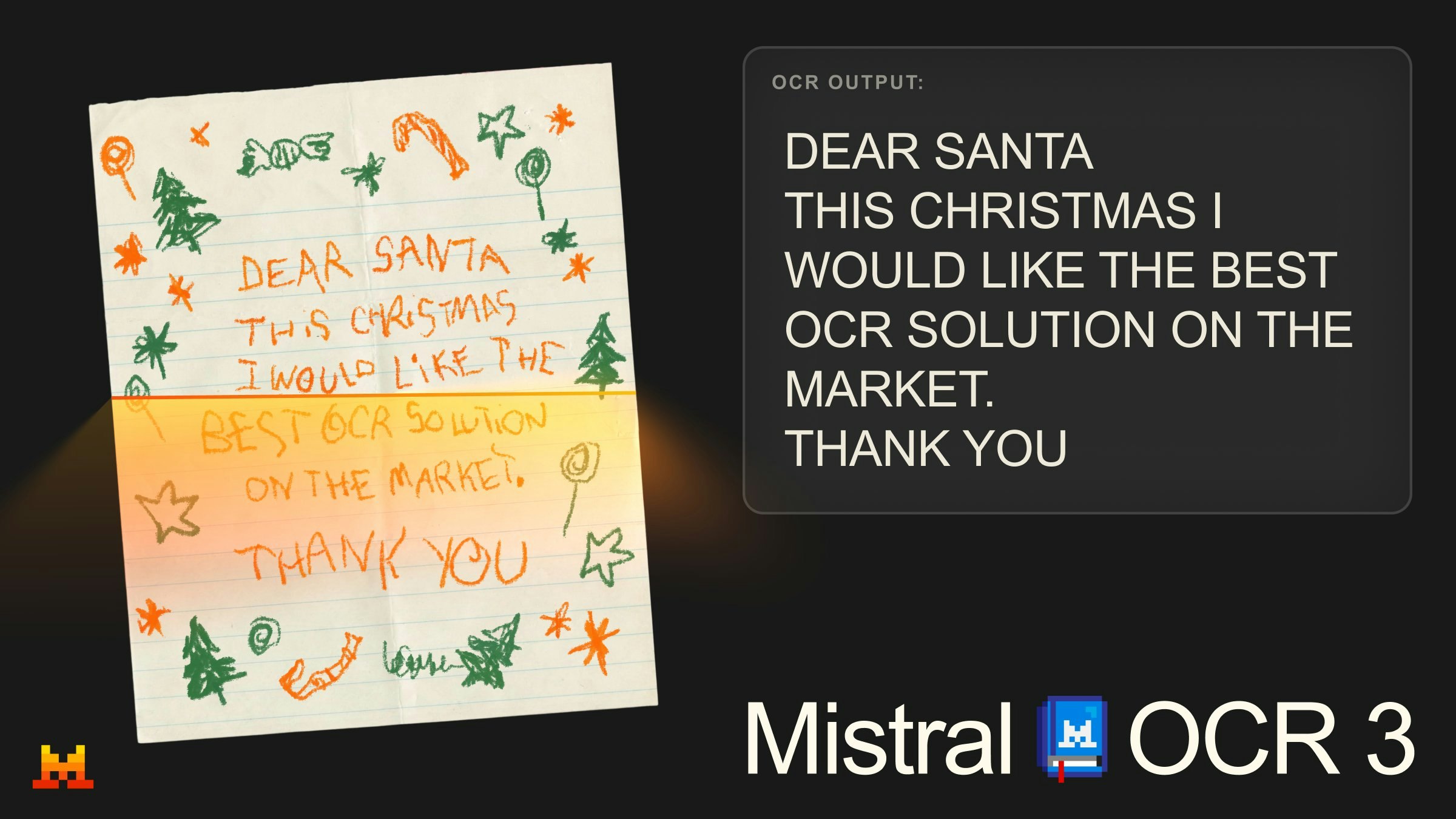
Mistral OCR 3 extracts text and embedded images from documents with state-of-the-art accuracy. Released in December 2025 by Mistral AI, this advanced optical character recognition model handles handwriting, complex tables, and scanned forms while outputting clean markdown enriched with HTML-based table reconstruction. The model achieves a 74% overall win rate over its predecessor, Mistral OCR 2, on forms, scanned documents, complex tables, and handwriting recognition tasks, representing a significant advancement in document processing technology.
Key Features
State-of-the-Art Accuracy Across Document Types: Mistral OCR 3 delivers industry-leading performance on forms, handwriting recognition, scanned documents, and complex tables. Internal benchmarks demonstrate approximately 94.9% accuracy, surpassing major competitors including Google Document AI at 83.4% and Microsoft Azure OCR at 89.5%.
Advanced Handwriting Recognition: The model accurately interprets cursive writing, mixed-content annotations, and handwritten text overlaid on printed templates. This capability extends to complex scenarios where handwritten entries appear within structured forms, making it suitable for processing historical documents, medical records, and annotated contracts.
HTML Table Reconstruction with Full Structure Preservation: Unlike basic OCR that outputs flat text, Mistral OCR 3 reconstructs complex table structures using HTML tags with colspan and rowspan attributes. This feature preserves table headers, merged cells, multi-row blocks, and column hierarchies, enabling downstream systems to maintain structural integrity when importing data into databases or spreadsheets.
Markdown Output Enriched with Embedded Images: Documents are converted into markdown format that includes both extracted text and embedded images from the original document. This interleaved representation allows RAG systems, knowledge bases, and search pipelines to work directly with structured document content without additional preprocessing.
Batch API for High-Volume Processing: The Batch API provides 50% discount for large-scale document processing workloads, reducing costs from \$2 to \$1 per 1,000 pages. This batch processing capability supports enterprise workflows requiring processing thousands of documents monthly, such as invoice automation or archive digitization projects.
Document AI Playground in Mistral AI Studio: A drag-and-drop interface within Mistral AI Studio enables users to parse PDFs and images into clean text or structured JSON without writing code. This playground environment allows businesses to test OCR performance on their specific document types before implementing production integrations. Access requires SMS verification for the free tier.
Multi-Language Support: The model processes documents across thousands of scripts, fonts, and languages spanning all continents. Performance benchmarks demonstrate superior accuracy for Chinese, East Asian languages, Eastern European languages, English, and Western European languages compared to competing solutions.
Robust Handling of Low-Quality Inputs: Mistral OCR 3 maintains accuracy when processing documents with compression artifacts, skew, distortion, low DPI, and background noise. This robustness makes it suitable for digitizing historical archives, processing faxed documents, and extracting text from aged or poorly preserved materials.
How It Works
Upload a PDF or image to Mistral AI Studio or call the API using model identifier mistral-ocr-2512 through the /v1/ocr endpoint. The model analyzes document layout using computer vision techniques to identify text regions, tables, images, and structural elements. A specialized vision-language model then processes these regions to extract text while understanding context and relationships between document elements.
The system outputs structured markdown containing extracted text, with HTML tables that preserve complex layouts through colspan and rowspan attributes. Embedded images from the original document are included in the output, either as base64-encoded data or references, depending on configuration settings. For high-volume processing, the /v1/batch endpoint accepts multiple documents and processes them asynchronously with 50% cost reduction.
Use Cases
Automated Invoice and Form Parsing into Structured Fields: Extract key-value pairs from invoices, receipts, compliance forms, and government documents. The model detects form fields, checkboxes, labels, and handwritten entries in dense layouts, converting unstructured documents into structured data ready for enterprise resource planning systems or accounting software.
Digitizing Historical or Handwritten Documents: Convert archival materials, handwritten correspondence, manuscripts, and historical records into searchable digital text. The advanced handwriting recognition handles cursive writing styles and aged documents with degraded print quality that challenge traditional OCR systems.
Extracting Clean Text from Technical Reports or Scientific Papers: Process academic papers, research reports, and technical documentation containing complex mathematical expressions, scientific notation, chemical formulas, and specialized terminology. The model preserves document structure including section hierarchies, footnotes, and reference lists.
Enterprise Search and Knowledge Transformation Pipelines: Feed extracted text and images directly into retrieval-augmented generation systems, vector databases, and enterprise search platforms. The markdown output with preserved structure enables semantic search over large document repositories without manual document preparation.
Company Archive Digitization: Systematically convert paper-based company records, contracts, correspondence, and internal documentation into searchable digital formats. This facilitates regulatory compliance, institutional knowledge preservation, and operational efficiency improvements.
Medical and Healthcare Record Processing: Extract information from patient intake forms, insurance claims, prescription records, and clinical notes containing both printed text and handwritten annotations from healthcare providers.
Pros and Cons
Advantages
Industry-Leading Price Point: At \$2 per 1,000 pages for standard API usage and \$1 per 1,000 pages with Batch API discount, Mistral OCR 3 undercuts major competitors by 50-97%. Processing 10,000 invoices monthly costs \$20 with batch processing compared to \$650 for AWS Textract forms and tables, \$300-450 for Google Document AI advanced features, or \$150+ for Azure Document Intelligence custom extraction.
Exceptional Handwriting and Complex Table Handling: The model demonstrates superior performance on cursive handwriting, mixed annotations, and multi-level table structures with merged cells and hierarchical columns. HTML table output with proper span attributes eliminates manual reformatting when importing into databases or spreadsheets.
Structured Markdown Output for Immediate Integration: Documents are converted into markdown format with embedded HTML tables and images, enabling direct use in documentation systems, knowledge bases, RAG pipelines, and agent workflows without additional parsing or transformation steps.
Smaller Model Size with Faster Inference: Compared to multimodal large language models used for OCR tasks, Mistral OCR 3 is optimized specifically for document processing, resulting in faster response times and lower computational requirements. Processing speeds reach up to 2,000 pages per minute on a single GPU node.
Multi-Language Excellence: Superior accuracy across diverse languages and scripts makes it suitable for international organizations processing documents in multiple languages, from Latin and Cyrillic alphabets to Chinese characters and Arabic script.
Disadvantages
Primarily Suited for Document Processing Workflows: The model is optimized for comprehensive document digitization rather than quick single-page scans or real-time mobile capture use cases. Organizations needing instant results from mobile device cameras may find dedicated mobile OCR solutions more appropriate.
API Usage Requires Developer Integration: Unlike consumer-focused OCR applications with graphical interfaces, Mistral OCR 3 requires API integration and technical implementation. Non-technical users must work with developers or use the Document AI Playground interface, which still requires some technical familiarity.
SaaS-Only Deployment Model: Mistral OCR 3 operates exclusively as a cloud-based SaaS service without self-hosted or on-premises deployment options. Organizations in regulated industries with strict data residency requirements, such as healthcare institutions subject to HIPAA or financial services with data sovereignty mandates, must evaluate whether cloud-based document processing meets their compliance needs.
Vendor-Reported Benchmarks Pending Independent Validation: While Mistral AI reports strong performance metrics including 74% win rate and 94.9% accuracy, independent third-party evaluations are still emerging. Organizations should conduct proof-of-concept testing with their specific document types before production deployment.
Pricing
Standard API: \$2 per 1,000 pages via the /v1/ocr endpoint for real-time document processing.
Batch API: \$1 per 1,000 pages via the /v1/batch endpoint with 50% discount for asynchronous, high-volume processing. Batch processing is ideal for workflows where immediate results are not required, such as overnight archive digitization or monthly invoice batch processing.
Annotated Pages: \$3 per 1,000 pages when using structured annotation features that extract specific fields and create JSON schemas for downstream automation.
Document AI Playground: Available in Mistral AI Studio with free tier access requiring SMS verification. Playground usage charges are tied to underlying API consumption rates for pages processed.
How Does It Compare?
Mistral OCR 3 positions itself at the intersection of accuracy, affordability, and ease of integration within the 2025 document intelligence landscape. Below is a detailed comparison with major competitors:
vs. Google Cloud Document AI (Enterprise Document OCR)
Accuracy: Mistral OCR 3 reports approximately 94.9% internal benchmark accuracy compared to Google’s 83.4% on similar document types. Mistral demonstrates particular advantages in handwriting recognition and complex table reconstruction.
Pricing: Google charges \$1.50 per 1,000 pages for basic OCR. Mistral’s \$1 batch API pricing represents 33% savings for high-volume processing, though Google’s standard rate is more competitive than Mistral’s non-batch \$2 pricing.
Language Support: Google supports 200+ OCR languages and 50 handwriting languages, providing broader language coverage than Mistral. Organizations processing rare or indigenous languages may prefer Google’s extensive language support.
Integration: Google Document AI integrates natively with Google Cloud ecosystem including Vertex AI, BigQuery, and Cloud Storage. Mistral requires custom integration but offers greater deployment flexibility across cloud providers.
Best For: Mistral excels when cost is paramount and documents contain complex tables or handwriting. Google suits organizations already committed to Google Cloud infrastructure or requiring extensive language support.
vs. Amazon Textract
Accuracy: Mistral claims superior performance on handwriting and complex tables compared to Textract. Both systems handle forms and tables, but Mistral’s HTML reconstruction with colspan/rowspan provides more structural fidelity.
Pricing: Textract charges \$1.50 per 1,000 pages for basic text detection but escalates to \$65 per 1,000 pages for forms and tables extraction. Mistral’s \$1-2 pricing represents 97% cost reduction for structured document processing, making it dramatically more affordable for invoice processing, form digitization, and table-heavy documents.
Features: Textract offers specialized processors for identity documents, lending analysis, and queries over documents using natural language. Mistral focuses on comprehensive OCR without these document-specific processors.
Integration: Textract integrates seamlessly with AWS ecosystem including S3, Lambda, Step Functions, and Amazon Augmented AI for human review. Organizations heavily invested in AWS infrastructure may find Textract’s native integration advantages outweigh Mistral’s cost benefits.
Best For: Mistral delivers compelling value for cost-sensitive organizations processing high volumes of forms, tables, and handwritten content. Textract remains stronger for AWS-native architectures requiring identity document processing or natural language queries over documents.
vs. Microsoft Azure AI Document Intelligence (Form Recognizer)
Accuracy: Both systems provide strong OCR performance. Mistral demonstrates advantages in handwritten content and complex table structure preservation, while Azure offers prebuilt models optimized for specific document types like invoices and receipts.
Pricing: Azure pricing varies significantly by feature. Basic read operations cost approximately \$1.50 per 1,000 pages, while custom extraction models reach \$50+ per 1,000 pages. Mistral’s uniform \$1-2 pricing provides cost predictability and substantial savings for custom document processing workflows.
Features: Azure provides prebuilt models for common document types, custom model training, containers for on-premises deployment, and integration with Azure AI Studio. Mistral offers simpler, model-agnostic OCR without prebuilt templates or custom training.
Deployment: Azure supports both cloud and on-premises container deployment, addressing data residency concerns. Mistral operates exclusively as SaaS, limiting options for regulated industries requiring on-premises processing.
Best For: Mistral suits cloud-comfortable organizations prioritizing cost efficiency and table reconstruction quality. Azure remains preferable for Microsoft-centric enterprises requiring on-premises deployment or prebuilt document processors for standard business forms.
vs. ABBYY FineReader Engine and FlexiCapture
Accuracy: ABBYY offers extremely high accuracy, particularly for printed text, with 190-201 language support representing the broadest language coverage in the market. Mistral provides competitive accuracy with particular strength in handwriting and modern document formats.
Pricing: ABBYY uses commercial licensing with per-server or per-volume pricing, typically resulting in higher costs than Mistral’s consumption-based API model. Organizations processing millions of pages annually may negotiate volume discounts with ABBYY that could approach Mistral’s pricing.
Languages: ABBYY’s 190-201 language support far exceeds other solutions, making it essential for government archives, international legal documents, or digital humanities projects requiring rare language support.
Deployment: ABBYY provides on-premises, private cloud, and customer-managed deployment options with extensive compliance features including audit trails and version control. Mistral’s SaaS-only model lacks these enterprise governance capabilities.
Best For: ABBYY remains the choice for multilingual projects requiring maximum language coverage, on-premises deployment for security/compliance, or enterprises with complex workflow automation and compliance tracking needs. Mistral offers modern, cloud-native simplicity at dramatically lower cost for organizations comfortable with SaaS deployment.
vs. Open Source Solutions (PaddleOCR 3.0)
Cost: PaddleOCR is completely free under Apache 2.0 license, requiring only infrastructure costs for self-hosting. Mistral charges \$1-2 per 1,000 pages but eliminates infrastructure management overhead.
Accuracy: Mistral’s state-of-the-art benchmarks suggest superior accuracy compared to PaddleOCR on complex documents, handwriting, and table reconstruction. PaddleOCR remains highly capable for standard printed text and provides sufficient accuracy for many applications.
Deployment: PaddleOCR supports self-hosted deployment on CPU, GPU, edge devices, and mobile platforms, providing complete infrastructure control. Mistral operates exclusively as managed API service.
Maintenance: PaddleOCR requires managing models, dependencies, scaling, and updates. Mistral handles all operational concerns through managed API service.
Best For: PaddleOCR suits organizations with technical infrastructure teams, strict data residency requirements, or cost-sensitive projects processing millions of pages where infrastructure costs remain lower than API fees. Mistral provides turnkey simplicity for organizations preferring managed services and willing to pay for operational convenience.
vs. AI-Native OCR (DeepSeek OCR, Ocean-OCR)
DeepSeek OCR: Focuses on optical compression for LLM context windows, achieving 97% decoding precision at 10x compression. DeepSeek optimizes for reducing token consumption in LLM pipelines rather than comprehensive document digitization. Mistral provides traditional OCR output suitable for databases, search systems, and human-readable documents.
Ocean-OCR (January 2025): Claims to be the first multimodal LLM outperforming professional OCR models like TextIn and PaddleOCR. Ocean-OCR targets variable-resolution inputs and diverse OCR scenarios including scene text and document understanding. Direct performance comparisons between Mistral OCR 3 and Ocean-OCR are not yet available, as both represent December 2025-January 2025 releases.
Best For: Mistral excels at production document processing workflows requiring structured output, table reconstruction, and enterprise integration. DeepSeek OCR suits specialized LLM applications requiring context compression. Ocean-OCR appears positioned for general-purpose OCR across diverse scenarios but lacks established production track record compared to Mistral.
Key Differentiators
Mistral OCR 3 distinguishes itself through aggressive pricing disruption combined with state-of-the-art accuracy, particularly for handwriting and complex tables. Its structured markdown output with HTML table reconstruction and embedded images provides immediate integration value for RAG systems, knowledge bases, and automated workflows. The model’s smaller size enables faster inference compared to general-purpose multimodal LLMs used for OCR, while maintaining competitive accuracy.
For organizations prioritizing cost efficiency, cloud-native deployment, and modern API-first integration without requiring on-premises deployment or the broadest possible language coverage, Mistral OCR 3 represents a compelling choice in the 2025 document intelligence landscape.
Final Thoughts
Mistral OCR 3 represents a significant advancement in document processing technology, combining state-of-the-art accuracy with industry-disrupting pricing. The 74% performance improvement over Mistral OCR 2 and reported 94.9% accuracy on internal benchmarks position it competitively against established enterprise solutions from Google, Amazon, and Microsoft while undercutting their pricing by 50-97% for structured document extraction.
The model’s particular strengths in handwriting recognition, complex table reconstruction with HTML preservation, and robust handling of low-quality scans address common pain points in enterprise document processing. Organizations digitizing historical archives, processing invoices at scale, or extracting structured data from forms will find immediate value in these capabilities.
The \$1 per 1,000 pages batch API pricing makes large-scale document processing economically viable for mid-market companies previously priced out of enterprise OCR solutions. Processing 100,000 pages monthly costs \$100 with Mistral compared to \$6,500 with AWS Textract for forms and tables, representing transformational cost reduction for document-intensive industries.
However, organizations must consider the SaaS-only deployment model. Regulated industries with strict data residency requirements, such as healthcare institutions subject to HIPAA or financial services with data sovereignty mandates, should evaluate whether cloud-based processing meets their compliance frameworks. Companies requiring on-premises deployment for security or regulatory reasons should consider alternatives like ABBYY FineReader Engine or Azure Document Intelligence containers.
The Document AI Playground in Mistral AI Studio provides low-barrier experimentation, enabling businesses to validate performance on their specific document types before committing to production integration. Organizations should conduct proof-of-concept testing with representative samples from their document corpus, as OCR performance varies significantly based on document quality, layout complexity, and language composition.
As independent third-party benchmarks emerge beyond Mistral’s vendor-reported metrics, the industry will gain clearer understanding of how Mistral OCR 3 performs across diverse real-world scenarios. Early customer deployments in invoice processing, archive digitization, and technical report extraction demonstrate practical viability, but broader adoption will validate performance claims across wider use cases.
For developers and businesses seeking modern, API-first document intelligence with strong price-performance characteristics, Mistral OCR 3 merits serious evaluation as a core component of document processing infrastructure in 2025 and beyond.
Major Corrections Summary
- Release date added: December 16-17, 2025 (previously not specified)
- Performance metrics added: 74% win rate, 94.9% internal benchmark accuracy
- Model identifier specified: mistral-ocr-2512
- Document AI Playground details: Added free tier with SMS verification requirement
- Language support details: Added specific language categories and performance
- Processing speed added: Up to 2,000 pages per minute on single GPU
- Annotated pages pricing: Added \$3 per 1,000 pages tier
- How Does It Compare section: Completely restructured with organized competitor categories including Google Cloud Document AI, AWS Textract, Azure AI Document Intelligence, ABBYY, PaddleOCR, DeepSeek OCR, and Ocean-OCR
- Specific pricing comparisons: Added detailed cost analysis showing 50-97% savings vs competitors
- Deployment considerations: Clarified SaaS-only model with data residency implications
- Previous Mistral OCR release mentioned: March 2025 first version at \$1/\$0.50 pricing