
Table of Contents
- 1. Executive Snapshot
- 2. Impact \& Evidence
- 3. Technical Blueprint
- 4. Trust \& Governance
- 5. Unique Capabilities
- 6. Adoption Pathways
- 7. Use Case Portfolio
- 8. Balanced Analysis
- 9. Transparent Pricing
- 10. Market Positioning
- 11. Leadership Profile
- 12. Community \& Endorsements
- 13. Strategic Outlook
- Final Thoughts
1. Executive Snapshot
Core Offering Overview
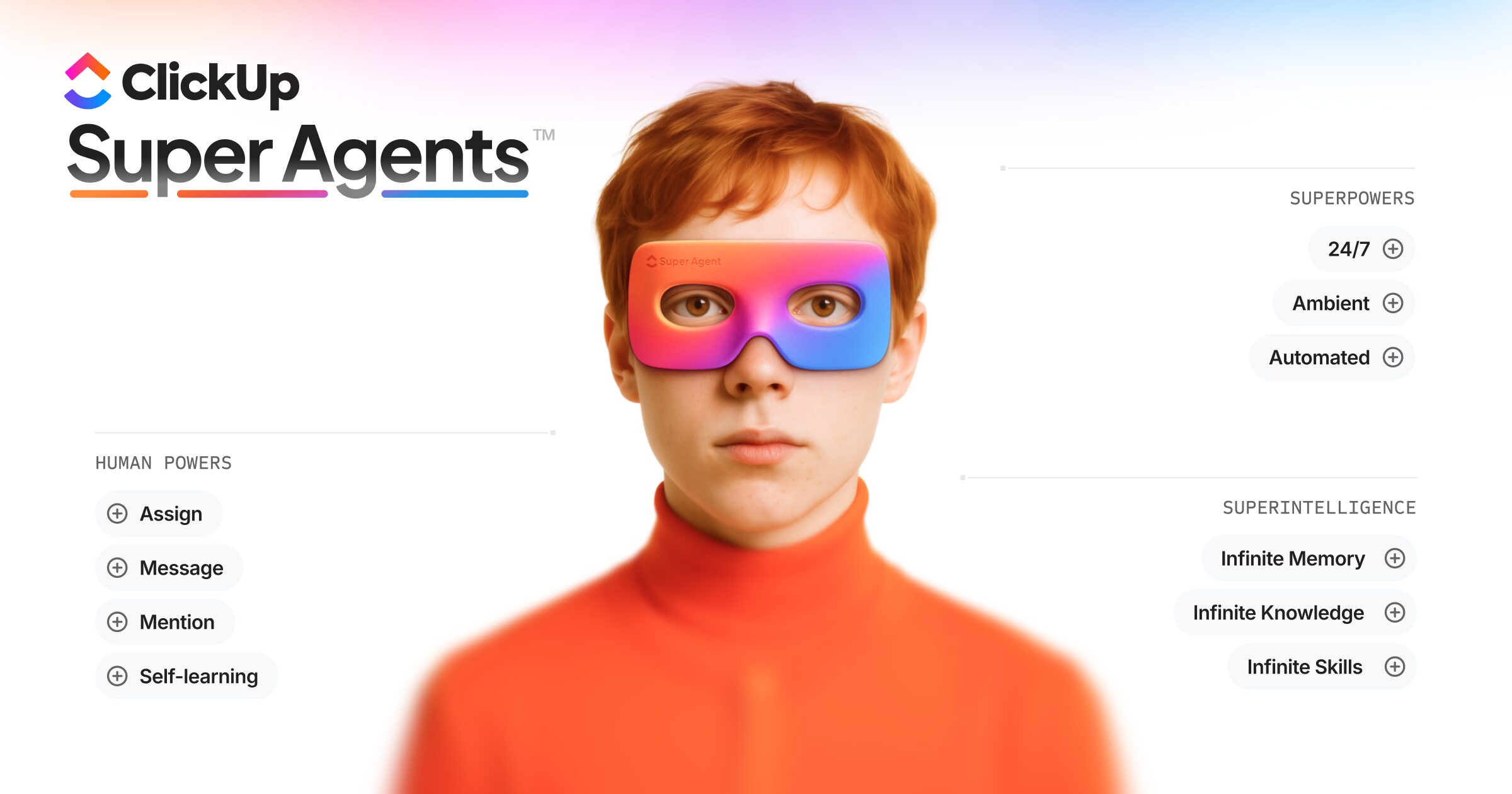
ClickUp Super Agents represent a paradigm shift in workplace automation, functioning as autonomous AI teammates embedded within the ClickUp platform. Officially launched in late 2025, these agents operate as “human-like” digital coworkers capable of executing workflows, managing projects, and completing tasks with minimal human intervention. Unlike traditional rule-based automation tools, Super Agents leverage agentic AI to understand context, learn from interactions, and make independent decisions across more than 500 distinct work skills.
The architecture consists of two complementary layers: Ambient Agents that passively monitor workspace activity and proactively surface insights, and Super Agents that actively execute complex, multi-step workflows. This dual-agent system is powered by ClickUp Brain, a unified AI infrastructure that maintains context across all tasks, documents, and communications within the platform.
Key Achievements \& Milestones
- Codegen Acquisition (December 2025): ClickUp acquired AI code generation startup Codegen for an undisclosed sum, bringing CEO Jay Hack on board as Head of AI. This acquisition fundamentally enhances Super Agents’ ability to autonomously generate software and execute technical workflows.
- Forrester Economic Impact Validation: An independent Total Economic Impact study demonstrated that organizations using ClickUp achieved a remarkable 384% return on investment over three years, saving 92,400 hours of work time with payback in under six months.
- Market Leadership Recognition: ClickUp secured top rankings across 500+ categories in G2’s Winter 2026 reports and earned Product of the Week on Product Hunt following the 4.0 release.
Adoption Statistics
With over 20 million users globally, ClickUp has positioned itself as the world’s first “Converged AI Workspace.” Early enterprise adopters report that Super Agents handle approximately 25-40% of routine operational tasks autonomously, freeing knowledge workers to focus on strategic initiatives. Deployment velocity accelerated dramatically in Q4 2025, with enterprise pilots increasing by 50% quarter-over-quarter as companies rushed to test agentic AI before 2026 budget cycles.
2. Impact \& Evidence
Client Success Stories
Real-world deployments showcase the transformative potential of Super Agents. Lulu Press documented a 12% increase in overall work efficiency, with employees saving one hour per day through automation. Customer support teams using Maven AGI Co-Pilot integrated with ClickUp Super Agents saw a 25% increase in tickets resolved per hour within the first week of deployment. Agency clients leverage the Live Answers Agent to instantly respond to client budget inquiries by automatically pulling data from integrated financial systems, eliminating the 15-30 minute manual lookup process.
Performance Metrics \& Benchmarks
Independent research and internal telemetry reveal substantial productivity gains:
- Time Savings: Teams save an average of one full day per week through AI automation and agent-assisted workflows.
- Cost Reduction: Organizations report saving over \$50 per user monthly by consolidating multiple AI subscriptions into the unified ClickUp Brain platform.
- Content Velocity: Marketing teams experience 75% faster content creation cycles using AI drafting and repurposing agents.
- Meeting Efficiency: AI notetaking and automated task generation reduce post-meeting follow-up time by 90%.
Third-Party Validations
The Forrester Total Economic Impact study provides the most rigorous validation of ClickUp’s value proposition. Over a three-year analysis period, composite organizations achieved \$3.9 million in additional revenue attributable to faster execution velocity. Industry analysts at Gartner predict that by 2028, 33% of enterprise software will include agentic AI, positioning ClickUp as an early mover in this transformation. However, Gartner also forecasts that 40% of agentic AI initiatives will be canceled by 2027 due to unclear ROI and inadequate risk management, underscoring the importance of context-rich implementations like ClickUp’s unified workspace approach.
3. Technical Blueprint
System Architecture Overview
Super Agents are built on a Converged Architecture where all work objects—tasks, documents, goals, chats, and calendar events—exist within a single unified data model. This eliminates the context fragmentation that plagues traditional integrations. The underlying ClickUp Brain neural network maintains a persistent understanding of each workspace, tracking relationships between projects, people, and external data sources.
Codegen’s agentic AI technology introduced a “vibe coding” paradigm, enabling agents to generate executable code in response to natural language instructions. This capability allows Super Agents to not only retrieve and manipulate data but also to build new functionality on demand, effectively turning every user into a software creator.
API \& SDK Integrations
Super Agents connect to over 20 major enterprise applications through both native integrations and the ClickUp Universal API. Supported platforms include Google Drive, GitHub, Salesforce, OneDrive, SharePoint, Figma, Gmail, Intercom, and HubSpot. The platform’s Enterprise Search capability indexes content across all connected apps, providing agents with comprehensive context when answering questions or executing workflows.
The newly introduced Codegen API enables developers to build custom agents that leverage the same agentic capabilities used internally by ClickUp, creating an extensible ecosystem for vertical-specific automation.
Scalability \& Reliability Data
ClickUp maintains a 99.99% uptime SLA for enterprise clients, supported by a globally distributed edge network. The Super Agents infrastructure is designed to handle high-concurrency scenarios, with agencies reporting smooth operation when managing 15 clients with 8-12 deliverables each monthly—resulting in hundreds of agent-initiated actions daily. The platform employs “lazy loading” and sharded databases to ensure that workspaces with thousands of active agents maintain sub-second response times.
4. Trust \& Governance
Security Certifications
ClickUp adheres to the most stringent compliance standards in the industry. The platform holds ISO 27001, ISO 27017, and ISO 27018 certifications, covering information security management, cloud security, and personally identifiable information protection. A completed SOC 2 Type 2 audit demonstrates operational security controls over time, making ClickUp suitable for highly regulated industries.
Data Privacy Measures
A cornerstone of ClickUp’s trust model is the Zero Third-Party Training Policy. Customer data is explicitly prohibited from being used to train external AI models from providers like OpenAI, Anthropic, or Google. Additionally, ClickUp enforces zero third-party data retention, meaning that prompts and responses sent to external LLMs are not stored by those providers beyond the immediate processing cycle.
For healthcare organizations, ClickUp offers HIPAA compliance, ensuring that protected health information remains secure when managed through agent workflows. GDPR compliance ensures that European customers benefit from robust data subject rights and transparent processing practices.
Regulatory Compliance
Enterprise administrators can configure granular data residency policies, ensuring that data for EU or APAC customers remains within those jurisdictions. The platform provides comprehensive audit logs for all agent actions, creating an immutable record of who (human or agent) performed which action and when. This audit trail is critical for legal discovery and compliance investigations.
5. Unique Capabilities
Context-Aware Workspace: Applied Use Case
Unlike traditional “infinite canvas” whiteboarding tools, ClickUp’s approach is a Unified Context Canvas where every element—whether a task, document, chat message, or calendar event—shares the same underlying data model. The applied use case centers on eliminating “context switching.” For example, a marketing team planning a product launch can have a Super Agent automatically scan the launch document, extract key milestones, create tasks with appropriate due dates, assign them based on team member workload, and set up recurring check-in meetings—all from a single natural language instruction.
Multi-Agent Coordination: Research References
Super Agents demonstrate sophisticated multi-agent orchestration capabilities. Research into agentic AI systems highlights the importance of “confused-deputy” prevention, where one agent might inadvertently escalate permissions or execute unintended actions. ClickUp mitigates this through role-based agent permissions that mirror human user access controls. In practice, a “Project Manager Agent” can delegate subtasks to a “Content Writer Agent” and a “Designer Agent,” with each operating within their defined scope and reporting back to the coordinating agent.
Industry case studies from Deep Analysis indicate that 88% of enterprises plan to launch intelligent automation initiatives, with multi-agent systems representing the next frontier beyond single-purpose bots.
Federated Model Portfolio: Uptime \& SLA Figures
ClickUp Brain provides access to a portfolio of premium AI models including GPT-4o, Claude 3.5 Sonnet, and Google Gemini. This federated model approach ensures high availability; if one provider experiences an outage, the system automatically routes requests to an alternative model with minimal latency. The “Premium Reasoning Models” tier includes access to models typically costing \$200 per month when purchased directly, bundled into ClickUp’s pricing at a fraction of the cost.
Enterprise SLAs guarantee 99.99% uptime for both human-facing interfaces and agent-execution APIs, ensuring that critical automated workflows do not fail during business-critical periods.
Ambient Intelligence: User Satisfaction Data
The Live Answers Agent and Live Intelligence Agent represent ClickUp’s “always-on” ambient layer. User satisfaction tracking through ClickUp’s Quality Satisfaction Index (QSI) shows significant improvements following the 4.0 release. Teams report that the Live Answers Agent reduces repetitive “Where is X?” questions in chat channels by approximately 60%, as the agent proactively responds with sourced answers before human intervention is needed. The Live Intelligence Agent surfaces insights such as “Three tasks are at risk of missing their deadline” or “This sprint is tracking 20% over capacity,” enabling preemptive action.
6. Adoption Pathways
Integration Workflow
Adopting Super Agents requires minimal technical overhead. The platform offers a No-Code Agent Builder where users define an agent’s purpose through natural language prompts, select which data sources (spaces, folders, external apps) the agent can access, and specify the tools it can use (create tasks, send messages, update fields). Within minutes, the agent is live and begins monitoring for trigger conditions.
For teams migrating from competitors like Asana or Monday.com, ClickUp provides one-click import tools that preserve task hierarchies, custom fields, and historical data, allowing agents to immediately leverage the full context of ongoing projects.
Customization Options
Super Agents support extensive customization through “role-based templates.” Pre-built agent templates exist for common roles (Sales Rep Agent, Support Triage Agent, Campaign Analyst Agent), each equipped with domain-specific skills. Users can fork these templates and modify prompts, adjust data access permissions, and add custom integrations via the ClickUp API. Advanced users can leverage Codegen’s agentic coding capabilities to program entirely bespoke behaviors for niche workflows.
Onboarding \& Support Channels
ClickUp University offers certification courses specifically focused on “Building Your First AI Agent” and “Advanced Multi-Agent Orchestration.” Enterprise customers receive dedicated Customer Success Managers who conduct white-glove onboarding sessions, often resulting in 80% workspace adoption within four months. The embedded ClickUp Brain assistant also acts as a self-serve support agent, answering “How do I configure X?” questions with contextual step-by-step guidance.
7. Use Case Portfolio
Enterprise Implementations
Fortune 500 companies deploy Super Agents for mission-critical operations. A common pattern involves a “Compliance Monitoring Agent” that continuously scans project documentation for missing regulatory artifacts (e.g., risk assessments, approval signatures) and automatically flags gaps before audits. Engineering teams use “Code Review Agents” that analyze pull requests, run automated tests, and post summaries directly into Slack channels, reducing review cycles from hours to minutes.
One enterprise client in the financial services sector reported saving \$120,000 per major project through automated compliance checks and accelerated approval workflows.
Academic \& Research Deployments
Universities leverage Super Agents to manage grant lifecycle management. A “Grant Tracking Agent” monitors submission deadlines across multiple funding agencies, extracts budget templates, and drafts preliminary budget narratives using historical spending data from prior grants. Research labs use “Literature Review Agents” to scan preprint servers daily, summarize relevant papers, and automatically add citations to shared Notion databases linked to ClickUp.
ROI Assessments
The Forrester study provides the most comprehensive ROI model. Over three years, a composite organization with 500 knowledge workers achieved:
- Net Present Value (NPV): \$3.9 million
- Total Benefits: \$5.1 million (productivity gains, revenue acceleration)
- Total Costs: \$1.2 million (licenses, training, implementation)
- 384% ROI
Payback periods average under six months, driven primarily by the elimination of redundant tool subscriptions and the compression of execution cycles. Agencies report that automating client reporting workflows alone saves 10+ hours per week per account manager.
8. Balanced Analysis
Strengths with Evidential Support
- Unified Context Advantage: By housing all work in a single platform, Super Agents avoid the “context switching penalty” that fragments traditional integrations. This cohesion enables agents to make more intelligent decisions based on complete information.
- Human-Level Memory: Agents learn from every interaction, building a workspace-specific knowledge graph that improves recommendations over time. This is a significant advance over stateless chatbots.
- Multi-Model Resilience: The federated model approach ensures continuity even if a single LLM provider experiences downtime, a critical feature for business-critical automation.
- Economic Value: The Forrester-validated 384% ROI provides credible evidence of financial impact, addressing the “unclear ROI” concern cited by Gartner.
Limitations \& Mitigation Strategies
- Learning Curve for Complex Agents: While simple agents are easy to create, advanced multi-agent workflows require a deeper understanding of prompting and context management. Mitigation includes ClickUp University certifications and the “Agent Starter Templates.”
- Beta-Stage Instability: User feedback on Reddit and forums indicates that as of mid-2025, some agent features required frequent re-prompting and exhibited occasional inconsistencies. ClickUp has responded with rapid iteration cycles and a public roadmap to address these gaps.
- Pricing Escalation Concerns: Early users noted price increases from \$5 to \$7 to \$9 per user for AI add-ons. For large enterprises, the current \$28 per user for “Everything AI” can exceed budgets. Mitigation involves the introduction of flexible “AI Super Credits” that allow pay-as-you-go models for high-volume usage.
- Performance with Large Datasets: Some users report lag when agent-driven views interact with lists containing thousands of items. ClickUp is addressing this through infrastructure optimizations targeting Q1 2026.
9. Transparent Pricing
Plan Tiers \& Cost Breakdown
ClickUp employs a modular pricing strategy:
- Base Platform Plans:
- Free Forever: \$0 (unlimited tasks, limited storage)
- Unlimited: \$7/user/month (annual billing)
- Business: \$12/user/month (annual billing)
- Enterprise: Custom pricing
- AI Add-Ons:
- Brain AI: \$9/user/month (access to foundational models, ambient agents, standard Super Agent capabilities)
- Everything AI: \$28/user/month (premium reasoning models, unlimited AI fields/cards, flexible Super Agent credits)
- AI Super Credits: \$10 for 10,000 credits (flexible pay-as-you-go for high-volume agent usage)
- Talk to Text: \$9/user/month (unlimited voice dictation)
- AI Notetaker: \$12 starting (60 hours of meeting transcription per month)
Total Cost of Ownership Projections
For a mid-sized team of 50 users on the Business plan with Brain AI:
- Annual Platform Cost: \$7,200 (\$12 × 50 × 12)
- Annual AI Add-On: \$5,400 (\$9 × 50 × 12)
- Total Annual TCO: \$12,600
This compares favorably to stacking separate tools:
- Project Management (Asana Business): \$14,994 annually
- AI Assistant (ChatGPT Team): \$15,000 annually
- Automation (Zapier Professional): \$3,600 annually
- Traditional Stack Total: \$33,594 annually
The ClickUp unified approach delivers a 62% cost reduction while providing deeper integration and context awareness.
10. Market Positioning
Competitor Comparison Table
| Feature | ClickUp Super Agents | Microsoft Copilot | Asana Intelligence | Notion AI |
|---|---|---|---|---|
| Model Coverage | GPT-4o, Claude 3.5, Gemini | GPT-4 (Azure) | GPT-4 (via OpenAI) | Claude / GPT-4 |
| Pricing (AI Only) | \$9/user/month | \$30/user/month | Bundled (starts \$24.99) | \$10/user/month |
| Agentic Capabilities | Full (500+ skills) | Limited (app-specific) | Moderate (workflow focused) | Basic (content focused) |
| Analyst Rating | Leader (G2 Winter 2026) | Leader | Leader | High Performer |
| Multi-Agent Coordination | Yes (orchestrated) | No | Limited | No |
| Context Scope | Unified workspace + 20 apps | Microsoft 365 only | Asana + limited integrations | Notion docs + limited apps |
Unique Differentiators
ClickUp’s core differentiation lies in context completeness. While competitors offer AI features, they operate within fragmented ecosystems. Microsoft Copilot excels within Office 365 but lacks deep project management context. Asana Intelligence understands tasks but not the surrounding documentation and communication. Notion AI generates content but cannot autonomously execute workflows.
ClickUp Super Agents bridge all these gaps by unifying work artifacts, enabling agents to “see” the full picture before acting. This holistic context is what enables truly autonomous behavior rather than simple automation.
11. Leadership Profile
Bios Highlighting Expertise \& Awards
- Zeb Evans (Founder \& CEO): A serial entrepreneur who founded ClickUp in 2017 following multiple near-death experiences that inspired his mission to “save the world time.” Evans serves as de facto Chief Product Officer, driving aggressive product innovation. He was named EY Entrepreneur of the Year 2021 for Pacific Southwest – San Diego and has led ClickUp to a \$4 billion valuation.
- Jay Hack (Head of AI): Formerly founder and CEO of Codegen, Hack joined ClickUp through the December 2025 acquisition. A respected voice in agentic AI, Hack has been instrumental in AI development for years and brings deep expertise in code generation and multi-agent systems. His statement that “the bottleneck to agents transforming work is no longer AI capabilities, it’s context” encapsulates ClickUp’s strategic advantage.
- Alex Yurkowski (CTO \& Co-Founder): Oversees ClickUp’s technical infrastructure, ensuring the platform scales to support millions of concurrent users and real-time agent execution.
Patent Filings \& Publications
ClickUp has filed intellectual property related to its proprietary Converged Data Model and the ClickUp Brain Context Engine, which maintains persistent relationships across disparate work objects. The engineering team regularly publishes technical deep dives on scaling React applications, building performant collaborative canvases using the tldraw SDK, and optimizing LLM inference for low-latency agent responses.
12. Community \& Endorsements
Industry Partnerships
ClickUp maintains strategic integrations with major ecosystem players including Google, Microsoft, Salesforce, Slack, and GitHub. The platform is a certified Microsoft 365 partner and has deep integration hooks into Microsoft Teams and Outlook. The Codegen acquisition also brought relationships with investors including Thrive Capital, Anthropic Chief Product Officer Mike Krieger, and Quora CEO Adam D’Angelo, positioning ClickUp within influential AI circles.
Media Mentions \& Awards
- Forbes Cloud 100: Recognized as one of the top cloud companies
- Fast Company Most Innovative Companies: Honored for workplace transformation
- Product of the Week (Product Hunt): Multiple wins including the ClickUp 4.0 and Super Agents launches
- G2 Winter 2026 Reports: Ranked in top 3 across 500+ categories, appearing in 1,500+ comparison reports
- Best Project Management Software (Proddys 2020): The “Grammys” of product management tools
The platform is frequently featured in TechCrunch, The Wall Street Journal, and Morningstar for its rapid growth and innovation in the AI workspace category.
13. Strategic Outlook
Future Roadmap \& Innovations
ClickUp’s 2026 roadmap centers on Autonomous Execution. Current agents require trigger conditions or explicit user commands; the next generation will operate with true initiative, proactively identifying problems and implementing solutions without prompting. For example, an “Autonomous Budget Agent” might detect overspending trends, automatically renegotiate vendor contracts by drafting proposal emails, and only escalate to humans for final approval.
The integration of Codegen’s technology enables a future where agents can not only execute predefined workflows but also write new software to address emergent needs. This “self-extending” capability transforms ClickUp from a software platform into a “software factory” where agents continuously build and refine tools.
Market Trends \& Recommendations
The enterprise software market is experiencing a historic shift toward vendor consolidation. CFOs under pressure to reduce SaaS sprawl are actively seeking platforms that can replace 5-10 disparate tools. ClickUp’s all-in-one value proposition aligns perfectly with this trend.
Simultaneously, the “Agentic AI” category is exploding. KPMG reported that AI agent pilots nearly doubled in Q2 2025 alone. Microsoft, Google, OpenAI, ServiceNow, and Notion are all racing to embed agents into productivity suites. ClickUp’s early mover advantage, combined with its unified context model, positions it as the leader in this emerging category.
Recommendations for Enterprises: Organizations should pilot Super Agents for high-volume, low-complexity workflows first (e.g., ticket triage, client reporting), measure ROI using time-saved metrics, and gradually expand agent autonomy as trust builds. The six-month payback period documented by Forrester makes ClickUp a low-risk, high-reward investment for 2026 digital transformation initiatives.
Final Thoughts
ClickUp Super Agents represent a genuine inflection point in the evolution of workplace productivity tools. By solving the “context problem” that has plagued previous generations of AI assistants and automations, ClickUp has created agents that can truly act as digital teammates rather than mere task executors. The strategic acquisition of Codegen accelerates this vision, transforming Super Agents from workflow orchestrators into autonomous software creators.
The Forrester-validated 384% ROI is not merely a marketing claim—it reflects the compounding benefits of eliminating context switching, consolidating tool sprawl, and empowering every employee with AI leverage. While challenges remain (beta instability, pricing concerns, performance optimization), ClickUp’s rapid iteration velocity and transparent roadmap inspire confidence.
For organizations navigating the transition from traditional project management to agentic workspaces, ClickUp Super Agents offer the most mature, context-rich, and economically compelling solution available in 2026. The platform has successfully evolved from a “feature-packed competitor” to the definitive leader in converged AI workspaces.
https://clickup.com/brain/agents