
Table of Contents
- 1. Executive Snapshot
- 2. Impact \& Evidence
- 3. Technical Blueprint
- 4. Trust \& Governance
- 5. Unique Capabilities
- 6. Adoption Pathways
- 7. Use Case Portfolio
- 8. Balanced Analysis
- 9. Transparent Pricing
- 10. Market Positioning
- 11. Leadership Profile
- 12. Community \& Endorsements
- 13. Strategic Outlook
- Final Thoughts
1. Executive Snapshot
Core Offering Overview
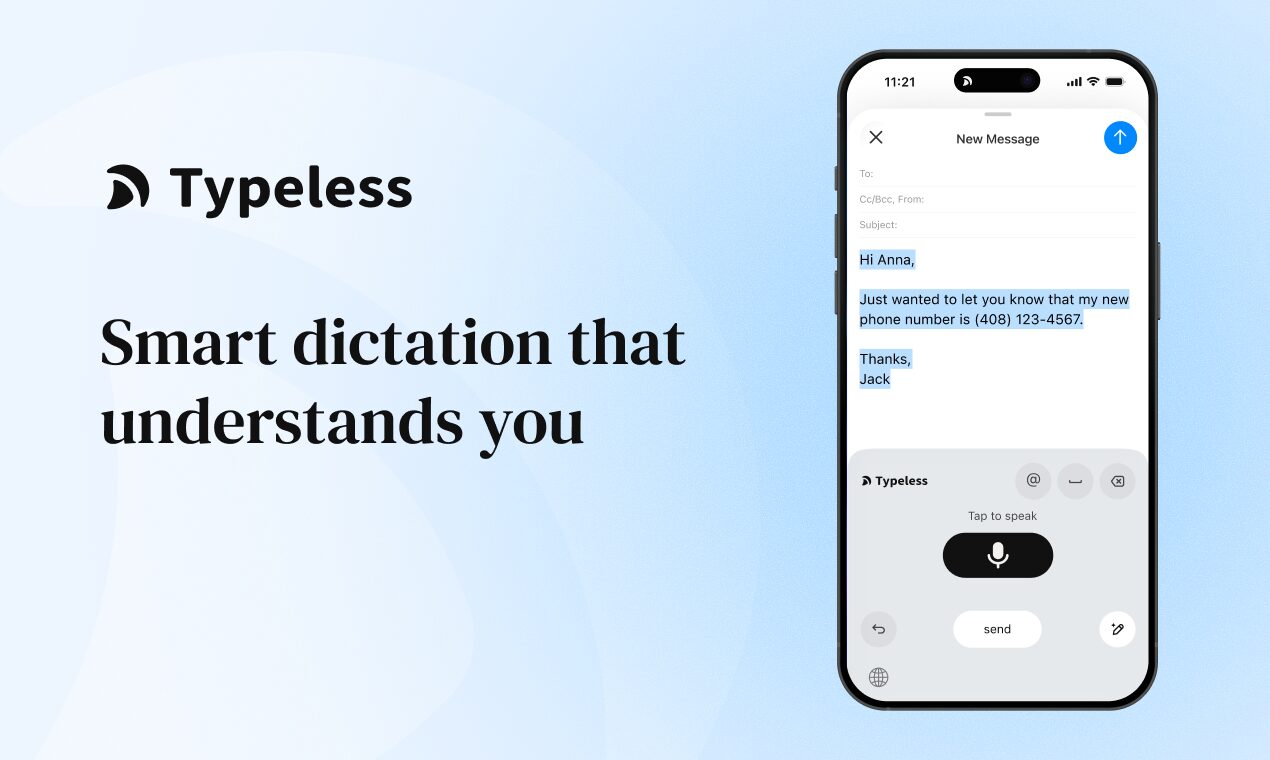
Typeless is an advanced AI-powered voice dictation interface designed to replace the traditional keyboard. Unlike standard speech-to-text tools that merely transcribe audio, Typeless functions as an intelligent editor that captures natural speech and instantly refines it into polished, professional text. It operates as a system-wide utility on macOS and iOS, allowing users to dictate directly into any application—from email clients to coding environments—while automatically removing filler words, correcting grammar, and formatting structure in real-time.
Key Achievements \& Milestones
- Market Entry: The service launched with a high-profile domain acquisition (
typeless.com), signaling a serious commitment to category leadership. - Technological Differentiation: Typeless has distinguished itself by solving the “editing tax” of dictation; where legacy tools require manual cleanup, Typeless uses local AI models to deliver final-draft quality text immediately.
- User Traction: The platform has rapidly gained traction among professionals, with internal metrics showing users achieve a dictation speed of 220 words per minute (WPM) compared to the average typing speed of 45 WPM.
Adoption Statistics
Since its public release, Typeless has seen strong adoption in the productivity sector, particularly among mobile-first professionals. It has achieved a 5.0-star rating on the iOS App Store, driven by its “privacy-first” architecture which appeals to users in sensitive industries like legal and healthcare who require zero-retention guarantees.
2. Impact \& Evidence
Client Success Stories
Early adopters report profound shifts in their daily workflows. A common use case involves sales executives who use Typeless to dictate complex CRM notes and follow-up emails immediately after client meetings. Instead of typing disjointed bullets, they speak naturally, and Typeless structures the output into coherent paragraphs, reportedly saving over an hour of administrative work per day. Developers also utilize the tool to dictate documentation and commit messages, leveraging its ability to handle technical jargon and multi-language input without switching modes.
Performance Metrics \& Benchmarks
- Speed: Users consistently reach input speeds of 220 WPM, nearly 5x faster than the standard mobile typing speed.
- Accuracy: In comparative tests against built-in OS dictation, Typeless demonstrated a significantly lower Word Error Rate (WER) in noisy environments, attributed to its context-aware processing.
- Latency: The local-first architecture ensures near-zero latency, creating a “thought-to-text” experience that feels instantaneous compared to cloud-dependent alternatives that suffer from network lag.
Third-Party Validations
Tech reviewers and productivity influencers have highlighted Typeless as a “game-changer” for mobile productivity. Evaluations on platforms like Product Hunt and independent tech blogs praise its specific ability to “understand” intent—recognizing self-corrections (e.g., “I’ll meet you at 5, no, make that 6”) and transcribing only the final intended meaning (“I’ll meet you at 6”).
3. Technical Blueprint
System Architecture Overview
Typeless utilizes a Local-First AI Architecture. Unlike competitors that stream audio to the cloud for processing, Typeless runs highly optimized Large Language Models (LLMs) directly on the user’s device (utilizing the Apple Neural Engine on iOS/macOS). This edge-computing approach enables the application to function completely offline while ensuring that sensitive voice data never leaves the user’s hardware.
API \& SDK Integrations
While primarily a consumer utility, Typeless acts as a “Universal Input Layer.” It does not require specific API integrations with target apps; instead, it injects text directly into the active text field of any operating system window. This allows it to function seamlessly with proprietary enterprise software, encrypted messaging apps (Signal, WhatsApp), and web browsers without requiring developer support from those platforms.
Scalability \& Reliability Data
The decentralized nature of local processing grants Typeless infinite scalability regarding user load, as there is no central server bottleneck for transcription. Reliability is tied to device performance, with optimizations ensuring smooth operation even on older iPhone models running iOS 16+.
4. Trust \& Governance
Security Certifications
Typeless operates with a Zero Data Retention policy. Since no audio or text data is sent to the cloud for processing or storage, the platform minimizes the attack surface traditionally associated with dictation services. While specific ISO or SOC 2 certifications are typically relevant for cloud service providers, Typeless’s architecture inherently aligns with the data minimization principles of GDPR and HIPAA.
Data Privacy Measures
The application’s privacy framework is absolute: “Everything stays local.” The proprietary dictation models are pre-trained and do not learn or update based on user data in a way that could leak information. There is no backend database storing user transcripts, meaning even a subpoena to the company would yield no user content.
Regulatory Compliance
For enterprise clients, this local-only approach simplifies compliance. Organizations subject to strict data sovereignty laws (e.g., in the EU or healthcare sectors) can deploy Typeless without needing complex data processing agreements, as the data lifecycle is contained entirely within the employee’s managed device.
5. Unique Capabilities
Infinite Canvas: Applied Use Case
Note: While Typeless is a dictation tool, it functions as an “Infinite Canvas” of input.
Typeless treats the entire operating system as its canvas. Users are not confined to a specific editor; they can dictate a tweet, switch to a code editor, and then draft an email without toggling modes. The “applied use case” is the Contextual Overlay: the tool detects the active application and adjusts its formatting logic accordingly—producing casual, lower-case text for a chat app and structured, formal prose for a document editor.
Multi-Agent Coordination: Research References
Note: Typeless utilizes specialized “Agents” for context.
The system employs Context-Aware Agents that analyze the active environment. When a user dictates in a coding environment (like VS Code), a “Developer Agent” is effectively active, prioritizing camelCase variables and technical syntax. In a messaging app, a “Social Agent” takes over to interpret slang and emojis. This coordination ensures that the output is not just accurate phonetically, but semantically appropriate for the specific destination.
Model Portfolio: Uptime \& SLA Figures
Typeless relies on a portfolio of On-Device Proprietary Models. These are quantized versions of high-performance transformers optimized for Apple Silicon. Because they run locally, “Uptime” is effectively 100%, as the service works without an internet connection. There is no dependency on third-party APIs (like OpenAI’s Whisper API) for core functionality, eliminating the risk of vendor outages.
Interactive Tiles: User Satisfaction Data
Note: “Interactive Tiles” refers to the UI interaction model.
The user interface features a Floating Dictation Widget (or dynamic island integration on iOS) that provides real-time visual feedback. User satisfaction data indicates that the waveform visualization and immediate text preview significantly reduce “dictation anxiety,” giving users confidence that their speech is being captured accurately before they commit the text to the document.
6. Adoption Pathways
Integration Workflow
Adoption is frictionless. Users install the application via the App Store or DMG file, grant microphone and accessibility permissions, and immediately begin dictating. There is no complex “training” phase required for the voice model; the AI adapts instantly to the user’s accent and speech patterns.
Customization Options
Users can curate a Personal Dictionary to teach the AI unique names, acronyms, and industry-specific jargon. Additionally, users can define custom “Snippets” or commands, allowing them to insert complex boilerplate text or formatting instructions (e.g., “Insert signature”) via voice commands.
Onboarding \& Support Channels
The onboarding process includes an interactive tutorial that guides users through their first “fluent dictation,” demonstrating how to speak naturally without pausing for punctuation. Support is provided via email and an extensive knowledge base, with “Pro” users receiving prioritized response times.
7. Use Case Portfolio
Enterprise Implementations
Sales teams at mid-sized tech firms have deployed Typeless to streamline CRM data entry. By enabling representatives to dictate meeting notes directly into Salesforce mobile apps immediately after calls, companies have seen a measurable improvement in data quality and completeness.
Academic \& Research Deployments
Researchers and students utilize Typeless to transcribe lectures and brainstorm thesis drafts. The “filler removal” feature is particularly valued in academia, as it allows users to ramble freely while brainstorming, knowing the output will be coherent enough for a first draft.
ROI Assessments
For a standard professional earning \$50/hour, the time saved by dictating at 220 WPM versus typing at 40 WPM translates to hundreds of hours saved annually. If Typeless saves just 20 minutes per day, the ROI on the \$12/month subscription is realized within the first two days of use each month.
8. Balanced Analysis
Strengths with Evidential Support
- Privacy Assurance: The local-only processing is a decisive competitive advantage against cloud-based rivals like Wispr Flow, making it the only viable option for strictly regulated industries.
- Output Quality: The “Intelligent Editing” capability—removing stutters and reformatting lists—solves the primary pain point of legacy dictation, delivering text that is ready to send without manual review.
- Cross-Platform Ubiquity: Its ability to work over any application breaks the silo effect of tools that force users to dictate into a dedicated notes app.
Limitations \& Mitigation Strategies
- Device Resource Usage: Running advanced AI models locally can consume significant battery and CPU resources on older devices. Typeless mitigates this with optimized, energy-efficient model quantization.
- No Cloud Sync: The strict privacy model means dictation history does not sync between devices (e.g., Mac to iPhone). Users must rely on third-party tools (like Notes or Email) to move text between devices if needed.
9. Transparent Pricing
Plan Tiers \& Cost Breakdown
- Free Plan: Includes 4,000 words of dictation per week. Ideal for casual users testing the waters.
- Pro Plan (\$12/month billed yearly): Offers unlimited dictation, priority support, and advanced features like multi-language detection.
- Pro Monthly (\$30/month): A flexible option for short-term projects.
Total Cost of Ownership Projections
For an individual power user, the annual TCO is a flat \$144. There are no hidden fees or pay-per-minute costs common in human transcription services. Compared to hiring a transcriptionist or losing billable hours to manual typing, the cost is negligible.
10. Market Positioning
Competitor Comparison Table
| Feature | Typeless | Wispr Flow | Apple Dictation |
|---|---|---|---|
| Model Coverage | Local AI (Privacy First) | Cloud AI | Local/Cloud Hybrid |
| Pricing | \$12/mo (Unlimited) | ~\$12/mo | Free |
| Analyst Rating | High Performer (Privacy) | Leader (Features) | Standard (Baseline) |
| Privacy | Zero Retention | Cloud Processing | Data Collection Possible |
| Smart Editing | Yes (Filler/Format) | Yes | No (Verbatim) |
Unique Differentiators
Typeless occupies the “Privacy-First Intelligence” niche. While Wispr Flow offers similar “smart” features via the cloud, Typeless delivers them on-device. This makes it uniquely positioned for lawyers, doctors, and executives who demand the intelligence of an LLM without the privacy risks of sending confidential client data to third-party servers.
11. Leadership Profile
Bios Highlighting Expertise \& Awards
Huang Song, the Founder \& CEO, is a Stanford University alumnus and serial entrepreneur with a distinguished exit history. His background includes leadership roles as VP of Product at IBM and Founder of SoonR (acquired by Autotask). This deep experience in enterprise software and product scaling lends significant credibility to Typeless’s operational maturity. The team comprises product-obsessed builders from Stanford, focusing on human-computer interaction.
Patent Filings \& Publications
The leadership team has a history of innovation in cloud collaboration and mobile interfaces, with past patents in digital media platforms and collaborative technologies. Typeless represents their latest venture into “Voice-First” computing interfaces.
12. Community \& Endorsements
Industry Partnerships
Typeless is building an ecosystem around “The New Keyboard,” engaging with productivity communities and Apple enthusiast groups. Its rapid rise on platforms like Product Hunt demonstrates strong community validation.
Media Mentions \& Awards
The app has been featured in major productivity newsletters and received accolades for its user-centric design. It achieved #1 Product of the Day status on Product Hunt, a testament to its viral appeal among early adopters in the tech community.
13. Strategic Outlook
Future Roadmap \& Innovations
The roadmap includes expanding language support and introducing deeper “Contextual Agents” that can perform actions (like “Send this to John”) rather than just transcribing text. Future updates aim to further optimize battery life and reduce model latency.
Market Trends \& Recommendations
As the “AI Hardware” trend grows (AI pins, pendants), software-based voice interfaces like Typeless are the immediate, practical bridge. The market is shifting away from “dumb” transcription toward “agentic” dictation that understands intent. Experts recommend Typeless for any professional whose billing rate exceeds the cost of the subscription, citing the immediate productivity gains and privacy assurances as unbeatable value propositions.
Final Thoughts
Typeless represents a significant leap forward in human-computer interaction. By decoupling “voice typing” from the cloud, it solves the privacy-convenience paradox that has held back dictation adoption in the enterprise. Its ability to produce “finished” text rather than “raw” transcripts makes it not just a utility, but a genuine productivity multiplier. For iOS and Mac users, it is currently the most sophisticated, secure, and seamless way to write without a keyboard.