
Table of Contents
Overview
A2UI is an open-source protocol released by Google on December 15, 2025, that enables AI agents to safely generate rich, interactive user interfaces by sending declarative JSON descriptions rather than executable code. Launched on Product Hunt on December 24, 2025 with 241 upvotes, A2UI addresses a fundamental limitation in agent-driven applications: traditional AI agents can only respond with text, forcing users to parse lengthy descriptions, respond to sequential questions, or accept degraded interfaces when rich interactions would provide dramatically better user experiences.
The protocol operates as part of Google’s emerging agentic ecosystem, layering on top of the A2A (Agent-to-Agent) protocol for secure inter-agent communication. A2UI specifies how agents can stream declarative component definitions as flat, LLM-friendly JSON to client applications that render components natively using their own framework implementations (React, Angular, Flutter, SwiftUI, Jetpack Compose, Web Components, or custom renderers). This architecture eliminates the core security risk of code-generating agents—arbitrary code execution on the client—while enabling true framework-agnostic cross-platform UI generation where a single agent response renders consistently on web, mobile, and desktop applications.
Currently in version 0.8 public preview, A2UI remains in active development with the specification and implementations actively evolving. The project is Apache 2.0 licensed and developed in collaboration with the open source community including CopilotKit, Flutter’s GenUI SDK, and AG-UI, ensuring multiple reference implementations and ecosystem adoption.
Key Features
Declarative Security-First Design: Rather than agents generating executable code that runs on clients with full system access, A2UI restricts agents to describing UI structure and data using declarative JSON. Clients maintain a catalog of pre-approved components that agents can request. Agents cannot execute arbitrary code, inject malicious scripts, or access systems beyond their declared capabilities. This security-by-architecture prevents entire categories of attack vectors (code injection, script execution, privilege escalation) that plague systems where agents generate executable code.
Flat Streaming JSON Optimized for LLMs: The A2UI specification uses simple, flat JSON structures specifically designed to be easily generated by transformer-based language models. Rather than requiring complex nested syntax or imperative command sequences, A2UI describes UI as declarative component trees (“this is a column with these children”). This structural simplicity enables LLMs to generate valid A2UI messages consistently without detailed prompt engineering or multi-shot examples. The flat structure also supports streaming and progressive generation—LLMs can generate the JSON incrementally without needing to produce perfect complete output in a single token sequence.
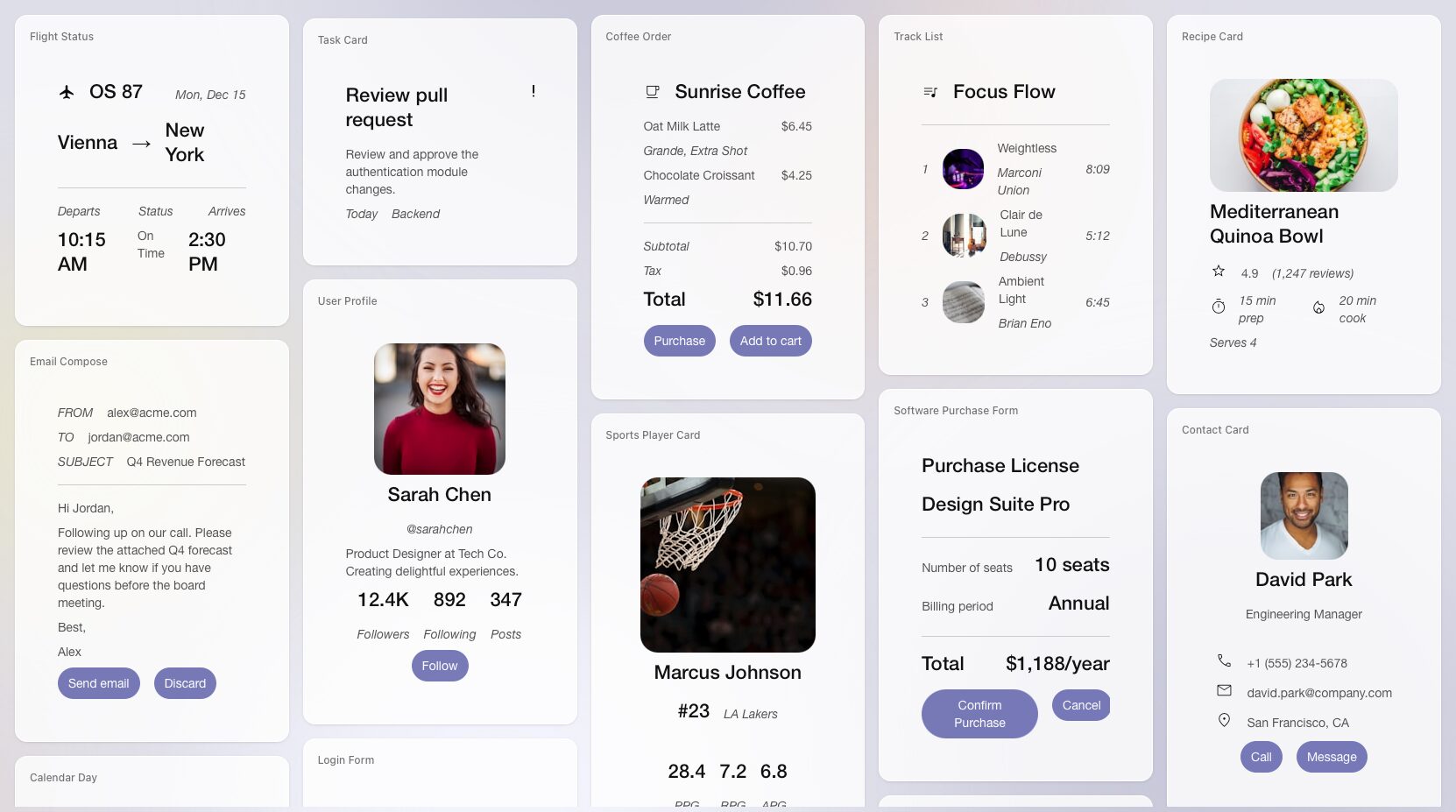
Framework-Agnostic Rendering: The same A2UI message streams to clients running on any platform and renders using native components appropriate to each platform’s UI framework. React applications render using React components, Flutter applications render using Flutter widgets, native mobile applications render using platform-native UI elements (SwiftUI on iOS, Jetpack Compose on Android). This portability stems from A2UI’s architecture: agents describe abstract component types (“I need a card with a button”), and each client maps these abstract types to its native widget implementations. The result is consistent visual and behavioral rendering across platforms while preserving each platform’s native feel, accessibility features, performance characteristics, and styling conventions.
Progressive Rendering from Streaming: A2UI messages stream to clients as JSON objects rather than arriving as monolithic payloads, enabling progressive rendering. Users see UI components appear and build in real-time as the agent generates them, reducing perceived latency and creating engaging animated experiences. This streaming architecture particularly benefits slower network connections and complex UIs where rendering each component as it arrives provides superior user experience to waiting for complete response generation.
Component Catalog Approval Model: Each client application defines which UI components agents can request, creating a flexible, extensible approach to capability control. Applications publish component catalogs describing available widgets (buttons, cards, forms, custom domain-specific components) along with their properties and constraints. Agents can request components only from the published catalog, preventing requests for undefined or dangerous components. This model enables custom domain-specific UI languages—healthcare applications can define health-record-specific components, fintech applications can define financial-instrument components—while maintaining security through explicit approval.
Layered Integration with A2A Protocol: A2UI builds on top of Google’s A2A (Agent-to-Agent) protocol for secure multi-agent communication. An orchestrator agent can understand, modify, and route A2UI messages between specialized sub-agents and client applications. This layering enables sophisticated architectures where database agents, API agents, and UI agents collaborate while maintaining clear contracts and trust boundaries through A2UI messages.
Day-0 AG-UI Compatibility: A2UI achieves seamless integration with the AG-UI protocol (Agent-to-User Interaction Protocol) created by CopilotKit, enabling developers to build full-stack agentic applications connecting A2A (agent-to-agent) backends with A2UI-based frontends. This compatibility ensures that teams can adopt A2UI within their existing AG-UI implementations without requiring separate integrations.
Multi-Agent Collaboration Support: A2UI’s lightweight, declarative format makes UI descriptions easy for orchestrator agents to understand, analyze, and modify. An orchestrator orchestrates work across specialized sub-agents, receiving A2UI messages describing required UIs, combining them, restructuring them, and sending combined messages to clients. This enables sophisticated multi-agent systems where database specialists, business logic specialists, and UI specialists operate as independent agents coordinated through A2UI contracts.
Data Binding Abstraction: A2UI provides data binding primitives enabling agents to connect UI components to data sources without specifying implementation details. Clients handle actual data binding, variable management, and reactivity using their platform’s native mechanisms, ensuring consistency with application architecture patterns.
Adjacency List Model for Complex Layouts: The specification uses adjacency list graph models enabling agents to describe complex multi-level nested layouts without rigid hierarchical constraints, supporting sophisticated component compositions.
How It Works
Users send requests to AI agents using natural language: “Find flights to Tokyo for next week, show options for economy and business class.”
The AI agent processes the request, determines what information needs to be displayed, and generates A2UI messages describing the required UI. Rather than responding with text like “I found 47 flight options with prices ranging from \$450-2100,” the agent generates declarative JSON describing a component tree: a list of flight cards, each card showing airline, departure time, arrival time, price, and clickable booking buttons.
This JSON message streams to the client application. As each JSON object arrives, the client renders corresponding UI components using its native framework. If the client is a React web application, it renders React components. If the client is a Flutter mobile application, it renders Flutter widgets. If the client is a native iOS application, it renders SwiftUI components. The visual result adapts to each platform while maintaining consistent behavior and information structure.
The client application maps abstract A2UI component types to its pre-approved component catalog. When the agent requests a “card” component, the client uses whatever card implementation exists in its design system. The agent never directly manipulates the UI—it only describes what components are needed, and the client maintains complete control over rendering and styling.
As the UI renders, users interact with components (clicking buttons, selecting options, entering text). These interactions send action events back to the agent. The agent receives the action (“user clicked booking button for flight option 2”), processes it (perhaps fetching detailed booking information or confirming the selection), and streams updated A2UI messages describing the next UI state.
This cycle repeats: user action → agent processes → streams new A2UI describing updated UI → client renders → user sees updated interface. Throughout this flow, the agent never executes arbitrary code, never directly manipulates client state, and never gains access to system resources beyond its declared capabilities.
Use Cases
AI Agents Delivering Rich Interactive UIs Without Code Execution Risk: Customer service agents responding to “help me check my account balance” can stream interactive account dashboards showing transaction history, account details, and action buttons—all safely described through A2UI without risking malicious code injection or unauthorized system access. Financial applications, healthcare systems, and sensitive industries can confidently deploy agent-generated UIs knowing execution remains restricted to pre-approved component catalogs.
Conversational Commerce and Transaction Processing: E-commerce agents responding to natural language requests like “show me running shoes in size 10” stream interactive product galleries with filtering, sorting, comparison tools, and shopping cart management—all generated on-the-fly rather than hardcoded for each product category. Users see exactly the interface needed for their specific query rather than generic predetermined layouts.
Multi-Platform Applications Requiring One Agent Response: Applications targeting web (React), iOS (SwiftUI), Android (Jetpack Compose), and desktop (Electron/Flutter) clients receive single A2UI messages that render appropriately on each platform. Development teams avoid maintaining separate agent logic per platform or forcing suboptimal UIs that work equally poorly everywhere.
Agent Orchestration Systems with Multiple Specialized Sub-Agents: Recruiting systems combine agents specializing in job listing databases, candidate evaluation, interview scheduling, and offer letter generation. The orchestrator coordinates these specialists, receiving A2UI messages describing required UI from each sub-agent, combining them into cohesive candidate journey interfaces. Complex workflows that would require intricate API contracts between agents instead use A2UI as the lingua franca for expressing capabilities and requirements.
Real-Time Data Visualization and Reporting: Analytics agents stream dynamic dashboards, charts, and reports as JSON descriptions, enabling progressive rendering that updates in real-time as agents calculate results. Users see visualizations building incrementally rather than waiting for complete computation.
Teams Building Agent Experiences Without Code Injection Risks: Development teams deploying third-party agents from external providers or untrusted sources can provide A2UI integration without security concerns. The pre-approved component catalog model ensures external agents cannot perform system operations beyond their declared capabilities, enabling safe integration of agents from open ecosystems.
Domain-Specific UI Languages for Specialized Applications: Healthcare applications define medical-record-specific components (vitals displays, medication trackers, symptom assessments). Financial applications define investment-specific components (portfolio dashboards, trade execution interfaces, risk analytics). Agents trained on domain-specific components can generate contextually appropriate UIs without generic component limitations.
Pros and Cons
Advantages
Secure by Design Eliminates Code Execution Risks: Unlike code-generating agents that present fundamental security vulnerabilities, A2UI restricts agents to declarative component descriptions from pre-approved catalogs. This architectural security-first approach eliminates entire attack vector categories including code injection, script execution, and privilege escalation. Organizations can confidently deploy third-party agents or agents trained on untrusted data knowing they cannot execute arbitrary code or access unauthorized resources.
LLM-Friendly JSON Makes Agent Integration Straightforward: The flat, declarative JSON structure designed specifically for transformer-based language models enables LLMs to generate valid A2UI messages consistently without complex prompt engineering or few-shot examples. This accessibility dramatically lowers the barrier to building agent applications, enabling developers without specialized agent training to implement sophisticated agentic UIs.
Framework-Agnostic Rendering Eliminates Multi-Platform Complexity: Building applications for web, iOS, Android, and desktop typically requires separate implementations, separate API contracts, or lowest-common-denominator UI experiences. A2UI’s platform-agnostic architecture means single agent implementations render optimally on all platforms using each platform’s native UI framework. This capability dramatically reduces development complexity and time-to-market for multi-platform applications.
Progressive Streaming Rendering Improves User Experience: Progressive rendering as agents generate JSON incrementally reduces perceived latency and creates engaging animated UI building experiences. Users see results appearing in real-time rather than waiting for complete computation, particularly valuable for slow networks or complex UIs requiring substantial computation.
Pre-Approved Component Catalogs Enable Custom Domain Languages: Applications define specialized components tailored to their domain rather than forcing agents to work with generic components. Healthcare applications can provide medical-record-specific UI components, financial applications can provide investment-specific components. This specialization enables agents to generate contextually appropriate UIs precisely matching business domain needs.
Enables Multi-Agent Orchestration with Clear Contracts: A2UI messages provide clean contracts between specialized sub-agents and orchestrators, enabling sophisticated agent systems. Database specialists, business logic specialists, and UI specialists operate as independent agents coordinating through A2UI messages, avoiding tight coupling and enabling team-based development.
Open Source Apache 2.0 Licensed with Active Ecosystem: The Apache 2.0 license permits commercial use and modification, and Google’s involvement ensures active development and ecosystem adoption. CopilotKit, Flutter’s GenUI SDK, AG-UI, and others provide reference implementations and production-ready integrations.
Disadvantages
Version 0.8 Public Preview Means Specification Still Evolving: A2UI remains in early preview status with the specification actively evolving. Developers building production applications on A2UI should anticipate breaking changes, specification refinements, and migration work as the protocol matures. This early-stage status introduces risk for mission-critical deployments that cannot tolerate protocol disruptions.
Requires Pre-Approved Component Catalog Setup: A2UI’s security model requires applications to explicitly define approved components before agents can use them. This initial setup adds overhead compared to frameworks enabling arbitrary UI generation. Applications must invest upfront in component catalog definition, documentation, and maintenance as agents’ capabilities expand.
Developer Integration Work Needed for Renderers and Transports: While Google provides reference implementations, teams must implement or integrate renderers for their specific platforms and configure transport mechanisms. This contrasts with higher-level frameworks providing complete end-to-end implementations, requiring more infrastructure development for adoption.
Limited Framework Support Beyond Major Platforms: A2UI support is confirmed for React, Angular, Flutter, iOS (Swift), Android (Jetpack Compose), and Web Components. Niche or specialized frameworks may lack community implementations, requiring custom renderer development. Organizations committed to less mainstream technology stacks may face implementation barriers.
Component Catalog Definition Complexity at Scale: Large applications with hundreds of specialized components face challenges documenting component properties, constraints, and agent capabilities. The component catalog itself becomes a complex artifact requiring governance, versioning, and synchronization between agents and renderers. This management burden grows with application complexity.
Unproven at Large Scale Enterprise Deployment: As a December 2025 release in public preview, A2UI lacks demonstrated capability at enterprise scale. Large organizations require proven reliability, scalability, support infrastructure, and customer references—credibility markers not yet available for a protocol weeks into public release.
Agent Generation Quality Depends on Training Data and Prompt Engineering: A2UI’s success depends on agents understanding component catalog capabilities and generating appropriate UI descriptions. Agents trained on outdated information, suffering hallucination issues, or limited context awareness may generate suboptimal or unusable UI descriptions requiring human intervention.
Pricing
Free and Open-Source Forever: A2UI as a protocol is completely free under the Apache 2.0 license. No licensing fees, no commercial restrictions, no usage-based pricing. The protocol itself can be used, modified, and redistributed without cost or legal obligation.
Implementation and Infrastructure Costs: While the protocol is free, implementing A2UI in applications requires developer effort:
- Client renderers (React, Flutter, Angular implementations) require engineering and maintenance
- Server infrastructure for running agents and serving A2UI messages scales with your application usage
- LLM API usage for running agents incurs costs from providers (OpenAI, Anthropic, Google Gemini, etc.)
For organizations building on top of existing implementations (CopilotKit’s AG-UI, Flutter’s GenUI SDK), integration costs are minimized through managed services providing production-ready A2UI infrastructure.
Comparative Cost Context: Code-generating agent frameworks charge licensing fees (\$0-100+ per developer per month) and introduce security overhead. Framework-specific solutions require separate implementations per platform. A2UI’s free protocol combined with open-source reference implementations enables cost-effective multi-platform agent development at scale, with costs limited to compute infrastructure and LLM API usage.
How Does It Compare?
A2UI occupies a unique position as the first open, standardized protocol for agent-generated UIs. Here’s how it compares to alternative approaches:
vs. Text-Only Agent Responses
User Experience: Text-only responses force users to parse information, respond to sequential questions, or suffer from degraded interaction experiences. A2UI enables agents to generate rich interactive UIs—flight booking forms with date pickers, shopping carts with product cards, data visualizations with filters—improving user experience dramatically.
Discoverability and Presentation: Agents can organize information optimally for the task rather than forcing linear text presentation. Users see relevant options, filters, and actions immediately rather than reading descriptions.
Iteration Efficiency: Interactive UIs enable direct user action rather than question-answer sequences. Booking a flight requires one interaction with A2UI’s generated form versus multiple question-answer cycles with text-only agents.
Best For: Use text-only responses for simple information retrieval or when rich UI isn’t necessary. Choose A2UI when user experience benefits from interactive exploration, complex data presentation, or transaction processing.
vs. Code-Generating Agents
Security: Code-generating agents present fundamental security vulnerabilities through arbitrary code execution. A2UI restricts agents to pre-approved component catalogs eliminating code execution risks entirely. Organizations can safely deploy agents from untrusted sources using A2UI; code-generating agents require extensive sandboxing and monitoring.
Implementation Complexity: Code-generating agents require sandboxes, execution environments, and security monitoring adding significant infrastructure complexity. A2UI generates declarative descriptions requiring no special security infrastructure—clients render components using standard framework mechanisms.
Cross-Platform Compatibility: Code generators typically produce JavaScript, Python, or language-specific implementations requiring separate implementations per platform. A2UI generates framework-agnostic JSON rendering on all platforms identically.
Debugging and Reliability: Code execution unpredictability (infinite loops, memory leaks, crashes) plagues code-generating agents. A2UI’s declarative nature means agents cannot produce runtime errors—invalid component descriptions are rejected rather than causing system crashes.
Best For: Code-generating agents may provide more fine-grained control for specialized use cases requiring custom logic. Choose A2UI for general-purpose agent applications prioritizing security, reliability, and cross-platform consistency.
vs. Framework-Specific Agent Solutions (Vercel AI SDK, Anthropic SDK, LlamaIndex UI)
Platform Agnosticism: Framework-specific solutions tie agents to particular technology stacks (React + Node.js, Python + Django, etc.). A2UI generates descriptions rendering on any platform using any framework, eliminating technology lock-in.
Multi-Agent Compatibility: Framework-specific solutions assume monolithic architecture with single framework controlling the entire application. A2UI enables multi-agent systems where agents on different technology stacks coordinate through A2UI messages.
Integration Effort: Framework-specific solutions provide deep integration with particular ecosystems requiring less setup work. A2UI requires more integration effort but provides superior long-term flexibility and ecosystem independence.
Standardization: Framework-specific solutions lack cross-industry standardization limiting ecosystem interoperability. A2UI as an open protocol enables standard interfaces enabling composability across organizations.
Best For: Framework-specific solutions provide optimal experience within supported ecosystems with minimal integration complexity. Choose A2UI for multi-platform, multi-agent, or ecosystem-agnostic applications requiring long-term flexibility.
vs. Hardcoded UI Systems
Flexibility and Adaptation: Hardcoded UIs force building separate interfaces for each conceivable agent response and user scenario, quickly becoming unmaintainable. A2UI enables agents to generate UIs dynamically adapting to specific contexts and user needs.
Time-to-Market: Building interfaces for every scenario takes extensive development time. A2UI enables shipping applications with flexible agent-generated UIs dramatically faster.
Maintenance Burden: Hardcoded systems require application updates whenever new agent capabilities should surface new UIs. A2UI’s dynamic generation enables agent improvements flowing through to users automatically.
Best For: Hardcoded UIs suit simple, unchanging scenarios with limited user interactions. Choose A2UI for complex applications requiring flexible, context-adaptive UIs.
vs. Rule-Based UI Generation Systems
AI Integration: Rule-based systems lack AI decision-making requiring explicit rule configuration for each scenario. A2UI leverages AI agents’ reasoning to generate appropriate UIs for novel situations without pre-programming every possibility.
Flexibility: Rule systems become complex and fragile at scale. A2UI’s AI-driven approach scales to arbitrary complexity.
Maintenance: Rule systems require manual updates as business logic changes. A2UI’s AI-driven generation often adapts automatically.
Best For: Rule-based systems suit highly constrained domains with finite, well-understood scenarios. Choose A2UI for complex, dynamic domains where AI reasoning provides value.
Key Differentiators
A2UI distinguishes itself as the first open-source, standardized protocol specifically designed for agent-generated UIs. Unlike framework-specific solutions tied to particular technology stacks, A2UI achieves true framework agnosticism. Unlike code-generating agents, A2UI provides security-by-architecture preventing code execution risks. Unlike hardcoded systems, A2UI enables dynamic adaptation to user needs and context. Unlike rule-based systems, A2UI leverages AI reasoning enabling flexible handling of novel scenarios.
The combination of security, portability, LLM-friendliness, and ecosystem neutrality positions A2UI as foundational infrastructure for the emerging agent-driven application landscape.
Final Thoughts
A2UI represents Google’s attempt to standardize how AI agents can safely generate user interfaces across platforms, addressing genuine pain points in current agent application development. The December 2025 announcement and Product Hunt launch with 241 upvotes signals growing recognition that text-only agent responses represent a severe limitation, and that code-generating agents introduce unacceptable security risks.
The protocol’s core insights are sound: declarative descriptions prevent code execution vulnerabilities, LLM-friendly JSON enables reliable agent generation, framework-agnostic rendering eliminates platform fragmentation, and pre-approved component catalogs balance capability with security. These design choices represent thoughtful architecture addressing real problems in agentic systems.
However, the December 2025 launch timing and v0.8 public preview status create adoption challenges. The specification is actively evolving, potentially disrupting early implementations. The reference implementation ecosystem, while promising (CopilotKit, Flutter GenUI, AG-UI), requires maturation before becoming production-default infrastructure. Organizations must assess whether A2UI’s current maturity aligns with their timeline and risk tolerance.
The protocol’s success depends on ecosystem adoption. If Flutter, React, Angular, iOS, and Android communities rapidly implement high-quality renderers and agents train on A2UI’s component catalogs, A2UI could become the lingua franca for agent-generated UIs. If adoption remains fragmented with multiple competing protocols, A2UI becomes one option among many rather than the de facto standard.
The positioning as part of Google’s broader agentic ecosystem (A2A, AG-UI) suggests long-term commitment and substantial investment in this protocol family. Google’s adoption internally across products should provide compelling use case validation and drive ecosystem momentum. However, companies burned by previous Google protocol initiatives (Polymer, AMP’s polarized reception) may rightfully demand more stable track records before major commitments.
For developers building agent applications in 2026, A2UI merits serious evaluation as a protocol-level infrastructure choice. The security guarantees, cross-platform capabilities, and emerging ecosystem support address genuine pain points. However, prudent adoption strategy suggests pilot implementations on non-critical applications, building abstractions enabling future switching if better alternatives emerge, and monitoring specification evolution as the v0.8 preview matures toward v1.0 stability.
For enterprise organizations, waiting for v1.0 stability, demonstrated customer references, and mature production infrastructure may be prudent. For startups and teams building agent applications without legacy constraints, A2UI’s promise of simplified multi-platform agent development and standardized ecosystem interoperability warrants experimentation now.
As the agentic application landscape matures and agents become increasingly capable, standardized UI generation protocols like A2UI will become foundational infrastructure as important to agent development as HTTP became to web development. The question is not whether agent-generated UIs become standard, but which protocols dominate. A2UI’s open-source foundation, Google backing, and thoughtful architecture position it well—though ecosystem adoption will ultimately determine success.
Major Corrections Summary
- Announcement date added: Google publicly announced December 15, 2025
- Product Hunt launch documented: December 24, 2025 with 241 upvotes
- Version status clarified: Currently v0.8 in public preview (early stage, specification evolving)
- Apache 2.0 license confirmed: Free and open-source verified
- Google authorship verified: Created by Google with CopilotKit and open source community contributions
- A2A protocol foundation: A2UI layers on top of A2A (Agent-to-Agent) protocol specified
- AG-UI compatibility: Day-0 support for AG-UI (Agent-to-User Interaction Protocol) verified
- Framework support detailed: React, Angular, Flutter, SwiftUI, Jetpack Compose, Web Components confirmed
- Component catalog security: Pre-approved component model preventing code execution verified
- Comprehensive competitive analysis: Structured comparisons with text-only responses, code-generating agents, framework-specific solutions, hardcoded UIs, and rule-based systems