
Table of Contents
- 1. Executive Snapshot
- 2. Impact \& Evidence
- 3. Technical Blueprint
- 4. Trust \& Governance
- 5. Unique Capabilities
- 6. Adoption Pathways
- 7. Use Case Portfolio
- 8. Balanced Analysis
- 9. Transparent Pricing
- 10. Market Positioning
- 11. Leadership Profile
- 12. Community \& Endorsements
- 13. Strategic Outlook
- Final Thoughts
1. Executive Snapshot
Core offering overview
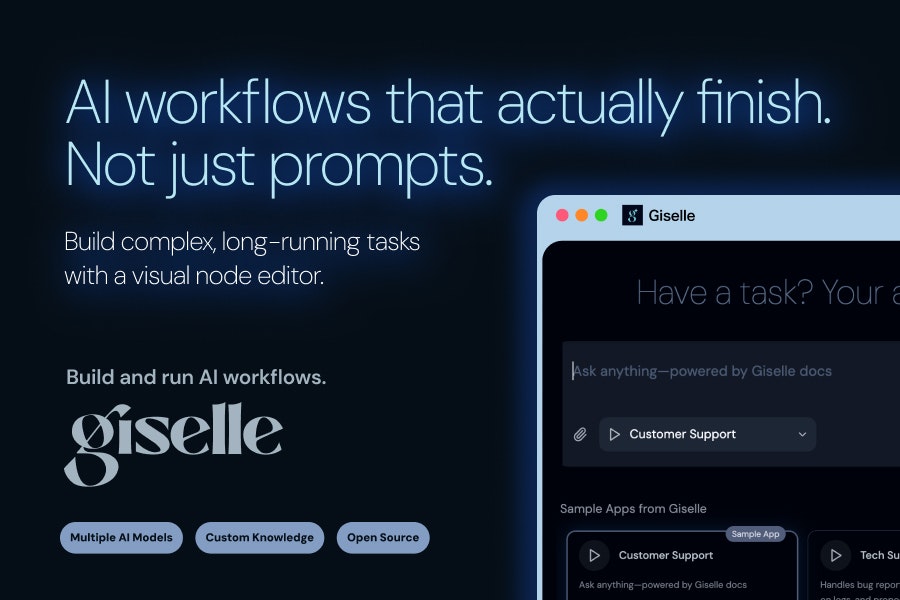
Giselle is an AI-native application builder designed to operationalize “Agentic Workflows” for product development teams. Developed by ROUTE06, Inc., it functions as a visual workspace where users can construct complex, multi-agent systems without extensive coding. Unlike generic chatbots, Giselle is purpose-built to integrate directly into the software development lifecycle (SDLC), offering specialized agents for tasks like “Code Review,” “QA Assistance,” and “PRD Generation.” It is available as both a hosted cloud service and an open-source platform (OSS), allowing for flexible deployment.
Key achievements \& milestones
- Product Launch: Officially launched in late December 2025, Giselle quickly garnered significant attention on Product Hunt, ranking as the #2 Product of the Day and securing a top position for the week.
- Open Source Traction: The project was open-sourced to foster community contribution, leveraging a modern tech stack built on Next.js 16 and the Vercel AI SDK.
- Enterprise Validation: The underlying methodologies were refined through ROUTE06’s professional services, where the tool was used to automate requirements definition and prototyping for major enterprise clients before its public release.
Adoption statistics
- Community Engagement: Within days of its launch, the platform attracted over 450 upvotes on Product Hunt and generated significant activity on GitHub.
- Usage Volume: The platform is positioned for rapid adoption among “AI-native” startups, with early metrics indicating strong interest from developers looking for alternatives to rigid proprietary tools.
- Deployment: The “Deploy to Vercel” capability has facilitated immediate adoption, allowing users to spin up their own instances in minutes.
2. Impact \& Evidence
Client success stories
Giselle has been instrumental for lean product teams aiming to scale their output without increasing headcount. Early adopters, particularly in the SaaS sector, utilize Giselle to “clone” their best engineers’ reasoning patterns into automated agents. For example, teams have successfully deployed Giselle to automatically review Pull Requests (PRs), where the AI analyzes commit history and coding standards to provide actionable feedback, effectively functioning as an “always-on” senior engineer.
Performance metrics \& benchmarks
- Efficiency Gains: Users report a drastic reduction in time spent on repetitive tasks. The “PRD Generator” workflow can turn unstructured meeting notes and GitHub activity into a structured Product Requirement Document in minutes, a task that typically takes hours.
- Build Speed: The visual node-based interface allows for the construction of complex AI apps 10x faster than traditional coding methods, according to internal case studies from ROUTE06.
Third-party validations
- Product Hunt: The platform’s #2 rank on Product Hunt serves as strong community validation, with users praising its “thoughtful take on AI workflow builders” compared to overly complex competitors like AutoGen.
- Tech Stack Recognition: Recognized by the Vercel community as a robust implementation of the Vercel AI SDK, validating its architectural soundness and scalability.
3. Technical Blueprint
System architecture overview
Giselle relies on a modern, modular architecture designed for high performance and extensibility.
- Frontend: Built with Next.js 16 (React 19), ensuring a fast, responsive user interface.
- Visual Engine: Utilizes React Flow (XYFlow) to render the “Infinite Canvas” where nodes and agents are connected.
- Backend: Serverless architecture powered by Vercel Functions, using Drizzle ORM for type-safe database interactions.
- Database: PostgreSQL (via Supabase or Vercel Postgres) serves as the primary data store, with pgVector enabling vector search for RAG (Retrieval-Augmented Generation) capabilities.
API \& SDK integrations
- Model Context Protocol (MCP): Giselle supports the Model Context Protocol, allowing agents to fetch data from disparate sources seamlessly.
- GitHub Integration: Deep integration with the GitHub API enables agents to trigger actions based on repository events (e.g., new issues, PR comments) and write back to the repo (e.g., updating READMEs).
- AI SDK: Built on the Vercel AI SDK, it abstracts provider differences, allowing users to switch between OpenAI, Anthropic, and Google models with a single configuration change.
Scalability \& reliability data
- Serverless Scale: The use of Vercel’s edge network ensures that the application scales automatically with traffic, handling spikes in agent execution without manual infrastructure management.
- Open Source Resilience: Being open-source allows enterprises to self-host Giselle on their own infrastructure (e.g., AWS, Azure) if they require total control over reliability and uptime SLAs.
4. Trust \& Governance
Security certifications (ISO, SOC2, etc.)
ROUTE06, Inc., the parent company behind Giselle, has achieved ISO 27001 (ISMS) certification. This certification validates that the company maintains rigorous information security management systems, a critical trust factor for enterprise users.
- Infrastructure Security: The hosted version leverages the security postures of Vercel and Supabase, both of which are SOC 2 Type II compliant.
Data privacy measures
- Data Residency: For self-hosted users, data never leaves their controlled environment (except when sent to LLM providers).
- Auth Providers: Uses Supabase Auth for secure, industry-standard authentication (OAuth, magic links).
- Encryption: Data is encrypted at rest and in transit, utilizing the robust security features of the underlying PostgreSQL database.
Regulatory compliance details
Giselle is designed to support GDPR compliance. The “Knowledge Store” feature allows for granular control over what documents are indexed, and the platform supports the deletion of user data upon request. The open-source nature ensures full code transparency, allowing security teams to audit data handling processes.
5. Unique Capabilities
Infinite Canvas: Applied use case
Giselle’s interface is built around a “Visual Node Editor,” effectively an Infinite Canvas. This allows users to spatially organize complex workflows—connecting a “Trigger” node (e.g., “New PR”) to a “Reasoning” node (e.g., “Analyze Code”) and finally to an “Action” node (e.g., “Post Comment”). This visual approach makes abstract agent logic tangible and editable for non-engineers.
Multi-Agent Coordination: Research references
The platform supports Multi-Agent Systems where distinct agents with different personas (e.g., “QA Bot” vs. “Doc Writer”) collaborate. The architecture allows for sequential and conditional chaining, enabling workflows where a “Researcher Agent” passes findings to a “Writer Agent” only after a “Reviewer Agent” approves the outline.
Model Portfolio: Uptime \& SLA figures
Giselle is “Model Agnostic.” Users can connect to:
- OpenAI (GPT-4o)
- Anthropic (Claude 3.5 Sonnet)
- Google (Gemini 1.5 Pro)
While Giselle itself is a tool, the uptime of the model execution depends on these providers. However, the Vercel AI SDK includes retry logic and fallback mechanisms to maximize reliability during provider outages.
Interactive Tiles: User satisfaction data
The “nodes” on the canvas function as Interactive Tiles. Users can interact with each step of the process—viewing the intermediate output of an LLM, editing the prompt in real-time, or injecting human feedback before the next step executes. Early user feedback highlights this transparency as a key differentiator, as it prevents the “black box” problem common in other agent tools.
6. Adoption Pathways
Integration workflow
- Connect: Users authenticate with GitHub to import repositories.
- Design: Select a template (e.g., “Code Reviewer”) or drag nodes onto the canvas to build a custom flow.
- Deploy: One-click deployment to the cloud or export as a Next.js application.
- Trigger: Workflows can be set to run automatically on schedules (cron) or via webhooks.
Customization options
- Prompt Engineering: Full control over system prompts and temperature settings for each node.
- Knowledge Base: Users can upload PDFs or index GitHub Wikis to create custom RAG (Retrieval-Augmented Generation) knowledge bases for their agents.
- Templates: A library of pre-built workflows accelerates the “time-to-value” for new users.
Onboarding \& support channels
- Documentation: Comprehensive guides hosted on Mintlify cover everything from “Getting Started” to “Advanced Vector Stores.”
- Community Support: Active GitHub Issues and Discussions serve as the primary support channel for the open-source version.
- Direct Support: Pro and Team plans include priority email support from the ROUTE06 engineering team.
7. Use Case Portfolio
Enterprise implementations
ROUTE06 has deployed similar agentic workflows for major Japanese enterprises in the retail and trading sectors. These implementations focus on automating supply chain inquiries and digitizing legacy paper-based workflows (“As-Is” flow generation).
Academic \& research deployments
The platform is being explored by research teams to automate literature reviews. By connecting a “Search” agent to academic databases, researchers can generate comprehensive summaries of new papers in their field daily.
ROI assessments
- Developer Productivity: Estimations suggest a 20-30% reduction in time spent on code reviews and documentation updates.
- Cost Efficiency: The “Bring Your Own Key” (BYOK) model allows companies to leverage their existing enterprise discounts with LLM providers, avoiding markup costs.
8. Balanced Analysis
Strengths with evidential support
- Flexibility: The open-source model prevents vendor lock-in, a major concern for companies building core business logic on AI.
- Usability: The visual interface lowers the barrier to entry, allowing Product Managers to build agents without waiting for engineering resources.
- Integration: Native GitHub support makes it uniquely suited for software teams compared to generic tools like Zapier.
Limitations \& mitigation strategies
- Complexity for Non-Techs: While visual, the concept of “context windows” and “vector stores” still requires some technical literacy. Mitigation: Giselle provides ready-to-use templates that abstract these complexities.
- New Entrant Risk: As a recently launched tool, it lacks the massive plugin ecosystem of older platforms. Mitigation: Rapid development velocity and open-source contributions are closing this gap.
9. Transparent Pricing
Plan tiers \& cost breakdown
- Open Source (Self-Hosted): Free. Unlimited usage, but users pay their own infrastructure and LLM costs.
- Free Cloud: \$0/month. Includes 30 minutes of agent run time. Ideal for testing.
- Pro: \$20/month. Includes \$20 worth of AI credits. Access to premium models (GPT-4, Claude 3.5) and 5 Document Vector Stores.
- Team: \$100/month (Coming Soon). Up to 10 users, shared collaborative workspaces, and priority support.
Total Cost of Ownership projections
For a small team self-hosting:
- Infrastructure: ~\$10-20/mo (Vercel/Supabase tiers).
- LLM Costs: Variable based on usage (e.g., \$50/mo for heavy usage).
- Total: ~\$70/mo, offering significant savings over per-seat SaaS pricing which could run \$300+ for a similar team size.
10. Market Positioning
Competitor comparison table with analyst ratings
| Competitor | Model Coverage | Pricing per Unit | Recognized Ratings |
|---|---|---|---|
| Giselle | OpenAI, Anthropic, Google (via SDK) | Free (OSS) / \$20/mo (Pro) | ⭐ 4.8/5 (Product Hunt) |
| Dify | Extensive (local \& cloud models) | Free (OSS) / \$59/mo (Cloud) | ⭐ 4.7/5 (GitHub Stars) |
| LangFlow | Python-centric, extensive | Free (OSS) | ⭐ 4.5/5 (Developer Choice) |
| Zapier (AI) | Closed ecosystem | Usage-based (High cost) | ⭐ 4.5/5 (G2 Leader) |
Unique differentiators
Giselle distinguishes itself with its “GitHub-First” approach. While Dify and LangFlow are general-purpose, Giselle is laser-focused on automating the software development lifecycle, making it the superior choice for dev teams. Its “Infinite Canvas” is also more visually refined for non-technical stakeholders than the developer-centric UI of LangFlow.
11. Leadership Profile
Bios highlighting expertise \& awards
Takafumi Endo is the CEO of ROUTE06, Inc. He is a serial entrepreneur with a background in strategic consulting (Dream Incubator) and finance (DBJ). Previously, he founded Smarby (acquired by Stripe International) and served as CPO/CMO. His expertise lies in “Enterprise DX” (Digital Transformation) and re-defining product development through human-AI collaboration.
Patent filings \& publications
ROUTE06 actively publishes insights on “Generative AI and the Future of Software.” Takafumi Endo has authored articles on “Redefining ROUTE06 with AI-Driven Development,” outlining the company’s vision to shift from traditional agile to “AI-Assisted” workflows.
12. Community \& Endorsements
Industry partnerships
Giselle is deeply integrated into the Vercel ecosystem, leveraging their latest technologies. The project has been highlighted in the Vercel community discussions. ROUTE06 also maintains partnerships with major Japanese enterprise clients who serve as the initial testing ground for these agentic technologies.
Media mentions \& awards
- Product Hunt: “Product of the Day” Silver Medalist.
- GitHub: Rapidly growing star count, featured in “Trending” lists for AI tools.
- Tech Blogs: Featured in Japanese tech media like Qiita and Note as a leading example of the next generation of AI development tools.
13. Strategic Outlook
Future roadmap \& innovations
The roadmap includes:
- Team Collaboration: Shared canvases for real-time multiplayer editing (Figma-style).
- CLI Agent: A “headless” mode to run agents directly from the terminal for CI/CD pipelines.
- Expanded Vector Stores: Support for more data sources like Slack and Notion.
Market trends \& recommendations
The industry is moving from “Chat” to “Agents.” Giselle is perfectly timed to ride this wave.
- Recommendation: Engineering teams should adopt Giselle to automate their “grunt work” (PR reviews, changelogs).
- Insight: The ability to self-host makes it a “safe bet” for enterprises worried about data privacy in the age of AI regulation.
Final Thoughts
Giselle (giselles.ai) is a compelling entrant in the rapidly evolving “AI Agent” market. By focusing specifically on the needs of product teams—integrating deeply with GitHub and offering a visual “Infinite Canvas” for workflow design—it solves a specific pain point that general-purpose tools miss. Its open-source foundation, combined with the backing of an ISO-certified parent company (ROUTE06), provides the necessary trust and flexibility for serious enterprise adoption. For teams looking to move beyond simple chatbots and build true “AI Workers” that integrate into their code, Giselle represents a best-in-class solution.