
Table of Contents
Overview
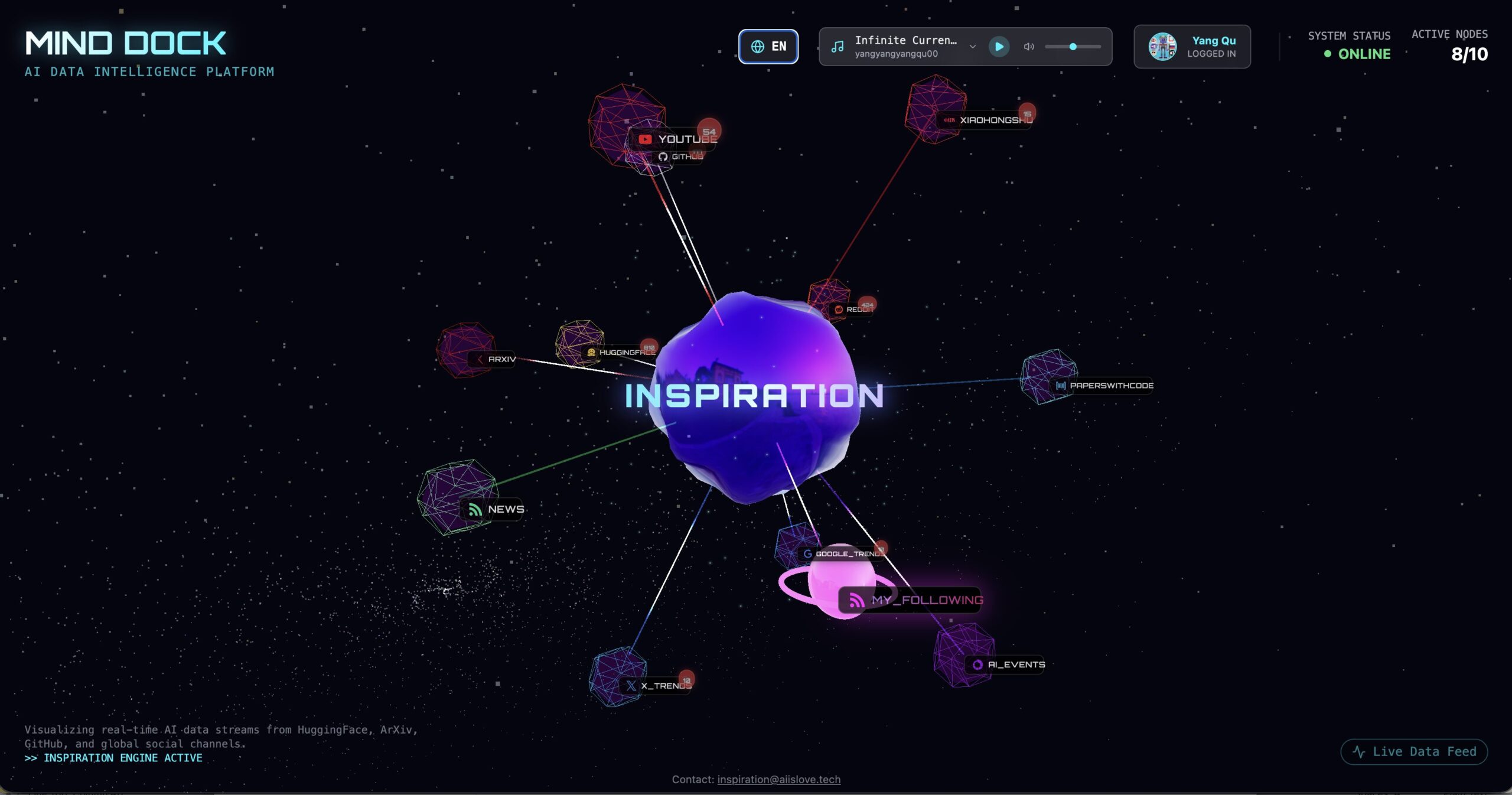
The artificial intelligence field evolves at extraordinary velocity—new models debut weekly, research papers flood arXiv daily, and implementation code appears constantly on GitHub. For professionals needing to track these developments, the challenge isn’t accessing information but filtering signal from overwhelming noise across fragmented sources. Inspiration by Mind Dock, launched on Product Hunt on December 31, 2025, addresses this problem through a specialized AI Data Map platform aggregating real-time trends from over 15 sources including HuggingFace for models, arXiv and Papers with Code for research, GitHub for implementations, and social platforms like Reddit, X (Twitter), YouTube, and Chinese service Xiaohongshu. Rather than presenting simple news lists, the platform visualizes relationships between research papers, resulting models, code repositories, and trend discussions, enabling users to trace complete innovation lifecycles from theoretical concepts through practical deployment. Offered free at launch with 8 of 10 data nodes operational, Inspiration targets AI researchers, ML engineers, product managers, and developers seeking consolidated intelligence replacing dozens of bookmarks, alerts, and scattered workflows.
Key Features
- Multi-Source Real-Time Aggregation: Integrates live data streams from 15+ specialized AI platforms including HuggingFace model repository tracking 809 models, arXiv research papers with 177 indexed preprints, Papers with Code connecting research to implementations, GitHub monitoring 424 active AI repositories, Reddit and X tracking 5,000+ daily AI discussion posts, YouTube for video tutorials and demos, Google Trends for search interest patterns, and Chinese platform Xiaohongshu for regional AI adoption signals unavailable in Western sources.
- Interactive AI Data Map Visualization: Presents aggregated information through visual relationship mapping showing connections between research papers, derivative models trained from those papers, GitHub code implementations, and social discussions. This network visualization reveals innovation pathways from academic concepts to production deployment, displaying how specific arXiv papers spawn HuggingFace models that generate GitHub repositories and community adoption visible through social trends.
- Infinite Currents Algorithm: Employs proprietary relevance-weighting system dynamically prioritizing data sources based on real-time activity velocity. High-velocity sources like HuggingFace model uploads receive priority over lower-velocity signals like certain subreddit discussions. Algorithm uses engagement metrics including GitHub stars, arXiv citations, Reddit upvotes, and YouTube views to surface genuinely impactful developments versus noise.
- Customizable Inspiration Engine: Filters over 1,000 daily AI data points through user-configurable preferences. Features “My Following” function enabling personalized tracking of specific topics, research areas, companies, or technologies. Applies engagement-based thresholds suppressing low-signal content below user-defined metrics like minimum GitHub stars or citation counts to reduce information overload.
- Category-Based Organization: Structures content into topical streams including AI Events aggregating conference announcements and webinars, Research Papers clustering arXiv submissions and Papers with Code entries by domain like NLP and computer vision, Models showcasing new HuggingFace uploads and significant model releases, Repositories highlighting trending GitHub AI projects, and Social Trends summarizing discussions from Reddit, X, and YouTube.
- Cross-Platform Trend Correlation: Connects technical data from academic and development platforms with social sentiment and adoption signals. Uses timestamp-weighted analysis identifying when arXiv papers gain sudden GitHub implementation activity or Reddit discussion momentum, surfacing rising trends before they reach mainstream awareness through correlation impossible when monitoring sources independently.
- Distributed Node Architecture: Operates through specialized data collection nodes with 8 of 10 currently active at launch. Each node focuses on specific source platforms using optimized scraping and API integration. NLP clustering algorithms process raw streams categorizing content by topic, technology area, and relevance before presentation to users.
- Multilingual Global Coverage: Monitors both English-dominant platforms and Chinese AI ecosystem through Xiaohongshu integration, providing visibility into regional innovation and adoption patterns often invisible to Western-focused tools, particularly valuable as Chinese AI development accelerates with models like DeepSeek and platforms unique to that market.
How It Works
Inspiration by Mind Dock functions as a web-based dashboard accessed through standard browsers without requiring software installation. The platform operates through distributed backend infrastructure collecting data from 15+ source platforms via APIs and targeted web scraping where APIs aren’t available.
Each data source connects through specialized collection nodes optimized for that platform’s structure. The HuggingFace node tracks model uploads, downloads, and metadata. The arXiv node monitors new preprint submissions across computer science categories. GitHub nodes watch repository creation, star velocity, and commit activity for AI projects. Social media nodes scrape Reddit discussions, X posts, and YouTube uploads matching AI-related keywords and topics.
Raw data streams flow into central processing infrastructure employing NLP clustering algorithms that categorize content by topic, technology area, research domain, and relevance. The Infinite Currents algorithm assigns dynamic weights to each source based on current activity levels and engagement metrics, ensuring high-impact signals from active sources rise above noise from quieter periods on other platforms.
The processed and weighted data feeds into the interactive AI Data Map visualization representing items as nodes with connections showing relationships. An arXiv paper might connect to derivative HuggingFace models trained on that research methodology, which connect to GitHub repositories implementing those models in production code, which correlate with Reddit threads and YouTube tutorials discussing practical applications. This network structure reveals innovation pathways invisible when sources exist in silos.
Users access the platform through category-filtered views focusing on specific content types, or use the My Following customization defining precise topics, keywords, companies, or technologies to track. Engagement threshold settings filter out low-signal noise below user-defined minimum metrics like GitHub stars or upvote counts.
The system surfaces trending items through timestamp-weighted analysis identifying content experiencing sudden velocity increases—papers gaining rapid citations, models achieving download spikes, repositories collecting stars quickly, or social discussions showing engagement momentum. This trend detection highlights emerging developments before mainstream awareness.
Results appear in clean dashboard feeds with item previews, engagement metrics, source attribution, and one-click access to original content. The interface emphasizes rapid scanning and discovery over deep analytics, optimized for users needing quick awareness of developments across the ecosystem versus exhaustive research requiring specialized tools.
Use Cases
- AI Research Tracking: Researchers monitor latest arXiv preprints, Papers with Code implementations, and related work citations within their specific domains without manually checking multiple platforms daily. Custom filters surface papers by methodology, dataset, or problem space enabling focused literature review and competitive intelligence on parallel research efforts.
- Model Discovery for ML Engineers: Developers scout HuggingFace for new pre-trained models matching project requirements, evaluate adoption signals through download metrics and GitHub implementations, and discover code examples demonstrating practical usage before investing time in integration, reducing trial-and-error experimentation.
- Trend Forecasting for Product Teams: Product managers identify emerging AI capabilities before mainstream hype by correlating research paper publication with early model availability and initial GitHub implementation activity. Social sentiment analysis from Reddit and YouTube reveals practitioner reception and practical applications informing product roadmap decisions.
- Competitive Intelligence: Innovation teams track specific companies, research labs, or technologies through custom following configurations, receiving alerts when competitors publish research, release models, or generate GitHub activity revealing strategic direction and capability development before public announcements.
- Technical Content Inspiration: Technical writers, YouTubers, and educators find fresh content topics by monitoring trending papers, popular new models generating community interest, and GitHub projects gaining star velocity, ensuring content covers developments audiences actively discuss and care about rather than outdated subjects.
- Open Source Project Scouting: Developers identify promising early-stage repositories gaining momentum through star velocity and commit activity before projects reach widespread adoption, enabling early contribution opportunities, partnership development, or integration into products while projects remain accessible to new contributors.
Pros \& Cons
Advantages
- Comprehensive Source Integration: Aggregates 15+ specialized platforms into single dashboard eliminating need to maintain dozens of bookmarks, RSS feeds, Twitter lists, and manual checking workflows that consume significant daily time for AI professionals staying current.
- Relationship Visualization: Maps connections between research papers, resulting models, code implementations, and social adoption revealing complete innovation lifecycles from theory through practice impossible to discern when sources exist separately, providing unique contextual intelligence.
- Global Coverage Including Chinese Ecosystem: Uniquely monitors Xiaohongshu and Chinese AI platforms alongside Western sources, providing visibility into regional innovations, model developments, and adoption patterns often invisible to English-only tools as Chinese AI ecosystem accelerates development.
- Free Access at Launch: Offers complete platform functionality without subscription fees, paywalls, or freemium limitations at initial release, lowering barrier for individual researchers and small teams versus enterprise-focused alternatives charging significant monthly subscriptions.
- Trend Velocity Detection: Timestamp-weighted analysis surfaces emerging developments experiencing sudden engagement momentum before mainstream awareness, enabling early adoption, content creation, or competitive response ahead of broader market recognition.
- Customizable Noise Reduction: User-defined topic following and engagement thresholds allow personalization from broad ecosystem monitoring to laser-focused niche tracking, solving the generic news aggregator problem of one-size-fits-all feeds delivering excessive irrelevant content.
Disadvantages
- Potentially Overwhelming for Beginners: The breadth of 15 aggregated sources presenting 1,000+ daily data points, even after filtering, can create information overload for newcomers unfamiliar with AI ecosystem structure, terminology, or significance criteria distinguishing important developments from incremental updates.
- Limited Analytical Depth: Platform optimizes for discovery and awareness through rapid scanning versus deep analysis requiring tools like metric-driven model evaluation, fine-grained performance comparisons, or enterprise reporting capabilities that specialized platforms provide for specific use cases.
- Internet Dependency for Real-Time Features: Requires stable internet connection to access live data streams and real-time updates that constitute core value proposition. Offline usage or limited connectivity scenarios prevent primary functionality versus downloadable tools or offline research workflows.
- New Platform Maturity: Launched December 31, 2025 with 8 of 10 data nodes operational indicates incomplete development. Limited user base means fewer reviews, community-validated best practices, or proven reliability at scale versus established alternatives with years of operation and user feedback.
- Unproven Long-Term Sustainability: Free launch offering without disclosed monetization model creates uncertainty whether platform will remain free, introduce subscription tiers limiting features, display advertising, or face sustainability challenges requiring business model changes affecting user experience.
- Potential Source Quality Variation: Aggregating social platforms like Reddit and YouTube alongside academic sources like arXiv introduces quality inconsistency where unvetted opinions mix with peer-reviewed research, demanding users exercise judgment distinguishing authoritative information from speculation or misinformation.
How Does It Compare?
The AI information landscape in early 2026 features diverse tools from general news aggregators to specialized research platforms. Here’s how Inspiration by Mind Dock positions itself:
Feedly and Feedly AI
Feedly dominates professional RSS aggregation with AI-enhanced capabilities through Feedly AI enabling topic tracking, competitor monitoring, and trend scouting across millions of sources. Feedly AI provides customizable AI Feeds combining AI Models detecting concepts like company names, technologies, strategic moves, and consumer insights using AND/OR/NOT operators for precision. The platform excels at market intelligence, competitive analysis, and focused research requiring granular control. Pricing ranges from free basic features through Pro at \$8 monthly and Pro+ at \$18 monthly for team features and integrations. Feedly and Inspiration share news aggregation focus with AI filtering. Feedly provides superior source control allowing users to define exact publications monitored via RSS, deeper integration with productivity tools through APIs and CRM connections, and established enterprise features for teams. Inspiration differentiates through specialized AI ecosystem focus surfacing relationships between papers, models, and code Feedly’s general market intelligence design doesn’t emphasize, and visual data mapping versus Feedly’s list-based feeds. Feedly suits professionals needing comprehensive customizable market intelligence across industries and topics. Inspiration serves AI-specific practitioners wanting integrated view of research, development, and social adoption within that particular ecosystem.
Papers with Code
Papers with Code connects machine learning research papers with code implementations, datasets, and benchmarks, serving as comprehensive resource for reproducible ML research. The platform provides state-of-the-art tracking across tasks showing which methods achieve best performance on standard benchmarks, paper-code linking enabling immediate implementation access, dataset discovery, and research trends within specific domains. Completely free and community-driven, Papers with Code emphasizes depth in ML research reproducibility. Papers with Code and Inspiration both aggregate AI research and implementations. Papers with Code focuses narrowly on academic papers linked to verified code implementations with benchmark performance data providing research depth. Inspiration aggregates broader content including social discussions, trend signals, model repositories beyond Papers with Code scope, and visualization showing relationships across ecosystem versus Papers with Code’s task-organized structure. Papers with Code suits researchers needing deep dive into specific ML tasks with reproducible results and benchmark comparisons. Inspiration serves users wanting broader awareness across AI ecosystem including social adoption signals and emerging trends before formal benchmarking.
Hugging Face Explore
Hugging Face operates as central hub for open-source ML models with Explore section showcasing trending models, new releases, and popular repositories. The platform provides model download, deployment infrastructure, and discovery organized by task, license, and framework. Hugging Face focuses specifically on pre-trained model accessibility and deployment tooling. Hugging Face and Inspiration both surface AI models and developments. Hugging Face provides superior depth for model-specific use cases including testing, deployment, fine-tuning capabilities, and production infrastructure Inspiration doesn’t attempt. Inspiration contextualizes Hugging Face models within broader ecosystem showing research papers generating those models, GitHub implementations using them, and social discussion adoption patterns Hugging Face’s model-centric view doesn’t emphasize. Hugging Face serves developers needing to evaluate, deploy, and use specific models in production. Inspiration helps users discover models within innovation context from research through community reception.
arXiv Alerts and arXiv Sanity
arXiv provides email alerts for new submissions in user-defined categories. arXiv Sanity (now discontinued) previously offered enhanced arXiv browsing with recommendations and social features. Various alternatives like Semantic Scholar, Connected Papers, and Emergent Mind provide research paper discovery with advanced search, citation graphs, and trend detection. These tools focus specifically on academic paper discovery and understanding. arXiv-focused tools and Inspiration both surface research papers. Specialized research tools provide deeper paper-specific functionality including citation analysis, semantic search understanding concepts beyond keywords, and co-author networks helping explore academic relationships. Inspiration places papers within broader ecosystem context showing when research spawns models on Hugging Face or implementations on GitHub versus pure academic discovery. arXiv tools suit academic researchers prioritizing literature review depth and citation analysis. Inspiration serves practitioners wanting to understand research impact through downstream model development and practical implementation.
GitHub Trending and GitHub Explore
GitHub provides native Trending and Explore features highlighting repositories gaining stars and developer activity across programming languages and topics including AI/ML. These features surface popular open-source projects through velocity metrics. GitHub Trending and Inspiration both showcase trending repositories. GitHub provides authoritative data directly from platform with extensive filtering by language, time period, and technology stack. Inspiration integrates GitHub trends within AI ecosystem context correlating repository activity with originating research papers and model availability versus GitHub’s code-centric isolated view. GitHub Trending suits developers wanting comprehensive open-source discovery across all technologies. Inspiration serves AI-focused users wanting GitHub activity contextualized within research and model landscape.
Reddit AI Subreddits and X (Twitter) Lists
Social platforms like r/MachineLearning, r/LocalLLaMA, and curated X lists provide community-driven discovery through discussions, paper announcements, and trending topics. These platforms offer real-time practitioner perspectives, practical advice, and emerging trends through crowdsourced curation. Reddit/X and Inspiration both aggregate social AI discussions. Social platforms provide unfiltered community voice with depth of discussion, debugging help, and personal experiences Inspiration’s aggregated previews don’t capture. Inspiration reduces social platform time investment by surfacing high-engagement discussions alongside correlated technical content from arXiv and GitHub versus requiring manual browsing. Social platforms suit users wanting community engagement and discussion participation. Inspiration serves those wanting social trend awareness without extensive platform browsing.
Google News and Google Alerts
Google News uses AI personalization surfacing news across thousands of sources with customizable topics. Google Alerts delivers email notifications for keyword mentions across web. Both provide broad information monitoring across general topics including AI. Google tools and Inspiration both aggregate information with customizable focus. Google provides unmatched source breadth across mainstream news, blogs, and general web content with superior general search infrastructure. Inspiration specializes in technical AI sources like arXiv, Hugging Face, GitHub that general news aggregators under-emphasize, plus visualization showing content relationships Google’s list format doesn’t provide. Google tools suit general news consumption across topics. Inspiration serves technical AI professionals needing specialized source integration.
Emergent Mind
Emergent Mind surfaces trending AI/ML papers based on social media engagement, providing email digests, filtering, sorting, and focus on what practitioners actually discuss versus pure publication volume. The platform emphasizes social signal-driven discovery highlighting papers gaining community traction. Emergent Mind and Inspiration both use social engagement for AI trend detection. Emergent Mind focuses specifically on research paper discovery through social signals with email digest format. Inspiration integrates papers within broader ecosystem including models, code, and multi-platform trend correlation versus paper-only focus. Emergent Mind suits researchers wanting social engagement-filtered paper discovery. Inspiration serves users wanting papers contextualized within complete development lifecycle.
AI Newsletter Aggregators (Superhuman AI, The Rundown AI, There’s an AI For That)
Specialized AI newsletters curate developments into email digests with human editorial selection and summarization. These newsletters provide convenient inbox delivery with expert curation determining significance. AI newsletters and Inspiration both deliver AI trend awareness. Newsletters provide human curation quality filtering signal from noise through editorial judgment and narrative context explaining significance. Inspiration offers real-time access, user-controlled customization, and visual relationship mapping versus periodic email delivery and editor-determined relevance. Newsletters suit passive consumption preferring curated digests. Inspiration serves active explorers wanting on-demand discovery and personalized filtering.
Final Thoughts
Inspiration by Mind Dock addresses a genuine pain point afflicting AI professionals—the fragmented, overwhelming nature of tracking developments across specialized platforms that don’t communicate with each other. By aggregating 15+ sources from research through implementation to social adoption into one visual dashboard, the platform promises significant time savings versus manual bookmark checking, RSS management, and platform-hopping workflows consuming hours daily.
The platform’s strongest value proposition centers on relationship visualization revealing innovation pathways from research papers through model development to code implementation and community adoption. This lifecycle perspective enables users to trace complete technology evolution understanding not just what research was published but whether it spawned usable models, generated practical implementations, and achieved community adoption indicating real-world utility. Such contextual intelligence remains unavailable when sources exist in silos—arXiv shows research, Hugging Face shows models, GitHub shows code, but no single tool connects these dots revealing the complete picture.
The Infinite Currents algorithm’s dynamic source weighting and engagement-based filtering attempts to solve the noise problem inherent in aggregation. By prioritizing active sources and suppressing low-engagement content, the system aims to surface genuinely impactful developments versus overwhelming users with every minor update. Customizable following and threshold settings enable personalization from broad ecosystem awareness to laser-focused niche tracking.
Global coverage including Chinese platforms like Xiaohongshu provides unique visibility into regional AI development increasingly important as Chinese ecosystem advances with competitive models and unique innovation. Most Western-focused tools completely miss this dimension creating blind spots for professionals needing comprehensive global awareness.
However, significant considerations warrant evaluation. The platform launched just weeks ago on December 31, 2025 with 8 of 10 data nodes operational, indicating incomplete development and limited validation at scale. The small initial user base means minimal community feedback, few established best practices, and uncertain reliability versus mature alternatives operating for years with proven track records.
Free access at launch without disclosed monetization creates sustainability uncertainty. Whether the platform remains free, introduces premium tiers, displays advertising, or faces business model challenges affecting user experience remains unknown. Early adopters risk investing time learning a tool that might change dramatically or discontinue service.
The breadth that constitutes the platform’s strength also creates weakness for certain use cases. Users needing deep model evaluation, academic citation analysis, enterprise team collaboration, or specialized analytics will find better-suited tools focusing narrowly on those needs. Inspiration optimizes for discovery and awareness through scanning versus depth requiring focused platforms.
Information quality variation mixing peer-reviewed arXiv papers with unvetted Reddit discussions demands user judgment distinguishing authoritative sources from speculation. The platform provides discovery but not validation—users must evaluate whether trending content represents genuine advancement or temporary hype.
The competitive landscape shows specialized tools often excel in narrow domains. Feedly provides superior general market intelligence. Papers with Code delivers deeper ML research functionality. Hugging Face offers better model deployment capabilities. Research-specific tools provide citation analysis Inspiration lacks. The question becomes whether integrated breadth compensating for specialized depth matches specific user workflows and priorities.
Ideal users for Inspiration include AI researchers tracking developments beyond their immediate specialization, ML engineers scouting models and implementations for projects, product managers forecasting technology trends informing roadmaps, and technical content creators finding timely topics audiences discuss. These roles benefit from broad ecosystem awareness connecting research, development, and adoption versus narrow specialization.
Conversely, the platform may not suit users needing deep research paper analysis requiring citation graphs and semantic search, model deployment requiring testing infrastructure and performance benchmarks, team collaboration requiring shared workspaces and commenting, or those preferring curated human editorial judgment in newsletters versus algorithmic filtering.
As the platform matures, key success factors include maintaining free access or transparent pricing if monetization becomes necessary, completing the full 10-node data collection infrastructure for comprehensive coverage, developing mobile apps or browser extensions increasing accessibility, introducing collaborative features enabling team usage, and generating case studies demonstrating value through real user outcomes.
For AI professionals currently spending significant time manually checking multiple platforms and feeling overwhelmed by fragmented workflows, Inspiration by Mind Dock offers compelling consolidation. The visual relationship mapping provides unique intelligence unavailable elsewhere. Free access eliminates adoption risk beyond time investment learning the interface.
Whether the platform achieves lasting impact depends on execution quality as user base scales, sustainable business model development avoiding disruptive changes, and continuous feature evolution maintaining competitive differentiation as established players like Feedly potentially extend into AI-specific territory. For now, Inspiration represents an innovative experiment worth exploring for AI professionals seeking better ways to navigate the ecosystem’s relentless information velocity.
https://inspiration.minddock.ai/