

Table of Contents
Plano: The AI-Native Delivery Layer for Scalable Agents
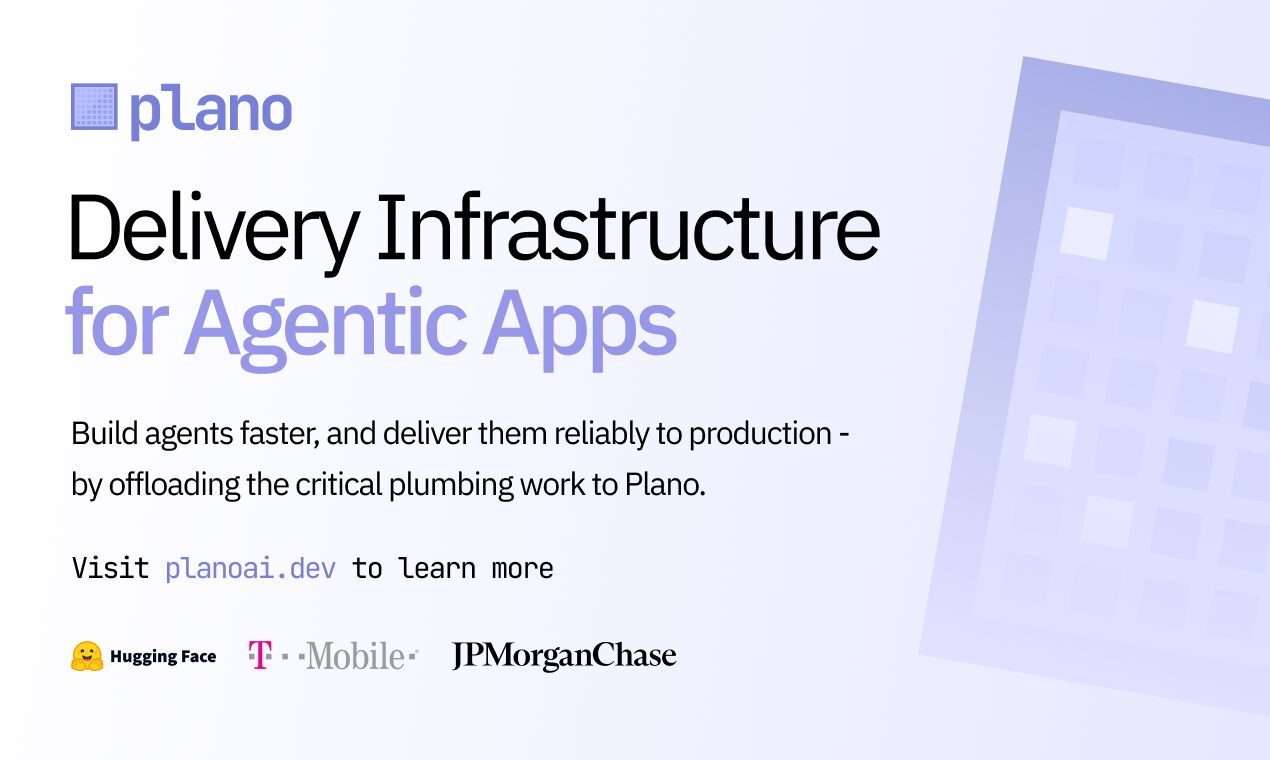
Plano is a purpose-built delivery infrastructure designed to bridge the gap between AI prototypes and production-ready agentic applications. Officially launched on January 6, 2026, the platform addresses the “plumbing” challenges—such as complex routing, observability, and safety—that typically require bespoke coding for every new agent. By operating as a high-performance proxy and dataplane built on the Envoy architecture, Plano centralizes these critical concerns into a modular sidecar.
The platform is framework-agnostic, allowing developers to use any language or AI library while standardizing policies across their entire agent ecosystem. This separation of concerns allows engineering teams to enforce global security guardrails and product teams to capture rich behavioral traces (Agentic Signals™) for continuous reinforcement learning. For enterprises, Plano provides a single point of control to manage model agility, enabling them to swap LLM providers or update agent orchestration strategies through a single configuration file without touching the core product logic.
Key Features
- Decoupled Agent Orchestration: Manage handoffs and routing logic between multiple specialized agents centrally, reducing application-level complexity.
- Unified Guardrail Hooks: Enforce consistent content moderation, jailbreak protection, and PII redaction policies across all agents via a centralized filter chain.
- Agentic Signals™ Observation: Capture deep behavioral traces, token usage, and performance metrics automatically without adding logging code to your agents.
- Model Agility & Smart Routing: Switch between hosted LLMs or proprietary APIs using semantic aliases and preference-driven routing policies for better accuracy and cost control.
- Sidecar Data Plane Architecture: Built on the industry-standard Envoy Proxy to provide high-frequency, low-latency processing of prompts and responses.
- One-File Configuration (YAML): Describe your agentic app, supported prompts, and retrieval queries in a single declarative file for rapid deployment.
- Open Source Core: The underlying dataplane is an open-source project, providing transparency and preventing vendor lock-in for critical AI infrastructure.
- Framework-Agnostic Integration: Seamlessly integrates with LangChain, LlamaIndex, or custom in-house frameworks by acting as a protocol-native proxy.
How It Works
Plano functions as an intelligent intermediary between your application code and the LLM providers. Instead of calling an AI API directly, your application routes requests through the Plano sidecar. Upon receiving a prompt, Plano applies your configured filter chains—checking for security violations, retrieving relevant context via RAG hooks, and selecting the optimal model for the task. It then orchestrates the necessary agent handoffs and streams the response back to your app while simultaneously logging detailed execution traces. This architectural pattern ensures that all non-functional requirements (security, logging, and routing) are handled consistently by the infrastructure layer.
Use Cases
- Enterprise AI Governance: Large organizations can enforce a single set of moderation and security policies across dozens of internal agents developed by different teams.
- Rapid Prototyping to Production: Startups can move from a simple script to a robust, observable agent system by offloading the infrastructure work to Plano’s “one config” setup.
- Multimodal Multi-Agent Systems: Coordinating specialized vision, audio, and text agents for complex workflows like automated customer support or industrial diagnostics.
- Regulated Data Environments: Utilizing Plano’s sidecar in on-premises or air-gapped deployments to maintain full data sovereignty while using external LLM APIs.
Pros and Cons
- Pros: Drastically reduces the “plumbing” code needed for production agents. Centralizes monitoring and security for better institutional oversight. Open-source core provides long-term flexibility and trust.
- Cons: Introducing a proxy layer requires careful configuration to minimize latency overhead. As a specialized infrastructure tool, it requires a shift in how teams architect their LLM-based services.
Pricing
- Community Tier: Free and Open Source. Includes the core dataplane, basic agent routing, and standard observability features for individual developers and small teams.
- Cloud/Pro Tier: Approximately $49/month. Offers hosted management of configuration files, advanced analytics dashboards, and extended history for Agentic Signals™.
- Enterprise Plan: Custom Pricing. Designed for high-volume deployments requiring dedicated support, advanced security certifications, and custom policy engine extensions.
How Does It Compare?
- Helicone / Portkey / LangSmith: These are primarily observability and gateway tools. While they offer great tracing and logging, Plano goes further by providing a true “dataplane” that handles agent orchestration and proactive routing logic.
- Envoy / Kong (Standard Proxies): General-purpose proxies that lack the “AI-native” logic needed for prompt engineering, jailbreak detection, and agent-specific handoffs. Plano is essentially Envoy with an AI-specific intelligence layer.
- Zapier Central / Make.com: Low-code automation platforms. Plano is developer-centric infrastructure (IaaS) meant for engineers building custom, high-performance agentic applications within their own codebases.
- Arize Phoenix: Focused heavily on evaluation and troubleshooting of LLM applications. Plano serves as the active delivery layer that executes policies and routing in real-time based on the insights gained from evaluation.
Final Thoughts
Plano represents the professionalization of the “Agentic Stack” in 2026. As companies move beyond simple chatbots into complex, multi-agent ecosystems, the need for a standardized delivery layer becomes undeniable. By treating AI infrastructure as a dedicated dataplane rather than a collection of scattered code hooks, Plano empowers developers to treat agents as modular, reliable software components. Its greatest value lies in the “Agentic Signals™” framework, which turns raw production data into the actionable feedback loop required for high-performing AI systems. For any team serious about scaling autonomous agents in a production environment, Plano is a foundational investment in operational stability.