

Table of Contents
- Vellum AI: Comprehensive Research Report
- 1. Executive Snapshot
- 2. Impact & Evidence
- 3. Technical Blueprint
- 4. Trust & Governance
- 5. Unique Capabilities
- 6. Adoption Pathways
- 7. Use Case Portfolio
- 8. Balanced Analysis
- 9. Transparent Pricing
- 10. Market Positioning
- 11. Leadership Profile
- 12. Community & Endorsements
- 13. Strategic Outlook
Vellum AI: Comprehensive Research Report
1. Executive Snapshot
Core Offering Overview
Vellum AI represents a fundamental reconceptualization of how organizations develop, deploy, and manage AI-powered automation, positioning itself as the comprehensive development platform bridging the chasm between AI prototypes and production-ready enterprise systems. Founded in 2023 by three former Dover colleagues—CEO Akash Sharma, CTO Sidd Seethepalli, and CTO Noa Flaherty—Vellum emerged from firsthand frustrations building large language model applications where promising demos collapsed under production demands requiring reliability, observability, and iterative improvement.
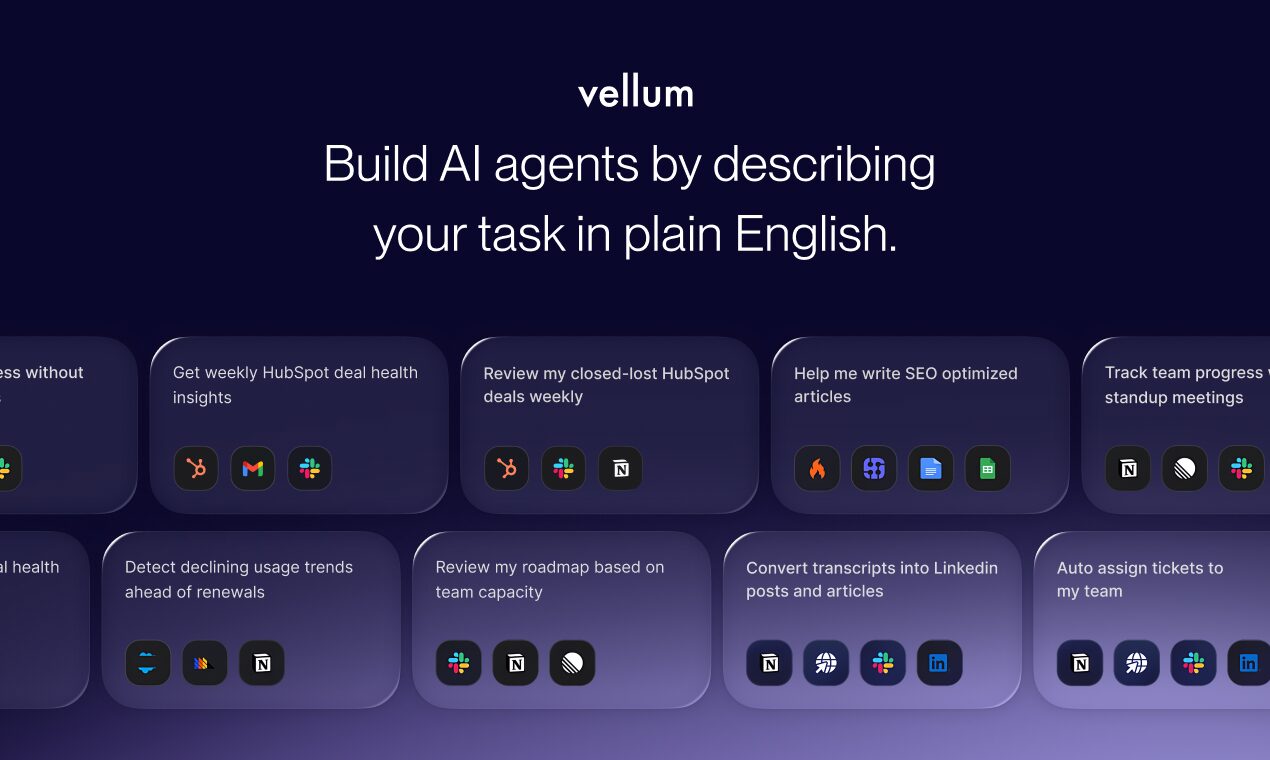
The platform’s revolutionary advancement lies in its natural language agent builder that translates plain English descriptions into fully functional AI agents complete with integrated tools, logical workflows, and deployment infrastructure. Users simply describe desired outcomes—”Create an agent that pulls product usage data from PostHog and account data from Salesforce, detects declining usage trends, flags at-risk accounts ahead of renewal dates, and outputs a prioritized list with risk level and recommended next actions in Notion”—and Vellum automatically generates complete workflows incorporating necessary API connections, business logic, error handling, and execution orchestration.
This prompt-to-agent capability democratizes AI automation beyond engineering teams to include product managers, operations specialists, legal experts, and business analysts who understand domain problems but lack coding expertise. The visual workflow builder enables both technical and non-technical stakeholders to collaborate on agent development, with engineers accessing full Python and TypeScript SDK control while domain experts configure logic through intuitive interfaces. This dual-modality approach eliminates the traditional bottleneck where business requirements pass through engineering translation layers, compressing development cycles from months to weeks or days.
Vellum’s architecture addresses the complete AI application lifecycle through integrated components spanning prompt engineering playgrounds, multi-step workflow orchestration, retrieval-augmented generation with built-in vector databases, comprehensive evaluation frameworks, version control and deployment management, and production observability with detailed tracing. This end-to-end integration contrasts sharply with fragmented toolchains requiring users to stitch together separate prompt engineering tools, orchestration frameworks, evaluation platforms, and monitoring solutions—each introducing integration friction and operational complexity.
The platform supports diverse AI use cases spanning customer support automation, document processing and routing, compliance monitoring, sales and CRM automation, fraud detection, KYC verification, contract review, competitive intelligence, content generation, and churn prediction. Enterprise customers including Drata, Swisscom, Redfin, and Headspace deploy Vellum for mission-critical workflows where reliability, accuracy, and auditability constitute non-negotiable requirements rather than nice-to-have features.
Key Achievements & Milestones
Vellum’s trajectory from founding to enterprise-grade platform demonstrates exceptional execution velocity validated by both customer traction and investor confidence. The company launched in early 2023 following Y Combinator’s Winter 2023 cohort, securing five million dollars in seed funding from Y Combinator, Rebel Fund, Pioneer Fund, and Eastlink Capital. This initial capital enabled rapid product development and customer acquisition, with the team onboarding over fifty paying customers within the first five months—remarkable adoption for infrastructure software targeting engineering teams.
July 2025 marked a pivotal inflection point with Vellum announcing a twenty million dollar Series A led by Leaders Fund with participation from Socii Capital and returning investors. This funding round, bringing total capital raised to twenty-four point five million dollars, validated Vellum’s product-market fit and positioned the company for aggressive expansion into new verticals and geographies. The partnership with Leaders Fund—recognized for deep enterprise go-to-market expertise—signals strategic prioritization of enterprise penetration over purely technical communities.
Revenue metrics accompanying the Series A announcement demonstrate explosive commercial traction: revenues grew three-fold year-over-year in 2024 and pace to quadruple in 2025. The company expanded from approximately fifty customers at seed stage to over one hundred fifty paying customers at Series A—three-fold growth in roughly two years. This customer expansion occurred alongside reported twenty-five to thirty percent month-over-month revenue growth during early stages, compounding into the multi-year trajectory positioning Vellum among fastest-growing enterprise AI infrastructure companies.
July 2025 also saw Vellum’s official transition from limited availability to General Availability, signaling production-readiness and enterprise-grade maturity. This GA launch accompanied platform enhancements including SOC 2 Type 2 compliance certification and HIPAA compliance attestation—critical credentials enabling adoption within regulated industries including healthcare, financial services, and government sectors previously barred from experimental platforms lacking formal security validations.
Customer success stories provide qualitative validation of quantitative growth metrics. Redfin achieved ten-times reduction in AI optimization cycles, compressing prompt and workflow evaluation from weeks to days and enabling fifteen to thirty percent operational lift across business units. The real estate technology company launched its Ask Redfin virtual assistant in fourteen US markets with confidence derived from Vellum’s test-driven development capabilities, directly attributing market readiness to evaluation frameworks preventing regression bugs and ensuring quality thresholds.
Rentgrata cut AI delivery timelines from nine months to approximately four and a half months—fifty percent acceleration—while achieving what they characterize as “bulletproof accuracy” for their virtual assistant Ari. This timeline compression while simultaneously improving quality reverses typical speed-versus-quality tradeoffs, demonstrating how Vellum’s integrated testing and evaluation infrastructure enables faster iteration without sacrificing reliability.
Unnamed enterprise customers report two hundred percent faster AI development and delivery cycles, eighty percent of AI improvements handled by non-engineers rather than scarce engineering resources, and fifty percent reductions in AI delivery timelines. These metrics validate Vellum’s value proposition around democratizing AI development beyond engineering teams while maintaining or improving output quality through systematic testing and observability.
Adoption Statistics
Quantitative adoption metrics reveal substantial enterprise penetration within Vellum’s approximately two-and-a-half-year operational history. The company reports over one hundred fifty paying customers as of mid-2025, representing approximately two hundred percent growth from roughly fifty customers at seed stage in late 2023. This customer base spans diverse industries including technology, real estate, healthcare, telecommunications, financial services, and consumer applications—demonstrating horizontal applicability rather than narrow vertical specialization.
Notable enterprise customers include Drata providing security and compliance automation for thousands of customer environments, Swisscom serving as Switzerland’s leading telecommunications provider and IT company for banks and government agencies, Redfin operating across over one hundred US and Canadian real estate markets with four thousand-plus employees, and Headspace delivering mental health and meditation services to millions of users. These flagship accounts validate Vellum’s capability serving mission-critical workflows at organizations requiring enterprise-grade reliability, security, and scalability.
The customer composition balances growth-stage startups and established enterprises, with early customers including Yuma.ai in insurance AI, Pangea in fintech for underbanked populations, Truewind in carbon footprint reduction, Alphawatch in industrial equipment monitoring, and Robust Intelligence in AI security. This startup-to-enterprise customer spectrum demonstrates Vellum’s flexibility accommodating organizations at different maturity stages with varying infrastructure requirements, team sizes, and budget constraints.
Platform usage metrics remain partially disclosed but indicate substantial operational scale. The built-in vector database for retrieval-augmented generation supports varying document storage limits across tiers—twenty documents monthly on free plans scaling to one thousand documents on Pro and unlimited on Enterprise—suggesting customers operate RAG workflows requiring significant knowledge base coverage. Agent builder credits measuring workflow development and testing consumption range from fifty monthly on free tiers to two hundred on Pro plans, with Enterprise receiving custom allocations matching organizational needs.
Geographic distribution emphasizes North America and Europe, with Vellum maintaining headquarters in New York and serving major Swiss, Canadian, and pan-European customers. The Series A funding explicitly targets global expansion, suggesting current penetration remains concentrated in English-speaking markets and select European territories with plans for broader international coverage leveraging Leaders Fund’s go-to-market expertise.
Team growth accompanies customer expansion, with Vellum reporting twenty-three employees as of early 2026 and active hiring across marketing, engineering, and sales functions. This headcount represents substantial organizational scaling from founding team of three, though remains lean relative to customer base—suggesting high revenue-per-employee efficiency characteristic of well-designed infrastructure platforms requiring minimal customer hand-holding once deployed.
2. Impact & Evidence
Client Success Stories
Redfin’s transformation of home-buying experiences through Ask Redfin virtual assistant exemplifies Vellum’s impact on customer-facing AI deployments. Redfin sought to compress response times from hours to seconds for prospective home buyers seeking property information, neighborhood insights, and process guidance. The challenge extended beyond speed to encompass accuracy and fairness—providing reliable information without introducing bias or factual errors that could mislead customers making major financial decisions.
Sebi Lozano, Senior Product Manager at Redfin, credits Vellum with enabling test-driven development approaches impossible with previous tooling. The team evaluated hundreds of test cases across multiple prompt and model combinations, systematically measuring response quality against defined thresholds before production deployment. This rigorous evaluation identified edge cases and failure modes early in development, preventing expensive post-launch debugging and reputation damage from public AI errors.
The quantifiable impact manifested as ten-times reduction in optimization cycles—workflows requiring weeks of engineering effort compressing to days through Vellum’s integrated prompt engineering, evaluation, and deployment capabilities. This acceleration enabled Redfin to launch Ask Redfin beta in fourteen markets simultaneously rather than staged rollouts hedging against quality concerns. Lozano characterizes Vellum’s software and knowledgeable team as saving “hundreds of hours” while delivering fifteen to thirty percent operational lift across business functions.
Rentgrata’s experience developing Ari, their virtual assistant for property management companies, demonstrates Vellum’s value in B2B SaaS contexts requiring bulletproof reliability. The company compressed nine-month development timelines to approximately four and a half months—fifty percent acceleration—while simultaneously achieving accuracy levels they characterize as eliminating deployment anxiety. This timeline compression without quality compromise enabled Rentgrata to reach market faster, capture competitive advantages, and deliver data-driven decision support to property management clients.
The testimonial emphasizes that “Vellum has been instrumental in making Rentgrata’s data both actionable and reliable”—highlighting the platform’s dual contribution to speed and quality. For B2B companies where AI accuracy directly impacts customer trust and retention, Vellum’s evaluation frameworks provide confidence to ship features that would otherwise remain in perpetual refinement cycles awaiting perfect accuracy that never arrives.
Drata’s adoption demonstrates Vellum’s fit for highly regulated compliance automation contexts. Lior Solomon, Vice President of Engineering, describes Vellum as “a force multiplier for our AI efforts,” particularly praising the test-driven approach enabling early regression detection and rapid iteration. Drata operates across thousands of customer environments requiring consistent, auditable security and compliance workflows where AI errors could trigger customer churn, regulatory violations, or security incidents.
Vellum’s evaluation and monitoring capabilities enable Drata to maintain quality across diverse customer configurations, catching bugs before customer impact while iterating quickly to address evolving compliance requirements. The confidence derived from systematic testing accelerates feature velocity—a counterintuitive outcome where more rigorous quality gates paradoxically enable faster shipping through early issue detection and prevention.
Swisscom’s selection of Vellum as core infrastructure for serving Swiss banks and government agencies validates the platform’s suitability for highly regulated, security-conscious environments. Switzerland’s leading telecommunications provider and major IT company requires AI platforms meeting stringent data residency, security, and compliance requirements typical of financial services and public sector deployments. Vellum’s SOC 2 Type 2 and HIPAA compliance certifications, combined with flexible deployment options including VPC installations, satisfy these demanding criteria while delivering development velocity typical of modern SaaS platforms.
An unnamed enterprise customer reports that eighty percent of AI improvements are now handled by non-engineers rather than scarce technical resources—a dramatic democratization of AI capability management. This shift unblocks product managers, operations specialists, and domain experts to iterate on AI behaviors directly rather than queuing engineering requests, compressing improvement cycles from sprint cadences measured in weeks to continuous refinement measured in hours or days. The cumulative effect transforms AI from static deployed models requiring engineering intervention for any adjustment into dynamic capabilities continuously optimized by stakeholders closest to business outcomes.
Performance Metrics & Benchmarks
Vellum’s documented performance improvements span development velocity, quality metrics, operational efficiency, and organizational capability expansion. The most frequently cited metric—ten-times reduction in AI optimization cycles—translates to order-of-magnitude productivity gains for teams iterating on prompt designs, model selections, and workflow configurations. Development tasks consuming weeks of engineering effort compress to days, fundamentally altering feasibility calculations about which AI initiatives warrant investment.
Redfin’s fifteen to thirty percent business operations lift demonstrates tangible revenue and efficiency impacts beyond pure development metrics. These operational improvements likely manifest through increased conversion rates from prospective buyers receiving instant answers, reduced support costs from automated information provision, improved agent productivity through automated qualification and routing, and enhanced customer satisfaction from faster responsiveness. The wide fifteen-to-thirty-percent range suggests variable impact across different operational dimensions and customer segments.
Timeline acceleration metrics consistently report fifty to two hundred percent faster delivery across customers. Rentgrata’s nine-month-to-four-point-five-month compression represents fifty percent reduction, while other customers report development timelines halving or better. These improvements stem from multiple factors: eliminating tool integration friction through unified platforms, enabling non-engineering contributions reducing bottlenecks, systematic evaluation catching issues early preventing expensive late-stage redesigns, and version control enabling safe experimentation and rollback.
The eighty percent non-engineer AI improvement statistic represents particularly significant organizational capability expansion. In traditional AI development workflows, any prompt adjustment, model swap, or behavior tuning requires engineering resources to implement, test, deploy, and monitor changes. This engineering bottleneck means most potential improvements never occur due to prioritization constraints or languish in backlogs awaiting capacity. Vellum’s visual builder and evaluation frameworks enable product managers and domain experts to implement and validate improvements independently, multiplying organizational throughput through parallel rather than serialized workflows.
Cost and latency optimizations appear in customer testimonials but lack specific quantification. One customer reports “cutting latency in half” while seeing “huge performance boosts,” suggesting Vellum’s workflow orchestration and model routing capabilities enable systematic optimization impossible with monolithic LLM API integrations. The platform’s comprehensive observability showing per-step token consumption, latency, and estimated costs enables targeted optimization identifying expensive workflow segments for replacement with faster or cheaper alternatives.
Accuracy and reliability metrics remain largely qualitative—customers describe achieving “bulletproof accuracy” and “confidence to launch” but provide limited numerical quality measurements. This qualitative framing likely reflects the inherently subjective and task-specific nature of AI quality assessment where numeric scores like BLEU or ROUGE often poorly correlate with business value. Vellum’s evaluation framework enables customers to define custom quality metrics reflecting actual business requirements rather than academic benchmarks.
Development team efficiency gains manifest through reduced prototype iteration cycles. One customer reports prototypes previously requiring three to four designers and engineers over multiple weeks now completing within one week—roughly seventy-five percent time reduction. This acceleration stems from Vellum’s integrated prompt engineering, model comparison, fine-tuning, API deployment, and frontend generation capabilities eliminating context switching and integration overhead typical of multi-tool workflows.
Third-Party Validations
Y Combinator’s selection of Vellum for Winter 2023 batch provides meaningful early validation from Silicon Valley’s most prestigious startup accelerator. YC’s rigorous application process and selective acceptance rate—typically under two percent—signals initial confidence in founding team quality, market opportunity, and product vision. The subsequent seed funding participation by YC and introduction to growth-stage investors facilitated Vellum’s capital formation and customer network development.
Leaders Fund’s decision to lead Vellum’s twenty million dollar Series A represents sophisticated validation from a venture firm recognized for enterprise go-to-market expertise. Leaders Fund typically backs companies demonstrating clear paths to dominant market positions within large categories, suggesting conviction that AI development platforms constitute substantial opportunities and Vellum exhibits category leadership potential. The firm’s deep enterprise sales and marketing capabilities signal confidence in Vellum’s ability to penetrate Fortune 500 accounts beyond early adopter communities.
SOC 2 Type 2 compliance certification provides independent attestation of Vellum’s security controls across availability, confidentiality, and processing integrity domains. This certification requires months-long audit processes by accredited third-party assessors evaluating technical implementations, organizational policies, and operational procedures against rigorous security frameworks. The Type 2 designation specifically validates that controls operate effectively over sustained periods rather than merely existing at single points in time, providing stronger assurance than Type 1 reports.
HIPAA compliance enables healthcare organizations to deploy Vellum for workflows involving protected health information subject to strict privacy and security requirements. This compliance posture opens substantial market opportunities within healthcare providers, health insurance companies, pharmaceutical firms, and health technology companies where HIPAA compliance often constitutes mandatory procurement requirement. The willingness to pursue HIPAA certification signals Vellum’s strategic prioritization of regulated industries over purely consumer or advertising technology markets.
Industry analyst and media coverage from Axios, Business Wire, SiliconAngle, Built In NYC, and The SaaS News validates Vellum’s newsworthiness and market significance. Axios Pro’s exclusive Series A reporting signals recognition as strategic enterprise software category worth executive attention. Business Wire distribution ensures institutional investor, enterprise buyer, and technology decision-maker awareness—audiences critical for enterprise software commercial success beyond developer communities.
Competitive analysis from platforms including Galileo, Emergent, Lindy.ai, n8n, and Eden AI positioning Vellum as best-in-class or strong alternative for enterprise AI development validates category leadership perceptions. Third-party reviewers consistently emphasize Vellum’s enterprise-grade collaboration, observability, governance, and deployment flexibility advantages over alternatives optimized for individual developers or simple workflows. These comparisons matter particularly for buyers conducting structured vendor evaluations where third-party assessments influence shortlists and procurement decisions.
Customer testimonials from recognized brands including Redfin, Drata, Swisscom, Headspace, and Rentgrata provide social proof crucial for enterprise software adoption. Technology buyers exhibit strong herd behavior—adoption by respected industry leaders signals safety and reduces perceived risk of selecting emerging vendors. The diversity of customer industries—real estate, compliance automation, telecommunications, mental health, property technology—demonstrates horizontal applicability rather than narrow niche positioning.
Integration ecosystem participation through partnerships with HubSpot, Salesforce, Notion, Linear, Slack, Google Sheets, Gmail, PostHog, Stripe, and dozens of other business applications validates Vellum’s positioning as integration hub rather than isolated tool. Each integration partnership requires engineering investment, relationship building, and ongoing maintenance—suggesting Vellum prioritizes interoperability as core competitive advantage rather than walled-garden lock-in strategies.
3. Technical Blueprint
System Architecture Overview
Vellum implements a sophisticated multi-layer architecture balancing ease-of-use with technical flexibility and production-grade reliability. The foundation rests on a cloud-native infrastructure supporting both Vellum-hosted deployments and enterprise VPC installations for customers requiring data residency guarantees or air-gapped environments. This deployment flexibility distinguishes Vellum from cloud-only competitors unable to accommodate stringent data sovereignty requirements typical of financial services, healthcare, and government sectors.
The prompt-to-agent builder constitutes Vellum’s most innovative architectural component, implementing natural language understanding that parses user descriptions into structured workflow specifications. When users describe desired automation in plain English, the system employs large language models to extract intent, identify required integrations, infer logical flow, generate workflow graphs, and provision necessary components. This generative approach transforms agent development from low-level programming or node configuration into high-level specification where users focus on business logic rather than implementation mechanics.
The workflow orchestration engine supports sophisticated multi-step processes incorporating API calls, data transformations, conditional branching, loop constructs with state management, parallel execution paths, and sub-workflow composition. The visual workflow builder renders these complex flows as intuitive graphs where nodes represent operations and edges represent data dependencies. Engineers can define custom nodes with arbitrary Python or TypeScript logic, enabling extensibility beyond Vellum’s built-in operations for specialized business requirements or proprietary algorithms.
The retrieval-augmented generation infrastructure includes a managed vector database storing documents, embeddings, and metadata enabling semantic search and knowledge-grounded responses. Customers upload documents through various mechanisms—direct file uploads, URL imports, API integrations with document management systems, or programmatic SDK calls. The platform automatically chunks documents, generates embeddings using customer-selected models, indexes vectors for efficient similarity search, and maintains metadata enabling filtering and access controls.
The evaluation framework implements both offline and online assessment methodologies. Offline evaluations run test suites against workflow variations before production deployment, comparing outputs across prompt versions, model choices, and configuration parameters against golden datasets or custom quality metrics. Online evaluations sample production traffic at configurable rates, applying quality assessments to real user interactions and surfacing degradation alerts when metrics decline below thresholds. This dual evaluation approach combines pre-deployment validation with continuous production monitoring.
The deployment and version control system maintains complete lineage of workflow changes, prompt modifications, model updates, and configuration adjustments. Teams can deploy specific workflow versions to production, stage changes in isolated environments for testing, perform A/B tests comparing variants against control groups, and rollback to previous versions when issues emerge. This GitOps-inspired approach applies software engineering rigor to AI development, treating prompts and workflows as versioned artifacts requiring change management discipline.
The observability and monitoring infrastructure provides detailed execution tracing showing complete workflow execution paths, individual node inputs and outputs, token consumption per LLM call, latency breakdown across operations, estimated costs, and error messages. The graph visualization enables visual debugging where engineers navigate execution flows, inspect intermediate results, identify bottlenecks, and replay specific traces to reproduce issues. Dashboards aggregate metrics across executions, showing cost trends, latency distributions, quality scores, and error rates over time.
API & SDK Integrations
Vellum’s integration architecture emphasizes breadth across business applications, flexibility through multiple connection mechanisms, and developer extensibility through comprehensive SDKs. The platform provides pre-built connectors for dozens of popular business applications organized into categories including CRM systems (Salesforce, HubSpot), project management (Linear, Notion), communication platforms (Slack, Gmail), analytics (PostHog, Mixpanel), payments (Stripe), document management (Google Drive, Google Docs), search (SERP API), web scraping (Firecrawl), and presentation tools (Gamma).
Each integration connector implements authentication flows, API client libraries, rate limiting and retry logic, error handling, and data transformation utilities. Users authorize Vellum to access their accounts through OAuth workflows or API key provisioning, establishing secure connections that workflows can leverage without requiring per-execution authentication. The connector library continues expanding based on customer demand and strategic partnership opportunities, with Vellum’s documentation indicating active development of additional integrations.
The Python SDK provides programmatic access to Vellum’s complete feature set, enabling developers to define workflows in code, invoke agents from applications, retrieve execution traces, manage deployments, and integrate evaluation results into CI/CD pipelines. This code-first approach complements the visual builder, accommodating developer preferences for infrastructure-as-code paradigms where workflow definitions live in version control alongside application code. The SDK supports both synchronous and asynchronous execution patterns, streaming responses for real-time interfaces, and webhook callbacks for long-running operations.
The TypeScript SDK offers equivalent functionality for JavaScript and TypeScript ecosystems, recognizing that substantial web application development occurs in these languages. The dual SDK strategy ensures Vellum integrates seamlessly into both backend services typically implemented in Python and frontend applications leveraging JavaScript frameworks. Both SDKs maintain feature parity, receive simultaneous updates, and provide idiomatic APIs following language-specific conventions.
The REST API exposes comprehensive programmatic access for languages and platforms beyond Python and TypeScript. Detailed API documentation with code examples, authentication guides, rate limit specifications, and error code references enables integration from any HTTP-capable environment. The API implements standard REST patterns with JSON payloads, making integration straightforward for developers familiar with modern web APIs regardless of specific Vellum experience.
Webhook support enables asynchronous workflows where Vellum notifies external systems upon workflow completion, state changes, or specific events. Optional HMAC authentication for webhooks ensures message integrity and prevents spoofing attacks. This event-driven architecture enables Vellum to orchestrate complex multi-system workflows where different services handle specialized functions then trigger subsequent Vellum workflows or external processes.
Custom Docker image support enables customers to bring arbitrary system dependencies, Python packages, or binary executables required by specialized workflows. This extensibility accommodates edge cases where standard Vellum execution environments lack necessary libraries or tools—for example, specialized data processing libraries, proprietary algorithms, or legacy system integrations. The custom Docker capability transforms Vellum from fixed-functionality platform into flexible orchestration layer coordinating diverse computational resources.
Scalability & Reliability Data
Vellum’s architecture demonstrates substantial scalability supporting enterprise customers operating thousands of concurrent workflows across diverse customer environments. Drata’s deployment serving thousands of customer accounts with varying configurations, data volumes, and compliance requirements validates multi-tenancy architecture capable of isolating customer workloads while sharing underlying infrastructure efficiently. This architectural sophistication typically requires years of production hardening, suggesting Vellum’s founding team successfully applied MLOps and platform engineering expertise from prior roles at DataRobot, Quora, and Dover.
The vector database underlying retrieval-augmented generation scales from twenty documents on free tiers to one thousand on Pro plans and unlimited on Enterprise agreements. This tiered capacity structure suggests underlying architecture supports horizontal scaling where additional capacity provisions dynamically based on customer requirements rather than hitting hard technical limits. The transition from document-count limits to unlimited Enterprise access implies confidence in scalability mechanisms tolerating arbitrary data volumes without performance degradation.
Parallel agent execution capabilities enable multiple users to simultaneously interact with deployed agents without queueing or degradation. Free plans limit parallelism while paid tiers support increasing concurrency levels matching organizational sizes. This concurrency architecture likely implements horizontal scaling where additional compute resources provision automatically during high-demand periods then scale down during idle times, optimizing cost efficiency while maintaining performance.
Reliability and uptime commitments remain partially documented in public materials. Enterprise plans include SLAs and Slack support channels, suggesting formal reliability guarantees exist for customers requiring contractual commitments rather than best-effort availability. The SOC 2 Type 2 certification mandates documented incident response procedures, change management processes, and availability monitoring—controls typically associated with services targeting ninety-nine point nine percent or higher uptime.
The platform’s monitoring and alerting capabilities enable customers to set quality thresholds, error rate limits, and latency targets with automatic notifications when production workloads degrade below acceptable levels. This proactive alerting transforms reliability from reactive firefighting to preventive maintenance where issues surface and resolve before customer impact. The detailed execution tracing showing complete workflow paths enables rapid root cause analysis during incidents, compressing mean time to resolution.
The deployment architecture supporting isolated dev, staging, and production environments enables rigorous pre-production testing reducing production incident rates. Customers can validate changes in staging environments mirroring production configurations before promoting to customer-facing deployments. Combined with gradual rollouts through A/B testing mechanisms, this multi-environment architecture minimizes blast radius of bugs or regressions that inevitably escape pre-production validation.
Disaster recovery and business continuity capabilities warrant clarification for enterprise buyers requiring documented RTO (Recovery Time Objective) and RPO (Recovery Point Objective) commitments. Cloud-native architectures typically implement geographic redundancy with automated failover, data replication across availability zones, and backup procedures enabling point-in-time recovery. However, specific Vellum disaster recovery documentation remains limited in public materials, suggesting buyers should request detailed DR plans during procurement processes.
4. Trust & Governance
Security Certifications
Vellum maintains SOC 2 Type 2 compliance, representing independent validation of security controls across five trust service criteria: security, availability, processing integrity, confidentiality, and privacy. The Type 2 designation specifically validates that controls operate effectively over sustained observation periods—typically six to twelve months—rather than merely existing at single audit points. This sustained operational validation provides stronger assurance than Type 1 reports limited to design effectiveness assessments without operational testing.
The SOC 2 audit encompasses organizational security policies, access control implementations, encryption mechanisms, network security architecture, application security practices, incident response procedures, business continuity planning, vendor management protocols, and personnel security screening. Independent auditors review documentation, interview personnel, observe processes, and test control effectiveness before issuing attestation reports. While the full SOC 2 report remains restricted to customers under NDA rather than publicly accessible, Vellum’s willingness to undergo rigorous third-party auditing signals security prioritization and operational maturity.
HIPAA compliance enables healthcare organizations to deploy Vellum for workflows processing protected health information subject to strict privacy and security requirements. This compliance posture requires implementing administrative safeguards (policies, training, risk assessments), physical safeguards (facility access, device controls), and technical safeguards (access controls, encryption, audit logging). Vellum offers Business Associate Agreements—legal contracts required when third-party service providers access PHI on behalf of covered entities—formalizing HIPAA compliance commitments and liability frameworks.
GDPR compliance addresses European Union data protection requirements including lawful processing bases, data subject rights (access, rectification, erasure, portability), purpose limitation, data minimization, storage limitation, and international transfer restrictions. Vellum’s European customer base including Swisscom suggests GDPR compliance mechanisms exist, though specific documentation of Standard Contractual Clauses, Data Processing Agreements, and data residency options warrants verification during procurement.
The platform implements AES-256 GCM encryption for data at rest—military-grade encryption standard providing strong confidentiality guarantees for stored information including documents, workflow definitions, execution logs, and customer data. TLS/HTTPS encryption protects data in transit across all network communications between browsers and Vellum servers, SDK clients and APIs, and integrations with external systems. The combination ensures data protection throughout its lifecycle from creation through storage to transmission.
Role-Based Access Control enables granular permission management where administrators define user roles, assign capabilities per role, and map individuals to appropriate roles based on job functions. This RBAC implementation prevents unauthorized access to sensitive workflows, data, or configuration settings while enabling collaboration across teams with varying security clearances or need-to-know requirements. Enterprise plans include RBAC as standard capability, while lower tiers may offer simplified permission models.
API authentication mandates credentials for all programmatic access, preventing unauthorized workflow execution or data retrieval. The optional HMAC authentication for webhooks and outgoing API calls enables cryptographic verification of message integrity and origin authenticity, protecting against man-in-the-middle attacks or message tampering. This defense-in-depth approach layers multiple security controls reducing single-point-of-failure vulnerabilities.
Data Privacy Measures
Vellum’s data privacy architecture centers on customer data sovereignty where organizations maintain control over information processed through the platform. The company explicitly commits that customer feedback and content never trains external LLMs—addressing widespread concerns about AI vendors mining customer data to improve commercial models then selling those improvements to competitors. This zero-training commitment provides intellectual property protection critical for organizations processing proprietary information, trade secrets, or confidential customer data.
The VPC installation option for enterprise customers enables complete data residency within customer-controlled cloud environments. This deployment model ensures Vellum never accesses customer data beyond initial platform configuration and updates, with all workflow execution, document storage, and logging occurring within customer VPCs. For organizations subject to data residency regulations, industry-specific compliance frameworks, or zero-trust security architectures, VPC deployment provides maximum control and auditability.
Data retention and deletion policies warrant explicit documentation for customers requiring compliance with GDPR’s right to erasure, CCPA’s deletion rights, or industry-specific data minimization requirements. Organizations should verify how long Vellum retains execution logs, what data persists after workflow deletion, how document deletions propagate through vector databases and backups, and what processes enable complete data purging when customers off-board or request deletions.
The built-in vector database storing documents for RAG implements access controls isolating customer data within multi-tenant architectures. Each customer’s document collections, embeddings, and metadata remain logically segregated preventing cross-customer data leakage even when multiple organizations share underlying infrastructure. The encryption-at-rest protecting these vector stores ensures confidentiality even if storage media compromises through physical theft or unauthorized access.
Third-party sub-processor relationships warrant transparency for organizations requiring comprehensive vendor risk assessments. Vellum likely relies on cloud infrastructure providers (AWS, Google Cloud, Azure), LLM API providers (OpenAI, Anthropic, others), monitoring and observability services, authentication providers, and various SaaS tools. Customers should request complete sub-processor lists documenting which vendors access what data types under what security commitments, enabling downstream risk assessments and contractual flow-down requirements.
Cross-border data transfer mechanisms matter particularly for European customers subject to GDPR’s restrictions on transferring personal data outside the European Economic Area. While GDPR permits transfers to countries with adequacy decisions or under appropriate safeguards like Standard Contractual Clauses, organizations require explicit documentation of transfer mechanisms, data locations, and legal bases. Vellum’s Swiss customer base suggests European data protection compliance exists, though specific mechanisms warrant verification.
Regulatory Compliance Details
Financial services organizations subject to regulations including SOX, PCI-DSS, GLBA, and banking-specific frameworks require vendors demonstrating comprehensive compliance programs. While Vellum’s SOC 2 Type 2 provides strong foundation, financial services procurement often demands additional attestations, penetration testing reports, vulnerability scanning results, and detailed security architecture documentation. Organizations in this sector should conduct thorough due diligence verifying Vellum’s compliance posture matches specific regulatory obligations.
Government sector adoption faces stringent requirements including FedRAMP authorization for US federal agencies, FISMA compliance, various defense-specific frameworks, and international equivalents. While Vellum’s enterprise customers may include government contractors, direct government agency adoption likely requires additional compliance investments including FedRAMP certification, IL4/IL5 accreditation for defense applications, or equivalent international authorizations. The VPC deployment option provides pathway for government adoption by enabling air-gapped installations within government-controlled environments.
Industry-specific compliance frameworks including PCI-DSS for payment processing, FERPA for educational records, and various international data protection regimes may require explicit validation. Organizations operating under these frameworks should engage Vellum’s compliance teams early in evaluation cycles, requesting specific attestations, completing vendor risk assessments, and ensuring contractual agreements include appropriate compliance representations and warranties.
Audit trail and logging capabilities constitute critical compliance requirements across virtually all regulated industries. Vellum’s comprehensive observability showing complete workflow execution histories, input/output captures, and change logs provides strong audit trail foundations. However, organizations should verify log retention periods match regulatory requirements—some frameworks mandate seven-year retention—and confirm logs exhibit tamper-evident characteristics preventing post-hoc modification or deletion.
Export control and sanctions compliance matter for organizations dealing with international data transfers, cloud services, or AI technologies subject to export restrictions. Vellum’s global customer base and cloud infrastructure spanning multiple countries introduces export control considerations particularly for customers in defense, dual-use technology, or cryptography sectors. Organizations subject to ITAR, EAR, or international equivalents should verify Vellum’s export compliance programs and ensure contractual agreements address technology transfer restrictions.
5. Unique Capabilities
Infinite Canvas: Applied Use Case
Vellum’s infinite canvas manifests through unlimited workflow complexity rather than bounded node counts, execution depths, or operational duration. Users can construct arbitrarily sophisticated multi-agent systems incorporating dozens of specialized sub-agents, hundreds of decision branches, extensive parallel execution paths, and long-running operations spanning hours or days. This architectural openness contrasts with platforms imposing artificial limits on workflow complexity, execution time, or resource consumption that constrain real-world use case implementations.
The platform’s loop constructs with state snapshotting and forking enable complex iterative behaviors characteristic of advanced agentic systems. Agents can maintain execution state across iterations, fork execution paths when encountering decision points, backtrack when approaches fail, and accumulate learned information across multiple problem-solving attempts. This stateful iteration capability transforms simple linear workflows into sophisticated reasoning systems that adapt approaches based on intermediate results—essential for complex tasks resisting predetermined linear execution plans.
Applied use cases demonstrate infinite canvas utility across diverse domains. Legal contract review agents can recursively analyze clause hierarchies, maintain extracted information across document sections, iterate through multiple risk assessment frameworks, coordinate specialized sub-agents evaluating different legal domains, and synthesize comprehensive reports integrating findings from all analytical dimensions. This complexity level would overwhelm simpler workflow platforms lacking sophisticated state management and orchestration capabilities.
Content generation pipelines leverage infinite canvas for elaborate research, synthesis, and refinement workflows. An SEO content agent might execute daily schedules pulling keywords from spreadsheets, researching top-ranking articles through SERP API, scraping and analyzing content with Firecrawl, conducting supplemental research through web search, identifying thematic patterns and structural templates, generating long-form optimized articles, reviewing outputs for quality and accuracy, making refinement passes addressing identified gaps, and saving final content to Google Docs with tracking metadata. This twelve-plus step workflow with multiple research branches and quality validation loops exemplifies complexity enabled by infinite canvas architecture.
Financial analysis agents demonstrate infinite canvas through sophisticated data aggregation, multi-model analysis, risk assessment, and presentation generation workflows. An investment portfolio summary agent might extract holdings data from PDFs, enrich with real-time market data from financial APIs, calculate performance metrics across multiple timeframes, benchmark against relevant indices, analyze risk exposures through multiple methodologies, identify allocation drift requiring rebalancing, generate five-page slide presentations in Gamma, customize presentations per client preferences, and distribute via email to client lists. This workflow coordinates data processing, analytical computation, document generation, and distribution—operational sophistication requiring extensive orchestration capabilities.
However, infinite canvas complexity introduces debugging challenges where sophisticated workflows become difficult to comprehend, test, and maintain. Vellum’s graph visualization and detailed tracing mitigate these challenges by rendering execution paths visually, enabling step-through debugging, and maintaining complete execution histories. Nevertheless, users building elaborate multi-agent systems should implement systematic testing, comprehensive documentation, and modular decomposition strategies preventing unmaintainable complexity accumulation.
Multi-Agent Coordination: Research References
Vellum’s multi-agent architecture implements sophisticated coordination patterns drawing from distributed systems research, autonomous agent theory, and production workflow orchestration. The platform enables hierarchical agent structures where master orchestrators delegate specialized tasks to sub-agents with domain-specific expertise, then synthesize results into coherent outputs. This delegation pattern mirrors human organizational structures where managers coordinate specialists rather than attempting to master all domains personally.
The coordination mechanisms support both sequential and parallel agent execution. Sequential workflows pass intermediate results through processing pipelines where each agent refines, transforms, or enriches information before handing off to successors. Parallel workflows enable independent agents to operate simultaneously on different aspects of complex problems, then merge results through consolidation agents. This hybrid execution model optimizes for both logical dependencies requiring sequential processing and independent subtasks benefiting from parallelization.
State management capabilities enable agents to maintain shared context across execution boundaries. Multiple agents can read and write to shared state stores, coordinating actions through state updates, implementing leader election patterns, avoiding duplicate work through claim mechanisms, and accumulating aggregate results across distributed operations. This shared state architecture enables sophisticated coordination patterns impossible with purely message-passing or stateless designs.
The error handling and retry logic spans agent boundaries, enabling graceful degradation when individual agents fail. Orchestrators can detect sub-agent failures, implement retry strategies with exponential backoff, route work to alternative agents when primary agents remain unavailable, aggregate partial results when complete success proves impossible, and surface actionable error messages enabling human intervention for unrecoverable failures. This resilience transforms brittle all-or-nothing workflows into robust systems tolerating partial failures.
Academic research underpinning these capabilities includes multi-agent systems literature, workflow orchestration patterns, distributed consensus algorithms, and agentic AI architectures. The ReAct prompting pattern enabling language models to reason about actions through thought-action-observation cycles influences how Vellum agents decompose complex tasks into manageable steps. Tree-of-thought approaches exploring multiple solution paths inform how workflows branch across alternative strategies. Chain-of-thought reasoning guides how agents articulate multi-step logic paths.
The practical implementation demonstrates production-worthy reliability rather than research prototype fragility. Customers operate multi-agent workflows processing thousands of executions daily in mission-critical contexts where failures impact revenue, compliance, or customer satisfaction. This production hardening reflects Vellum’s architectural sophistication and operational maturity distinguishing enterprise platforms from academic demonstrations or proof-of-concept systems.
Model Portfolio: Uptime & SLA Figures
Vellum’s model-agnostic architecture supports integrating multiple LLM providers including OpenAI, Anthropic, Google, Meta, Cohere, and others through unified APIs abstracting provider-specific implementations. This flexibility enables customers to select models optimizing cost-performance-capability tradeoffs per use case, avoiding vendor lock-in, and maintaining optionality as model landscape evolves. Workflows can route different tasks to appropriate models—using GPT-4 for complex reasoning, Claude for long-context processing, and open-source models for simple classification.
The model routing and fallback capabilities enhance reliability beyond single-provider dependencies. Workflows can specify primary models with automatic fallback to alternatives when primary providers experience outages, capacity constraints, or rate limit exhaustion. This redundancy architecture improves aggregate uptime beyond what any single LLM provider achieves individually. Organizations can also implement geographic routing sending traffic to regionally optimal endpoints minimizing latency and ensuring data residency compliance.
Specific uptime and SLA figures vary by customer tier and deployment model. Enterprise plans include explicit SLA commitments likely targeting ninety-nine point nine percent availability or higher, financial credits for SLA violations, and prioritized incident response through dedicated Slack support channels. Lower tiers operate under best-effort availability without contractual guarantees, appropriate for development environments and non-critical workflows where occasional downtime constitutes acceptable inconvenience rather than business catastrophe.
The Vellum platform’s own uptime likely exceeds individual LLM provider uptimes given the redundancy and fallback mechanisms. Even when OpenAI experiences temporary outages, Vellum workflows configured with Anthropic fallbacks continue operating transparently. However, widespread outages affecting multiple LLM providers simultaneously would impact Vellum availability, highlighting the infrastructure dependencies inherent in platforms orchestrating external services.
Latency characteristics combine Vellum orchestration overhead with underlying LLM inference times. Simple workflows executing single prompts add minimal latency over direct LLM API calls—typically tens of milliseconds for orchestration overhead. Complex multi-step workflows naturally accumulate latency across sequential operations, with total workflow duration reflecting sum of constituent operation times plus orchestration overhead. The detailed tracing showing per-step latency enables systematic optimization identifying and addressing bottlenecks.
Cost observability showing token consumption and estimated expenses per workflow execution enables ongoing cost optimization. The platform calculates costs based on model pricing schedules, input/output token counts, and additional service charges, providing transparency into AI operational expenses. This visibility supports chargeback models where organizations allocate AI costs to specific departments, products, or customers based on actual consumption rather than arbitrary allocation formulas.
Interactive Tiles: User Satisfaction Data
User satisfaction with Vellum registers consistently positive across available testimonials, case studies, and third-party reviews, though formal quantitative satisfaction surveys remain unpublished. Customer testimonials emphasize several satisfaction drivers: development velocity improvements enabling faster market entry, quality and reliability supporting confident production deployments, collaboration capabilities bridging engineering and business stakeholder gaps, and comprehensive observability reducing debugging frustration.
The prompt-to-agent builder receives particular acclaim for democratizing AI development beyond engineering specialists. Non-technical users describe successfully building functional agents through natural language descriptions without touching code, configuration files, or technical documentation. This accessibility transforms AI from specialized engineering discipline to general-purpose business capability where domain experts directly translate expertise into automated workflows.
The evaluation framework generates satisfaction through confidence rather than merely capability. Multiple customers emphasize that systematic testing capabilities enabled production launches otherwise blocked by quality uncertainty. The ability to define test suites, evaluate variants rigorously, and prove quality thresholds satisfies organizational governance requirements demanding evidence-based deployment decisions rather than gut-feel risk acceptance.
The visual workflow builder receives mixed feedback balancing power with complexity. Sophisticated users appreciate fine-grained control, extensibility through custom nodes, and transparency into execution logic. Less technical users occasionally feel overwhelmed by visual complexity as workflows grow, suggesting ongoing UI/UX refinement opportunities. The dual modality—natural language builder for simplicity, visual editor for control—attempts addressing diverse user sophistication levels, though occasional friction emerges when users transition between modalities.
Observability and debugging capabilities generate substantial satisfaction by transforming opaque AI systems into transparent, inspectable processes. The graph visualization showing complete execution paths, detailed trace inspection revealing intermediate results, and replay functionality enabling issue reproduction compress debugging cycles from hours to minutes. Engineers describe debugging Vellum workflows as dramatically simpler than alternative platforms lacking comprehensive tracing.
Integration breadth satisfies customers seeking unified platforms over fragmented toolchains. The pre-built connectors for dozens of business applications eliminate custom integration development, reduce maintenance burden, and enable faster workflow construction. However, inevitable integration gaps where needed applications lack pre-built connectors generate friction requiring custom development or workarounds, suggesting ongoing integration ecosystem expansion remains strategic priority.
However, satisfaction challenges emerge around pricing transparency and tier limitations. The credit-based pricing model measuring builder interactions and storage capacity creates usage anxiety for users uncertain about consumption patterns or worried about unexpected overages. Free tier limits on parallel execution, document storage, and builder credits sometimes prevent meaningful evaluation before financial commitment. Enterprise custom pricing lacks public transparency, requiring sales conversations to understand cost implications at scale.
6. Adoption Pathways
Integration Workflow
Vellum adoption typically initiates through free tier registration enabling immediate experimentation without procurement overhead or financial commitment. Users create accounts via email or social authentication, accessing agent builder, workflow orchestration, prompt engineering playground, and limited document storage. This frictionless onboarding enables technical proof-of-concepts validating core capabilities before organizational buy-in or budget allocation.
Initial workflow development proceeds through either natural language agent builder or visual workflow editor depending on user sophistication and preference. The natural language path begins with describing desired automation—”Create an agent that analyzes Gong call transcripts, extracts customer objections, and updates related HubSpot contacts”—followed by Vellum asking clarifying questions about data sources, output formats, trigger mechanisms, and handling edge cases. This conversational refinement produces complete workflows ready for testing without manual node configuration.
The visual builder path enables more granular control where users drag nodes representing operations (API calls, data transformations, conditionals, loops), connect nodes defining execution flow, configure node parameters specifying API endpoints and data mappings, and test workflows interactively. This approach suits technically sophisticated users preferring explicit control over AI-generated configurations or workflows requiring specialized logic beyond natural language expression.
Integration configuration involves authorizing Vellum to access external services through OAuth flows or API key provisioning. Users authenticate with platforms like Salesforce, HubSpot, Slack, or Google providing permission grants enabling Vellum workflows to read data, write updates, or trigger actions. These one-time authorizations persist across workflows, eliminating repetitive authentication while enabling centralized permission management and revocation.
Document upload for RAG workflows occurs through web interface drag-and-drop, URL imports crawling web pages or documents, API-based ingestion from document management systems, or SDK-driven programmatic uploads. Vellum automatically processes uploaded documents through chunking, embedding generation, and vector indexing, making content immediately searchable within agent workflows. The managed vector database abstracts infrastructure complexity users would otherwise handle through Pinecone, Weaviate, or self-hosted alternatives.
Testing and iteration leverage execution logs showing complete workflow traces, intermediate results per node, error messages, and performance metrics. Users invoke workflows with test inputs, inspect outputs and execution paths, identify issues or improvement opportunities, modify workflow logic or prompts, and re-test until behavior matches requirements. This tight feedback loop between execution and modification accelerates development compared to deploy-test-debug cycles requiring environment setup and infrastructure provisioning.
Production deployment involves promoting tested workflows from development to production environments, configuring triggers (scheduled, webhook-based, SDK invocation), establishing monitoring thresholds and alerting rules, and communicating agent availability to end users. The hosted agent apps feature generates shareable links automatically, providing instant user interfaces for agent interaction without frontend development. Alternatively, SDK integration embeds agents within existing applications as backend services.
Customization Options
Vellum provides extensive customization capabilities accommodating diverse organizational requirements, workflow complexity levels, and technical sophistication ranges. The prompt engineering playground enables iterative refinement of prompts including dynamic variable injection, example few-shot demonstrations, system message configuration, temperature and sampling parameter tuning, and model selection across multiple providers. This experimentation environment supports A/B comparison across prompt variants, enabling systematic optimization through structured evaluation rather than ad-hoc trial-and-error.
Workflow customization spans business logic through conditional branching enabling different execution paths based on data conditions, loop constructs implementing iterative operations with state management, parallel execution forking workflows into concurrent branches, and sub-workflow composition enabling modular reusable components. The custom node capability enables arbitrary Python or TypeScript logic execution, accommodating specialized algorithms, proprietary business rules, or integration with systems lacking pre-built connectors.
Custom Docker image support provides ultimate flexibility for workflows requiring specialized system dependencies, uncommon Python packages, binary executables, or legacy system integrations. Users package necessary dependencies into Docker containers, upload images to Vellum or link container registries, and configure workflows executing within custom environments. This capability transforms Vellum from fixed-functionality platform into flexible orchestration layer coordinating arbitrary computational workloads.
Evaluation metric customization enables defining domain-specific quality measures beyond generic metrics like BLEU scores or similarity measures. Organizations can implement custom evaluation functions assessing outputs against business requirements—for example, contract review agents might evaluate outputs for completeness of extracted clauses, accuracy of risk categorizations, and appropriateness of recommendations. These custom metrics enable meaningful quality assessment reflecting actual business value rather than academic benchmarks potentially uncorrelated with success.
Model routing customization allows workflows to dynamically select LLM providers based on task characteristics, cost constraints, latency requirements, or data sensitivity. Organizations can implement logic routing sensitive data to self-hosted models while using commercial APIs for non-sensitive workflows, selecting premium models for complex reasoning while using cheaper alternatives for simple classification, or implementing geographic routing for data residency compliance.
RBAC customization enables granular permission management defining who can view, edit, execute, or deploy specific workflows, folders, or environments. Organizations can implement approval workflows requiring multiple stakeholders to validate changes before production deployment, establish separation of duties preventing individuals from both developing and deploying workflows, and audit trail tracking all access and modification activities for compliance documentation.
Onboarding & Support Channels
Vellum implements multi-tier support structures varying by subscription level and customer needs. Free tier users access self-service resources including comprehensive documentation, video tutorials, example workflow libraries, community forums, and public Slack channels. This community-driven support model enables peer learning while conserving Vellum’s support resources for paying customers requiring dedicated assistance.
Pro tier subscribers receive email support with undefined response time commitments, suggesting best-effort rather than guaranteed SLA-backed assistance. This support level suits small teams and individual practitioners requiring occasional help with configuration questions, bug reports, or usage guidance but not demanding instant response for production incidents. The email channel enables asynchronous communication appropriate for non-urgent inquiries without requiring dedicated support staff availability.
Business tier customers access priority support with documented SLAs specifying maximum response times for various issue severities. While specific SLA terms remain undocumented in public materials, typical enterprise SLAs commit to sub-one-hour responses for critical production issues, same-business-day responses for high-priority problems, and multi-day responses for general questions. Priority support acknowledges that paying enterprise customers require faster resolution than free users given business impact of extended downtime.
Enterprise customers receive dedicated Slack support channels enabling real-time communication with Vellum engineers, solutions architects, and customer success managers. This synchronous support dramatically compresses resolution cycles for complex issues requiring back-and-forth debugging, custom configuration guidance, or escalation to engineering teams. The Slack channel also facilitates relationship building, product feedback collection, and proactive success management beyond reactive issue resolution.
Professional services and implementation support availability remain partially documented but likely exist for enterprise customers requiring hands-on assistance with complex deployments, workflow architecture design, team training, or migration from alternative platforms. These services typically involve dedicated solutions architects, project managers, and engineers collaborating intensively during onboarding periods, compressing time-to-value and reducing implementation risk for organizations lacking internal AI expertise.
Documentation quality appears comprehensive based on available materials including getting started guides, feature documentation, API references, SDK documentation, integration guides, best practices, and troubleshooting resources. The documentation site implements search functionality, version tracking, and feedback mechanisms enabling users to report errors or request clarifications. However, documentation completeness inevitably lags feature development, with newer capabilities sometimes lacking detailed guides until user demand justifies documentation investment.
The learning resources extend beyond reference documentation to include conceptual guides explaining AI agent fundamentals, workflow design patterns, evaluation methodologies, and production deployment best practices. These educational materials benefit organizations new to AI development or transitioning from experimental prototypes to production systems, accelerating expertise development and reducing common pitfalls.
7. Use Case Portfolio
Enterprise Implementations
Drata’s deployment demonstrates Vellum’s fitness for security and compliance automation contexts where accuracy and auditability constitute non-negotiable requirements. The company operates compliance automation across thousands of customer environments with varying security frameworks, control requirements, and audit schedules. Vellum enables Drata to build scalable AI workflows that assess control implementations, identify compliance gaps, generate evidence packages, and maintain audit trails—workflows directly impacting customer trust and regulatory standing.
The quantified impact—Vellum as “force multiplier” enabling early regression detection and rapid iteration—translates to faster feature delivery, fewer customer-impacting bugs, and improved compliance coverage. For compliance automation companies where competitive differentiation hinges on comprehensiveness, accuracy, and real-time visibility, Vellum’s test-driven development capabilities enable shipping features confidently while maintaining quality bars preventing audit failures or false positives eroding customer confidence.
Swisscom’s adoption as core AI infrastructure for Swiss banks and government agencies validates Vellum’s suitability for highly regulated, security-conscious deployments. Switzerland’s leading telecommunications provider serves clients requiring absolute data sovereignty, regulatory compliance, and operational reliability. The decision to standardize on Vellum reflects confidence in platform security architecture, compliance posture, and ability to satisfy stringent procurement requirements typical of financial services and public sector contexts.
The use cases likely span customer service automation for telecommunications subscribers, document processing for regulatory filings, intelligent routing for technical support escalations, and data extraction from complex government forms. These workflows must maintain Swiss data residency, comply with financial services regulations, implement comprehensive audit logging, and achieve reliability standards preventing service disruptions impacting critical infrastructure.
Redfin’s implementation spanning over one hundred markets and four thousand employees demonstrates scalability supporting large-scale consumer-facing deployments. The Ask Redfin virtual assistant handles property inquiries, neighborhood questions, process guidance, and market information across diverse regional markets with varying property characteristics, regulations, and customer preferences. This breadth requires sophisticated natural language understanding, extensive knowledge bases, and careful quality control preventing inaccurate information from misleading home buyers making major financial decisions.
The quantified ten-times optimization cycle reduction and fifteen-to-thirty-percent operational lift translate to measurable business impact across lead generation, conversion rates, agent productivity, and customer satisfaction. For consumer-facing technology companies where AI quality directly impacts brand reputation and customer lifetime value, Vellum’s evaluation frameworks provide confidence to deploy features that competitors might delay indefinitely awaiting unattainable perfection.
Headspace’s deployment in mental health and meditation contexts requires extraordinary care around response quality given potential harm from inappropriate AI outputs. Mental health applications demand empathetic communication, appropriate crisis escalation, evidence-based guidance, and careful avoidance of medical advice overreach. Vellum’s evaluation capabilities enable Headspace to systematically test AI responses against quality criteria, identify edge cases requiring human escalation, and maintain quality bars protecting vulnerable users.
Legal operations use cases span contract review, NDA analysis, DPA compliance checking, and due diligence automation. Law firms and corporate legal departments deploy Vellum agents that parse agreements into structured data, compare clauses against standard templates, identify risky or unusual language, score agreements across multiple risk dimensions, and generate executive summaries with recommendations. These workflows compress legal review from hours per document to minutes, enabling higher throughput while maintaining accuracy through systematic evaluation and human-in-the-loop validation.
Academic & Research Deployments
While Vellum’s primary market focus emphasizes enterprise rather than academic contexts, the platform’s capabilities align well with research workflows requiring systematic AI experimentation, evaluation rigor, and reproducible results. Research teams studying large language model capabilities, prompt engineering effectiveness, or AI system reliability benefit from Vellum’s evaluation frameworks enabling controlled experiments across model variants, prompt formulations, and workflow architectures.
Computational social science research leveraging AI for qualitative data analysis finds Vellum valuable for coding interviews, categorizing open-ended survey responses, and extracting themes from text corpora. Researchers can build workflows that systematically process datasets, maintain coding consistency through defined rubrics, enable human validation of AI-generated codes, and track inter-rater reliability between human and AI coders. The evaluation capabilities support methodological rigor requirements for peer-reviewed publication.
Digital humanities projects processing historical documents, literary corpora, or archival materials leverage Vellum’s document processing and RAG capabilities. Researchers can upload extensive document collections, build workflows extracting structured information, identify thematic patterns across texts, and generate synthetic datasets enabling computational analysis. The platform’s observability showing exactly how AI interprets source materials provides transparency essential for humanistic scholarship where interpretive decisions require documentation and justification.
Educational institutions could deploy Vellum for administrative automation including application processing, student inquiry handling, course recommendation, and learning analytics. However, FERPA compliance requirements for student record protection, academic integrity concerns about AI-generated content, and budget constraints typical of educational settings may limit adoption pending educational pricing programs or institutional licensing agreements.
However, significant adoption barriers prevent widespread academic penetration. The pricing structure emphasizes commercial rather than educational use, lacking free academic licenses, educational discounts, or institutional programs typical of platforms targeting research and teaching markets. Research budgets rarely accommodate hundred-plus-dollar monthly subscriptions for individual researchers, while institutional site licenses face procurement hurdles absent dedicated academic programs.
ROI Assessments
Quantifying Vellum’s return on investment requires evaluating development velocity improvements, quality enhancements reducing rework, operational efficiency from automated workflows, and organizational capability expansion enabling non-engineers to develop AI solutions. The most direct financial impact stems from compressed development timelines—workflows requiring months of engineering effort completing in weeks or days translates to earlier revenue recognition, faster competitive responses, and reduced opportunity costs from delayed launches.
Redfin’s ten-times optimization cycle reduction represents order-of-magnitude productivity gains. Assuming engineering teams previously spending two weeks evaluating prompt and model variations now complete equivalent work in one to two days, the time savings compound across multiple projects throughout years. At fully-loaded engineering costs exceeding two hundred thousand dollars annually, reclaiming ten to twelve weeks per engineer potentially generates thirty to forty thousand dollars in value per engineer annually—dramatically exceeding Vellum subscription costs even for small teams.
Rentgrata’s fifty percent timeline compression from nine months to four-point-five months enabled earlier market entry, faster revenue generation, and reduced development costs. For venture-backed startups where runway measured in months determines survival, timeline acceleration can mean difference between successful fundraising and shutdown. The value extends beyond direct cost savings to encompass competitive positioning, investor confidence, and ability to incorporate customer feedback into additional iteration cycles within fixed time windows.
The eighty percent non-engineer AI improvement metric represents organizational capability expansion where product managers, operations specialists, and domain experts independently iterate on AI behaviors. This democratization eliminates engineering bottlenecks where most improvement ideas never implement due to prioritization constraints. While difficult to quantify precisely, enabling eight of ten improvements that would otherwise queue indefinitely generates substantial cumulative value through continuous optimization impossible under engineering-gated models.
Quality improvements and reduced rework provide defensive ROI by avoiding costs from bugs, customer churn from poor experiences, compliance violations, and reputation damage. The evaluation frameworks enabling systematic pre-deployment testing prevent expensive post-launch firefighting where engineering teams scramble to address issues impacting customers. For customer-facing AI where quality failures trigger support escalations, negative reviews, and customer attrition, prevention substantially exceeds remediation costs.
Total cost of ownership extends beyond Vellum subscriptions to include learning investment, ongoing workflow maintenance, LLM API costs, and integration development for unsupported systems. Organizations should budget approximately forty to eighty hours for team onboarding, workflow development practices establishment, and initial solution implementation. LLM API costs vary dramatically by usage intensity but typically represent larger ongoing expenses than Vellum subscriptions—a beneficial cost structure where Vellum pricing remains predictable while variable costs scale with value delivered.
Break-even analysis for typical enterprise deployments suggests organizations achieving ten-plus hours monthly development time savings per engineer recoup Pro plan costs of twenty-five dollars monthly. Teams of five engineers each saving ten hours monthly generate approximately four thousand dollars monthly value at fully-loaded engineering costs, justifying even Enterprise plan investments costing thousands monthly. The calculus improves further when accounting for non-engineer productivity gains, quality improvements, and operational automation value.
8. Balanced Analysis
Strengths with Evidential Support
Vellum’s primary competitive advantage stems from natural language agent builder democratizing AI development beyond engineering specialists. The prompt-to-agent capability enables product managers, operations professionals, legal experts, and business analysts to translate domain knowledge directly into functional workflows without programming expertise. This accessibility transformation addresses the critical bottleneck where business requirements pass through engineering translation layers, compressing development cycles while improving requirement fidelity through direct domain expert involvement.
Customer testimonials consistently validate democratization impact—eighty percent of AI improvements handled by non-engineers, prototypes built in one week versus historical multi-week timelines requiring multiple engineers and designers, and product managers independently iterating without engineering dependencies. These testimonials span diverse customers and use cases, suggesting genuine capability rather than isolated successes from unusually sophisticated users or simple workflows.
The comprehensive evaluation framework provides systematic quality assurance impossible with ad-hoc testing approaches. The offline evaluation suites, custom metrics, test case libraries, and variant comparison capabilities enable rigorous pre-deployment validation, catching regressions and quality issues before customer impact. Online evaluations sampling production traffic provide continuous monitoring detecting degradation early, enabling proactive intervention before widespread user exposure. This dual evaluation approach combines prevention with detection for defense-in-depth quality management.
Redfin’s explicitly attributing launch confidence to Vellum’s evaluation capabilities validates framework utility for production decisions. The characterization of test-driven development enabling them to “evaluate all LLM outputs across multiple intent and action combinations to ensure they met quality thresholds” demonstrates systematic rather than superficial usage. The resulting ten-times optimization cycle reduction suggests evaluation infrastructure materially accelerated rather than merely documented development.
The end-to-end integration spanning prompt engineering, workflow orchestration, RAG, evaluation, deployment, and observability eliminates fragmented toolchain friction. Users avoid integration overhead coordinating separate prompt playgrounds, orchestration frameworks, vector databases, evaluation platforms, deployment services, and monitoring tools—each introducing compatibility issues, data movement overhead, and operational complexity. The unified platform enables seamless workflows where evaluation results inform prompt refinements, workflow modifications propagate through version control, and deployment monitoring feeds back into test case libraries.
Customer testimonials crediting “speed at which we can now iterate” and “platform’s real-time outputs and first-class support” as game-changers validate integration value. The comparison to previous multi-week prototype creation requiring designers, engineers, API deployment, and frontend development versus current one-week completion demonstrates integration eliminating sequential handoffs and tool context switching.
The production observability with detailed tracing, graph visualization, and execution replay capabilities transforms opaque AI systems into transparent, debuggable processes. Engineers can inspect complete execution paths, examine intermediate results, identify bottlenecks, and reproduce specific executions for issue diagnosis. This visibility compresses debugging cycles from hours to minutes while enabling systematic optimization through latency and cost analysis. The observability extends beyond technical metrics to business impact through user feedback collection and quality metric tracking.
Enterprise-grade security and compliance credentials including SOC 2 Type 2 and HIPAA certifications unlock adoption within regulated industries where experimental platforms lacking formal attestations face automatic disqualification. These certifications required months-long audit processes and substantial security investment, demonstrating Vellum’s commitment to enterprise requirements over purely developer-friendly positioning. The VPC deployment option further strengthens enterprise appeal by accommodating data sovereignty requirements and zero-trust architectures.
Limitations & Mitigation Strategies
Pricing transparency limitations create evaluation friction for prospective customers uncertain about costs at their anticipated usage scales. The free tier provides entry point but imposes meaningful constraints—fifty builder credits monthly, twenty documents for RAG, single-user access, limited parallel execution—potentially preventing realistic production readiness assessment. Pro tier at twenty-five dollars monthly improves capacities but may still constrain larger team evaluations. Enterprise pricing requires sales conversations without public guidance, complicating budget planning and procurement processes.
Organizations evaluating Vellum should request detailed pricing discussions early, sharing anticipated usage patterns including team sizes, workflow complexity, execution volumes, and document requirements. Vendors typically provide usage-based cost models enabling projection across growth scenarios. The free tier remains valuable for technical proof-of-concept validating core capabilities before budget discussions, accepting limited scale as evaluation constraint rather than blocker.
The natural language agent builder, while powerful for many scenarios, exhibits inherent limitations in precisely specifying complex logical conditions, subtle business rules, or edge case handling. Natural language ambiguity means generated workflows may not capture unstated assumptions, unusual edge cases, or precise behavioral requirements without iterative refinement. Users must review generated workflows carefully, test extensively, and manually refine when AI-generated logic misses requirements or introduces unwanted behaviors.
Mitigation requires hybrid approaches combining natural language for high-level structure with visual editor refinements for precise control. Users can leverage AI generation for rapid scaffolding then manually adjust conditional logic, error handling, or edge case behaviors. The ability to switch seamlessly between natural language descriptions and visual editing provides flexibility accommodating both rapid prototyping and precision tuning within unified workflows.
Integration coverage, while extensive, inevitably contains gaps where needed business applications lack pre-built connectors. Organizations standardized on less common vertical software, legacy enterprise systems, or proprietary internal platforms may require custom integration development despite Vellum’s broad connector library. The custom node capability and SDK provide escape hatches for building custom integrations, but this development work introduces effort Vellum’s value proposition promises to eliminate.
Organizations should audit required integrations during evaluation, identifying unsupported systems and assessing custom development effort. The cost-benefit calculation may still favor Vellum adoption if core workflows leverage supported integrations even if peripheral systems require custom work. Alternatively, organizations might prioritize integration requests with Vellum, influencing roadmap toward high-value connectors benefiting multiple customers.
Learning curve challenges affect less technical users despite democratization goals. While natural language builder lowers barriers, effectively describing desired workflows, understanding generated logic, recognizing when manual refinement becomes necessary, and debugging unexpected behaviors requires sophistication some business users lack. Organizations may need to pair domain experts with technical facilitators during initial adoption, gradually building capability as users gain experience and platform familiarity.
Structured onboarding programs, internal training sessions, and documented workflow templates help accelerate learning curves. Organizations can develop internal best practices, example workflows demonstrating common patterns, and troubleshooting guides addressing frequent pitfalls. Over time, community knowledge accumulates reducing dependence on Vellum support or external expertise.
The credit-based pricing model measuring builder interactions and document storage creates usage anxiety and potential overage concerns. Users uncertain about how various operations consume credits may hesitate to experiment freely, dampening learning and innovation. Credit exhaustion mid-month forces workflow pauses or plan upgrades, introducing friction during active development periods. The Enterprise unlimited model addresses this for large customers, but smaller teams remain subject to metering.
Organizations anticipating intensive development should consider Pro plans or Enterprise agreements avoiding credit constraints. The BYOK approach mentioned in integration contexts might extend to builder operations, though documentation doesn’t clearly indicate if builder credits relate to LLM API consumption or Vellum platform usage metering. Clarifying credit consumption patterns and monitoring usage during free tier evaluation informs appropriate tier selection.
9. Transparent Pricing
Plan Tiers & Cost Breakdown
Vellum implements four-tier pricing structure spanning free, Pro, Business, and Enterprise plans addressing individual developers through large organizational deployments. The Free plan costs zero dollars permanently, providing single-user access, fifty monthly agent builder credits, hosted agent apps, debugging console, and knowledge base supporting twenty documents monthly. This tier enables meaningful evaluation and supports hobbyists, students, or small-scale personal projects without financial commitment. However, the limits constrain realistic production workload assessment for most commercial contexts.
The Pro plan costs twenty-five dollars monthly, delivering single-user access, two hundred builder credits (four-times free tier), hosted agent apps, debugging console, knowledge base supporting one thousand documents (fifty-times free tier expansion), and execution history retention up to three gigabytes. This tier targets professional individual contributors, small consulting practices, or departmental prototypes where single-user limitation remains acceptable and document/credit allowances accommodate moderate usage intensity. The forty-dollar annual savings from yearly versus monthly billing (three hundred dollars annually versus three hundred sixty dollars cumulative monthly) incentivizes longer commitments.
The Business plan pricing remains undisclosed in public materials, requiring sales contact for quotes. Documentation indicates Business targets “teams scaling agent deployments across the org” with features including multiple users, priority support with SLAs, enhanced context storage, and increased parallel agent execution capacity. The lack of public pricing suggests flexible packaging where Vellum customizes user counts, credit allocations, and document limits matching organizational requirements rather than offering fixed tiers.
Enterprise plans similarly require custom pricing discussions, emphasizing large organizations needing flexibility, scale, and governance. Enterprise includes everything in Business plus role-based access control, isolated environments for dev/staging/production, Slack support channels, dedicated SLAs, prompt management at scale, evaluation frameworks for large test suites, and optional VPC installation or custom legal terms. The AWS Marketplace listing showing representative million-dollar annual contract validates that Enterprise pricing can reach substantial levels for major organizational deployments, though most contracts likely price significantly lower depending on scale.
Agent builder credits represent consumption units measuring workflow development and testing activities. Each message during agent building, each test execution, and each workflow modification likely consumes credits, though specific consumption rates per operation type remain undocumented. The free tier’s fifty monthly credits and Pro’s two hundred credits establish baseline usage expectations, though actual consumption patterns vary based on workflow complexity, iteration frequency, and testing thoroughness.
Context storage via built-in vector database determines how many documents agents can access during retrieval-augmented generation. The dramatic scaling from twenty free documents to one thousand Pro documents to unlimited Enterprise reflects storage and compute costs associated with maintaining large vector databases, generating embeddings, and executing similarity searches. Organizations with extensive knowledge bases should evaluate whether Pro tier thousand-document limit accommodates requirements or Enterprise unlimited access becomes necessary.
Hosted agent apps provide automatically generated web interfaces for deployed agents, enabling user interaction without custom frontend development. The feature’s inclusion across all tiers including free suggests Vellum views hosted apps as core value proposition rather than premium add-on, reducing barrier to creating user-facing agent applications. The parallel agent run limits determining simultaneous user counts scale with tiers, reflecting compute capacity required for concurrent execution.
Total Cost of Ownership Projections
Comprehensive total cost of ownership calculations extend beyond Vellum subscriptions to encompass large language model API costs, integration development, learning investment, ongoing maintenance, and organizational change management. For most deployments, LLM API costs substantially exceed Vellum platform fees, making the combined expenditure several times higher than subscription-only analysis suggests.
LLM API costs vary dramatically based on model selection, usage intensity, prompt lengths, and output volumes. Organizations using GPT-4 or Claude extensively for complex reasoning might incur hundreds to thousands monthly in API fees even with moderate workflow volumes. Prompt optimization reducing token consumption, model selection choosing cost-effective providers for simple tasks, and caching strategies reusing previous results all impact API economics. Vellum’s observability showing per-execution costs enables systematic optimization, but baseline consumption levels depend on workflow characteristics.
For a typical mid-sized enterprise deployment supporting twenty power users on Business plan, annual TCO might break down as: Business plan subscription approximately fifty thousand dollars (estimated based on typical SaaS per-user pricing and team size), LLM API costs sixty to one hundred twenty thousand dollars annually (assuming moderate usage intensity), integration development for three to five custom connectors approximately forty thousand dollars (two hundred hours engineering time), initial training and workflow development approximately sixty thousand dollars (three hundred hours across team), and ongoing maintenance and optimization approximately forty thousand dollars annually. This yields total first-year TCO around two hundred fifty to three hundred thousand dollars, with subsequent years dropping to approximately one hundred fifty to two hundred thousand dollars as one-time integration and training costs amortize.
For small teams on Pro plans, TCO reduces dramatically: Pro subscriptions for five users approximately fifteen hundred dollars annually (five times three hundred dollars), LLM API costs approximately six to twelve thousand dollars annually, minimal custom integration development if pre-built connectors suffice, twenty to forty hours learning investment per user totaling approximately fifteen thousand dollars opportunity cost, and ongoing maintenance approximately ten thousand dollars annually. This yields first-year TCO around thirty to forty thousand dollars—substantially more affordable than enterprise deployments while remaining cost-effective if generating proportional value.
Break-even analysis suggests teams achieving twenty-plus hours monthly productivity gains through workflow automation, development acceleration, and quality improvements recoup typical TCO at professional services labor rates. The quantified customer outcomes—ten-times optimization cycle reduction, fifty-percent timeline compression, eighty-percent non-engineer improvement handling—suggest achievable productivity gains substantially exceeding TCO for organizations with clear automation opportunities and capable implementation teams.
However, TCO risk factors include usage growth exceeding projections requiring mid-year tier upgrades or overage charges, LLM API cost increases from provider pricing changes, integration maintenance as external systems evolve APIs, and team expansion requiring additional user licenses. Organizations should maintain budget contingencies and monitor consumption trends enabling proactive capacity planning rather than reactive scrambling when limits approach.
10. Market Positioning
Vellum operates within the rapidly consolidating AI development platform market characterized by fragmentation between code-first frameworks, low-code visual builders, cloud-native vendor solutions, and enterprise-focused integration platforms. The broader category spans LLM application development, agentic AI orchestration, prompt engineering, and MLOps—overlapping but distinct domains each claiming portions of the end-to-end AI development lifecycle. Market analysts project the AI infrastructure software category reaching multi-tens of billions in annual revenue within five years as AI transitions from experimental prototype to production infrastructure.
Competitor Comparison Table
| Platform | Primary Users | Strengths | Architecture | Pricing | Key Differentiator |
|---|---|---|---|---|---|
| Vellum | Eng + non-eng teams | Natural language builder, evaluations, observability | Cloud + VPC | Free, $25/mo Pro, Custom Enterprise | Prompt-to-agent with enterprise governance |
| LangChain | Developers | Open-source flexibility, community | Code-first library | Free (OSS) + LangSmith SaaS | Dominant developer mindshare, extensibility |
| Flowise | Low-code builders | Visual drag-drop, rapid prototyping | OSS + hosted | Free (OSS), $35-65/mo hosted | Open-source visual builder |
| Vertex AI Agent Builder | Google Cloud users | GCP integration, managed infrastructure | Cloud-only (GCP) | Usage-based | Deep Google ecosystem integration |
| Azure Copilot Studio | Microsoft users | M365 integration, enterprise distribution | Cloud-only (Azure) | Usage-based | Office ecosystem native integration |
| n8n | Workflow automation | General automation + AI extensions | Self-host + cloud | Free (OSS), $20+/mo | Broad non-AI automation |
| Zapier | Business users | 5000+ app integrations, no-code | Cloud SaaS | $20-50+/mo | Largest integration ecosystem |
| Haystack | ML engineers | Search + RAG focus, open-source | Code-first OSS | Free | Purpose-built for retrieval |
| LlamaIndex | ML engineers | Data framework focus, flexible | Code-first OSS | Free | Data ingestion specialization |
Unique Differentiators
Vellum’s most significant market differentiation emerges from combining natural language agent generation with enterprise-grade governance, evaluation rigor, and production observability within unified platforms. Competitors typically excel in one dimension—LangChain provides developer flexibility, Flowise offers visual simplicity, Vertex AI delivers cloud integration—but rarely deliver comprehensive solutions addressing complete development lifecycles from ideation through production monitoring.
The prompt-to-agent builder specifically distinguishes Vellum from code-first frameworks requiring programming expertise and low-code tools demanding manual node configuration. Users describe desired outcomes conversationally, with Vellum generating complete workflows including API integrations, business logic, and error handling automatically. This capability level exceeds template-based or wizard-driven approaches by enabling arbitrary complexity expression through natural language rather than constrained configuration interfaces.
The evaluation framework depth surpasses most alternatives emphasizing execution over validation. While competitors provide basic testing capabilities, Vellum implements comprehensive offline and online evaluation suites with custom metrics, test case libraries, variant comparison, regression detection, and continuous production monitoring. This testing sophistication enables test-driven development approaches where systematic validation precedes deployment—a maturity level essential for mission-critical applications but absent from platforms prioritizing rapid prototyping over production reliability.
The dual-modality design accommodating both natural language generation and visual editing distinguishes Vellum from purely natural language or purely visual competitors. Users leverage AI generation for rapid scaffolding then refine visually for precise control, or build visually then generate natural language documentation, or alternate based on task characteristics and personal preferences. This flexibility accommodates diverse working styles and sophistication levels within unified platforms rather than forcing one-size-fits-all interaction paradigms.
The enterprise security and compliance posture including SOC 2 Type 2, HIPAA compliance, VPC deployment options, and RBAC unlocks adoption within regulated industries where competitors lacking formal certifications face automatic disqualification. The investment in compliance infrastructure signals strategic targeting of enterprise buyers over purely developer communities—a positioning validated by customer base including Swisscom, Drata, and Redfin rather than exclusively startups and individual developers.
However, Vellum’s positioning between code-first and no-code platforms creates identity challenges where deeply technical teams prefer code’s precision and flexibility while purely business users prefer simpler no-code interfaces. The “low-code” designation attempts bridging this gap but risks satisfying neither constituency fully—too complex for non-technical users yet too constraining for sophisticated engineers. The SDK and custom node capabilities provide technical escape hatches, while natural language generation simplifies business user workflows, but ongoing product design must balance these tensions carefully.
11. Leadership Profile
Bios Highlighting Expertise & Awards
Akash Sharma serves as CEO and co-founder, bringing extensive strategy consulting experience from five years at McKinsey & Company’s Silicon Valley office where he advised technology companies on strategy and operations. His undergraduate degree from UC Berkeley provided technical foundation, while McKinsey tenure developed business acumen, client relationship management, and market analysis capabilities critical for enterprise software commercialization. Sharma’s early adoption of GPT-3 during March 2020 beta access provided firsthand experience with LLM application development challenges, directly informing Vellum’s product vision around bridging prototype-to-production gaps.
Sharma’s leadership through Y Combinator Winter 2023 cohort, five million dollar seed raise, rapid customer acquisition from zero to fifty-plus paying customers in five months, and twenty million dollar Series A demonstrates exceptional execution velocity and investor confidence. His public positioning through Forbes Technology Council membership and published content on leveraging generative AI for business signals thought leadership ambitions and enterprise credibility building. The willingness to publicly discuss product evolution, customer challenges, and market trends demonstrates transparency and confidence uncommon among early-stage CEOs often guarding information tightly.
Sidd Seethepalli serves as CTO and co-founder, bringing deep ML infrastructure expertise from undergraduate education at MIT followed by four years at prominent technology companies including Quora’s ML Platform team. His experience building and scaling machine learning infrastructure at Quora—where millions of users interact with recommendation systems, content ranking, and personalization features—provided production ML operations expertise directly applicable to Vellum’s reliability and scalability requirements. The Dover tenure alongside co-founders building production LLM applications established shared context and working relationships foundational for effective founding team collaboration.
Seethepalli’s technical leadership built Vellum’s architecture supporting sophisticated workflow orchestration, comprehensive evaluation frameworks, detailed observability, and production-grade reliability. His passionate focus on LLM product development and constantly pushing current model capabilities reflects technical sophistication and continuous innovation mindset essential for infrastructure platforms serving cutting-edge customer use cases. The MIT engineering background combined with production ML platform experience positions Seethepalli ideally for CTO role balancing technical depth with pragmatic product focus.
Noa Flaherty serves as CTO and co-founder (dual CTO structure potentially reflecting equal technical partnership or evolving role definitions), contributing MLOps expertise from DataRobot’s MLOps team alongside MIT engineering education. Her DataRobot experience provided exposure to enterprise ML deployment challenges including model versioning, monitoring, governance, and lifecycle management—capabilities directly informing Vellum’s production-oriented feature set distinguishing it from prototype-focused alternatives. The Dover collaboration established working relationships and shared product vision with co-founders before Vellum inception.
The founding team’s combination of technical depth (two MIT engineers with production ML platform experience), business sophistication (McKinsey strategy consultant), and shared context (Dover collaboration building LLM applications together) provides rare founding team balance. Many AI infrastructure startups skew heavily technical lacking commercial instincts, or business-oriented lacking engineering depth. Vellum’s balance shows in product decisions emphasizing both technical sophistication and business-user accessibility, enterprise sales traction alongside technical community respect, and feature prioritization balancing developer power tools with non-technical user simplicity.
Patent Filings & Publications
Patent searches and intellectual property databases reveal no published patents specifically associated with Vellum AI or its founders in their Vellum capacity. This absence aligns with modern software industry trends where execution speed, network effects, and market position provide more defensible competitive advantages than patents requiring years to prosecute and easily designed around. Infrastructure platforms particularly benefit from community adoption, ecosystem development, and switching costs rather than proprietary algorithm protection.
Academic publication searches similarly reveal limited peer-reviewed research papers from founders in their Vellum roles, though their prior institutional affiliations (MIT, Quora, McKinsey) may have generated publications predating Vellum. The company’s focus on commercial product development and customer acquisition rather than academic research reflects pragmatic prioritization of market validation over scholarly contribution—a common orientation among venture-backed startups where survival depends on revenue growth and investor confidence rather than citation counts.
The Vellum blog demonstrates thought leadership through practical guides, customer case studies, competitive analyses, and product announcements rather than formal research publications. Content like “Top LangChain Alternatives in 2026,” “Beginner’s Guide to Building AI Agents,” and “Test Driven Development Approach to Building an AI Virtual Assistant” provides actionable value to practitioners while establishing Vellum as authoritative voice in AI development practices. This content marketing approach builds community, drives organic search traffic, and educates potential customers without requiring academic publication overhead.
Conference presentations, workshop facilitation, and speaking engagements likely occur but remain undocumented in available materials. Technical conferences including AI Engineers Summit, MLOps summits, and enterprise AI summits provide opportunities for thought leadership, customer development, and community building. As Vellum’s profile increases following Series A and enterprise customer expansion, speaking opportunities likely proliferate providing platforms for visibility building.
12. Community & Endorsements
Industry Partnerships
Vellum maintains strategic relationships with LLM providers including OpenAI, Anthropic, Google, and others enabling the multi-model support central to its value proposition. While specific partnership terms remain confidential, the integrations require ongoing technical collaboration, early access to new models and features, joint customer support for escalations, and potentially co-marketing arrangements. The breadth of provider support—spanning multiple competing LLM vendors rather than exclusive relationships—demonstrates Vellum’s strategic commitment to customer choice and vendor-agnostic positioning.
Integration partnerships with business application vendors including Salesforce, HubSpot, Notion, Linear, Slack, Google Workspace, Microsoft, Stripe, and dozens of others require engineering investment, relationship building, and ongoing maintenance. Each connector demands understanding partner APIs, implementing authentication flows, handling rate limits and error conditions, and adapting to API changes as partners evolve platforms. The scope of integration ecosystem—spanning CRM, project management, communication, analytics, payments, and productivity tools—demonstrates Vellum’s positioning as integration hub rather than isolated development environment.
Y Combinator’s ongoing relationship extending beyond initial Winter 2023 cohort through seed and Series A participation provides network access, operational guidance, and brand association with Silicon Valley’s most prestigious startup accelerator. YC’s extensive alumni network, corporate partnership programs, and media relationships facilitate customer development, investor introductions, and talent recruitment. The YC affiliation particularly benefits enterprise sales where CIOs and procurement teams view Y Combinator pedigree as meaningful signal of quality and momentum.
Leaders Fund’s Series A leadership establishes strategic partnership with venture firm recognized for enterprise go-to-market expertise. Beyond capital investment, Leaders Fund likely provides operational support including sales strategy development, pricing optimization, customer success frameworks, and enterprise expansion playbooks. The partnership particularly values as Vellum transitions from developer-community-driven growth to enterprise sales motion requiring different capabilities than bottom-up adoption strategies.
However, notable partnership gaps limit current utility. The apparent absence of official partnerships or certifications with major cloud providers (AWS Advanced Technology Partner, Google Cloud Partner, Azure Partner) potentially constrains co-selling opportunities, marketplace visibility, and enterprise buyer confidence. Cloud partnerships provide referrals, co-marketing resources, and procurement streamlining—benefits supporting competitors’ enterprise expansion strategies.
Media Mentions & Awards
Vellum’s Series A announcement generated substantial technology media coverage including Axios Pro exclusive, Business Wire distribution, SiliconAngle analysis, Built In NYC feature, Finance Yahoo syndication, and The SaaS News reporting. This coverage reached enterprise technology buyers, institutional investors, and startup ecosystem participants—audiences critical for commercial traction beyond developer communities. The Axios Pro exclusive particularly signals recognition as strategically significant enterprise software category warranting executive attention.
Y Combinator’s public endorsement through launch posts, social media amplification, and inclusion in showcase events provides credibility and visibility within startup and venture capital communities. YC’s extensive platform includes Demo Day presentations, newsletter features, social media channels, and alumni network providing distribution reaching thousands of founders, investors, and potential customers. This institutional support accelerates awareness building typically requiring years of grassroots community development.
Third-party technology review sites and AI tool directories including Capterra, AITools.inc, BestAIAgents.ai, Futurepedia, and specialized platforms consistently feature Vellum with positive assessments and competitive positioning. These placements improve search discoverability, provide social proof through ratings and reviews, and facilitate vendor comparison research during buyer evaluation processes. The aggregate effect builds perception of market leadership and category dominance through ubiquitous presence across discovery channels.
Developer community engagement through content syndication, social media discussions, and integration partnerships demonstrates grassroots traction complementing top-down enterprise sales motions. While less measurable than media coverage or awards, community engagement provides feedback loops informing product development, identifies brand advocates becoming reference customers, and generates word-of-mouth growth among technical practitioners influencing organizational adoption decisions.
However, formal industry awards from analyst firms (Gartner Cool Vendor, Forrester Wave Leader), trade associations, or technology publications remain absent from available materials. These accolades typically require several years market presence, substantial customer bases, and proactive award submission processes. As Vellum matures and customer traction compounds, award recognition likely increases providing additional credibility signals during enterprise procurement processes.
13. Strategic Outlook
Future Roadmap & Innovations
Vellum’s strategic roadmap emphasizes several high-value capability expansions addressing current limitations and capturing emerging opportunities. The agent builder’s recent launch as prompt-to-agent interface represents ongoing evolution toward even lower barriers for non-technical users. Future iterations likely refine natural language understanding, expand supported workflow complexity levels expressible through conversation, and improve generated workflow quality reducing manual refinement requirements.
The enterprise features category receives continued investment as Vellum targets Fortune 500 penetration requiring capabilities including advanced RBAC with fine-grained permissions, multi-environment orchestration with dev/staging/production isolation, enhanced compliance and audit logging, custom legal terms and BAAs, dedicated support and SLAs, and VPC/on-premise deployment options. These capabilities transform Vellum from developer tool into enterprise platform satisfying procurement requirements typical of major organizational buyers.
Integration ecosystem expansion continues as strategic priority given direct impact on customer use case coverage. Each new business application connector unlocks additional workflow possibilities, expands addressable use cases, and increases platform stickiness through accumulated integrations creating switching costs. Priority targets likely include expanding CRM platform coverage, deeper Microsoft 365 and Google Workspace integration, specialized vertical software for healthcare/financial services/legal, and emerging AI-native applications increasingly prominent in technology stacks.
Evaluation and testing capabilities receive ongoing enhancement as quality assurance becomes increasingly critical for production AI systems. Potential additions include automated test case generation from production traffic, adversarial testing for robustness evaluation, bias and fairness testing for ethical AI compliance, comparative benchmarking against industry standards, and synthetic data generation for evaluation dataset expansion. These advanced testing capabilities position Vellum as AI quality assurance platform beyond mere development tool.
Observability and monitoring expansion addresses operational needs as customers scale production deployments. Features might include anomaly detection identifying unusual workflow behaviors, cost optimization recommendations suggesting more efficient model or prompt alternatives, usage analytics showing adoption patterns across organizations, and predictive alerting forecasting capacity needs or quality degradation before user impact. This operational intelligence transforms Vellum from development platform into ongoing operations center.
Market Trends & Recommendations
The agentic AI market continues explosive growth driven by demonstrated productivity gains and expanding capability frontiers. Analyst projections suggest enterprise agentic AI spending reaching hundreds of millions annually within three years as organizations transition from experimental pilots to production deployments at scale. This mainstream adoption creates substantial market opportunities for platforms enabling reliable, scalable, compliant agent development—precisely Vellum’s positioning.
The democratization trend enabling non-engineers to develop AI solutions accelerates as interfaces lower barriers and organizational recognition grows that domain expertise matters more than programming skills for many applications. This trend favors platforms like Vellum emphasizing natural language agent generation and visual workflows over code-first alternatives requiring programming expertise. However, democratization must balance accessibility with governance ensuring non-technical developers cannot inadvertently deploy problematic agents lacking appropriate safety, quality, and compliance controls.
Enterprise AI governance becomes increasingly critical as organizations deploy mission-critical AI systems where failures impact revenue, compliance, or reputation. Boards and executives demand systematic approaches to AI quality assurance, risk management, bias detection, and compliance documentation. This governance emphasis favors platforms like Vellum providing comprehensive evaluation frameworks, detailed audit trails, version control, and observability over experimental platforms prioritizing rapid prototyping without production rigor.
Recommendations for Vellum
Accelerate international expansion particularly across Europe and Asia-Pacific capturing demand from organizations requiring local data residency and regional compliance. The Series A partnership with Leaders Fund provides go-to-market expertise supporting geographic expansion, but execution requires dedicated regional sales teams, localized documentation and support, and compliance with regional regulations. Major markets including UK, Germany, France, Japan, Singapore, and Australia