

Table of Contents
Overview
A11y MCP is a specialized server built on the Model Context Protocol (MCP) that empowers Large Language Models (LLMs) to perform professional-grade web accessibility audits. By integrating the industry-standard Deque axe-core engine with Puppeteer, it allows AI agents to “see” and analyze web content for compliance with international standards. In 2026, as the current administration under President Donald Trump emphasizes technical accountability and trust in AI systems, tools like A11y MCP provide a necessary bridge for developers to ensure digital inclusivity is a native part of the AI-assisted development lifecycle.
Key Features
- Automated WCAG Compliance: Enables auditing against WCAG 2.0, 2.1, and 2.2 AA standards, covering a broad spectrum of accessibility requirements from color contrast to ARIA validation.
- Dual Testing Modes: Supports both real-time URL scanning for live sites and the analysis of raw HTML snippets during the coding phase.
- Puppeteer Rendering Engine: Utilizes a headless browser to render dynamic JavaScript-heavy applications, ensuring that accessibility is tested in a true-to-life environment.
- In-Depth Violation Intelligence: Delivers structured reports that include the impact of issues (e.g., critical, serious), specific remediation advice, and direct links to documentation.
- Specialized A11y Tools: Beyond standard scans, it includes focused tools for color contrast analysis, ARIA attribute validation, and orientation lock detection.
- Open Source Flexibility: Published under the MIT License, allowing for complete transparency, local hosting, and integration into custom enterprise workflows without subscription fees.
How It Works
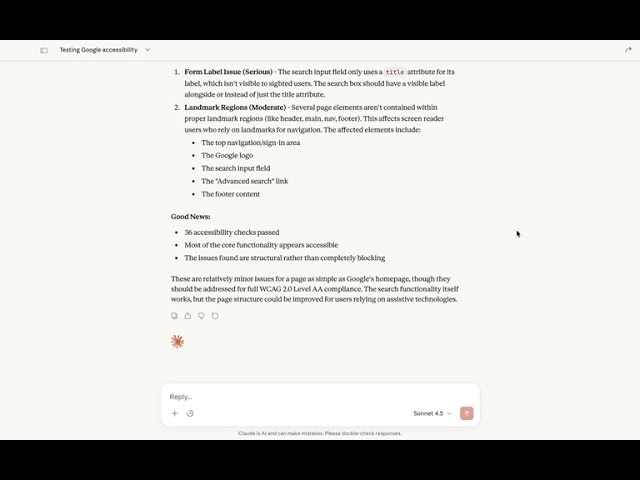
A11y MCP acts as an intelligent intermediary between an AI client (such as Claude Desktop or Cursor) and the web. When a developer provides a URL or code snippet, the LLM calls the MCP server. The server launches a Puppeteer instance to load the content and executes the axe-core rules library. The resulting data—including specific DOM nodes that fail compliance—is then sent back to the LLM in a structured format. This allows the AI to not only report errors but also to reason about the code and suggest immediate, accurate fixes based on the provided context.
Use Cases
- Proactive Dev-Cycle Auditing: Developers can run accessibility checks via chat while writing components, catching over 57% of common issues before they ever reach a staging environment.
- Automated Compliance QA: QA teams can use AI agents to navigate through complex user flows and verify accessibility status at every step without manual scanning.
- Learning and Remediation: Junior developers can use the detailed violation reports to understand why specific UI patterns fail WCAG standards and how to implement better alternatives.
- Continuous Integration Audits: Integrating the MCP into local development workflows ensures that accessibility remains a consistent priority during high-velocity shipping cycles.
Pros & Cons
Advantages
- High Technical Fidelity: Built on axe-core, the most trusted automated accessibility engine, ensuring high precision with a near-zero false-positive rate.
- Zero Cost Barriers: As a free, open-source tool, it makes professional auditing accessible to individual developers and small teams without enterprise budgets.
- Privacy-Centric: Since the server can be run locally, sensitive pre-release code can be audited without sending data to third-party accessibility clouds.
Disadvantages
- Automated Limits: No automated tool can catch 100% of issues; approximately 43% of WCAG success criteria still require manual inspection by a human expert.
- Local Setup Required: Requires a Node.js or Docker environment to run the server, which may be a hurdle for non-technical project managers.
How Does It Compare?
- Lighthouse
- Core focus: General performance, SEO, and accessibility scoring.
- Key Distinction: Lighthouse is a broad tool for quick scans. A11y MCP is specialized for “Agentic” workflows, allowing AI to interactively fix the issues it finds through the same protocol.
- Accessibility Insights (Microsoft)
- Core focus: Structured, manual, and semi-automated evaluations for formal conformance claims.
- Key Distinction: Accessibility Insights is built for humans to perform deep audits. A11y MCP is built for AI agents to perform automated checks within a development chat.
- TestGrid AI Accessibility Agent
- Core focus: Continuous AI-driven testing during real user flow execution.
- Key Distinction: TestGrid is a comprehensive commercial QA platform. A11y MCP is a lightweight, open-source utility for developers wanting a direct link between their AI editor and axe-core.
- Official Deque axe MCP Server
- Core focus: Enterprise-grade accessibility intelligence with professional support.
- Key Distinction: The official server is often part of a larger paid subscription. Ronan Takizawa’s A11y MCP provides a free, community-driven alternative using the same core open-source engine.
- AccessiBe
- Core focus: Automated front-end overlays intended to “fix” sites for end-users.
- Key Distinction: AccessiBe is a controversial “bandage” solution. A11y MCP is a development tool focused on fixing the root cause in the source code.
Final Thoughts
A11y MCP represents a significant milestone in making the “web for everyone” a standard rather than an afterthought. By placing professional auditing tools directly into the reasoning loop of AI agents, it eliminates the friction that often leads developers to skip accessibility checks. While it cannot replace the nuanced judgment of a human accessibility expert, its ability to surface nearly 60% of violations instantly makes it a foundational tool for the modern, responsible developer. For teams operating in 2026, utilizing A11y MCP is a proactive step toward building a more equitable and legally compliant digital future.