

Table of Contents
Figy.ai
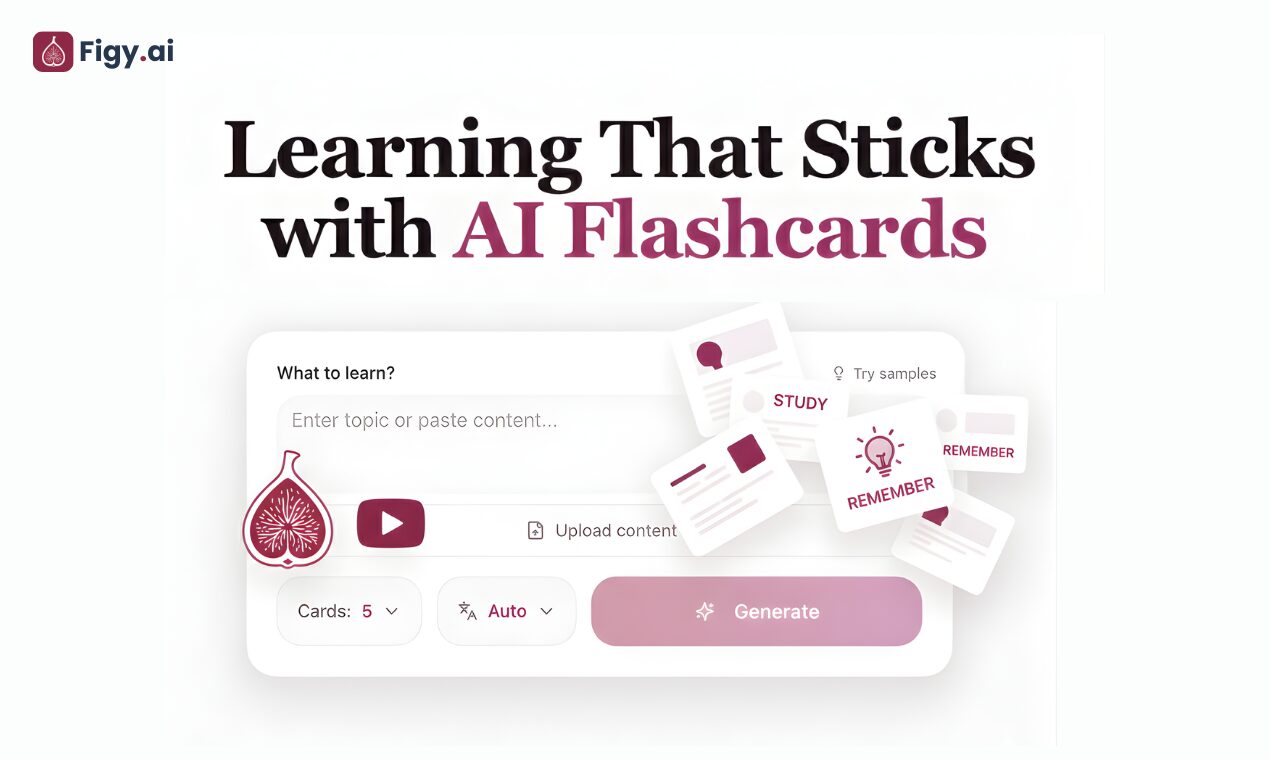
Figy.ai is an AI-powered study tool designed to minimize the friction between consuming content and retaining it. Launched in January 2026 by the team behind MyLens AI, it automates the creation of active recall materials. Instead of manually typing out hundreds of cards, students simply feed their course notes or reading materials into Figy, which instantly structures the key concepts into an interactive learning stream. Its “flow” philosophy aims to keep learners engaged by continuously adapting the challenge level and generating new questions as they master old ones.
Core Features
- Continuous Card Generation: Unlike traditional decks that are static once created, Figy’s AI can dynamically generate new, deeper follow-up questions as you progress, preventing you from just memorizing the answer by rote.
- Instant Content Conversion: Users can upload PDFs, paste article text, or input raw lecture notes, and the engine extracts the core facts to build a ready-to-use deck in seconds.
- Adaptive Review Flow: The interface is designed to maintain a “flow state,” presenting cards in a rhythm that optimizes focus and retention without the administrative overhead of organizing decks.
- Editable & Visual: Cards are not just text; the system formats them visually for better readability, and users can tweak the AI’s output to add their own mnemonics or context.
How It Works
You start by uploading your source material—such as a history essay or a biology textbook chapter—directly to the web app. The AI analyzes the text to identify definition-heavy terms, cause-and-effect relationships, and key dates. It then presents a set of flashcards. As you review them, you can indicate how well you know each fact. Based on your confidence, Figy schedules the card for later or immediately generates a harder variation to test your understanding.
Best Use Cases
- Cramming for Exams: Rapidly converting a semester’s worth of digital notes into a testable format the night before a test.
- Lifelong Learning: turning casual reading (like long-form articles or newsletters) into permanent knowledge by doing a quick 5-minute review after reading.
- Language Acquisition: Generating vocabulary drills from foreign language texts or subtitles to practice in context.
Pros and Cons
- Pros: Removes the “setup tax” of studying by automating card creation; free to use; dynamic question generation prevents the boredom of static repetition.
- Cons: As a newer tool (2026), it lacks the massive pre-made community libraries of Quizlet or the rich plugin ecosystem of Anki; primarily focused on Q&A, less effective for complex problem-solving (like math proofs).
Pricing
Free: Figy.ai launched with a completely free access model to build its user base. Currently, there are no public paywalls for standard generation features, making it highly accessible for students.
How Does It Compare?
- Gizmo: The closest direct competitor in 2026. Gizmo focuses heavily on gamification (leaderboards, cute pets), whereas Figy focuses on a minimalist “flow” state and continuous generation.
- Wisdolia: Specialized in generating flashcards specifically from PDFs and diagrams for medical students. Figy is broader, handling general text and notes with a simpler interface.
- Anki: The gold standard for long-term retention via spaced repetition algorithms. However, Anki is manual and has a steep learning curve. Figy is the “zero-config” alternative for immediate study.
- Quizlet: The incumbent giant. While Quizlet now has AI features (Q-Chat), many are locked behind a “Plus” subscription. Figy offers a lightweight, free alternative for the core “generate and study” loop.
Final Thoughts
Figy.ai represents the “unbundling” of the flashcard giant. By focusing strictly on the speed of creation and the quality of the review loop, it serves students who want the benefits of active recall without the drudgery of data entry. While it may not replace Anki for the hardcore “med school student” demographic who need 5-year retention plans, it is an excellent tool for the 99% of learners who just want to pass their next exam with less stress.