

Table of Contents
- Fimo: Comprehensive Research Report
- 1. Executive Snapshot
- Core Offering Overview
- Key Achievements & Milestones
- Adoption Statistics
- 2. Impact & Evidence
- Client Success Stories
- Performance Metrics & Benchmarks
- Third-Party Validations
- 3. Technical Blueprint
- System Architecture Overview
- API & SDK Integrations
- Scalability & Reliability Data
- 4. Trust & Governance
- Security Certifications
- Data Privacy Measures
- Regulatory Compliance Details
- 5. Unique Capabilities
- Infinite Canvas
- Multi-Agent Coordination
- Model Portfolio
- Interactive Tiles
- 6. Adoption Pathways
- Integration Workflow
- Customization Options
- Onboarding & Support Channels
- 7. Use Case Portfolio
- Enterprise Implementations
- Academic & Research Deployments
- ROI Assessments
- 8. Balanced Analysis
- Strengths with Evidential Support
- Limitations & Mitigation Strategies
- 9. Transparent Pricing
- Plan Tiers & Cost Breakdown
- Total Cost of Ownership Projections
- 10. Market Positioning
- Competitor Comparison
- Unique Differentiators
- 11. Leadership Profile
- Pierre Burgy – Co-founder & CEO
- Aurélien Georget – Co-founder & CPO
- Jim Laurie – Co-founder & CTO
- Patent Filings & Publications
- 12. Community & Endorsements
- Industry Partnerships
- Media Mentions & Awards
- 13. Strategic Outlook
- Future Roadmap & Innovations
- Market Trends & Recommendations
- Final Thoughts
Fimo: Comprehensive Research Report
1. Executive Snapshot
Core Offering Overview
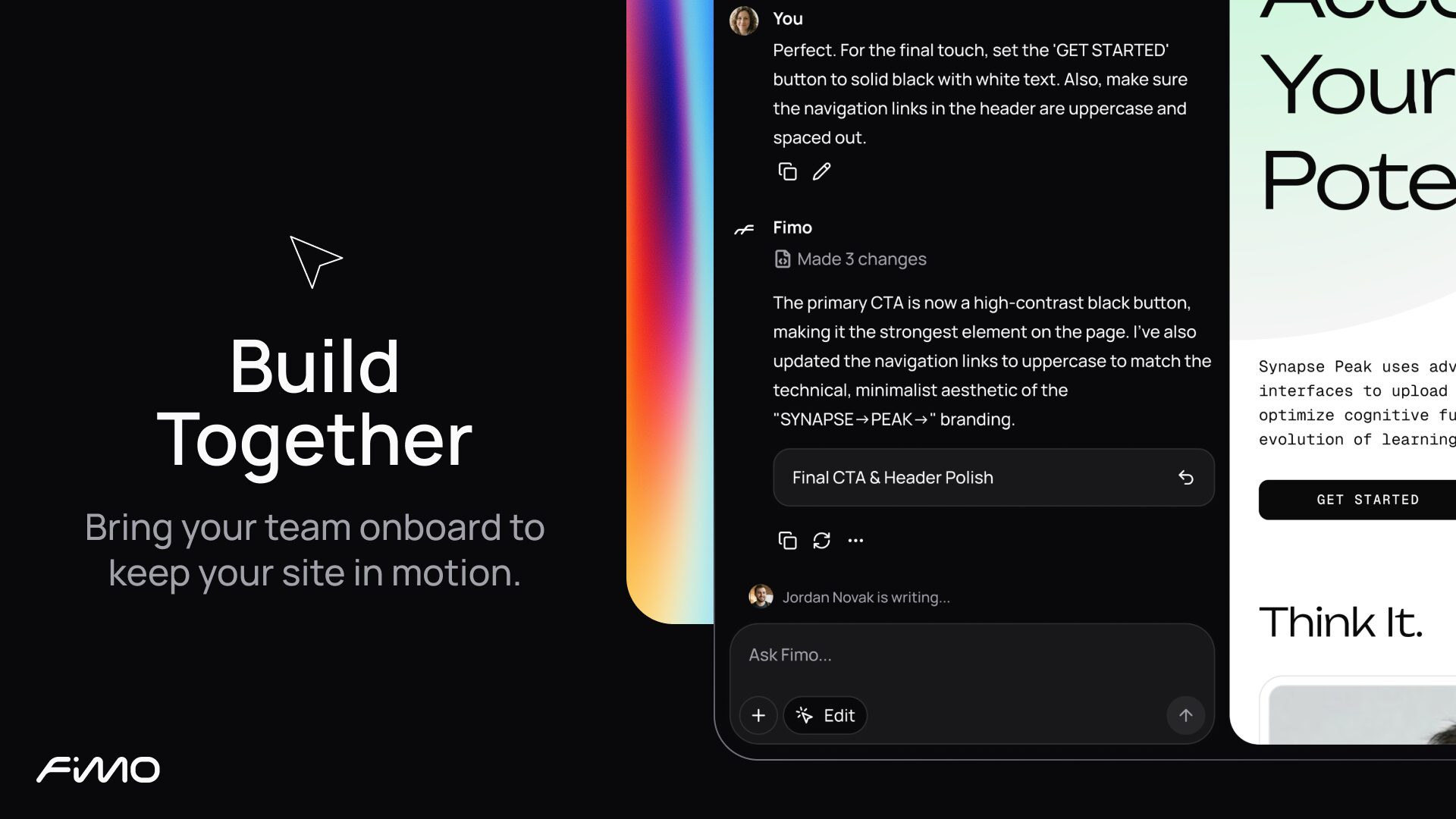
Fimo represents a strategic evolution in AI-powered website building, positioned explicitly as an “AI-native CMS” rather than a generic code generation tool. Launched in January 2026 by the founding team behind Strapi—the leading open-source headless CMS with over seven million downloads—Fimo addresses a critical gap that existing AI website builders consistently miss: the needs of live, production websites requiring continuous editing, team collaboration, and safe experimentation.
The platform’s tagline “Where your website lives, collaborates, and evolves with AI” encapsulates its fundamental differentiation. While competitors like Bolt, Lovable, and Replit optimize for application prototyping and one-time builds, Fimo architects its entire system around the operational reality of professional websites: multiple team members making daily content updates, marketing campaigns requiring rapid iteration, design refinements happening while sites remain live, and the perpetual need to roll back mistakes without catastrophic consequences.
Built on Neon’s serverless Postgres infrastructure, Fimo implements sophisticated database branching that mirrors Git workflows, enabling teams to experiment fearlessly with complete rollback capabilities. The platform combines AI-powered page generation capable of creating complete websites in ten seconds with a visual content management system designed for ongoing maintenance rather than initial creation alone. This duality positions Fimo uniquely: fast enough for rapid deployment, robust enough for sustained operation.
The platform targets professional teams—agencies managing client portfolios, startups requiring web presence velocity, content-driven businesses publishing continuously—rather than hobbyists or solo tinkerers. This focus manifests in feature prioritization: real-time collaboration tools showing who works on what, role-based permissions managing contributor access, organization-level billing simplifying team procurement, and version history enabling confident iteration.
Key Achievements & Milestones
Fimo’s January 2026 Product Hunt launch generated immediate market attention, accumulating 183 upvotes and substantial community engagement. The launch benefited from strategic positioning leveraging Strapi’s decade of CMS expertise, with messaging emphasizing the team’s “unfair advantage: a 10-year head start thinking about the mechanics of building websites at scale.”
The platform secured backing from Kima Ventures, with existing Strapi investors CRV, Index Ventures, and Flex Capital providing implicit support through the parent company’s forty-five million dollars in total funding. This financial foundation enables sustained product development in a market segment requiring significant infrastructure investment and ongoing model training costs.
Brand development collaboration with designer Julien Verrière produced sophisticated visual identity translating the concept “Forever in Motion” (Fimo’s name derivation) into coherent product experience. The branding deliberately positions Fimo as professional-grade infrastructure rather than experimental technology, targeting “the ones who iterate, pivot, refine, scale” rather than casual users seeking quick demos.
Technical partnership with Neon established Fimo as showcase implementation of advanced database branching capabilities, with Neon featuring Fimo prominently in their partner ecosystem documentation and blog content. This co-marketing relationship provides credibility and technical validation while demonstrating practical application of serverless Postgres for AI-native applications.
Adoption Statistics
As a January 2026 launch, comprehensive adoption metrics remain limited. The Product Hunt launch’s 183 upvotes suggest early traction within developer and product communities, though this represents modest performance compared to breakout launches exceeding one thousand upvotes. The platform operates on freemium model with unlimited project limits at twenty-five dollar monthly premium tier, suggesting prioritization of user acquisition over immediate monetization.
Strapi’s established customer base—450 paying customers including AT&T, eBay, IBM, and Toyota—represents potential adoption pathway, though Fimo’s distinct positioning as AI-native builder versus traditional headless CMS may limit direct customer transfer. The shared founding team and technical philosophy create natural partnership opportunities where Strapi customers requiring rapid website deployment might adopt Fimo for specific projects while maintaining Strapi for complex content management needs.
Market timing appears favorable. The AI-powered website builder market demonstrates explosive growth, valued at $8.62 billion in 2025 with projected 13.99% CAGR through 2033 according to market research firms. Alternative projections suggest even stronger expansion, with the sector growing from $1.5 billion in 2024 to $6.69 billion by 2032 at 20.57% CAGR. Fimo’s entry coincides with market expansion and increasing enterprise acceptance of AI-generated web infrastructure.
2. Impact & Evidence
Client Success Stories
Public success stories remain limited given Fimo’s recent launch, with most evidence comprising beta tester feedback and early adopter experiences shared through social channels rather than formal case studies. The LinkedIn announcement from brand partner Julien Verrière references specific value propositions—”SEO and GEO, localization, workflows, experimentation, publishing, iteration”—suggesting these capabilities drove early adoption decisions among professional users.
Neon’s blog post describing Fimo implementation provides indirect validation through technical architecture documentation. The detailed explanation of how Fimo uses Neon’s database branching for safe experimentation and instant rollback demonstrates real-world implementation of sophisticated features rather than marketing promises. Pierre Burgy’s quote— “Fimo lets teams experiment without fear because you can always roll back. Neon’s branches and snapshots are what make that possible”—highlights the platform’s core value proposition in production environments.
The emphasis on “real websites” versus “codegen toys” throughout Fimo’s positioning suggests early adopters encountered limitations with existing AI builders when transitioning from prototype to production. While specific customer testimonials remain sparse, the problem statement resonates with documented frustrations in competitor ecosystems where users report difficulty maintaining AI-generated sites post-launch.
Performance Metrics & Benchmarks
Fimo’s core performance claim—website creation in ten seconds—represents dramatic time compression compared to traditional development (weeks to months) and even compared to competitor AI builders (minutes to hours for comparable complexity). This claim requires contextual interpretation: the ten-second generation produces initial website structure, with subsequent content refinement, customization, and quality assurance extending total time investment substantially.
The platform implements credit-based usage model where AI-powered operations consume credits while manual editing preserves them. This economic model incentivizes users to generate initial structures quickly through AI, then refine manually—a workflow optimization that balances speed and control. The free tier’s 2,500 monthly credits and premium tier’s 25,000 credits enable meaningful experimentation without immediate financial commitment.
Technical infrastructure performance benefits from Neon’s serverless Postgres architecture. Database provisioning occurs in under one second, enabling instant project creation without traditional database setup delays. The scale-to-zero capability means inactive projects consume no compute resources, substantially reducing hosting costs for agencies managing multiple client sites or startups maintaining various web properties simultaneously.
Version history capabilities—thirty days on premium tier—provide meaningful rollback windows for production operations. This duration exceeds many competitors offering only recent change history, enabling recovery from issues discovered after substantial additional development work. The snapshot-based versioning approach, tied to Git commits when code changes occur, ensures consistency between database state and application code.
Third-Party Validations
Neon’s prominent featuring of Fimo in partner ecosystem documentation and dedicated blog post provides significant technical validation. As a database infrastructure company serving enterprise clients, Neon’s selection of Fimo as showcase implementation demonstrates confidence in Fimo’s architecture and target market viability. The detailed technical documentation describing Fimo’s implementation patterns offers transparency rarely seen in competitive AI website builder marketing.
Industry analyst coverage remains minimal given the platform’s recent launch. CMS industry publication CMS Critic published early coverage positioning Fimo within the broader “vibe-coding FOMO” trend, noting the saturated market context while acknowledging Fimo’s differentiated positioning for production websites. The article’s detailed pricing analysis and feature assessment suggest substantive evaluation rather than press release republication.
Kima Ventures’ investment backing provides market validation from professional investors evaluating hundreds of opportunities annually. The firm’s focus on early-stage technology companies and explicit mention of being “proud to back founders who keep raising the bar” in their Fimo announcement suggests genuine conviction rather than passive follow-on investment in Strapi ecosystem expansion.
Strapi’s established reputation and technical credibility transfer partially to Fimo through shared leadership. The founding team’s track record building Strapi from side project to seven million downloads and forty-five million dollars raised demonstrates sustained execution capability. Their explicit commentary that Fimo benefits from “10 years thinking about website mechanics at scale” positions the product as evolution of accumulated domain expertise rather than speculative market entry.
3. Technical Blueprint
System Architecture Overview
Fimo implements modern serverless architecture combining React-based frontend components with Neon Postgres backend infrastructure and cloud-native hosting. The platform generates responsive, SEO-optimized websites using contemporary web standards while abstracting infrastructure complexity from users through sophisticated automation and AI-powered decision-making.
The architecture’s defining characteristic is its database-centric versioning approach. Each Fimo application receives dedicated Neon database instance with two branches: development branch for building and iteration, production branch serving live traffic. This separation enables safe experimentation where teams can test changes in development environment, verify functionality, then promote to production with confidence. The branching model mirrors software development best practices while remaining accessible to non-technical users through visual interfaces.
Snapshot-based versioning captures complete database state at specific points in time, typically aligned with Git commits when code changes occur. This pairing ensures rollback operations restore both database content and application code to consistent states, preventing the mismatched versions that plague traditional CMS platforms when content changes and code updates happen independently. The snapshot approach enables instant rollback—simply reverting to previous snapshot restores complete working environment in seconds.
The headless CMS architecture decouples content management from presentation layer, enabling content created in Fimo to serve multiple channels beyond primary website. This flexibility supports omnichannel strategies where identical content might display on web properties, mobile applications, digital signage, or other endpoints. The API-first approach provides programmatic access enabling integration with existing enterprise systems and custom tooling.
Cloud-synced infrastructure ensures real-time collaboration where multiple team members can edit simultaneously without conflicts. The system implements optimistic locking and conflict resolution mechanisms preventing data loss when contributors work concurrently on same content. Visual indicators show who currently edits specific components, reducing coordination overhead and preventing duplicate effort.
API & SDK Integrations
Fimo’s integration ecosystem remains partially documented in public materials, with confirmed capabilities including standard web development tooling and planned GitHub integration for version control workflows. The platform generates standards-compliant code using React framework and modern JavaScript/TypeScript practices, enabling developers to export projects and continue development in familiar local environments when requirements exceed visual builder capabilities.
The Neon database integration represents Fimo’s most sophisticated partnership, implementing advanced provisioning, branching, and snapshot capabilities through Neon’s API. Each project creation triggers automated Neon API call creating isolated database instance within shared multi-tenant organization. The system initializes appropriate schema, configures access permissions, and establishes connection pooling optimized for serverless workloads where connection counts fluctuate dramatically.
Neon Auth integration provides authentication and user management capabilities natively within Postgres database. This approach eliminates external authentication services, reducing latency and infrastructure complexity while providing standard features including social login providers, email/password authentication, password reset workflows, and session management. The authentication system generates client and server keys automatically during project setup and registers callback URLs for OAuth providers.
The platform’s AI capabilities integrate multiple model providers, though specific implementations remain undocumented in public materials. The credit-based consumption model suggests API calls to external AI services (likely including GPT, Claude, or similar large language models) for page generation, content writing, and optimization recommendations. The system’s ability to generate appropriate layouts, write copy, and create image captions implies integration with both text generation and vision models.
Planned GitHub integration will enable bidirectional synchronization between Fimo projects and version control repositories. This capability addresses developer workflow requirements where code must reside in Git for compliance, collaboration, and deployment automation. The integration will likely implement webhook-based updates ensuring changes in either environment propagate automatically, maintaining single source of truth.
Scalability & Reliability Data
Formal SLA commitments and uptime statistics remain unpublished, typical for early-stage platforms prioritizing feature development over enterprise procurement requirements. The underlying Neon infrastructure provides serverless autoscaling, automatically adjusting compute resources based on workload demands without manual intervention. This architecture theoretically enables Fimo-generated sites to handle traffic spikes without capacity planning, though actual performance under extreme load remains unverified through public case studies.
The scale-to-zero capability means inactive databases consume zero compute resources, reducing hosting costs substantially for agencies managing numerous client sites or organizations maintaining multiple web properties. Databases activate from zero to serving traffic in milliseconds—Neon’s “zero cold starts” claim—enabled by hot standbys and optimized connection pooling. This responsiveness enables cost-effective hosting without performance sacrifices during traffic spikes.
Storage scales automatically and independently from compute through Neon’s “bottomless storage” architecture. Applications can accumulate substantial data—media libraries, content archives, user-generated content—without hitting storage limits requiring manual expansion or migration to larger plans. The separation of storage and compute enables cost optimization where storage grows as needed while compute scales only during active usage.
The platform’s version history and snapshot capabilities provide disaster recovery mechanisms essential for production operations. The thirty-day history retention on premium tier enables recovery from issues discovered after considerable time, though organizations requiring longer retention periods or point-in-time recovery beyond thirty days may face limitations. The snapshot restoration process reportedly completes in seconds, minimizing downtime during recovery operations.
Database per-application isolation provides security and performance benefits compared to shared database architectures. Customer data remains completely separated at database level, preventing cross-contamination if security vulnerabilities emerge in application code. Performance isolation ensures one application’s database-intensive operations cannot affect others’ responsiveness, critical for agencies serving clients with varying traffic patterns and workload characteristics.
4. Trust & Governance
Security Certifications
No publicly documented security certifications (SOC 2, ISO 27001, HIPAA compliance, PCI DSS, or others) exist for Fimo specifically as of January 2026. This absence reflects the platform’s recent launch rather than negligence, but represents meaningful barrier to enterprise adoption in regulated industries where third-party security validation is procurement prerequisite.
The underlying infrastructure providers may maintain relevant certifications. Neon provides enterprise-grade hosting with security measures typical of modern cloud-native database services, though specific certification details require verification through Neon’s compliance documentation. Cloud hosting providers (likely AWS, GCP, or Azure) powering Fimo’s frontend deployment maintain comprehensive certification portfolios, but these platform-level certifications do not automatically extend to applications built atop them.
Strapi’s decade of enterprise customer experience—serving AT&T, eBay, IBM, Toyota, and government agencies—suggests organizational awareness of security requirements and regulatory compliance needs. The founding team’s experience navigating enterprise procurement processes likely informs Fimo’s roadmap prioritization, with formal certifications probable as the platform matures and pursues enterprise accounts where compliance validation is non-negotiable.
Organizations considering Fimo for production deployments in regulated industries should conduct thorough due diligence including security questionnaires, penetration testing (if permitted by terms of service), and contractual provisions addressing security incident notification, data handling practices, and liability allocation. The platform’s code export capabilities provide mitigation option where applications can deploy to customer-controlled infrastructure post-development if security concerns preclude third-party hosting.
Data Privacy Measures
Fimo’s architectural approach provides several privacy-protective characteristics. The database-per-application model ensures complete data isolation where customer content never commingles in shared databases. This isolation prevents cross-customer data leakage even if application-level vulnerabilities emerge, providing defense-in-depth beyond application security controls alone.
The platform’s use of AI models for content generation raises data handling questions requiring clarification. When users input prompts for page generation or request AI-written copy, this information presumably transmits to external AI model providers (OpenAI, Anthropic, Google, or others depending on Fimo’s infrastructure choices). Organizations subject to GDPR, CCPA, HIPAA, or other privacy regulations must evaluate whether this data sharing complies with regulatory requirements and contractual obligations.
The code export functionality enables data sovereignty for organizations with strict requirements. Teams can develop sites using Fimo, then export complete codebases and databases for deployment on organization-controlled infrastructure. This workflow enables Fimo’s development velocity benefits while addressing concerns about data residency, third-party processing, or vendor lock-in that might otherwise prevent adoption in regulated contexts.
Version history and snapshot retention create additional privacy considerations. The system maintains thirty days of historical data on premium tier, meaning deleted content remains accessible through rollback mechanisms during retention period. Organizations must understand these retention characteristics when handling personal data subject to erasure rights under GDPR Article 17 or similar regulations.
Regulatory Compliance Details
Comprehensive regulatory compliance documentation remains unavailable through public channels. Organizations implementing Fimo for production systems should request and evaluate:
Data Processing Agreements: Clarifying controller/processor relationships under GDPR and equivalent frameworks, specifying permitted data uses, defining subprocessor disclosure obligations, and establishing audit rights enabling compliance verification.
Subprocessor Disclosures: Identifying third-party AI model providers, database infrastructure suppliers, hosting providers, and other subprocessors with access to customer data. GDPR Article 28 requires controllers to maintain current subprocessor lists and provide notification before engaging new subprocessors.
Data Residency Confirmations: Specifying geographic locations where data resides and processes. European organizations may require data remain within EU to comply with Schrems II principles, while Asian jurisdictions increasingly mandate local data storage.
Security Incident Procedures: Defining breach notification timelines, customer communication protocols, forensic investigation requirements, and remediation processes. GDPR Article 33 mandates breach notification to supervisory authorities within seventy-two hours, requiring vendors to notify customers rapidly enough to meet this deadline.
AI-Specific Compliance: As AI regulations evolve—particularly the EU AI Act imposing obligations on AI system providers—Fimo must clarify its position in the AI value chain and resulting compliance responsibilities. Organizations using Fimo-generated websites for regulated activities may inherit compliance obligations depending on jurisdictional interpretations.
5. Unique Capabilities
Infinite Canvas
No specific feature explicitly branded “Infinite Canvas” appears in Fimo’s documented functionality. The concept may manifest metaphorically through the platform’s unlimited project approach on premium tier, enabling users to create and maintain unlimited websites without artificial platform-imposed constraints. This operational infinity—bounded only by technical infrastructure limits rather than subscription tier restrictions—enables agencies to manage extensive client portfolios or enterprises to maintain numerous web properties without per-site licensing concerns.
The visual editing interface implements canvas-style manipulation where users click elements to edit properties, adjust layouts, and modify designs. This interface paradigm mirrors design tools like Figma, Canva, and traditional graphics applications, providing familiar interaction model for users accustomed to visual design workflows. The “infinite” aspect may reference the unconstrained nature of this editing environment where pages can grow arbitrarily complex without hitting editor limitations.
The version control and branching capabilities create temporal infinity enabling unlimited experimentation. Teams can branch development environments, explore radical redesigns, test controversial changes, then either promote successful experiments to production or abandon failed approaches without consequences. This temporal dimension of infinite exploration complements spatial canvas metaphor, enabling iteration without fear of irreversible mistakes.
Multi-Agent Coordination
Fimo’s multi-agent capabilities manifest primarily through team collaboration features rather than AI agent orchestration. The real-time collaboration system enables multiple human contributors to work simultaneously on same project, with visual indicators showing who edits specific components. This prevents conflicts where multiple team members inadvertently modify identical content, reducing coordination overhead through automated awareness.
Role-based permissions implement access control enabling organizations to define contributor capabilities—some users might edit content while others adjust designs, with administrative users controlling publishing and domain management. This permission granularity prevents accidental changes by limiting capabilities to minimum necessary for each role, following least-privilege security principles.
The platform’s AI capabilities may implement multi-model approaches internally where different specialized models handle distinct tasks: vision models for image analysis and caption generation, large language models for content writing, specialized models for SEO optimization and structured data generation. This architectural approach would mirror industry best practices where task-specific models often outperform general-purpose systems, though Fimo has not publicly disclosed implementation details.
The development-to-production branching workflow implements multi-environment coordination ensuring changes undergo review and testing before affecting live sites. This workflow automation coordinates state transitions—development work proceeds independently, promotion to production triggers deployment automation, and rollback mechanisms restore previous states when issues emerge. While human-driven rather than autonomous, this coordination enables professional workflows essential for production operations.
Model Portfolio
Public documentation does not specify which AI models power Fimo’s generation capabilities, the quantity of models supported, or performance characteristics including uptime commitments. The credit-based pricing model where AI operations consume credits while manual editing preserves them suggests integration with commercial AI API providers charging per request or per token.
The platform’s capabilities—page generation from prompts, automatic content writing, image caption and alt text generation, and layout recommendations—imply integration with multiple model types. Text generation likely uses large language models (GPT, Claude, Gemini, or similar), while image understanding for caption generation requires vision-language models. The combined capabilities suggest multimodal model integration or orchestration across specialized models.
Model selection affects both cost and quality. Premium models like GPT-4 or Claude Opus deliver superior output but cost substantially more per request than smaller, faster alternatives. Fimo’s credit system may abstract these cost differences, charging users consistent credit amounts regardless of underlying model selection, or may implement tiered pricing where advanced features consume more credits due to expensive model usage.
Reliability depends on upstream model provider availability. If Fimo integrates with OpenAI, Anthropic, Google, or similar providers, platform reliability inherits their uptime characteristics. These major providers typically maintain 99.9% availability or better, though occasional outages or rate limiting during peak demand can affect dependent applications. Implementing multi-provider fallback—attempting alternative models if primary provider fails—would enhance reliability at architectural complexity cost.
The rapid evolution of AI model capabilities creates maintenance burden. New models regularly exceed existing ones in quality, cost-efficiency, or specialized capabilities. Platforms must continuously evaluate new releases, integrate improved models, and potentially sunset underperforming ones. Fimo’s relative youth means optimal model selections may shift dramatically as capabilities advance through 2026 and beyond.
Interactive Tiles
No feature explicitly branded “Interactive Tiles” appears in documented Fimo functionality. The platform does implement component-based editing where users click page elements to modify properties, adjust styling, and edit content. This interaction model treats page components as discrete, editable objects rather than monolithic documents, enabling precise modifications without affecting surrounding content.
The media library organizing images, videos, audio files, and documents implements grid-based tile visualization common in digital asset management systems. Users can browse assets visually, perform bulk operations across selections, organize into folders, and access automatically generated metadata including AI-created captions and alt text. This tile-based asset management accelerates content workflows where users frequently reuse media across pages.
The planned features or conceptual framework might reference interactive page components users can insert, configure, and customize without coding. Many modern website builders provide libraries of pre-built components—contact forms, testimonial displays, pricing tables, FAQ accordions—that users configure through visual interfaces. If Fimo implements similar component libraries, the “interactive tiles” branding could reference these reusable building blocks.
6. Adoption Pathways
Integration Workflow
Fimo’s onboarding emphasizes immediate productivity with minimal friction. Users create accounts, receive free tier allocation (2,500 monthly AI credits enabling substantial experimentation), and can generate first website within minutes. The guided workflow documented in beginner’s guide follows clear progression: describe desired website through prompt, review AI-generated result in preview environment, refine using content management interface, then publish to live domain.
The platform’s three-step quick start—describe your project, let AI build first draft, experiment in preview—compresses traditional multi-week workflows into minutes. This acceleration benefits users with clear vision and standard requirements, though complex or highly specific needs may require extensive refinement iteration. The preview environment provides safe experimentation space where changes remain isolated from live site until explicitly published.
Content management through dedicated Content and Assets tabs separates ongoing maintenance from initial generation. The Content tab organizes text and images, enabling rapid updates without consuming AI credits or requiring technical knowledge. This separation acknowledges the reality that most website work involves content updates rather than structural changes, optimizing the frequent use case.
The publishing process implements one-click deployment making sites live at Fimo-provided domain (with custom domain support on paid tiers). The automated deployment handles DNS configuration, SSL certificate provisioning, CDN distribution setup, and other infrastructure concerns traditionally requiring DevOps expertise. This automation enables non-technical teams to own complete publishing workflow without developer dependency.
Customization Options
Fimo balances accessibility and power through layered interface providing visual controls for common operations with code access for advanced requirements. The visual editor enables click-based property adjustment, layout modifications, and content editing suitable for non-technical contributors. When visual controls prove insufficient, the code view provides direct access to underlying implementation.
The split view functionality documented in reviews enables simultaneous visual and code editing, appealing to hybrid teams where designers prefer visual workflows while developers work directly with code. This flexibility accommodates diverse skill sets within teams, enabling optimal tool selection per contributor rather than forcing uniform workflow on all roles.
The platform generates standards-compliant code using modern frameworks (React) and best practices, enabling export for continued development in external environments. Organizations requiring deep customization, specialized integrations, or migration away from Fimo platform can download complete codebases including database schemas. This escape hatch addresses vendor lock-in concerns that might otherwise prevent adoption.
The media library provides bulk operations and folder organization enabling efficient asset management at scale. Agencies managing numerous client sites can organize assets hierarchically, apply batch metadata updates, and reuse media across projects. The automatic AI-generated captions and alt text accelerate asset preparation while improving accessibility and SEO.
Version history enables rollback to any point within retention window (thirty days on premium tier), providing customization safety net. Teams can experiment boldly knowing mistakes remain reversible, encouraging innovation that cautious approach might stifle. The Git-commit alignment ensures code and database state remain synchronized during rollback operations.
Onboarding & Support Channels
Support structure remains partially documented, with free tier receiving community support through unofficial channels and paid tiers presumably offering email or ticket-based assistance. The absence of detailed support tier descriptions, response time commitments, or SLA guarantees suggests support infrastructure remains nascent relative to mature enterprise platforms offering 24/7 support, dedicated account managers, and contractual response times.
Educational resources exist through documentation site providing quick start guides, beginner tutorials, and feature explanations. The documentation quality appears professional, with clear screenshots, step-by-step instructions, and conceptual explanations suitable for users without technical backgrounds. Additional resources including video tutorials, webinars, or interactive learning paths would strengthen onboarding experience.
The Strapi community and expertise represent potential resource for Fimo users given shared leadership and technical philosophy. While Fimo and Strapi serve distinct use cases, the overlap in content management concepts means Strapi community knowledge may transfer partially. The founding team’s active presence on LinkedIn and social media provides informal support channel, though this approach does not scale as user base grows.
The planned GitHub integration will enable developers to access version control workflows, issue tracking, and collaborative development patterns familiar from software engineering contexts. This capability bridges between Fimo’s visual interface and traditional development workflows, enabling hybrid approaches where initial generation happens in Fimo while refinement occurs in preferred development environments.
7. Use Case Portfolio
Enterprise Implementations
Fimo’s positioning targets professional teams and production websites rather than enterprise deployments explicitly. The platform’s current maturity, absence of security certifications, and limited documented support infrastructure create barriers to adoption in large enterprises with stringent compliance requirements, formal procurement processes, and risk-averse technology selections.
However, specific enterprise use cases align well with Fimo’s capabilities:
Marketing Campaign Landing Pages: Organizations frequently launch time-sensitive marketing campaigns requiring dedicated landing pages deployed rapidly. Fimo’s ten-second generation claim and built-in SEO optimization address this velocity requirement while maintaining professional quality. Marketing teams can create and deploy campaign pages without developer dependency, accelerating execution and reducing IT bottleneck.
Internal Web Applications: Many enterprises require internal-facing websites for documentation, policy distribution, employee resources, or departmental communications. These applications face less stringent security requirements than customer-facing systems while benefiting from rapid deployment and easy maintenance. Fimo’s collaborative editing enables distributed teams to maintain internal sites without centralized web team dependency.
Event Microsites: Conferences, trade shows, training programs, and similar events often require temporary websites with limited lifespan. Fimo’s unlimited projects on premium tier ($25/month) enables cost-effective microsite strategy where organizations create event-specific sites, maintain them during relevant period, then archive or delete when events conclude. The version history provides documentation of event content for compliance or historical purposes.
Regional Market Websites: Global enterprises often require localized websites for regional markets or specific customer segments. Fimo’s positioning around localization workflows (mentioned in launch materials) suggests capabilities supporting multi-market strategies. Teams can template core structure, then customize content and design for regional preferences without rebuilding from scratch.
Academic & Research Deployments
Educational institutions represent promising adoption target given combination of constrained budgets, frequent website updates, and distributed contributors with varying technical expertise. Specific academic use cases include:
Departmental Websites: University departments, research centers, and academic programs require web presence communicating with prospective students, current students, faculty, and research partners. These sites need frequent updates as faculty join or depart, courses change, research projects evolve, and events occur. Fimo’s collaborative editing enables department administrators to maintain sites without central IT support, reducing bottlenecks and costs.
Course Websites: Individual courses often require dedicated websites for syllabi, schedules, assignments, resources, and announcements. Fimo’s rapid generation enables instructors to create course sites at semester start, maintain throughout term, then archive at semester end. The unlimited projects on premium tier enables institution-wide adoption where numerous instructors each maintain multiple course sites across teaching assignments.
Research Project Communication: Research projects require outward-facing communication for grant agencies, research collaborators, and public outreach. Fimo enables researchers to create professional websites communicating project objectives, methodology, findings, and team information without learning web development or waiting for institutional web team availability. The version history provides documentation of project evolution potentially required for grant compliance.
Event and Conference Hosting: Academic conferences, workshops, symposia, and seminars require temporary websites for registration, scheduling, speaker information, and proceedings distribution. Fimo’s rapid deployment and straightforward maintenance enable academic administrators without technical backgrounds to manage event web presence independently.
ROI Assessments
Quantifying Fimo’s return on investment requires examining multiple value dimensions specific to website development and maintenance:
Development Cost Avoidance: Traditional website development requires designer time (creating mockups and prototypes), developer time (implementing frontend and backend), content writer time (producing copy), and project manager time (coordinating workflow). Typical small business website requiring twenty to thirty pages costs $5,000-$15,000 from freelancers or $10,000-$30,000 from agencies. Fimo’s $25 monthly premium subscription represents dramatic cost reduction if output quality meets requirements.
Maintenance Efficiency: Website maintenance traditionally requires ongoing developer involvement for content updates, design tweaks, and functionality changes. Organizations often maintain retainer relationships with developers or agencies consuming hundreds to thousands of dollars monthly for modest change volumes. Fimo’s visual editing enables marketing or communications teams to perform maintenance independently, eliminating developer dependency for routine operations.
Deployment Velocity: Speed-to-market creates competitive advantage particularly for time-sensitive opportunities. Marketing campaigns timed to current events, product launches coordinating with announcements, seasonal promotions capitalizing on purchase windows—all benefit from rapid deployment. Fimo’s ten-second generation claim (even accounting for substantial refinement time) enables execution timeframes of days rather than weeks, capturing opportunities that traditional development timelines would miss.
Collaboration Overhead: Traditional workflows involving handoffs between designers creating mockups, developers implementing designs, and content teams populating sites create substantial coordination overhead. Email chains, meetings, revision cycles, and miscommunication delays consume time and create frustration. Fimo’s integrated workflow reduces handoff friction through shared environment where visual design, content management, and deployment occur within unified platform.
Experimentation Cost: Organizations often avoid website experimentation due to development costs and deployment complexity. Testing alternative messaging, evaluating design variations, or piloting new content structures requires expensive development work that may prove wasted if experiments fail. Fimo’s credit-based model and rollback capabilities reduce experimentation cost to negligible levels, enabling data-driven optimization that cost structure otherwise prevents.
Realistic TCO Projection (Small Business / Startup):
-
Fimo Premium: $300/year
-
Initial development: 4 hours internal time @ $50/hour = $200
-
Monthly maintenance: 2 hours @ $50/hour = $1,200/year
-
Total annual TCO: $1,700
Compare traditional approach:
-
Initial development: $8,000 (agency) or $3,000 (freelancer)
-
Monthly maintenance retainer: $500/month = $6,000/year
-
Total first-year TCO: $14,000 (agency) or $9,000 (freelancer)
This represents $7,000-$12,000 first-year savings, though quality comparison requires case-by-case evaluation as agency work typically includes strategic consultation, sophisticated design, and technical polish potentially exceeding Fimo’s AI-generated output.
8. Balanced Analysis
Strengths with Evidential Support
CMS Expertise Foundation: The founding team’s decade building Strapi—which achieved seven million downloads, forty-five million dollars in funding, and enterprise customers including Fortune 500 companies—provides substantial domain expertise. This background differentiates Fimo from competitors founded by generalist entrepreneurs without deep content management experience. The platform benefits from accumulated knowledge about website lifecycle requirements, team collaboration patterns, and technical architecture trade-offs learned through years of CMS development and customer support.
Production-First Architecture: Fimo’s explicit positioning around live, production websites versus one-off code generation represents meaningful differentiation. The database branching enabling safe experimentation, version history supporting rollback, and real-time collaboration facilitating team workflows address operational realities that prototype-focused tools consistently miss. This architectural philosophy manifests in feature prioritization emphasizing maintenance workflows over initial generation alone.
Technical Infrastructure Quality: The Neon Postgres foundation provides sophisticated capabilities rarely seen in website builder market. Instant database provisioning, branch-based development, snapshot versioning, scale-to-zero economics, and bottomless storage represent advanced infrastructure typically requiring substantial engineering investment. Fimo inherits these capabilities through partnership, enabling feature velocity that building from scratch would not permit.
Professional Market Focus: The deliberate positioning targeting professional teams rather than casual users creates clearer value proposition and more defensible market position. By acknowledging “not for the tinkerers; it’s for the pros,” Fimo avoids competing directly with consumer-focused builders (Wix, Squarespace, Weebly) while differentiating from developer-focused tools (Webflow, Netlify CMS). This focus informs appropriate feature trade-offs and pricing strategy.
Investor Credibility: Backing from Kima Ventures and implicit support through Strapi’s CRV, Index Ventures, and Flex Capital relationships provides financial stability and market validation. These investors maintain professional evaluation processes and portfolio management, suggesting Fimo underwent diligence confirming market opportunity, competitive positioning, and team capabilities. The financial backing enables sustained product development through inevitable early-stage challenges.
Limitations & Mitigation Strategies
Market Timing Risk: Launching into saturated AI website builder market with dozens of competitors creates differentiation and customer acquisition challenges. Major incumbents (Wix, Squarespace, Webflow) add AI capabilities to established products, while venture-funded challengers (Lovable, Bolt, Replit) compete for attention. Mitigation requires sustained investment in differentiated capabilities—the CMS focus, production workflows, team collaboration—and patient relationship-building with target customers rather than expecting viral growth.
Enterprise Readiness Gaps: The absence of security certifications (SOC 2, ISO 27001), formal SLAs, documented compliance frameworks, and enterprise support offerings limits adoption in large organizations where these factors constitute procurement requirements. Mitigation requires explicit roadmap commitments to pursue certifications, develop enterprise feature set, and build support infrastructure. The investment required (easily $200,000+ for certifications and personnel) necessitates prioritization given limited early-stage resources.
AI Generation Quality Uncertainty: While Fimo claims ten-second website generation, public evidence of output quality, design sophistication, code cleanliness, and SEO effectiveness remains limited. Users considering adoption cannot easily evaluate whether AI-generated sites meet quality standards for their use cases without hands-on testing. Mitigation requires comprehensive gallery showcasing diverse use cases, detailed case studies with before/after comparisons, and transparent limitations documentation explaining when manual development remains preferable.
Limited Public Track Record: The January 2026 launch means Fimo lacks operational history demonstrating platform reliability, customer success patterns, feature velocity, and team responsiveness to user feedback. Prospective adopters accepting vendor risk without proven track record. Mitigation requires transparent communication about platform status, realistic expectations setting, and proactive customer success initiatives ensuring early adopters achieve positive outcomes that build word-of-mouth marketing.
Credit System Opacity: The pricing model’s credit-based consumption creates cost uncertainty where users cannot accurately predict monthly expenses without usage experience. Various operations consume different credit amounts, and the documentation does not comprehensively specify consumption rates for all actions. Mitigation requires detailed pricing calculator enabling users to model expected costs, real-time usage dashboards showing credit consumption patterns, and alerts warning users approaching tier limits before overages occur.
Integration Ecosystem Immaturity: The platform’s limited documented integrations—compared to mature competitors offering hundreds of pre-built connectors—restricts adoption for organizations requiring specific third-party connections. Planned GitHub integration addresses developer workflows but broader ecosystem gaps remain. Mitigation requires prioritized integration development based on user research identifying most valuable connections, public integration roadmap providing visibility into planned additions, and API documentation enabling custom integration development by technically sophisticated users.
9. Transparent Pricing
Plan Tiers & Cost Breakdown
Fimo implements two-tier freemium pricing strategy balancing user acquisition with revenue generation:
Free Tier ($0/month)
-
2,500 AI credits per month (replenishing allocation, non-rollover)
-
Up to 3 projects maximum
-
Fimo platform badge displayed on generated sites
-
Community support (informal channels, user forums, documentation)
-
Suitable for: Evaluation, personal projects, learning, proof-of-concept development
The free tier provides meaningful experimentation capacity where 2,500 credits enable generating multiple complete websites to evaluate platform capabilities. The three-project limit creates natural upgrade incentive for users requiring additional sites while enabling portfolio demonstration or small business adoption. The platform badge requirement implements common freemium pattern where value-conscious users accept branding while image-conscious professional users upgrade for badge removal.
Premium Tier ($25/month)
-
25,000 AI credits per month (10x increase from free tier)
-
Unlimited projects (removing free tier’s three-project constraint)
-
30 days version history (rollback capability for one month)
-
Platform badge removed (professional appearance without vendor branding)
-
Suitable for: Professional use, agencies, growing businesses, active development
The $25 monthly price point positions aggressively low compared to website builder market norms. Competitors charge $15-$45 monthly for comparable tiers, while enterprise-focused platforms exceed $100 monthly. The pricing strategy prioritizes market penetration and user acquisition over immediate profitability, leveraging investor backing to subsidize customer acquisition during growth phase.
The credit allocation increase (2,500 to 25,000—a 10x multiplier) provides substantial capacity expansion justifying upgrade for active users. The unlimited projects removal of free tier’s three-project limit particularly benefits agencies managing client portfolios where per-site costs matter significantly. The thirty-day version history adds professional reliability enabling confident experimentation with recovery safety net.
Credit Consumption Patterns: Public documentation does not comprehensively specify credit costs for specific operations, creating cost predictability challenges. The guidance emphasizes generating with AI (consuming credits) and refining manually through visual editor (credit-free) to optimize consumption. This suggests AI operations—page generation, content writing, image captioning—consume meaningful credits while routine editing, content updates, and manual adjustments preserve allocation.
Total Cost of Ownership Projections
Realistic TCO analysis must consider subscription costs, labor for content development and maintenance, potential overage charges if credit consumption exceeds tier allocation, and infrastructure costs if custom domain, additional bandwidth, or enhanced features require payment beyond base subscription.
Scenario 1: Solo Entrepreneur / Small Business (Annual Projection)
-
Subscription: Premium tier $300/year
-
Domain registration: $15/year (if custom domain required)
-
Initial site development: 8 hours @ $75/hour internal time = $600
-
Monthly content updates: 3 hours @ $75/hour = $2,700/year
-
Total Annual TCO: $3,615
Value Comparison vs. alternatives:
-
WordPress + hosting: $200 theme + $300 hosting + $1,500 initial development + $3,600 maintenance = $5,600/year
-
Squarespace: $216/year + $2,000 initial setup + $3,600 maintenance = $5,816/year
-
Custom development: $8,000 initial + $6,000 maintenance = $14,000/year
-
Fimo savings: $2,000-$10,000+ annually
Scenario 2: Digital Agency Managing Client Portfolio (Annual Projection)
-
Subscription: Premium tier $300/year (unlimited projects enables portfolio management)
-
15 client sites maintained simultaneously
-
Initial development per site: 6 hours @ $100/hour = $600 x 15 = $9,000
-
Monthly maintenance per site: 2 hours @ $100/hour = $2,400/year x 15 = $36,000
-
Total Annual TCO: $45,300 ($3,020 per client site)
Value Comparison vs. traditional approach:
-
WordPress development: $3,000 per site initial + $4,800 per site annual maintenance = $7,800 per site x 15 = $117,000
-
Fimo savings: $71,700 annually (61% cost reduction)
-
Additional benefit: Velocity enabling more client work within same timeframe, potentially increasing revenue $50,000-$100,000 annually
Scenario 3: Enterprise Marketing Team (Annual Projection)
-
Subscription: Premium tier $300/year
-
Campaign landing pages: 24 annually (two per month average)
-
Development per landing page: 4 hours @ $125/hour = $500 x 24 = $12,000
-
Page maintenance/optimization: 2 hours per page = $250 x 24 = $6,000
-
Total Annual TCO: $18,300 ($763 per landing page)
Value Comparison vs. traditional approach:
-
Agency landing page development: $2,500 per page x 24 = $60,000
-
Fimo savings: $41,700 annually (70% cost reduction)
-
Velocity benefit: Reduced time-to-market enables campaign launches synchronized with market opportunities rather than delayed by development bottlenecks
Hidden Costs and Considerations:
-
Learning curve: 4-8 hours becoming proficient with platform workflows, credit optimization strategies, and advanced features
-
Quality variations: AI-generated output may require more manual refinement than experienced developer work, partially offsetting time savings
-
Credit management: Active monitoring preventing unexpected allocation exhaustion mid-project
-
Export complexity: If migration away from Fimo becomes necessary, exported code may require developer involvement for deployment to alternative infrastructure
-
Support limitations: Free community support on free tier means issues may resolve slowly compared to paid support with SLA commitments
10. Market Positioning
Competitor Comparison
| Platform | Primary Focus | Pricing Range | Collaboration | Version Control | AI Capabilities | Best For |
|---|---|---|---|---|---|---|
| Fimo | AI-native CMS for live websites | $0-$25/mo | ⭐⭐⭐⭐⭐ Real-time team editing | ⭐⭐⭐⭐⭐ 30-day history + snapshots | ⭐⭐⭐⭐ Page gen, content writing, SEO | Professional teams, agencies, production sites |
| Wix | All-in-one website builder | $17-$159/mo | ⭐⭐⭐ Limited collaboration | ⭐⭐ Basic | ⭐⭐⭐ ADI site generation, content tools | Small businesses, e-commerce, general purpose |
| Webflow | Visual development platform | $14-$235/mo | ⭐⭐⭐⭐ Designer+developer workflows | ⭐⭐⭐⭐ Git-like branching | ⭐⭐ AI copilot (limited) | Professional designers, agencies, complex sites |
| Squarespace | Design-focused builder | $16-$65/mo | ⭐⭐ Basic | ⭐ Limited | ⭐⭐ AI content, design suggestions | Creatives, portfolios, small business |
| WordPress + AI plugins | Flexible CMS + AI extensions | $4-$500+/mo | ⭐⭐⭐ Via plugins | ⭐⭐⭐ Via Git | ⭐⭐⭐ Plugin-dependent | DIY developers, enterprises, maximum flexibility |
| Lovable | AI vibe-coding for apps/sites | $0-$39/mo | ⭐⭐ Limited | ⭐⭐ Basic | ⭐⭐⭐⭐ Supabase-focused generation | Rapid prototyping, non-technical founders |
| Strapi | Headless CMS (Fimo’s parent) | $0-Custom | ⭐⭐⭐⭐ Team features | ⭐⭐⭐⭐ Advanced | ⭐⭐ Plugin-based | Developers, API-first apps, complex content |
Unique Differentiators
CMS-First AI Implementation: While competitors add AI features to existing website builders (Wix ADI, Webflow AI Copilot) or build AI-first code generators targeting applications (Lovable, Bolt, Replit), Fimo architects entirely around AI-native content management for production websites. This distinction manifests in feature priorities: version history, rollback mechanisms, team collaboration, content-first editing—capabilities essential for live sites requiring ongoing maintenance rather than one-time deployment.
Production Website Lifecycle Focus: The platform’s explicit positioning—”where your website lives, collaborates, and evolves”—emphasizes operational phase rather than creation moment alone. Most competitors optimize for initial build experience, treating maintenance as afterthought. Fimo inverts priorities, assuming websites are living entities requiring daily attention, multiple contributors, safe experimentation, and institutional memory through version history. This philosophical difference drives architectural decisions profoundly affecting user experience.
Database Branching Sophistication: The Neon partnership provides infrastructure capabilities unmatched in website builder market. Competitors typically share databases across customers, implement simplistic versioning (if any), and lack development-production separation. Fimo’s database-per-application architecture with branch-based workflows and snapshot versioning enables enterprise-grade operational patterns while maintaining consumer-friendly pricing and usability.
Aggressive Pricing Strategy: The $25 monthly premium tier with unlimited projects undercuts competitors by 50-75% while providing comparable or superior feature sets. This pricing reflects investor-backed growth strategy tolerating losses during customer acquisition rather than immediate profitability requirements. The approach creates market disruption forcing competitors to justify premium pricing or match Fimo’s rates at margin sacrifice.
Strapi Ecosystem Leverage: The connection to Strapi—the leading open-source headless CMS—provides technical credibility, potential customer pipeline, and philosophical foundation that startup competitors lack. Organizations already using Strapi for complex applications might adopt Fimo for simpler marketing websites, creating synergistic relationship where each platform addresses distinct use cases within customer technology portfolio.
Professional-First Positioning: The deliberate messaging—”not for tinkerers; for the pros”—creates differentiation through customer selection rather than feature comparison. By targeting professional teams managing production sites rather than hobbyists building personal projects, Fimo competes in segment with higher customer lifetime value, lower price sensitivity, and more sophisticated requirements aligning with platform capabilities.
11. Leadership Profile
Pierre Burgy – Co-founder & CEO
Pierre Burgy exemplifies the technical founder archetype: engineering education, hands-on product development, entrepreneurial multiple ventures, and philosophical commitment to open-source principles. His career trajectory from freelance developer to venture-backed CEO demonstrates progression through escalating responsibility and expanding vision.
Early Career Formation: Burgy’s freelance development work during university provided foundational experience understanding client needs, project management under resource constraints, and the practical challenges of web development using existing tools. This ground-level perspective—building real websites for paying clients rather than theoretical academic projects—informed his later product development philosophy prioritizing practical utility over technical elegance.
Strapi Creation and Growth: The decision to publish Strapi open-source on GitHub in 2015 reflected conviction in community-driven development and business model confidence that open-source software could generate sustainable revenue. This belief proved prescient as open-source commercial companies (GitLab, MongoDB, Elastic) demonstrated viability, though Burgy’s timing preceded broad investor acceptance requiring persistent evangelism to secure initial funding.
The company’s growth from side project to seven million downloads, 450 paying enterprise customers, and forty-five million dollars in funding demonstrates sustained execution capability across multiple dimensions: product development maintaining technical excellence, community building fostering contributor engagement, enterprise sales navigating complex procurement, and capital raising convincing increasingly sophisticated investors through multiple rounds.
Leadership Philosophy: Burgy’s public statements emphasize long-term thinking over short-term optimization. His willingness to operate five years without revenue (2015 launch to 2020 monetization) while building community and product quality demonstrates patience unusual in startup ecosystem often pressuring founders toward premature monetization. This philosophy likely informs Fimo’s development, suggesting willingness to invest in foundational capabilities before pursuing aggressive growth.
Domain Expertise: The decade spent building Strapi provides unmatched CMS domain knowledge among AI website builder founders. Understanding content modeling, workflow management, multi-channel publishing, API design, and enterprise content requirements positions Burgy to anticipate customer needs that generalist entrepreneurs might miss. This expertise manifests in Fimo’s architecture prioritizing operational workflows over initial generation novelty.
Aurélien Georget – Co-founder & CPO
Georget’s Chief Product Officer role places him at intersection of user needs, technical capabilities, and business strategy. The partnership with Burgy spanning over decade (university through Strapi to Fimo) demonstrates working relationship continuity enabling efficient collaboration and shared vision alignment.
Product Design Background: Georget’s focus on product design and user experience complements Burgy’s technical and business orientation. This skill combination—technical implementation capability plus design sensibility—enables products balancing functionality and usability rather than optimizing one dimension at others’ expense.
Board Director Responsibilities: Serving on Strapi’s board alongside CEO, CTO, and investor representatives indicates Georget’s strategic involvement beyond tactical product decisions. This governance participation exposes him to investor perspectives, competitive dynamics, and strategic choices informing product roadmap prioritization.
CPO Accountability: The Chief Product Officer role owns product strategy, feature prioritization, user research, design consistency, and cross-functional coordination. Georget’s success in this role at Strapi—evidenced by product-market fit achieving seven million downloads and enterprise adoption—suggests capability translating user needs into product specifications and coordinating development execution.
Jim Laurie – Co-founder & CTO
Laurie’s Chief Technology Officer position makes him responsible for technical architecture, infrastructure reliability, security posture, and engineering team productivity. The technical decisions establishing Fimo’s foundation—Neon database selection, React framework choice, serverless architecture approach—reflect his architectural philosophy.
Technical Architecture Choices: The sophisticated database branching, snapshot-based versioning, and scale-to-zero infrastructure suggest Laurie embraces modern cloud-native patterns rather than traditional monolithic approaches. This architectural modernism enables capabilities (instant provisioning, cost-efficient scaling, development-production isolation) that older architectures would not support.
CTO Experience at Strapi: Managing technical operations for platform serving 450 enterprise customers including Fortune 500 companies provides operational experience understanding reliability requirements, security obligations, and performance expectations at scale. This background informs Fimo’s technical decisions even during early stage when immediate scale remains modest.
Patent Filings & Publications
No patents or academic publications attributed to the founding team emerged through research. As practitioners focused on product development and company building rather than academic contribution or intellectual property creation, this absence is unsurprising. The team’s credibility derives from demonstrated execution (building Strapi to market leadership) rather than inventorship or scholarly recognition.
The open-source philosophy embraced through Strapi suggests lower priority placed on patent protection compared to proprietary software companies. Open-source practitioners typically view patents as inconsistent with collaborative development ethos, preferring competitive advantage through execution velocity, community relationships, and operational excellence rather than legal exclusivity.
12. Community & Endorsements
Industry Partnerships
The Neon partnership represents Fimo’s most significant relationship, functioning as technical foundation and co-marketing channel. Neon’s prominent featuring of Fimo in partner ecosystem documentation and dedicated blog post provides visibility reaching Neon’s customer base and broader PostgreSQL community. This relationship benefits both parties: Fimo gains sophisticated database infrastructure without building from scratch, while Neon demonstrates practical AI-native application patterns inspiring other developers.
Kima Ventures’ investment backing provides financial capital plus potential operational support through the firm’s portfolio network and advisory capabilities. Early-stage venture capital firms typically offer strategic guidance, customer introductions, and operational best practices sharing beyond pure capital provision. The firm’s explicit pride in backing the founding team suggests active relationship rather than passive shareholding.
The Strapi ecosystem represents potential partnership avenue as Fimo matures. Organizations using Strapi for complex headless CMS needs might adopt Fimo for simpler marketing websites, creating complementary product relationship. While currently unstated, formal technical integration enabling Strapi-managed content to populate Fimo-generated sites could create powerful workflow where content teams work in Strapi while marketing deploys through Fimo.
The absence of major cloud provider partnerships (AWS, Google Cloud, Microsoft Azure), AI model provider collaborations (OpenAI, Anthropic, Google), or technology ecosystem integrations (Shopify, HubSpot, Salesforce) reflects early stage status. As platform matures, establishing these relationships becomes increasingly important for enterprise sales, technical capabilities expansion, and market credibility.
Media Mentions & Awards
CMS Critic Coverage: The industry publication’s prompt coverage—publishing detailed review within days of launch—suggests the founding team’s established industry relationships and newsworthy positioning. The article’s substantive analysis examining pricing, features, and market context indicates editorial assessment rather than press release republication.
Neon Blog Feature: The technical deep-dive explaining Fimo’s architectural implementation represents significant endorsement from infrastructure partner. The detailed explanation of database branching, snapshot workflows, and integration patterns provides transparency rarely offered by vendors protecting proprietary implementations as trade secrets.
Product Hunt Launch: The 183-upvote reception represents moderate performance—meaningful engagement suggesting genuine interest but falling short of breakout viral launches exceeding 1,000 upvotes. This moderate reception may reflect saturated AI website builder market where novelty threshold rises continuously, or may indicate audience composition skewing toward developers less interested in no-code tools.
Social Media Engagement: The founding team’s active LinkedIn presence generates engagement from professional networks, with launch announcements receiving hundreds of reactions and dozens of comments. This organic reach provides cost-effective marketing reaching target audience of professional teams and agency principals most likely to become customers.
Absence of Major Technology Press: Mainstream publications (TechCrunch, The Verge, VentureBeat) have not covered Fimo as of research date, suggesting platform remains within niche industry audience rather than breaking into broader technology news cycle. This absence is typical for early launches unless accompanying significant funding announcements, celebrity founder involvement, or paradigm-shifting claims attracting journalistic interest.
No Industry Awards: As January 2026 launch, insufficient time has passed for inclusion in annual awards cycles typically occurring Q3-Q4. Future recognition opportunities include Product Hunt “Golden Kitty” awards, Webby Awards for web services, Fast Company Innovation by Design awards, and CMS-specific recognition from industry analyst firms.
13. Strategic Outlook
Future Roadmap & Innovations
Fimo’s publicly announced roadmap priorities indicate platform evolution trajectory:
GitHub Integration: Bidirectional synchronization between Fimo projects and version control repositories addresses developer workflow requirements where code must reside in Git for organizational standards compliance, team collaboration patterns, and deployment automation. The integration will likely enable pushing Fimo-generated sites to customer repositories, maintaining synchronization as edits occur in either environment, and potentially triggering Fimo regeneration when repository changes occur. This capability bridges visual development and traditional coding workflows, enabling hybrid approaches where appropriate tool matches specific task.
Team Workspaces: Enhanced collaboration capabilities supporting larger teams with more sophisticated coordination requirements will likely include role-based access controls, approval workflows for publishing changes, commenting and annotation systems for asynchronous feedback, and activity logs tracking who modified what content when. These enterprise features expand addressable market beyond small teams into larger organizations where governance and accountability matter.
API Access: Programmatic platform control enables automation, integration with existing enterprise systems, and custom tooling development. Potential API capabilities include project creation and management, content programmatic updates, deployment triggering, usage analytics access, and webhook configuration for event notifications. API availability particularly matters for agencies managing numerous client sites where automation substantially improves operational efficiency.
Beyond explicitly announced features, strategic imperatives likely include:
Security Certification Pursuit: SOC 2 Type 2 and ISO 27001 certifications unlock enterprise sales opportunities currently blocked by compliance requirements. The investment required—approximately $100,000-$200,000 for consultant engagement, technical controls implementation, and audit execution—represents significant commitment but necessary for upmarket growth.
Integration Ecosystem Expansion: Pre-built connectors for marketing platforms (HubSpot, Marketo, Mailchimp), e-commerce systems (Shopify, WooCommerce, BigCommerce), analytics tools (Google Analytics, Mixpanel, Amplitude), and customer data platforms enable adoption by organizations requiring specific technology stack compatibility. Each integration developed expands total addressable market by including organizations requiring that particular connection.
AI Capability Enhancement: As foundation models evolve, Fimo must continuously evaluate new releases, integrate improved models, and potentially sunset underperforming ones. Multimodal capabilities enabling video generation, voice interfaces, or augmented reality content could differentiate platform as these technologies mature. Specialized vertical models trained on industry-specific content (legal, medical, financial) might enable professional service providers currently unable to use generic AI generation.
Performance Optimization: As user base grows, infrastructure efficiency increasingly affects unit economics. Optimizations reducing AI model invocations, caching frequently generated patterns, and implementing edge computing for global performance could substantially improve margins while maintaining or improving user experience.
Market Trends & Recommendations
AI Website Builder Market Consolidation: The saturated market with dozens of AI website builders will inevitably consolidate as venture capital funding tightens, customer acquisition costs increase, and competitive differentiation proves difficult. Larger incumbents (Wix, Squarespace, Adobe) have acquired or will acquire innovative challengers to rapidly integrate AI capabilities. Fimo must either establish defensible market position preventing acquisition necessity, achieve sufficient scale justifying independent operation, or position attractively for strategic acquisition by larger player seeking capabilities or talent.
Headless CMS Market Growth: Multiple analysts project headless CMS market expansion at 20-35% CAGR through 2030-2035, with market size growing from approximately $1 billion currently to $3-7 billion by decade end depending on analyst methodology. This rising tide provides favorable environment for CMS-adjacent products like Fimo, particularly if positioning emphasizes content management capabilities differentiating from pure website builders.
Enterprise AI Acceptance: Large organizations increasingly adopt AI tools for content creation, code generation, and workflow automation, overcoming initial skepticism about AI quality and reliability. This acceptance trend benefits Fimo if platform pursues enterprise readiness through compliance certifications, security enhancements, and support infrastructure. The enterprise segment offers higher customer lifetime value, longer retention, and greater price tolerance compared to small business market.
Composable Architecture Adoption: Modern enterprises increasingly favor composable architectures assembling best-of-breed components rather than monolithic all-in-one platforms. This trend benefits specialized tools like Fimo positioned for specific use cases (marketing websites, campaign landing pages) while integrating with broader ecosystem (Strapi for complex content, Shopify for e-commerce, HubSpot for marketing automation).
Recommendations for Fimo Leadership:
-
Accelerate Enterprise Readiness: Pursue SOC 2 Type 2 certification immediately, targeting completion by Q3 2026. Allocate $150,000-$200,000 budget and assign senior engineering leader as compliance program owner. This investment unlocks enterprise market segment potentially providing majority of long-term revenue.
-
Expand Integration Ecosystem: Dedicate engineering resources to pre-built integrations prioritized through customer research identifying highest-value connections. Target twenty integrations by year-end 2026, focusing on marketing platforms (HubSpot, Marketo), analytics (Google Analytics), and e-commerce (Shopify). Each integration completed expands addressable market measurably.
-
Develop Vertical Solutions: Create industry-specific templates, compliance frameworks, and AI models for high-value verticals (healthcare, financial services, legal, real estate). These specializations command premium pricing while reducing competitive intensity through differentiation. Partner with industry associations or consultancies for credibility and customer access.
-
Establish Thought Leadership: Publish comprehensive content demonstrating AI-native CMS philosophy through detailed case studies, technical architecture documentation, and operational best practices. Position founding team as authoritative voices through conference speaking, podcast appearances, and contributed articles in industry publications. This visibility builds brand awareness cost-effectively while establishing credibility.
-
Optimize Unit Economics: Conduct detailed analysis of credit consumption patterns, AI model costs, infrastructure expenses, and customer behaviors to optimize margins. Experiment with tiered model access where premium models cost more credits, implement intelligent caching reducing duplicate generation, and establish partnerships with AI providers negotiating volume discounts.
-
Build Partner Channel: Develop agency partner program recruiting web design firms, digital marketing agencies, and consultancies to resell Fimo to clients. Create partner portal with white-label capabilities, revenue sharing models, dedicated support, and co-marketing resources. Channel partners provide customer access and implementation services while Fimo focuses on product development.
-
Measure and Communicate Success: Implement comprehensive analytics tracking customer outcomes—time saved, costs avoided, website performance metrics. Publish anonymized aggregate data demonstrating ROI, highlighting successful customer stories with measurable business impact. This evidence-based marketing builds credibility addressing skepticism about AI-generated website quality.
Final Thoughts
Fimo enters fiercely competitive AI website builder market with meaningful differentiation rooted in authentic domain expertise. The founding team’s decade building Strapi provides unmatched content management system knowledge among AI builder founders, manifesting in architectural decisions prioritizing production website operational needs over initial generation novelty alone. This CMS-first philosophy—emphasizing team collaboration, version control, safe experimentation, and ongoing maintenance—addresses genuine market gap where existing tools optimize for prototype creation but struggle supporting live sites requiring continuous evolution.
The technical foundation built on Neon’s sophisticated serverless Postgres infrastructure provides capabilities rarely seen at Fimo’s price point. Database branching enabling development-production separation, snapshot-based versioning supporting instant rollback, and scale-to-zero economics optimizing costs represent enterprise-grade features delivered through consumer-friendly interfaces. This infrastructure quality reflects strategic partnership leverage rather than engineering resources solo startup could marshal, creating competitive advantage through ecosystem positioning.
The aggressive $25 monthly pricing with unlimited projects strategy prioritizes market penetration over immediate profitability, enabled by investor backing providing runway to build customer base before optimizing unit economics. This approach disrupts market forcing competitors to justify premium pricing or match Fimo’s rates at margin sacrifice. The freemium model with generous free tier (2,500 credits, three projects) enables meaningful evaluation reducing adoption friction while natural upgrade incentives (credit limits, project caps, branding requirements) drive conversion to paid tiers.
However, Fimo faces substantial challenges common to early-stage platforms in crowded markets. The January 2026 launch means limited operational track record demonstrating platform reliability, customer success patterns, or team responsiveness to user feedback. Prospective adopters accept vendor risk without proven history. The absence of security certifications, formal SLAs, and comprehensive support infrastructure limits enterprise adoption where these factors constitute procurement requirements. The saturated competitive landscape with dozens of AI website builders—including well-funded venture-backed challengers and major incumbents adding AI capabilities—creates customer acquisition challenges and differentiation pressures.
The credit-based pricing model’s opacity creates cost predictability issues where users cannot accurately forecast monthly expenses without usage experience. Public documentation does not comprehensively specify credit consumption rates for various operations, forcing users to learn through trial and error. The AI generation quality remains incompletely validated through public case studies, leaving prospective customers uncertain whether output meets their quality standards without hands-on testing.
For individual entrepreneurs, small businesses, and digital agencies managing client portfolios, Fimo offers compelling value proposition if output quality meets requirements. The platform enables dramatic time compression—days or hours rather than weeks or months—for website deployment while maintaining professional appearance and functionality. The collaborative editing, version control, and unlimited projects at accessible price point create particularly strong fit for agencies where per-site economics matter significantly and team coordination workflow efficiencies compound across client portfolio.
For enterprise organizations, Fimo represents intriguing option for specific use cases—marketing campaign landing pages, internal communication sites, event microsites—where rapid deployment and easy maintenance outweigh concerns about vendor maturity and compliance certifications. The platform’s current capabilities suit these non-critical applications while enterprise readiness gaps preclude adoption for mission-critical customer-facing systems or regulated industry deployments requiring compliance validation.
The strategic question confronting Fimo is whether CMS-focused differentiation and production website positioning create defensible market position justifying independent operation or instead position attractively for acquisition by larger player seeking capabilities or talent. The Strapi connection provides potential acquisition pathway where established CMS company might purchase Fimo to rapidly integrate AI-native website building complementing core headless CMS offering. Alternatively, major website builder incumbent could acquire Fimo for sophisticated collaboration and version control capabilities while sunsetting redundant AI generation features in favor of internal implementations.
The platform’s success ultimately depends on execution across multiple dimensions: achieving AI generation quality consistently meeting professional standards, building integration ecosystem enabling adoption by organizations requiring specific technology compatibility, pursuing compliance certifications unlocking enterprise opportunities, developing support infrastructure matching customer service expectations, and sustaining product development velocity maintaining competitive feature parity. The founding team’s Strapi track record demonstrates capability across these dimensions, though past success provides no guarantee of future outcomes in different market context.
For the AI-powered website development market broadly, Fimo exemplifies evolution beyond generic code generation toward specialized tools addressing specific operational contexts. The recognition that “vibe coding” alone proves insufficient for production websites requiring ongoing maintenance represents market maturation, with vendors increasingly differentiating through operational workflow support rather than initial generation speed alone. Whether this specialization enables sustainable competitive advantage or merely delays inevitable commoditization as AI capabilities improve across all platforms remains open question that Fimo’s trajectory will help answer.