
Table of Contents
Zenflow by Zencoder
Zenflow transforms AI-assisted development from chaotic prompting into structured engineering workflows, enabling teams to ship production-grade software through specification-driven architecture, multi-agent verification, and parallel execution.
What It Does
Zenflow is an AI orchestration platform that replaces fragmented chat-based coding with disciplined, repeatable workflows. Instead of relying on single AI assistants that produce inconsistent results, Zenflow coordinates multiple specialized agents working from a central technical specification. This approach ensures code quality through built-in verification loops before any changes reach your repository.
The platform introduces Spec-Driven Development, where every project begins with explicit requirements and technical specifications. AI agents generate implementation plans that humans review and approve before execution begins. This prevents the common problem of AI-generated code that appears functional but fails in production or degrades across iterations.
Core Features
Specification-Driven Development: Requirements and technical specs serve as the single source of truth. Agents propose specifications, humans refine them, and all subsequent code generation references the approved spec to prevent drift.
Multi-Agent Verification: Different AI models cross-check each other’s work. For example, Claude reviews code written by OpenAI models, eliminating single-model blind spots. Internal testing shows this approach improves code correctness by approximately 20% compared to standard prompting.
Parallel Agent Execution: Run multiple agents simultaneously in isolated sandboxes. Implement new features, fix bugs, and refactor legacy code concurrently without workflow conflicts.
Built-in Testing and Verification: Every implementation plan includes verification loops. Agents write tests, execute them, and confirm functionality before marking tasks complete.
Model Agnostic Platform: Works with Anthropic Claude, OpenAI models, and Google Gemini. Switch between providers or leverage multiple models for cross-verification without changing workflows.
How It Works
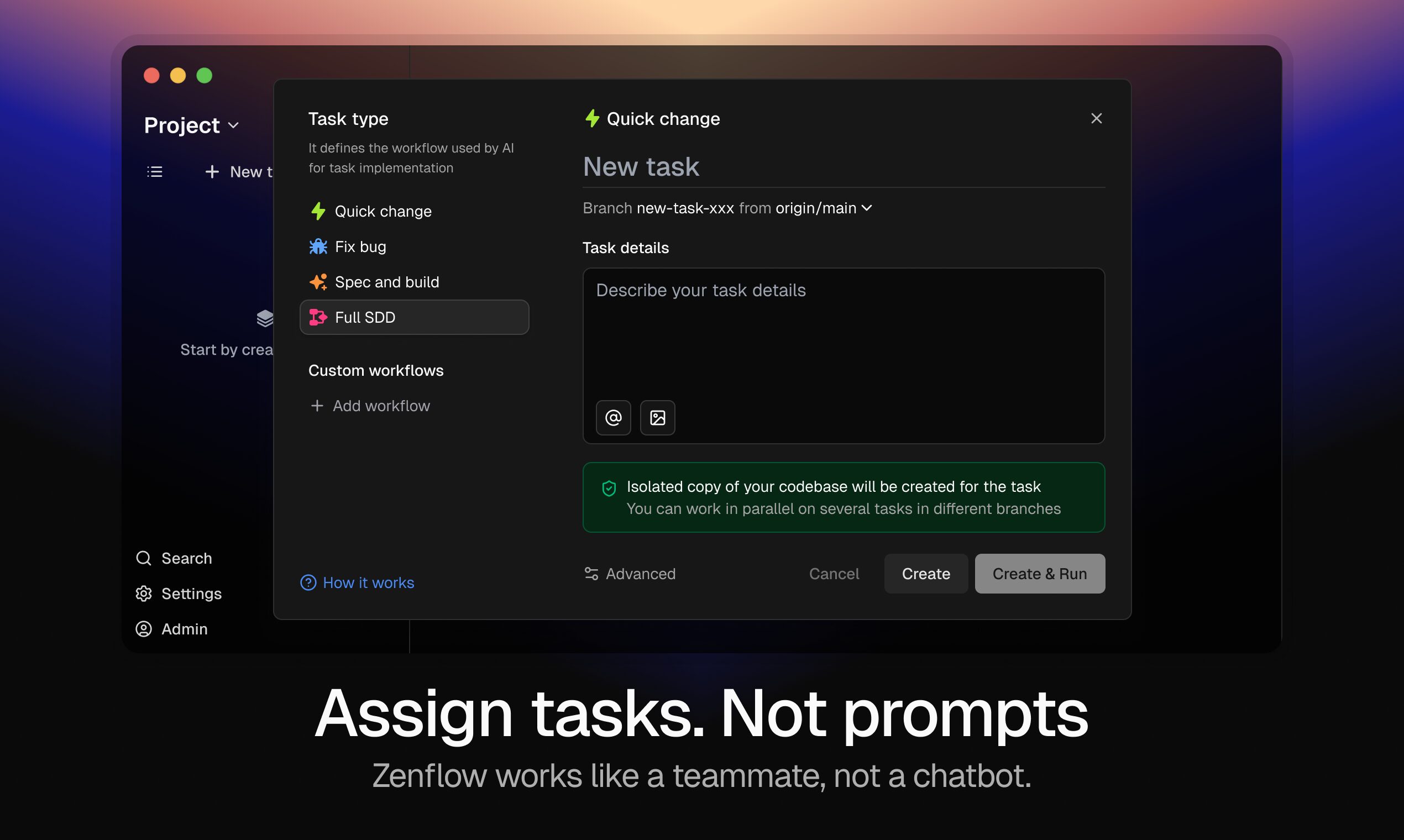
Define your software requirements or select from workflow templates. Zenflow generates a technical specification outlining architecture, data flows, and affected files. Review and refine the spec until it accurately captures your intent. The platform then creates a detailed implementation plan with specific steps and verification checkpoints.
Once you approve the plan, agents execute in parallel while continuously testing against the specification. Each code change undergoes verification before proceeding to the next step. The entire process maintains human oversight at critical decision points without requiring constant supervision of implementation details.
Ideal Use Cases
Full-stack feature development from requirements to tested implementation. Automated generation of comprehensive unit test suites. Legacy codebase refactoring with verification that functionality remains intact. Rapid prototyping with production-quality code standards from the start.
Strengths and Considerations
Strengths: Parallel processing significantly accelerates development timelines. Multi-agent verification produces measurably higher code quality than single-agent approaches. Spec-driven workflows create repeatable processes that reduce technical debt. Free desktop application makes the platform accessible for individual developers and teams to evaluate.
Considerations: Specification-driven methodology requires upfront planning, which may feel slower initially compared to immediate prompting. Teams accustomed to informal AI interactions need time to adopt structured workflows. Maximum value emerges when working on complex projects where verification and planning prevent costly errors.
Pricing
Zenflow Desktop: Free with no usage limits for the orchestration platform.
Zencoder Platform Integration: Free tier includes 30 Premium LLM calls per day. Starter at $19/month provides 280 calls daily for individual developers and side projects. Core at $49/user/month offers 750 calls daily, suitable for professional development teams. Advanced at $119/user/month delivers 1,900 calls daily for AI-first organizations requiring heavy automation.
All paid plans include unlimited calls in slow mode and bring-your-own-key options for major AI providers.
How Does It Compare?
Cursor: AI-native code editor forked from VS Code with deep codebase understanding. Excels at inline editing and multi-file changes through its Composer feature. Best for developers wanting AI integrated directly into their familiar editing environment. Pricing starts at $20/month.
GitHub Copilot Workspace: IDE-integrated assistant from GitHub with agentic capabilities allowing issue-to-implementation workflows. Copilot plans changes, edits multiple files, and prepares build environments. Stronger enterprise integration with GitHub ecosystem. Individual plan at $10/month, Business at $19/user/month.
Windsurf: First AI-native IDE built around Cascade for project-wide multi-file understanding and Supercomplete for advanced code prediction. Free tier available with premium features. Prioritizes keeping developers in flow state with minimal context switching.
Bolt.new: Browser-based full-stack development powered by Claude coding agents. Zero setup required with instant deployment and integrated backend infrastructure including databases, hosting, and authentication. Best for rapid prototyping and visual development without local environment configuration.
Replit Agent: Autonomous AI agent within cloud-based development platform. Builds complete applications from natural language descriptions with instant deployment. Agent 3 includes extended reasoning and autonomous testing. Strong for collaborative coding and learning. Core plan at $25/month.
Devin by Cognition: Autonomous AI software engineer capable of executing entire projects from natural language prompts. Includes GitHub integration and autonomous bug fixing. Deployed at enterprise scale including Goldman Sachs. Focuses on complete task autonomy rather than developer augmentation.
Zenflow distinguishes itself through orchestration rather than being another AI coding assistant. While competitors provide powerful single-agent experiences or editing interfaces, Zenflow coordinates multiple agents with formal verification steps. This makes it particularly valuable for teams prioritizing code quality and repeatability over raw coding speed.
Final Thoughts
Zenflow addresses a critical gap in AI-assisted development: the transition from experimental AI tools to production-grade engineering systems. By enforcing specifications before implementation and requiring verification before completion, it brings traditional software engineering discipline to AI workflows. Teams struggling with inconsistent AI output, technical debt from rapid AI-generated code, or difficulty scaling AI tools across larger projects will find Zenflow’s structured approach particularly valuable. The free desktop application provides an accessible entry point to evaluate whether specification-driven AI orchestration fits your development methodology.