
Table of Contents
Invofox
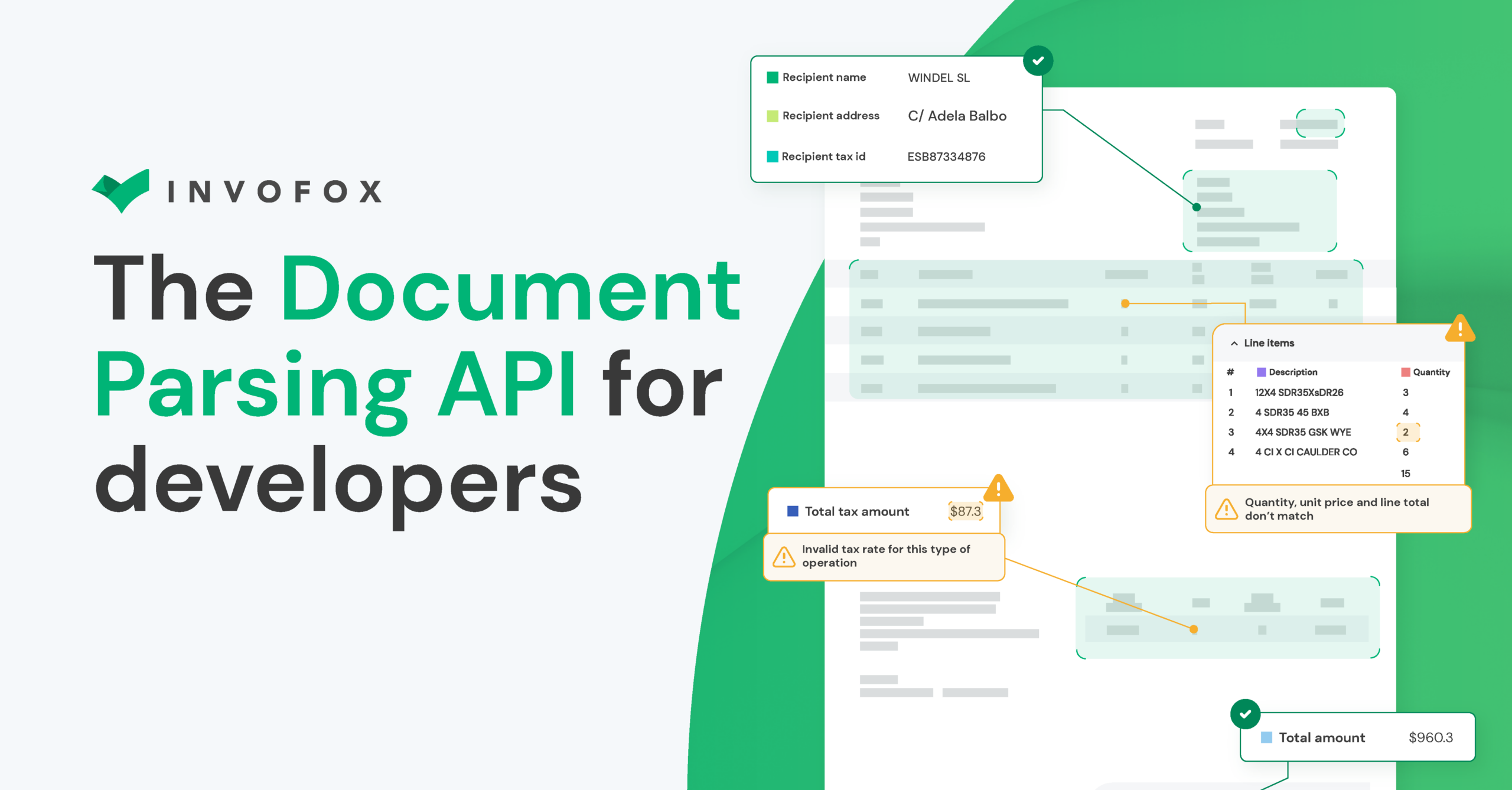
Invofox is a specialized document parsing API designed for developers who need to turn messy, real-world documents into accurate, structured data. Unlike basic OCR tools that simply read text, Invofox utilizes intelligent models to classify documents, validate data integrity, and extract specific fields regardless of layout variations. It is built to handle high-variance workflows—such as processing invoices from thousands of different vendors—scaling reliably in production environments without the need for manual template maintenance.
Key Features
- Structured Data Extraction: Converts unstructured PDFs and images into clean, standardized JSON output.
- Intelligent Classification: Automatically identifies document types (e.g., distinguishing an invoice from a receipt) before processing.
- Advanced Validation: Includes built-in data verification steps to catch errors and inconsistencies (e.g., checking if line items sum up to the total).
- High-Variance Handling: Designed to process documents with unpredictable layouts without requiring custom templates for each format.
- Developer-Centric API: Simple integration via REST API and Webhooks, avoiding complex setup procedures.
Use Cases
- Invoice Processing: Automating accounts payable by extracting vendor details, line items, and tax amounts.
- Logistics & Shipping: Parsing high-volume shipping manifests and bills of lading.
- Receipt Digitization: Extracting expense data from photos of crumpled or low-quality receipts.
- Identity Verification (KYC): Extracting data from passports and ID cards for user onboarding workflows.
Pros & Cons
- Pros:
- Accuracy: Performs significantly better on “messy” real-world documents compared to standard raw OCR.
- Scalability: Built to handle enterprise-level volumes via API.
- Predictable Pricing: Offers unique “pay-per-document” or “pay-per-result” models, avoiding the unpredictability of token-based billing.
- Cons:
- Developer Focus: Requires technical implementation; not a “drag-and-drop” tool for non-technical end users.
- API Dependency: Fully cloud-based, meaning data must leave your local infrastructure (though standard security compliances apply).
How Does It Compare?
Invofox positions itself as a “batteries-included” API specifically for structured data, sitting between raw cloud OCR and expensive enterprise platforms.
- vs. AWS Textract / Google Document AI:
- AWS/Google are massive, general-purpose cloud infrastructure services. They offer powerful raw OCR but often require significant post-processing code to structure the data and validate business logic.
- Invofox provides a higher level of abstraction, handling the validation and structuring logic out-of-the-box, saving developers from writing complex “glue code.”
- vs. Mindee:
- Mindee is a direct competitor offering similar developer-friendly APIs for specific document types.
- Invofox often competes on its pricing flexibility and specific strengths in handling highly variable multi-page documents where layout consistency is poor.
- vs. Rossum:
- Rossum is primarily a UI-first platform designed for operations teams to manually review and validate data (Human-in-the-loop focus).
- Invofox is API-first and “headless,” designed for fully automated background workflows where human review is the exception, not the rule.
- vs. Docparser:
- Docparser typically relies on rule-based parsing where users set up “zonal OCR” templates.
- Invofox uses AI/ML to understand documents without needing rigid zonal templates, making it far more resilient when document layouts change.
Pricing
- Model: Pay-per-document or Pay-per-result.
- Details: Unlike many AI tools that charge by “token” or “computation time,” Invofox charges based on business value (e.g., number of invoices processed), ensuring costs remain predictable and aligned with usage.
Final Thoughts
Invofox is an excellent choice for software teams building products that need to ingest user-uploaded documents. By abstracting away the complexity of OCR, classification, and validation, it allows developers to focus on their core product logic rather than maintaining fragile parsing scripts. It is particularly valuable for “high-variance” use cases where documents come in thousands of different formats, a scenario where traditional template-based tools often fail.