

Table of Contents
- 1. Executive Snapshot
- 2. Impact and Evidence
- 3. Technical Blueprint
- 4. Trust and Governance
- 5. Unique Capabilities
- 6. Adoption Pathways
- 7. Use Case Portfolio
- 8. Balanced Analysis
- 9. Transparent Pricing
- 10. Market Positioning
- 11. Leadership Profile
- 12. Community and Endorsements
- 13. Strategic Outlook
- Final Thoughts
1. Executive Snapshot
Core Offering Overview
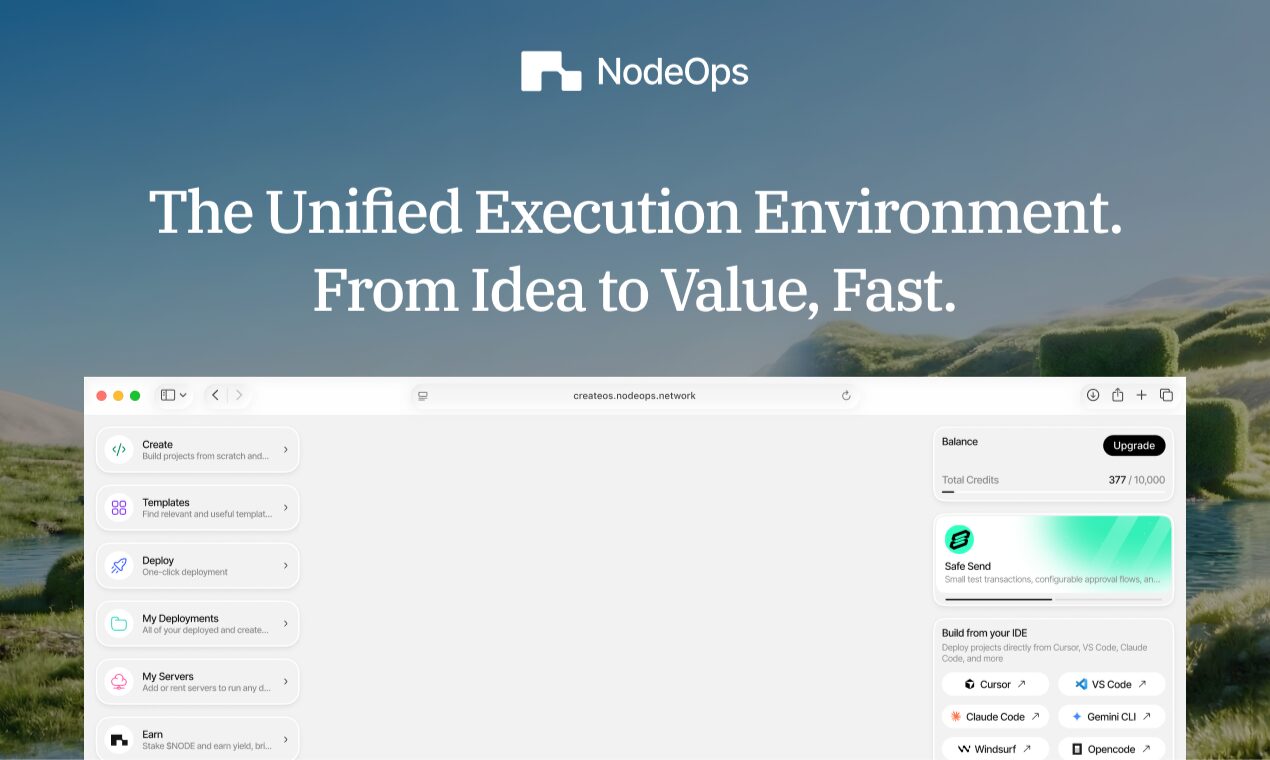
CreateOS is a unified, AI-assisted execution environment developed by NodeOps Network that enables builders to create, deploy, scale, and monetize applications from a single browser-based workspace. Rather than stitching together separate tools for coding, containerization, CI/CD, hosting, and monitoring, CreateOS consolidates the entire development lifecycle into one platform—powered underneath by NodeOps Network’s decentralized compute infrastructure of 89,000+ machines across 60+ blockchain ecosystems.
CreateOS is the “intelligence layer” of the NodeOps ecosystem. It functions as a full-stack development environment where users can build applications using natural language prompts (via an integrated AI co-pilot called NodeOpsGPT), deploy them globally in approximately 90 seconds on decentralized infrastructure, monitor performance through built-in observability, and monetize their creations through a built-in Template Marketplace and App Store. The platform supports a wide range of workloads: traditional web applications (frontend + backend + database), AI/ML model training and inference with GPU compute, decentralized applications (dApps) with native wallet and RPC integration, API services, and DevOps automation.
CreateOS sits within the broader NodeOps ecosystem, which includes the NodeOps Network (decentralized compute coordination layer), the NodeOps Console (no-code blockchain node management), NodeOps Cloud (decentralized compute marketplace), and the $NODE token (economic engine). Together, these components form what NodeOps describes as a “DePIN orchestration layer”—a chain-agnostic infrastructure platform that coordinates decentralized physical infrastructure for general-purpose computing.
Key Achievements and Milestones
- June 2023: NodeOps founded by Naman Kabra, Pratik Balar, and Jagdish Chudasama, initially as a Node-as-a-Service (NaaS) platform.
- May 2024: Closed a $5 million seed funding round led by L1D, with participation from Blockchain Founders Fund, Finality Capital Partners, Oak Grove Ventures, Double Peak Group, Momentum6, Bitscale Capital, Skyland Ventures, and notable angel investors including JD Kanani (former Polygon co-founder), Richard Ma (Quantstamp), Rushi Manche (Movement Labs), and Dorothy Liu (AltLayer).
- 2024–2025: Scaled from 17,000+ deployed nodes at seed to 60,000+ deployed nodes, 89,000+ connected machines, and 23,000+ onboarded compute providers.
- 2025: Achieved over $5 million in annual recurring revenue (ARR), managing approximately $150 million in assets under management (AUM)—making NodeOps one of the only profitable DePIN infrastructure platforms in the industry.
- June 30, 2025: $NODE Token Generation Event (TGE) launched exclusively through Binance Wallet as the 27th TGE project, raising $300,000 in BNB at $0.022 per token.
- 2025–2026: CreateOS launched and iteratively expanded with AI Playground, Template Marketplace, App Store, Security Hub, and Staking Hub features.
- February 2026: CreateOS promotional video and expanded developer documentation published, signaling the product’s transition from beta to general availability.
Adoption Statistics
NodeOps Network’s publicly reported metrics (figures vary by source and date, reflecting rapid growth):
- Over 700,000 verified users (per official documentation) / 130,000+ monthly active users (per multiple third-party sources).
- 89,000+ machines connected to the network.
- 23,000–24,000 compute providers onboarded.
- 60,000+ blockchain nodes deployed.
- 20,000+ NodeFolios (staking portfolios) created.
- Infrastructure spanning 52–60+ blockchain networks.
- Approximately $150 million in assets under management.
- $5 million+ in annual recurring revenue.
- $3 million developer grant program to fund tools and AI agents built on NodeOps.
- Listed on DeFiLlama’s Fees and Revenue Dashboard, confirming on-chain revenue tracking.
CreateOS-specific adoption metrics (number of deployed applications, active AI Playground sessions, marketplace template sales) have not been publicly disclosed as separate figures.
2. Impact and Evidence
Client Success Stories
NodeOps has disclosed several categories of institutional and protocol-level clients:
- Strategic partnerships with Maven 11, Spartan Group, Hashed, Bitscale Capital, CARV, 0G Labs, and Avail.
- Enterprise node deployment services provided through the NodeOps Validator product for institutional clients requiring high-performance node operations.
- Protocol-level integrations with Arbitrum, Polygon, EigenLayer, Babylon, and Solayer for restaking and validator services.
- The company’s CEO, Naman Kabra, has stated in interviews that NodeOps serves both retail users (via Console) and institutional operators (via Validator), with use cases spanning blockchain node operations, AI compute provisioning, and decentralized cloud services.
Specific named enterprise case studies with quantified ROI have not been published. The $5 million ARR figure, validated by inclusion on DeFiLlama’s revenue dashboard, serves as the primary evidence of commercial traction.
Performance Metrics and Benchmarks
- Deployment speed: CreateOS advertises global deployment in approximately 90 seconds with zero configuration required.
- Node deployment: The Console enables one-click node deployment, with the company claiming 30-second deployment times in video demonstrations.
- Compute pricing: Pay-as-you-go pricing at $0.0000075/vCPU/second, $0.0000027/GB memory/second, and $0.00000005/GB storage/second—positioned as significantly more cost-effective than centralized cloud providers.
- Network scale: 89,000+ machines provide substantial distributed compute capacity for horizontal and vertical scaling.
- Revenue validation: Tracked on DeFiLlama with on-chain fees from subscriptions, protocol usage, and NODE-to-credit conversions.
Third-Party Validations
- Binance: Selected NodeOps as its 27th exclusive Binance Wallet TGE project, a significant endorsement from the world’s largest cryptocurrency exchange.
- DeFiLlama: NodeOps listed on the Fees and Revenue Dashboard, providing transparent on-chain revenue tracking.
- Xangle Research: Published an in-depth research report analyzing NodeOps as a leading DePIN infrastructure platform with proven product-market fit.
- CEOWORLD Magazine: Featured Naman Kabra in a CEO Spotlight interview discussing Web3 infrastructure challenges and NodeOps’s solutions.
- CryptoTotem: Described NodeOps as “the only profitable DePIN infrastructure platform” with $5M ARR from real enterprise clients.
- Multiple blockchain media: Covered by IoT Now, Phemex Academy, CoinGecko, Binance Square, and numerous crypto-focused publications.
3. Technical Blueprint
System Architecture Overview
The NodeOps ecosystem is built on a four-layer modular architecture:
1. Decentralized Compute Layer (NodeOps Network)
The foundation layer aggregates global computing resources into standardized Compute Units (CUs), where 1 CU equals 1 CPU core + 2GB RAM + 30GB storage. Only certified high-performance hardware from data centers is permitted, ensuring reliability above consumer-grade devices. The network supports elastic scaling from lightweight Web3 nodes to heavy AI training workloads.
2. Economic Coordination Layer
An AI engine analyzes real-time supply-demand dynamics to optimize resource matching. The layer integrates Autonomous Verifiable Services (AVS) modules, connecting with restaking protocols like EigenLayer, Babylon, and Solayer. Validator nodes monitor computing service quality, and underperforming nodes face slashing of staked $NODE tokens—creating economic deterrence against poor performance.
3. CreateOS (Execution and Intelligence Layer)
The user-facing workspace that unifies development, deployment, and monetization. Components include:
– AI Playground: Browser-based, AI-assisted coding environment connected to GitHub repositories with inline editing and automatic deployment on commit.
– NodeOpsGPT: AI co-pilot that automates environment setup, suggests deployment paths, handles boilerplate, and enables “vibe coding” through natural language.
– Template Marketplace and App Store: Discovery, deployment, and monetization platform for production-ready templates and applications.
– Security Hub: One-click vulnerability analysis and scanning with AI-powered reports and real-time alerts.
– Agent Terminal: Collaborative AI and blockchain developer sandbox for building, testing, and deploying AI agents.
4. $NODE Token Layer (Economic Engine)
Powers DeFi primitives and captures real platform usage through transparent burns and staking yield. 50% of service revenue flows to token burns. Compute providers must stake 2,000 NODE per machine plus 200 NODE per Compute Unit. The burn-to-use model ties token supply to actual demand rather than speculation.
API and SDK Integrations
CreateOS provides extensive integration capabilities:
- GitHub Integration: Connect repositories for automated builds, forks, and CI/CD pipeline triggers.
- Docker Support: Deploy from pre-built Docker images or let CreateOS auto-containerize applications.
- IDE Integrations: Compatible with VS Code, Cursor, ChatGPT, and Claude through MCP connections.
- Figma Integration: Design-to-development workflow support.
- API Key Management: Generate and manage API keys from the user profile for secure external integrations.
- Web3 Native: Built-in wallet integration, RPC access, and smart contract deployment capabilities.
- Database Support: Managed PostgreSQL, MySQL, Valkey (cache), and Kafka (message queue) services.
- Language and Framework Agnostic: Supports JavaScript, TypeScript, Go, Python, Rust, Java, and containerized applications of any stack.
Scalability and Reliability Data
- Global compute network: 89,000+ machines across multiple continents provide geographic distribution and redundancy.
- Elastic scaling: Horizontal and vertical scaling controls available on Pro and Enterprise plans, with up to 2,000 cores and 1TB RAM on Enterprise.
- Environment replicas: Up to 10 on Pro plan for staging/production separation.
- AVS-enforced reliability: Autonomous Verifiable Services monitor node performance and enforce slashing for underperformance, creating economic incentives for reliability.
- Hot reloads and instant rollbacks: Deployment management features for continuous delivery.
No formal SLA (uptime percentage guarantee) has been publicly committed for CreateOS. The decentralized architecture provides inherent redundancy, but enterprise customers should evaluate reliability requirements against the platform’s maturity.
4. Trust and Governance
Security Certifications
NodeOps has not publicly disclosed holding ISO 27001, SOC 2, or comparable third-party security certifications. As a DePIN (Decentralized Physical Infrastructure Network) platform, its security model differs fundamentally from centralized cloud providers:
- AVS-Enforced Security: Autonomous Verifiable Services integrated through EigenLayer, Babylon, and Solayer provide cryptoeconomic security. Validators stake assets that can be slashed for misbehavior, creating financial accountability for compute quality and uptime.
- Security Hub: Built-in vulnerability scanning with AI-powered reporting for deployed applications, containers, and infrastructure.
- Restaking Security: Leverages staked assets from Ethereum, Bitcoin, and Solana through restaking protocols, aligning economic incentives with network security.
Data Privacy Measures
- Self-custody model: Users maintain full control over their keys and deployments. CreateOS emphasizes “your code, your ownership.”
- Decentralized architecture: Compute is distributed across independent providers rather than concentrated in centralized data centers, reducing single points of failure and centralized data exposure.
- On-chain transparency: Revenue, fees, and token economics are tracked on-chain through DeFiLlama, providing verifiable transparency.
Regulatory Compliance Details
No specific regulatory compliance certifications (GDPR, CCPA, HIPAA, SOX) have been publicly announced. The platform’s decentralized architecture and $NODE token economics introduce unique regulatory considerations:
- The $NODE token’s classification (utility vs. security) varies by jurisdiction.
- Compute provider operations span multiple jurisdictions, creating complex compliance landscapes.
- The Binance Wallet TGE followed Binance’s compliance framework, providing some level of regulatory vetting.
Organizations with strict compliance requirements should conduct independent legal and compliance assessments before deploying sensitive workloads on CreateOS.
5. Unique Capabilities
- Decentralized Compute Foundation: Unlike centralized AI builders (Replit, Vercel, Lovable), CreateOS runs on a decentralized network of 89,000+ machines. This provides vendor lock-in freedom, geographic distribution, and cost advantages from aggregating idle compute resources globally. Users are not dependent on AWS, GCP, or Azure pricing or terms.
- AI-Assisted Full Lifecycle: The NodeOpsGPT co-pilot handles everything from project scaffolding (“start from a Vibe”) through framework detection, build configuration, port assignment, and deployment pipeline setup—enabling zero-config deployment in approximately 90 seconds. The AI Playground provides browser-based coding with inline AI assistance connected directly to GitHub repositories.
-
Built-In Monetization: CreateOS is one of the only development platforms with a native marketplace economy. Developers can publish templates and applications to the Template Marketplace or App Store, set their own pricing, and earn revenue whenever others deploy their work. This transforms code from a cost center into a revenue stream.
-
Web3 Native Architecture: Pre-configured wallet integration, RPC access, smart contract deployment, and AI agent orchestration eliminate the setup complexity typically required for blockchain development. This makes CreateOS particularly suited for dApp development, DeFi applications, and autonomous AI agent deployment.
-
Security Hub: Integrated one-click vulnerability scanning with AI-powered reporting covers codebases, containers, and infrastructure environments. This provides security capabilities typically requiring separate tools and subscriptions.
-
Agent Terminal: A dedicated sandbox environment for AI agent development, enabling builders to experiment with, build, and deploy AI agents with access to GPU compute—directly integrated with the broader NodeOps compute network.
-
Cryptoeconomic Incentive Alignment: The $NODE token creates a circular economy where platform usage drives token burns (deflation), compute providers stake tokens for network access, and the economic model ties growth to actual demand rather than speculation.
6. Adoption Pathways
Integration Workflow
CreateOS supports four primary paths to deployment:
- AI-Assisted Build (Recommended): Connect a GitHub repository, and CreateOS AI automatically detects the framework, configures build and run commands, assigns the correct server port, and sets up the deployment pipeline. Minimal input required.
- Manual Configuration: For advanced users who want full control over build settings, environment variables, and deployment parameters.
- Docker Deployment: Upload a pre-built Docker image or reference a container registry for immediate deployment.
- Template Deployment: Browse the marketplace, select a template, fork to GitHub automatically, and deploy with one click using credits.
The AI Playground enables continuous development: every commit to the connected GitHub repository automatically triggers the deployment pipeline, providing seamless CI/CD without external configuration.
Customization Options
- Language and framework agnostic: JavaScript, TypeScript, Go, Python, Rust, Java, and any containerized application.
- Full code ownership and export via GitHub synchronization.
- Custom template creation and publishing to the marketplace.
- Environment variable management and API key configuration.
- Multi-environment support (Dev/Staging/Production) on Pro and Enterprise plans.
- Custom domain configuration.
- Managed database services (PostgreSQL, MySQL) and caching (Valkey) and messaging (Kafka).
Onboarding and Support Channels
- Documentation: Comprehensive docs hosted at docs.nodeops.xyz and the CreateOS documentation section.
- Discord: Active community server for technical support and discussion.
- Telegram: Community chat channel.
- YouTube: Official channel with product demos, tutorials, and launch videos.
- Developer Grants: $3 million grant program to fund tools and AI agents built on NodeOps.
- Beta Testing Program: Agent Terminal and other features available through beta access with assigned credits.
- X (Twitter): Active social presence via @NodeOpsHQ for announcements and community engagement.
7. Use Case Portfolio
Enterprise Implementations
CreateOS targets multiple builder personas and workload types:
- Full-Stack Web Applications: Build and deploy complete applications with frontend, backend, and database from a single workspace. The platform positions itself as superior to Vercel (frontend-centric), Railway (service-centric), and Replit (prototype-focused) for full-stack production workloads.
- AI/ML Workloads: Train and deploy AI models with access to GPU compute through the decentralized network. Run inference at scale without infrastructure management overhead. The Agent Terminal provides a dedicated sandbox for AI agent development.
- Decentralized Applications: Native wallet integration, RPC access, and smart contract deployment capabilities make CreateOS purpose-built for Web3 development—a capability absent from conventional platforms.
- API Services: Build, test, and deploy APIs with built-in observability and auto-generated documentation.
- DevOps Automation: CI/CD, monitoring, and scaling handled automatically with AI assistance.
- Startup MVPs: Ship minimum viable products rapidly with AI-assisted development and one-click deployment, with built-in monetization through the marketplace.
Academic and Research Deployments
NodeOps’s founders have published research on Web3 payments, fully homomorphic encryption (FHE), supply chain applications, and AppChains. The platform’s decentralized compute model has been analyzed in multiple research reports by Xangle, Binance Research, and independent analysts. However, formal academic research partnerships or university deployments have not been publicly announced.
ROI Assessments
Formal third-party ROI studies are not available. However, the economic case can be estimated:
- Compute cost savings: Decentralized compute pricing ($0.0000075/vCPU/second) is positioned as significantly cheaper than centralized alternatives. For context, comparable AWS EC2 on-demand pricing for general-purpose instances runs approximately 2–5x higher.
- Tool consolidation: By replacing separate services for hosting (Vercel/AWS), CI/CD (GitHub Actions), monitoring (Datadog), security scanning (Snyk), and marketplace (Gumroad), CreateOS reduces multi-tool subscription costs.
- Revenue generation: The marketplace monetization feature enables developers to generate passive income from published templates and applications—a revenue stream unavailable on competing platforms.
- Time savings: 90-second deployment versus manual configuration processes that typically require 30–60 minutes of setup.
8. Balanced Analysis
Strengths with Evidential Support
- Proven revenue generation: $5M+ ARR tracked on DeFiLlama distinguishes NodeOps from the many DePIN projects that lack commercial traction. This is one of the strongest product-market fit signals in the decentralized infrastructure space.
- Binance endorsement: Selection as the 27th Binance Wallet TGE project provides significant credibility and distribution exposure to Binance’s global user base.
- Massive compute network: 89,000+ machines and 23,000+ providers create genuine infrastructure scale that most competitors cannot match. This translates to geographic distribution, redundancy, and competitive pricing.
- Experienced founding team: Co-founders bring backgrounds from Infura, Alchemy, Polygon, Bosch, Persistence, and Metasky—core infrastructure experience directly relevant to the platform’s mission.
- Full-lifecycle platform: CreateOS’s combination of AI-assisted development, decentralized deployment, built-in security, and native monetization is genuinely unique. No competitor offers the same breadth within a single workspace.
- Web3 native advantage: For blockchain and dApp developers, CreateOS’s built-in wallet, RPC, and smart contract capabilities eliminate significant setup friction that exists on conventional platforms.
- Strong investor backing: $5M seed from L1D, Blockchain Founders Fund, Finality Capital, and angels including former Polygon co-founder JD Kanani validates the technical approach.
Limitations and Mitigation Strategies
- No formal security certifications: The absence of SOC 2, ISO 27001, or comparable attestations limits enterprise adoption in regulated industries. Mitigation: The AVS-enforced security model provides cryptoeconomic guarantees, and the Security Hub offers built-in scanning. Enterprise customers can deploy exported code on certified infrastructure.
- Decentralized compute reliability concerns: Distributed compute from independent providers inherently carries more variability than centralized data centers with guaranteed SLAs. Mitigation: The AVS slashing mechanism creates economic penalties for underperformance, and the network’s scale (89,000+ machines) provides redundancy.
- Platform maturity: CreateOS is a relatively new product layer on top of NodeOps Network. Edge cases, documentation gaps, and feature completeness are still evolving. Mitigation: The $3M developer grant program and active beta testing community provide feedback loops for rapid improvement.
- Token dependency complexity: The $NODE token introduces additional complexity for users unfamiliar with cryptocurrency. Credit systems, staking requirements, and token economics add cognitive overhead. Mitigation: Credit card payments and stablecoin (USDC/USDT) support provide conventional payment options alongside token-based systems.
- CreateOS-specific adoption data unavailable: While NodeOps Network reports impressive aggregate metrics (700K users, $5M ARR), CreateOS-specific figures (deployed applications, active developers, marketplace transactions) have not been separately disclosed. Mitigation: Monitor DeFiLlama data and future disclosures for CreateOS-specific metrics.
- Competitive Web2 alternatives: Established platforms like Vercel, Railway, and Replit offer more mature ecosystems, larger communities, and more extensive documentation. Mitigation: CreateOS differentiates through decentralized compute, Web3 native support, and built-in monetization—features unavailable on centralized competitors.
9. Transparent Pricing
Plan Tiers and Cost Breakdown
| Plan | Monthly Cost (Annual Billing) | CPU Per Service | RAM Per Service | Included Credits | Key Features |
|---|---|---|---|---|---|
| Free | $0 | Up to 1 Core | Up to 2 GB | 500 | Personal projects; 1 environment replica; basic features |
| Beginner | ~$10 (20% annual discount) | Up to 48 Cores | Up to 48 GB | 1,000 | 1.2x credit top-up multiplier; 2 environment replicas; logs and analytics |
| Pro | ~$75 (20% annual discount) | Up to 1,000 Cores | Up to 1,000 GB | 5,000 | 1.5x credit top-up multiplier; 10 environment replicas; full security scan; managed databases |
| Enterprise | Custom | Up to 2,000 Cores | Up to 1 TB | 20,000+ | 5x credit top-up multiplier; custom SLA; priority support |
Pay-as-you-go compute pricing:
– CPU: $0.0000075 per vCPU per second
– Memory: $0.0000027 per GB per second
– Storage: $0.00000005 per GB per second
All plans include unlimited deployments and services. Credits can be topped up at any time, with multiplier bonuses increasing on higher tiers. The credit system uses $NODE tokens or traditional payment methods.
Total Cost of Ownership Projections
For an indie builder or small team running a typical web application:
- Light usage (prototyping): Free plan at $0/month with 500 credits—sufficient for basic experimentation.
- Active development (1–3 applications): Beginner plan at ~$10/month with 1,000 credits and up to 48 cores per service—adequate for production-ready small applications.
- Production workloads (multiple services, databases): Pro plan at ~$75/month with 5,000 credits, managed databases, security scanning, and up to 1,000 cores—comparable to mid-tier cloud hosting costs but with integrated development tooling.
- Enterprise-scale deployments: Custom pricing with dedicated resources, SLA commitments, and 5x credit multipliers on top-ups.
Compared to centralized alternatives, the free tier is competitive with Vercel’s free tier and Railway’s starter plan. The Pro tier at $75/month offers significantly more compute capacity than comparable Railway or Render plans at similar price points, with the added benefits of decentralized infrastructure and marketplace monetization.
10. Market Positioning
Competitor Comparison Table
| Platform | Full-Stack Support | AI-Assisted Creation | Decentralized Compute | GPU Access | Built-In Marketplace | Web3 Native | Starting Price |
|---|---|---|---|---|---|---|---|
| CreateOS | Frontend + Backend + DB | NodeOpsGPT (vibe coding) | Yes (89K+ machines) | Yes | Yes (Templates + Apps) | Yes (wallet, RPC, smart contracts) | Free / $10 Beginner |
| Vercel + v0 | Frontend-centric | v0 UI generation | No (centralized) | No | No | No | Free / ~$20 |
| Railway | Service-centric | Basic templates | No (centralized) | No | No | No | Free / ~$5 |
| Replit | Good for prototypes | AI editor assistance | No (centralized) | No | Community templates | Limited | Free / ~$25 |
| Lovable | Prototype/app generation | Prompt-to-app | No (centralized) | No | No | No | Free / ~$20 |
| Akash Network | Compute only (no IDE) | No | Yes (decentralized) | Yes | Marketplace | Yes | Pay-as-you-go |
| Render | Full-stack hosting | No | No (centralized) | No | No | No | Free / ~$7 |
| Flux | Compute + OS | Limited | Yes (decentralized) | Yes | FluxOS apps | Yes | Pay-as-you-go |
Unique Differentiators
CreateOS occupies a unique intersection that no single competitor fully replicates:
- Decentralized compute + full development environment: Akash and Flux offer decentralized compute but lack integrated development tooling. Vercel, Railway, and Replit offer development tools but run on centralized infrastructure. CreateOS combines both.
-
Native monetization layer: No competing development platform includes a built-in marketplace where developers earn revenue from published templates and applications. This transforms the economics of building from cost to potential profit.
-
Web3-native by design: While competitors add Web3 support as an afterthought (if at all), CreateOS was built from the ground up with wallet integration, RPC access, smart contract deployment, and AI agent orchestration as core features.
-
Cryptoeconomic security model: The AVS-enforced slashing mechanism and token staking requirements create economic accountability for compute quality—a fundamentally different (and in some ways stronger) security model than centralized provider SLAs.
11. Leadership Profile
Naman Kabra — Co-Founder and CEO
Naman Kabra is the co-founder and CEO of NodeOps, bringing extensive experience in blockchain infrastructure and Web3 product development:
- Blockchain research since 2017: Published work on Web3 payments, fully homomorphic encryption (FHE), supply chain applications, and AppChains.
- Robert Bosch: Led their Centre of Excellence for blockchain, bridging traditional enterprise with decentralized applications.
- Persistence (Binance Labs-backed): Held a senior role focusing on the Cosmos ecosystem, where he contributed to tokenomics design, launch strategy, fundraising, and validator onboarding for AssetMantle.
- Metasky (Sequoia and Coinbase Ventures-backed): Focused on scaling community-first products.
- Social payment extension: Built a Web3 social payment product that processed $14 million in gross merchandise value in six months before being acquired.
- Featured in: CEOWORLD Magazine CEO Spotlight, Blockchain Interviews, The Crypto Podcast, and multiple industry conferences.
Pratik Balar — Co-Founder
Pratik Balar co-founded NodeOps with deep experience in node platform operations and API services. His background includes leading large-scale infrastructure projects across well-known blockchain infrastructure companies including Infura and Alchemy.
Jagdish Chudasama — Co-Founder
Jagdish Chudasama rounds out the founding team with over ten years of frontline experience in infrastructure, node platforms, and API services, complementing the technical and business development expertise of the other co-founders.
Patent Filings and Publications
No patent filings associated with NodeOps or CreateOS have been publicly identified. The team’s intellectual contributions are primarily expressed through open-source software, the published research of founder Naman Kabra on Web3 topics, and the platform’s architecture itself. The decentralized, open-protocol approach of NodeOps Network is philosophically aligned with open-source and permissionless principles rather than patent-driven IP protection.
12. Community and Endorsements
Industry Partnerships
- Binance: 27th exclusive Binance Wallet TGE project—a significant endorsement from the world’s largest crypto exchange.
- EigenLayer: AVS integration for cryptoeconomic security through Ethereum restaking.
- Babylon: Bitcoin restaking protocol integration.
- Solayer: Solana restaking protocol integration.
- Arbitrum, Polygon: Protocol-level node deployment partnerships.
- Maven 11, Spartan Group, Hashed: Strategic institutional partners.
- CARV, 0G Labs, Avail: Ecosystem partnerships for infrastructure coordination.
- L1D: Lead seed investor and strategic partner.
Media Mentions and Awards
- Binance Square: Featured in multiple analysis pieces and the official TGE announcement.
- IoT Now: Covered the $5M seed funding round.
- CEOWORLD Magazine: CEO Spotlight feature on Naman Kabra.
- Xangle Research: Published comprehensive research report on NodeOps.
- Phemex Academy: Deep dive educational article on the NodeOps ecosystem.
- DeFiLlama: Revenue dashboard listing—a significant transparency milestone.
- CryptoTotem: Described NodeOps as “the only profitable DePIN infrastructure platform.”
- Blockchain Interviews (YouTube): In-depth interview with CEO covering growth, architecture, and roadmap.
- Multiple podcasts: Featured on The Crypto Podcast, SaaS-focused shows, and blockchain media outlets.
No formal industry awards (such as Gartner recognition or similar analyst firm ratings) have been publicly disclosed, which is typical for Web3 infrastructure projects at this stage.
13. Strategic Outlook
Future Roadmap and Innovations
Based on public statements, documentation, and observable product trajectory:
- Agent Terminal expansion: The AI agent development sandbox is currently in beta. Full general availability with expanded GPU compute access and collaborative features is expected as a near-term priority.
- Mainnet launch: NodeOps Network is moving toward full mainnet deployment with complete $NODE token economics, governance mechanisms, and decentralized validation infrastructure.
- CreateOS marketplace growth: Expansion of the Template Marketplace and App Store with more categories, contributor incentives, and discovery features.
- Mobile access: An Agent Terminal mobile application has been referenced in the roadmap, aiming to enable “one-click node operation” from mobile devices.
- Enterprise tier maturation: Expansion of custom SLA offerings, dedicated support, and compliance features for institutional customers.
- Cross-chain staking expansion: Integration with additional Layer 1 blockchains for restaking security across the network.
- AI compute specialization: As AI workload demand grows, deeper GPU compute capabilities and AI-specific tooling are expected to become a major focus area.
- Developer ecosystem scaling: The $3M grant program signals intent to build a thriving third-party developer ecosystem around CreateOS.
Market Trends and Recommendations
CreateOS enters the market at the intersection of several powerful trends:
- Decentralized compute demand: The global cloud computing market is projected to reach $1.5 trillion by 2030. Decentralized alternatives like NodeOps offer cost advantages (aggregating idle resources) and architectural benefits (vendor independence, censorship resistance) that are increasingly attractive as centralized providers face pricing pressure and geopolitical concerns.
- AI infrastructure bottleneck: Demand for GPU compute for AI training and inference is growing exponentially. Decentralized GPU marketplaces like those provided through NodeOps Cloud address supply constraints that major cloud providers struggle to meet.
- DePIN sector maturation: The DePIN (Decentralized Physical Infrastructure) sector is evolving from speculative token-driven projects to revenue-generating platforms. NodeOps’s $5M ARR and DeFiLlama listing position it as a leader in this maturation.
- Vibe coding movement: The trend toward AI-assisted “vibe coding” (building applications through natural language prompts) is accelerating. CreateOS’s NodeOpsGPT co-pilot and template-based workflows align directly with this movement.
- Web3 developer experience gap: Despite growth in blockchain adoption, developer tooling remains fragmented and complex. CreateOS’s unified workspace addresses this friction directly, potentially accelerating Web3 application development.
For potential users:
– Web3 developers and dApp builders will find CreateOS’s native wallet, RPC, and smart contract integration uniquely valuable.
– AI/ML builders seeking affordable GPU compute should evaluate the decentralized network’s pricing against centralized alternatives.
– Indie hackers and startup founders will benefit from the rapid prototyping, one-click deployment, and marketplace monetization features.
– Enterprise teams requiring compliance certifications should wait for the platform’s maturation or plan to deploy exported code on certified infrastructure.
– Investors in the DePIN thesis should monitor NodeOps’s revenue growth and CreateOS adoption metrics as leading indicators of the sector’s commercial viability.
Final Thoughts
CreateOS represents an ambitious attempt to unify two powerful movements—AI-assisted development and decentralized compute infrastructure—into a single, coherent platform. In a market fragmented between centralized AI builders (Vercel, Replit, Lovable) and decentralized compute networks (Akash, Render, Flux), CreateOS is positioning itself as the only platform that combines a full development environment with decentralized execution infrastructure and a built-in monetization economy.
The strongest evidence for NodeOps’s viability is financial: $5 million in annual recurring revenue, tracked transparently on DeFiLlama, from a platform with 89,000+ connected machines and 60,000+ deployed nodes. In the DePIN sector, where most projects operate without meaningful revenue, this positions NodeOps as one of the few platforms with demonstrated product-market fit. The Binance Wallet TGE selection, $5M seed from credible blockchain investors, and strategic partnerships with EigenLayer, Arbitrum, and Polygon provide additional validation.
The founding team’s backgrounds at Infura, Alchemy, Polygon, and Bosch bring directly relevant infrastructure experience. Naman Kabra’s published research and progressive career from enterprise blockchain at Bosch through Persistence and Metasky to founding NodeOps demonstrate a coherent trajectory of deepening expertise in the exact domain the platform addresses.
Where CreateOS faces its greatest challenges is in competing for mainstream developer mindshare against established platforms with larger communities, more extensive documentation, and simpler onboarding. The $NODE token economics and Web3 terminology add cognitive barriers for traditional developers who simply want to ship applications. The absence of enterprise security certifications limits upward market penetration.
For its core audience—Web3 developers, AI builders seeking affordable GPU compute, and indie hackers who value decentralization and monetization—CreateOS offers a genuinely differentiated value proposition. The combination of AI-assisted full-stack development, 90-second global deployment on decentralized infrastructure, built-in security scanning, and native marketplace monetization is not available from any single competing platform. As the underlying NodeOps Network matures toward mainnet and the CreateOS developer ecosystem grows, this platform has the technical foundation and economic model to become a significant force in the emerging decentralized development infrastructure category.