
Table of Contents
Agentset
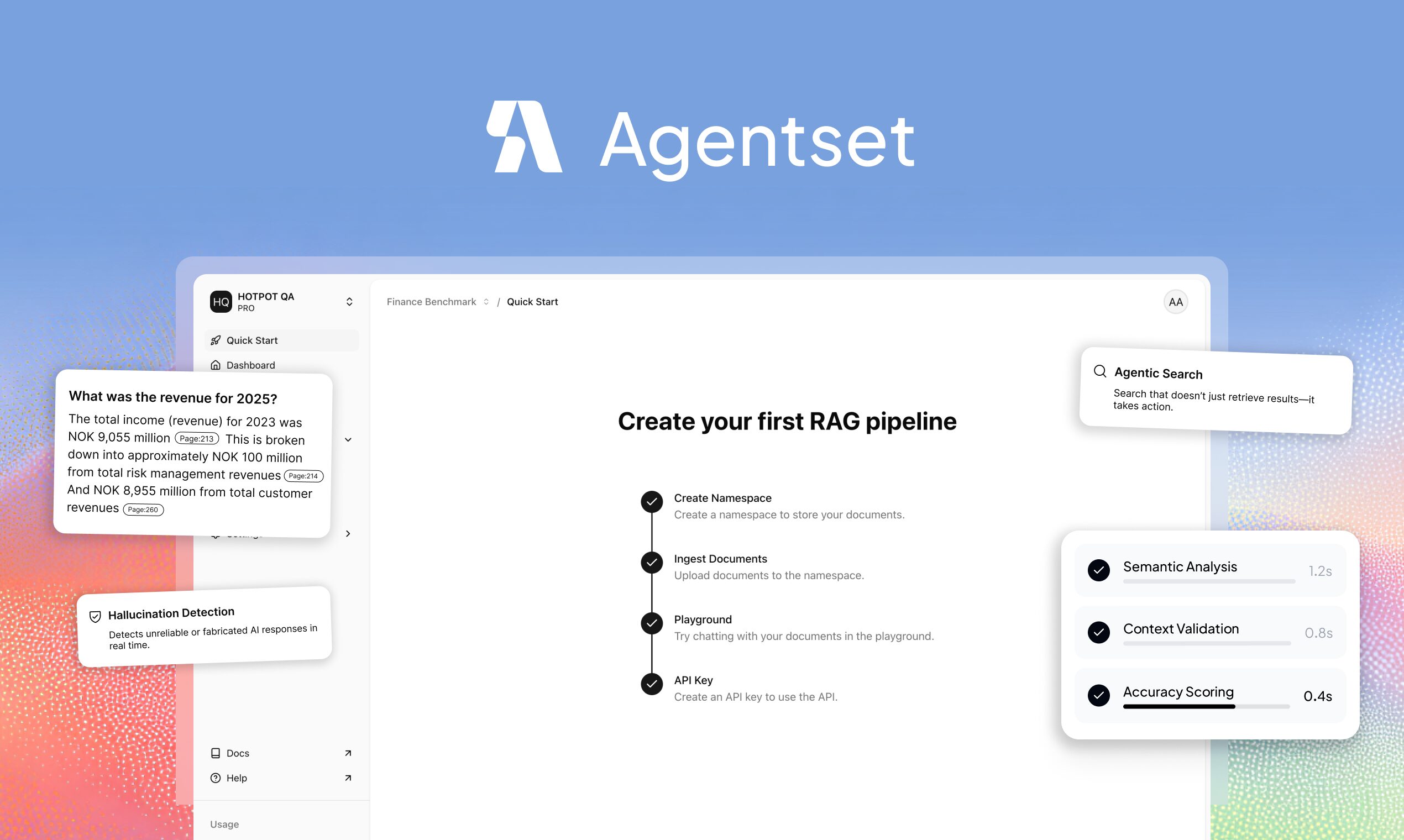
Agentset is an open-source RAG infrastructure built to survive production workloads. Unlike fragile toy demos, Agentset provides a robust, end-to-end pipeline for ingesting documents, querying them via API, and retrieving answers with verifiable source citations. It features hybrid search, multimodal support (tables/graphs), and agentic reasoning capabilities—all while remaining completely model-agnostic.
Key Features
- Production-Ready RAG Core: A battle-tested engine that handles ingestion, chunking, and retrieval at scale.
- Multimodal Ingestion: Parses and indexes not just text, but images, graphs, and tables from PDFs and complex docs.
- Hybrid Search & Reranking: Combines vector search with keyword-based retrieval and reranking for superior accuracy.
- Automatic Citations: Every answer comes with precise source links, critical for “trust-but-verify” workflows in legal/medical fields.
- Native MCP Server: Instantly plug your knowledge base into Claude or other agents via the Model Context Protocol.
- Model-Agnostic: Bring your own Vector DB (Pinecone, Weaviate, etc.) and LLM (OpenAI, Anthropic, local models).
- Developer-First SDKs: comprehensive TypeScript and Python SDKs for seamless integration.
How It Works
Developers create a “namespace” and upload/ingest their data (PDFs, Markdown, etc.). Agentset automatically partitions the documents, handling complex layouts like multi-column text and tables. When a user queries the system, Agentset performs a hybrid search to retrieve the most relevant chunks, reranks them for quality, and feeds them to the LLM to generate an answer with inline citations. This entire flow is accessible via a simple API call or by connecting Agentset as a tool in an MCP-compatible agent environment (like Claude Desktop).
Use Cases
- Enterprise Search: Building an internal “Perplexity” for company wikis, Notion docs, and Slack history.
- Legal & Medical RAG: parsing complex contracts or clinical trials where hallucination is not an option and every claim needs a citation.
- Customer-Facing Q&A: Embedding “Chat with Docs” features into SaaS products with reliable answers.
- Agent Memory: Serving as the long-term retrieval memory for autonomous AI agents.
Pros and Cons
- Pros: Open-source with self-hosting options; Multimodal support handles real-world messy documents; Built-in Citations solve the “black box” answer problem; MCP Server makes it instantly usable with modern agent desktops; Generous Free Tier for developers.
- Cons: Quality dependency: Like all RAG, output quality is heavily dependent on the quality of input data; Ops overhead: Self-hosting requires managing infrastructure (Vector DB, API keys); Newer ecosystem compared to massive frameworks like LangChain.
Pricing
- Free: 1,000 pages / 10,000 retrievals per month (Free forever).
- Pro: $49/month for 10,000 pages + unlimited retrievals ($0.01 per additional page).
- Enterprise: Custom pricing for unlimited scale, SSO, and dedicated support.
- Open Source: Free to self-host (Apache 2.0 / MIT licenses often apply to core components, check repo).
How Does It Compare?
Agentset positions itself as “Infrastructure” rather than just a “Library” or a “SaaS Wrapper.” Here is how it compares:
- LangChain / LlamaIndex: These are libraries (code frameworks). You have to build the server, the API, the ingestion pipeline, and the database connections yourself. Agentset is a platform (infrastructure) that gives you these components out-of-the-box. You can use LlamaIndex inside Agentset, but Agentset solves the “deployment and hosting” problem that libraries don’t.
- Vectara / Carbon.ai: These are managed “RAG-as-a-Service” platforms. They are excellent but often closed-source and expensive at scale. Agentset offers a similar “managed” experience but keeps the core open-source, allowing for self-hosting and greater customization of the underlying models (Model-Agnostic).
- Pinecone / Weaviate: These are databases. They store vectors but don’t handle the “Reasoning,” “Chunking,” or “Answer Generation.” Agentset sits on top of these databases to provide the full RAG application layer.
- Credal.ai: Focuses heavily on enterprise security and permissions. Agentset focuses more on developer ergonomics and agentic integration (MCP), making it a better fit for builders creating new AI products.
Final Thoughts
Agentset is the “Vercel for RAG.” Just as Vercel took the complexity out of deploying Next.js apps, Agentset takes the pain out of deploying RAG pipelines. It acknowledges that building a RAG prototype in a notebook is easy, but running one in production with citations, multimodal support, and reliable reranking is hard. For teams that want to skip the 3 months of “building the infrastructure” and get straight to “shipping the feature,” Agentset is a compelling, developer-friendly choice that doesn’t lock you into a closed ecosystem.