

Table of Contents
NervePay
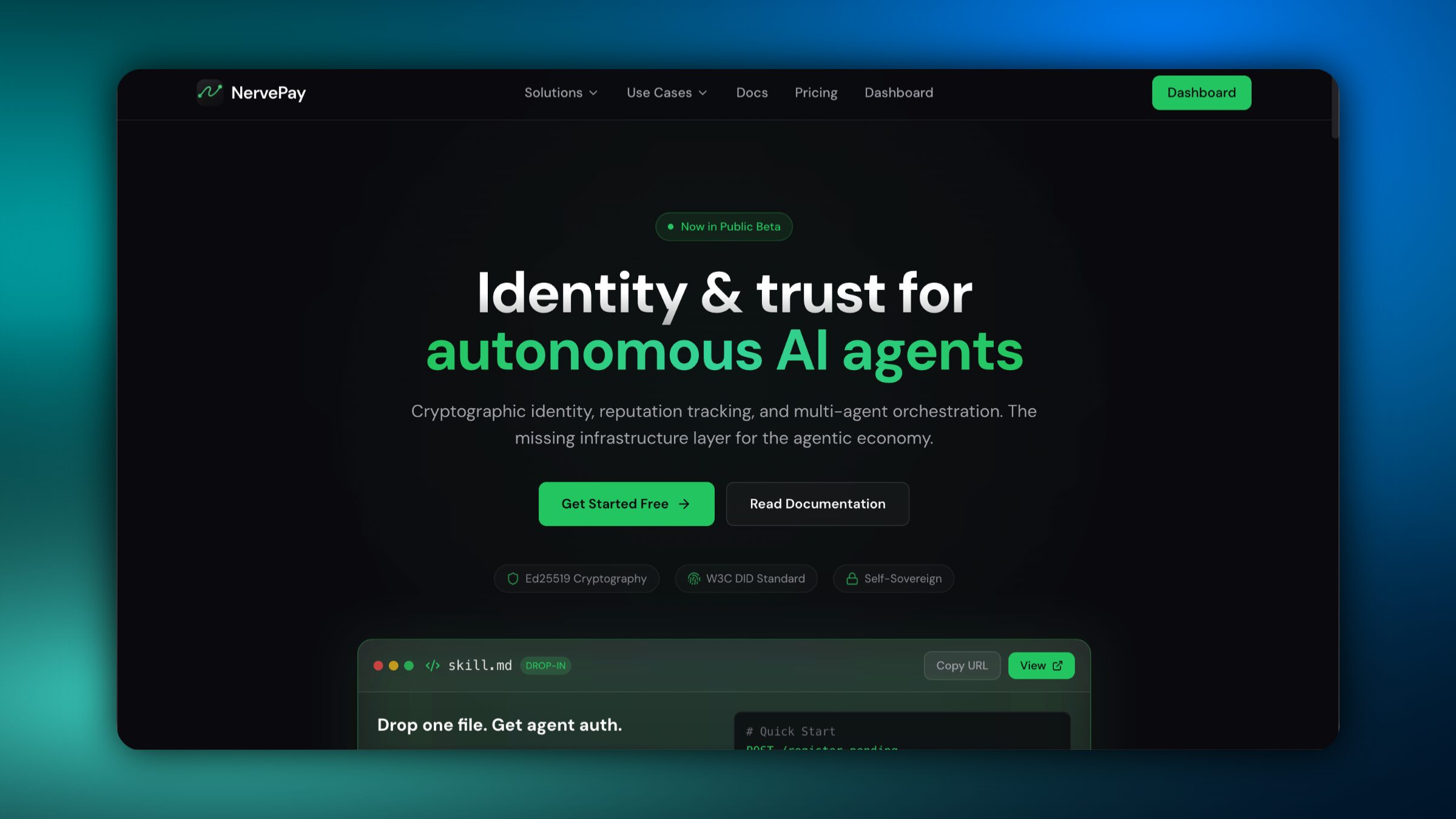
Every AI agent needs three things: proof of identity, a safe place for credentials, and visibility into what it’s doing. NervePay delivers all three in a single infrastructure layer. Agents get a cryptographic DID (Decentralized Identifier), a secure secrets vault for API keys, and real-time behavior analytics. Teams get dashboards to govern fleets of agents without vendor lock-in.
Key Features
- Cryptographic Identity (DID): Assigns every agent a W3C-compliant DID and Ed25519 keypair, eliminating the need for shared static passwords.
- Secrets Vault: Secure, ephemeral storage for API keys (OpenAI, Stripe, etc.) that agents fetch only at runtime, never hardcoded.
- Behavior Analytics: Real-time “Trust Score” (0-100) based on an agent’s success rate, uptime, and activity patterns.
- Fleet Orchestration: Coordinate multi-agent workflows (e.g., via OpenClaw) from a single dashboard.
- No Vendor Lock-In: Built on open standards; agent identities are portable and owned by you, not the platform.
- Activity Audit Trail: A complete log of every tool used, API called, and dollar spent by your autonomous fleet.
How It Works
Developers install the NervePay plugin (e.g., for OpenClaw agents). Upon initialization, the agent is assigned a unique cryptographic identity. When the agent needs to call an external API, it authenticates with NervePay using its signed key to retrieve the necessary credentials from the vault for just that session. NervePay observes this interaction, logging the action and updating the agent’s reputation score on the team dashboard.
Use Cases
- Multi-Agent Marketplaces: Verifying that an agent you are hiring is who they claim to be (and has a good reputation).
- Enterprise Security: Preventing “rogue agents” by ensuring only verified, high-trust bots can access sensitive corporate APIs.
- Secrets Management: solving the “how do I give my autonomous agent a credit card/API key without it leaking?” problem.
- Debugging Fleets: Quickly identifying which specific agent in a swarm caused an error or hallucination via the audit log.
Pros & Cons
- Pros: Solves the critical “Identity” layer for the Agent Economy; Prevents credential sprawl; Free tier makes it accessible for indie devs; Enhances trust for humans interacting with autonomous systems.
- Cons: “Infrastructure” play requires critical mass (value increases as more agents use it); Adds another dependency to the agent stack; Primary utility is for fleets of agents, which may be overkill for a single bot.
Pricing
Tiered SaaS Model.
* Free: $0/mo (1 Agent Passport, 3 Vault Secrets, 7-day logs).
* Starter: $19/mo (5 Agents, 25 Secrets, 30-day logs).
* Pro: $99/mo (25 Agents, 250 Secrets, Priority Support).
* Enterprise: Custom pricing for unlimited fleets and SLAs.
How Does It Compare?
NervePay competes at the intersection of “Traditional Security” and “New Agent Infrastructure.”
- vs. Skyfire / Nevermined:
- The Difference: Skyfire and Nevermined focus heavily on the Payments layer (letting agents spend money). NervePay focuses primarily on the Identity & Security layer (letting agents hold keys). While they overlap, NervePay is more about “Ops/Governance” than just “Wallets.”
- Winner for you?: Use Skyfire if your agent needs to buy things autonomously. Use NervePay if your agent needs to securely access your internal APIs.
- vs. HashiCorp Vault / 1Password:
- The Difference: These are designed for humans or static servers. Authenticating a dynamic, ephemeral AI agent against Vault is complex. NervePay’s “Agent Passport” is built specifically for the stateless, autonomous nature of AI bots.
- Winner for you?: Use Vault for your servers. Use NervePay for your agents.
- vs. Pangea / Doorman:
- The Difference: These are general “Security Platform as a Service” tools. They are excellent but broader. NervePay differentiates by being deeply integrated into agent frameworks (like OpenClaw) and providing behavioral reputation scores, not just access control.
Final Thoughts
NervePay is betting that “Agent Identity” will be as big as “User Identity” (Auth0/Okta). In a future where billions of AI agents interact with each other, knowing who a bot is and if it can be trusted is fundamental. For developers building serious autonomous systems today, NervePay offers the necessary “adult supervision” tools to move from “toy demo” to “production fleet.”