
Table of Contents
Skillkit
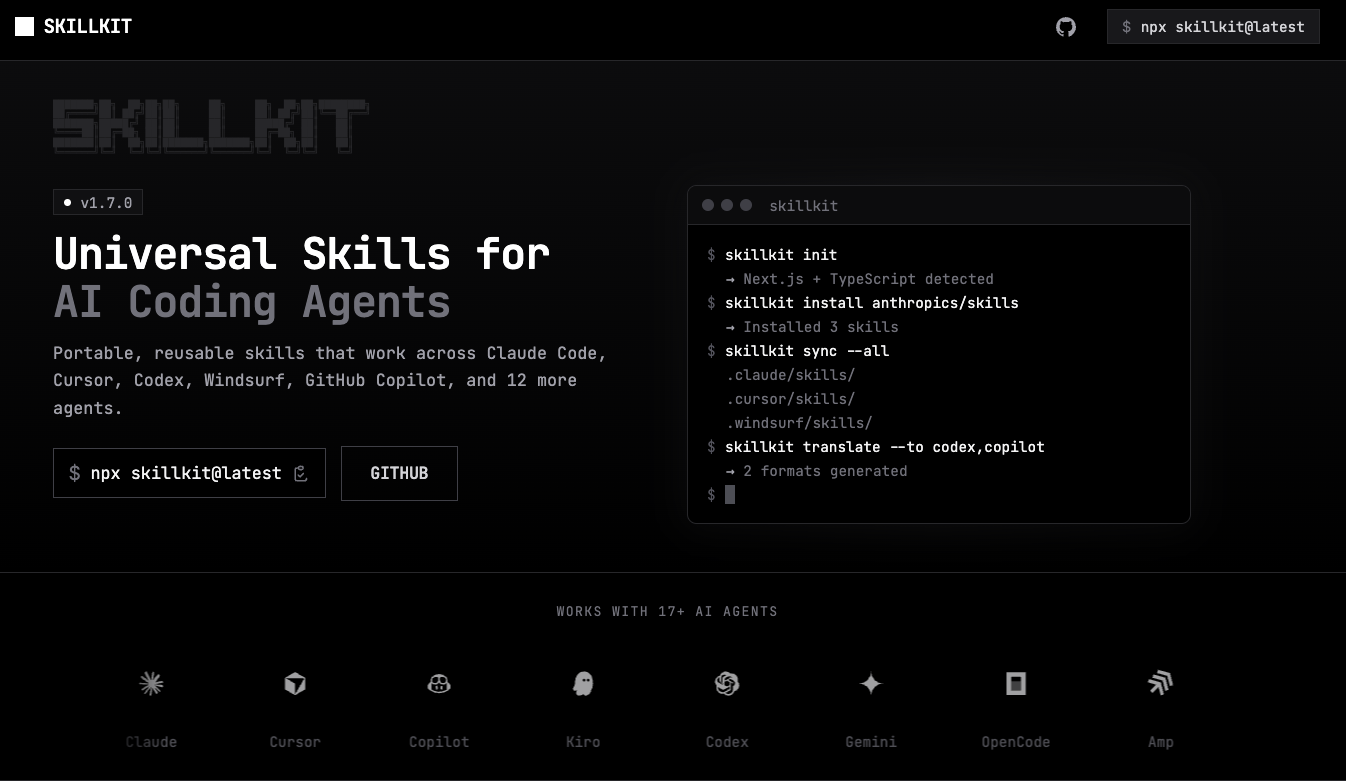
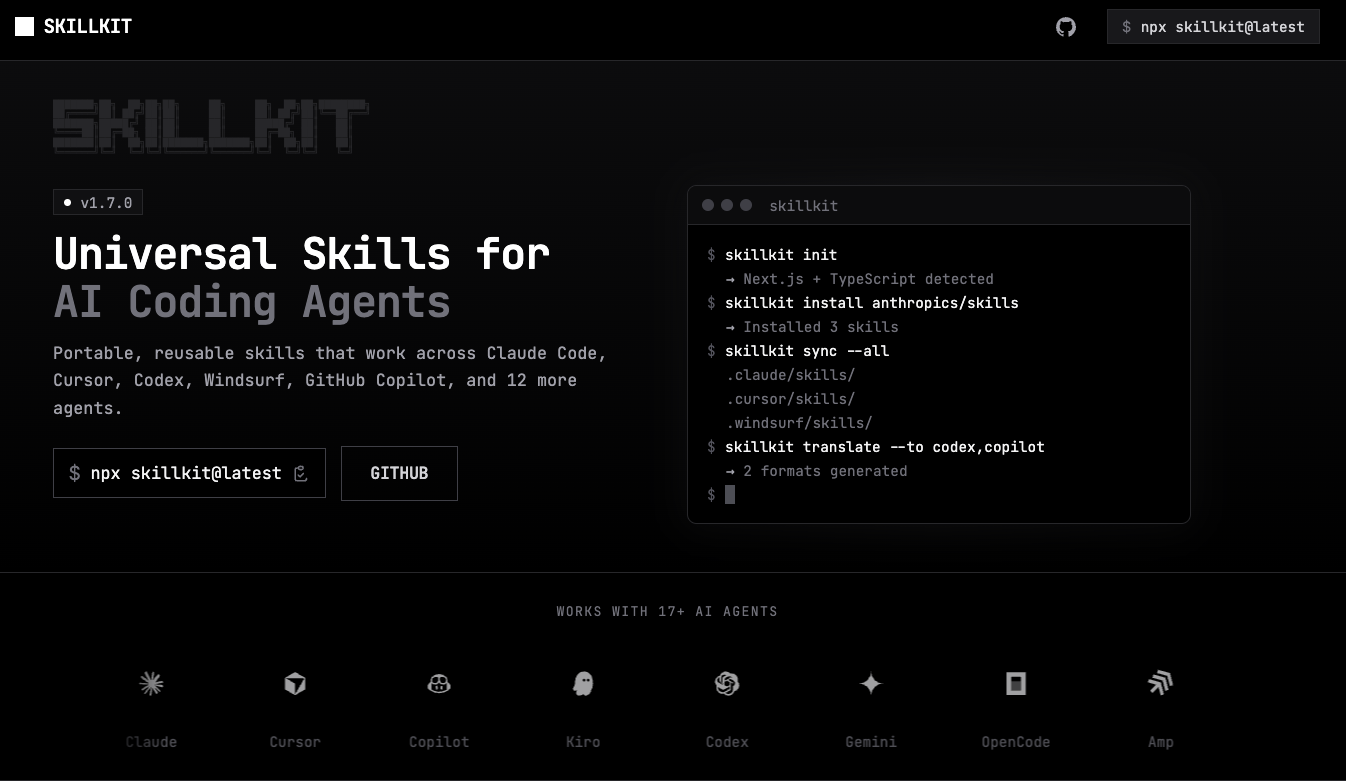
The universal skill platform for AI coding agents. Auto-generate instructions with Primer, persist learnings with Memory, and distribute across Mesh networks. One CLI for Claude Code, Cursor, Windsurf, Copilot, Codex, Gemini CLI, and 38 more agents.
What It Does
Skillkit is an open-source package manager and universal platform for AI coding agent skills. It addresses a core pain point in the AI development ecosystem: every coding agent uses a different format for skills and instructions. Claude Code expects .claude/skills/, Cursor uses .mdc, Copilot looks in .github/skills/, and Codex reads from ~/.codex/skills/. Skillkit eliminates this fragmentation by letting developers write a skill once and deploy it across all supported platforms.
Built on the open Agent Skills standard (originally created by Anthropic in December 2025 and now governed at agentskills.io), Skillkit goes beyond simple skill installation to provide translation, memory persistence, mesh networking, and multi-agent orchestration capabilities.
Key Features
- Skill Marketplace: Access 15,000+ pre-built skills aggregated from 31 curated sources including official repositories from Anthropic, Vercel, Stripe, Supabase, Expo, and Remotion, as well as community contributions
- Cross-Agent Translation: Write a skill for one agent and automatically translate it to any other supported format using a proprietary intermediate representation (IR) and agent-specific transpilers. Supports 44 agents including Claude Code, Cursor, Codex, GitHub Copilot, Windsurf, Gemini CLI, Roo Code, Trae, Cline, Amp, Goose, Kiro CLI, and more
- Primer: Auto-generates optimized agent instruction files (CLAUDE.md, .cursorrules, etc.) by analyzing your codebase using static analysis and pattern recognition
- Memory: Captures AI agent learnings from sessions using semantic embeddings and persists them across sessions and projects with an encrypted, versioned datastore. Supports compress, search, and export operations
- Mesh Network: Enables peer-to-peer distribution of skills and agent states across machines with Ed25519 cryptography, XChaCha20-Poly1305 encryption, and UDP multicast LAN discovery
- Multi-Agent Teams: Orchestrate teams of AI agents with leader/teammate hierarchies, task assignment, plan approval workflows, inter-agent messaging, and code review stages
- Security Scanner: Every skill is scanned before installation for prompt injection, hardcoded secrets, command injection, and other threats
- Skill Testing: Built-in testing framework with 14+ assertion types for validating skills
- CI/CD Integration: Auto-generate GitHub Actions and GitLab CI configurations
- Runtime Discovery: REST API server on port 3737 and MCP (Model Context Protocol) server for native agent integration
- TUI Dashboard: Terminal UI for browsing marketplace, recommendations, and skill management
How to Get Started
Install and run with a single command:
npx skillkit@latest
Core workflow:
skillkit init               # Detect agents, create directories
skillkit recommend          # Get smart skill suggestions
skillkit install <source>   # Install from marketplace or repo
skillkit sync               # Deploy to your agent configs
skillkit translate <skill> --to cursor  # Translate between formats
Who Is It For
- Developers who switch between multiple AI coding agents and want portable skills
- Teams where different members use different AI tools (Claude Code, Cursor, Copilot, etc.)
- Engineering managers looking for enterprise-grade skill management and team-wide standardization
- Anyone building multi-agent workflows or wanting persistent AI learning across sessions
How Does It Compare?
skills.sh (Vercel)
Vercel’s open-source CLI for installing agent skills from GitHub repositories. Launched January 2026 as the primary distribution hub for the Agent Skills ecosystem. Focuses specifically on skill discovery and installation rather than translation or orchestration. Uses npx skills add <owner/repo> for one-command installation with automatic agent detection. Free and community-driven, but limited to installation and discovery without cross-format translation, memory, or mesh networking capabilities. Ideal for developers who only need to install pre-built skills without advanced management features.
skillc
A Rust-based development kit for Agent Skills created by govctl-org. Focuses on building, validating, and optimizing skills rather than installing or managing them. Provides compilation, full-text search indexing, usage analytics tracking, and an MCP server for programmatic access. Best for skill authors who want to create high-quality skills with proper validation, linting, and statistics. Does not handle cross-agent translation or team orchestration. Install via cargo install skillc.
Skillset
A Rust CLI package manager for agent skills with npm-like commands. Supports multiple frameworks including Auto-GPT, LangChain, and Vercel Agent Skills. Features version management, scoped namespaces, and OCI registry support. More lightweight than Skillkit, focusing on package management fundamentals rather than memory, mesh, or multi-agent orchestration.
Native Agent Skills (Claude Code, Codex, Cursor, Copilot)
Each major AI coding agent now natively supports the Agent Skills standard (SKILL.md format). Claude Code reads from ~/.claude/skills/, Codex CLI from ~/.codex/skills/, Cursor from project-level directories, and GitHub Copilot from .github/skills/. These built-in systems are simple and require no additional tooling but lack cross-agent portability, automated translation, persistent memory, or team orchestration. Best for developers committed to a single agent who want the simplest possible setup.
Context7 MCP (Upstash)
An MCP server that injects real-time, up-to-date library documentation into AI agent prompts. Solves a different but complementary problem: ensuring agents have accurate, current documentation rather than outdated training data. Does not manage skills or instructions but can be used alongside Skillkit to provide documentation context. Free and open-source.
Pros and Cons
Pros:
– Universal compatibility across 44 AI coding agents with automatic format translation
– Open source with active development (launched on Product Hunt February 7, 2026)
– Persistent memory system that captures and recalls AI learnings across sessions
– Large marketplace with 15,000+ skills from 31 curated sources
– Mesh networking for distributed multi-machine agent collaboration
– Built-in security scanning for skill validation before installation
– Supports both REST API and MCP for runtime skill discovery
Cons:
– Requires technical CLI setup and Node.js environment
– Learning curve for advanced features like mesh networking and multi-agent orchestration
– Relatively new project (launched February 2026), so ecosystem maturity is still developing
– Memory and mesh features add complexity that may be unnecessary for single-agent, single-developer use cases
– Translation between agent formats may not be perfectly lossless for complex skills
Pricing
Free and open source. Available via npm (npx skillkit@latest) and GitHub (rohitg00/skillkit). Licensed under open-source terms.
Final Thoughts
Skillkit fills a genuine gap in the rapidly expanding AI coding agent ecosystem. With major platforms like Claude Code, Codex, Cursor, and GitHub Copilot all adopting the Agent Skills standard in late 2025 and early 2026, the need for a universal management layer has become clear. While simpler tools like Vercel’s skills.sh handle basic installation, Skillkit differentiates itself through cross-agent translation, persistent memory, and mesh networking — features particularly valuable for teams using multiple agents or building complex multi-agent workflows.
The platform is still early-stage, having launched in February 2026, so potential users should expect rapid iteration and occasional rough edges. For developers working exclusively with a single agent, native skill support may be sufficient. But for teams managing skills across multiple platforms, or anyone who wants their AI agents to retain learnings between sessions, Skillkit offers a compelling all-in-one solution that no single competitor currently matches.