
Table of Contents
- SecondBrain Note by Genspark — VC Investment Analysis
- Investment Metric Summary
- Executive Summary
- 1. Product Overview and Product Quality
- 2. Founder and Team Assessment
- 3. Market Opportunity
- 4. Traction and Growth Signals
- 5. Competitive Position
- 6. Business Model and Economics
- 7. Unicorn Path
- 8. Valuation Assessment
- 9. Key Risks
- 10. Final Assessment
- Upgrade and Downgrade Conditions
- Questions for Further Diligence
- Principal Sources
SecondBrain Note by Genspark — VC Investment Analysis
Report date: August 13, 2026
Category: AI productivity, voice capture, enterprise knowledge management, consumer hardware
Company: Genspark Inc.
Stage: Growth / Series B extension
Founders: Publicly identified co-founders include Eric Jing, Kay Zhu, Wen Sang, and Ray Zhong
Headquarters: Palo Alto, California
Funding: More than $645 million raised; latest $100 million Series B extension at a $2.6 billion post-money valuation
Business model: Hardware sales plus freemium/paid AI-workspace subscriptions and enterprise contracts
Product launch: Genspark Workspace 6.0 and SecondBrain Note announced in July 2026; Product Hunt launch on August 10, 2026
Product Hunt: Ranked #4 of the day; treated only as an early-interest indicator
Investment Metric Summary
| Investment metric | Assessment |
|---|---|
| Venture Potential | 86/100 — High |
| Unicorn Path | Clear / Already achieved at company level; Conditional for SecondBrain Note as a standalone line |
| Valuation Attractiveness | Attractive, with material verification and margin caveats |
| Evidence Confidence | 78/100 — Medium-high |
| Final Decision | Proceed to diligence / Selective Invest |
Executive Summary
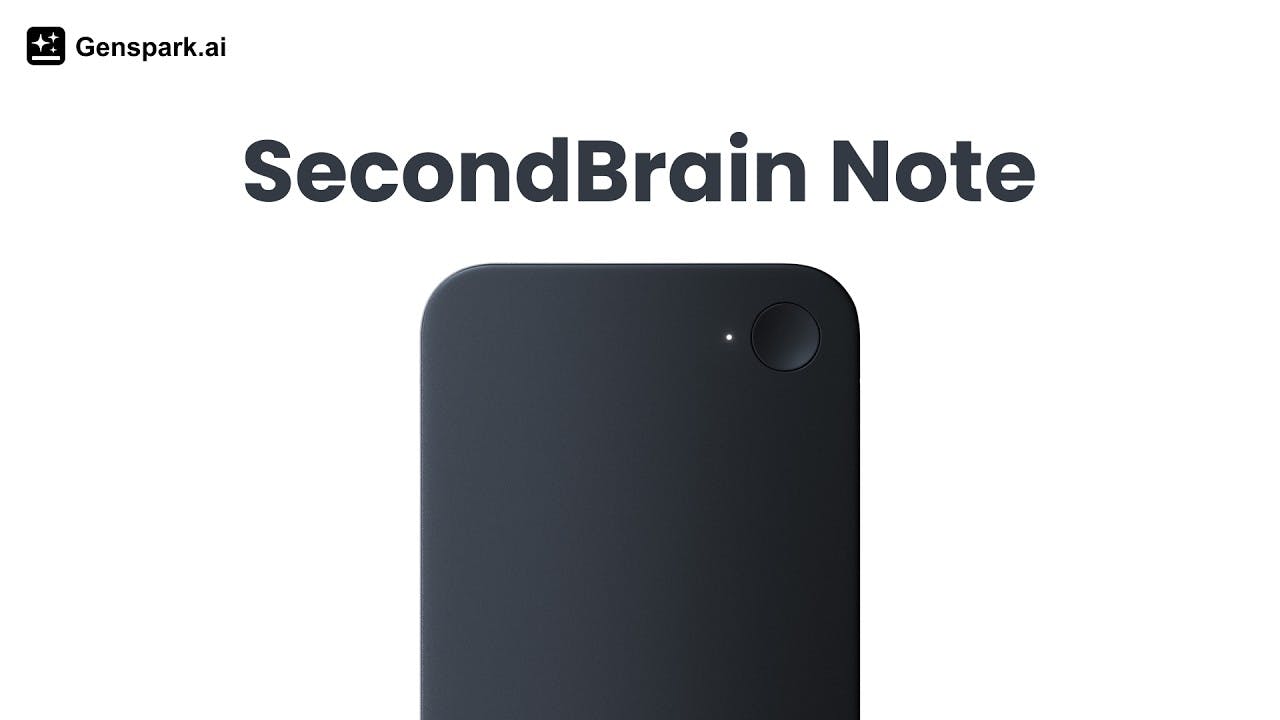
SecondBrain Note is a card-sized AI voice recorder that captures meetings, calls, and conversations, then transfers recordings into Genspark for transcription, summarization, retrieval, and agent-driven follow-up. The hardware costs approximately $179 at launch versus a stated $199 list price and includes 300 transcription minutes per month without a subscription. It is positioned as an input device for Genspark’s broader SecondBrain memory layer rather than as a standalone recorder.
The product is credible on design and ecosystem integration. It weighs 26 grams, is 2.95 millimetres thick, includes 64 GB of storage, four microphones and a vibration sensor, and offers up to 35 hours of recording. Recordings can be made offline and processed after synchronization. However, real-time transcription is not currently supported, shipping is limited to the United States, Japan, and South Korea, and product-specific sales, returns, engagement, and subscription conversion have not been disclosed (SecondBrain Note help centre; official shop).
The company is substantially more mature than the hardware product. Reuters reported that Genspark said it reached approximately $250 million in ARR after adding $150 million during the first three months of 2026, while Axios reported a $100 million financing extension at a $2.6 billion valuation and more than $645 million raised. These figures imply approximately 10.4× reported ARR, potentially attractive for a company growing this rapidly, although ARR quality, contract duration, inference costs and gross margins are not public (Reuters; Axios).
The investment case therefore depends less on whether Genspark can become a unicorn—it already has—and more on whether SecondBrain can improve retention, proprietary context accumulation and cross-product usage without introducing low-margin hardware complexity or unacceptable privacy risk.
1. Product Overview and Product Quality
SecondBrain Note performs four connected functions:
- Captures in-person meetings, interviews, lectures, ideas and phone calls.
- Stores audio locally when disconnected.
- Transfers recordings to the Genspark application by Bluetooth or direct Wi-Fi.
- Generates transcripts and summaries that become accessible to Genspark’s agents.
The device includes a MagSafe wallet, phone stand functionality and a vibration-conduction microphone for capturing phone audio. A long button press starts or stops recording; a short press marks an important moment. Recordings shorter than two minutes receive transcription only, while longer recordings receive both a transcript and summary. Audio is processed after recording—there is no real-time transcription in the current release (official documentation).
Product strengths
- Low-friction capture: One-button recording and long battery life address the practical failure modes of mobile-app recording.
- Strong form factor: At 2.95 mm and 26 g, the product is meaningfully portable.
- Ecosystem integration: Notes can feed Genspark SecondBrain, GenMail, presentations, reports, CRM workflows and the Super Agent.
- Offline capability: Recording does not require an active phone or internet connection.
- Security posture: Genspark states that transfers are encrypted and its security framework is SOC 2 Type II and ISO 27001 certified. Certification resources are referenced through its Trust Center.
- Usable free allowance: Hardware owners receive 300 transcription and summary minutes monthly.
Product weaknesses
- Transcription accuracy, speaker identification performance and summary reliability have not been independently benchmarked.
- Real-time transcription is unavailable.
- The device depends on Genspark’s cloud and mobile application for full utility.
- Shipping currently covers only three countries.
- The return policy accepts only unopened, sealed products within 30 days; this is restrictive for users seeking to test recording quality.
- Product-specific active-device, repeat-usage and return rates are not publicly disclosed.
Overall product quality is high conceptually, but evidence of sustained field performance remains limited.
2. Founder and Team Assessment
The founding team is unusually strong for this product category.
- Eric Jing, CEO, was a founding member of Microsoft Bing and has experience building search infrastructure.
- Kay Zhu, CTO, previously worked on Google ranking systems and is publicly credited with search-ranking and machine-learning experience.
- Wen Sang, COO, founded enterprise parking SaaS company Smarking, which was acquired in 2022. He holds a PhD from MIT and is a Y Combinator alumnus (Wen Sang profile).
- Genspark also publicly identifies Ray Zhong as a co-founder and engineer.
Emergence Capital’s investment announcement emphasizes founder experience across Microsoft, Google, Meta, YouTube and Pinterest and reports that the company reached $50 million ARR within five months of its agent product’s launch (Emergence Capital).
LinkedIn lists Genspark as having 51–200 employees, with approximately 70 profiles associated with the company, and operations in Palo Alto and Singapore (company profile). Precise headcount, hardware-team composition and executive responsibilities are not publicly verified.
Company quality conclusion: Excellent founder-market fit and access to capital. The principal concern is operational complexity: Genspark is simultaneously developing AI agents, enterprise software, mobile applications and physical hardware.
3. Market Opportunity
SecondBrain Note participates in several overlapping markets:
- AI meeting assistants and transcription;
- consumer and professional voice recorders;
- enterprise knowledge management;
- personal AI memory and context infrastructure;
- workflow and productivity software.
The addressable use cases span sales, consulting, recruiting, research, education, medicine, legal work and executive productivity. Nevertheless, privacy rules constrain adoption in regulated and confidential settings.
Competitor scale provides stronger market validation than speculative market reports. Plaud states that its products serve more than two million users, while TechCrunch reported more than 1.5 million devices sold by early 2026. This demonstrates material demand for dedicated AI-recording hardware (Plaud; TechCrunch).
At SecondBrain Note’s $179 launch price:
- 559,000 annual device sales would produce approximately $100 million in gross hardware bookings.
- 1.12 million annual device sales would produce approximately $200 million.
These are scenario calculations, not forecasts, and exclude discounts, returns, channel fees and manufacturing costs. More valuable economically would be hardware-assisted subscription conversion into Genspark Plus, Pro or enterprise contracts.
4. Traction and Growth Signals
Company-level traction
- Genspark reported approximately $250 million ARR by early 2026.
- The company separately claimed more than 7,000 business customers.
- Its US iOS application has approximately 3,900 ratings and a 4.7/5 score as of the report date (App Store).
- Genspark raised more than $645 million and was valued at $2.6 billion.
ARR and customer figures are company-reported and have not been independently audited in public materials. They nevertheless represent substantially stronger evidence than Product Hunt engagement.
Product-specific traction
- SecondBrain Note was ranked #4 on Product Hunt on August 10, 2026.
- Product-specific orders, shipped units, active devices, processing minutes and subscription attach rates are not publicly disclosed.
- Product Hunt popularity indicates launch awareness, not product-market fit.
5. Competitive Position
The closest hardware competitor is Plaud Note, which offers a similarly thin recorder, 300 free monthly transcription minutes and paid plans ranging from 1,200 minutes to unlimited processing (Plaud pricing). Plaud has a large installed base and earlier specialization in recording.
Other competitors include:
- Otter.ai, Fireflies.ai and Notta for meeting transcription;
- native recording and transcription from Apple, Google and Microsoft;
- smartphone voice-memo applications;
- broader persistent-memory products and AI workspaces.
SecondBrain Note’s primary differentiation is not its hardware. It is the ability to convert captured context into downstream work across Genspark’s agents, documents, presentations, email and CRM connections. This could create switching costs as a user’s accumulated memory grows.
Defensibility is moderated by low hardware differentiation, dependence on third-party foundation models and the possibility that operating-system vendors add comparable transcription and memory features.
6. Business Model and Economics
Revenue sources include:
- $179 launch-price hardware sales;
- Plus subscriptions, starting around $24.99 per month;
- Pro subscriptions, starting around $249.99 per month;
- credit purchases;
- team and enterprise contracts.
The hardware includes 300 processing minutes monthly. Paid members receive unlimited transcription and summarization up to 24 hours per day, subject to platform policies (membership documentation).
The model has attractive potential if hardware serves as a low-churn acquisition channel for recurring subscriptions. However, bill-of-materials cost, fulfilment cost, warranty rate, subscription attach rate and inference cost are all not publicly disclosed. Consequently, product-level gross margin and customer lifetime value cannot be assessed.
7. Unicorn Path
Company-level classification: Clear / achieved
The latest public financing valued Genspark at $2.6 billion. At reported ARR of $250 million, the valuation equals approximately:
\[
\$2.6B \div \$250M = 10.4\times ARR
\]
A $1 billion valuation at the same 10.4× multiple would require only about $96 million ARR, which the company claims to have exceeded. A future $10 billion valuation at a 10× multiple would require approximately $1 billion ARR, or four times current reported ARR.
Standalone SecondBrain Note classification: Conditional
Using a 5× hardware-revenue multiple, a $1 billion product-line valuation would require about $200 million annual revenue, equivalent to approximately 1.12 million $179 devices per year before subscription revenue. A higher-margin subscription mix could materially reduce the required unit volume.
8. Valuation Assessment
Assessment: Attractive, with caveats.
The $2.6 billion valuation is supported by reported $250 million ARR and exceptional growth, yielding a relatively reasonable 10.4× ARR multiple. However:
- ARR quality and renewal rates are not public.
- AI inference may reduce gross margins.
- Promotional credits may inflate usage without equivalent economics.
- SecondBrain Note’s revenue contribution is unknown.
- Hardware could dilute consolidated margin.
- More than $645 million of financing creates a substantial liquidation-preference and ownership-structure diligence requirement.
9. Key Risks
- Recording-consent, privacy and workplace-surveillance liability.
- Commoditization by Plaud, smartphones and operating-system vendors.
- Unproven product-specific demand and retention.
- Hardware inventory, quality-control and warranty exposure.
- High model and cloud-compute costs.
- Security breach involving sensitive conversations.
- Dependence on third-party AI providers.
- Rapid expansion across too many product categories.
- Reported ARR may not equal durable, high-margin recurring revenue.
10. Final Assessment
Venture Potential Score Breakdown
| Category | Maximum | Score | Rationale |
|---|---|---|---|
| Market size | 20 | 18 | Large global productivity and knowledge-management opportunity |
| Traction | 20 | 15 | Exceptional company-level ARR; product-specific sales absent |
| Founder/team | 15 | 15 | Search, AI, enterprise SaaS and prior-exit experience |
| Product strength | 10 | 9 | Strong form factor and integrated workflow; limited independent testing |
| Distribution | 15 | 14 | Existing user base, mobile apps, enterprise clients and global capital |
| Business model | 10 | 8 | Hardware plus subscriptions; margins and attach rates unknown |
| Defensibility | 10 | 7 | Context and workflow data can compound, but hardware is replicable |
| Total | 100 | 86 | High venture potential |
Evidence Confidence: 78/100. Funding, valuation, app presence, specifications and corporate ARR are reasonably well documented. Confidence is reduced by company-reported operating metrics and the absence of product-level sales, retention and unit economics.
Decision: Proceed to diligence / Selective Invest. Genspark is a credible growth-stage investment candidate. SecondBrain Note strengthens the ecosystem thesis, but should not yet be valued as a proven standalone growth engine.
Upgrade and Downgrade Conditions
Upgrade if:
- More than 250,000 devices ship with low return rates.
- Paid subscription attach exceeds 20%.
- Six-month active-device retention exceeds 60%.
- Consolidated gross margin remains above 65%.
- Independent tests validate transcription and speaker accuracy.
- Enterprise customers deploy SecondBrain across regulated workflows.
Downgrade if:
- Hardware sales rely primarily on discounts or influencer campaigns.
- Warranty and return rates materially erode margins.
- Native smartphone features eliminate the need for dedicated hardware.
- Privacy incidents or recording-law disputes emerge.
- ARR growth depends on temporary promotions or low-retention subscriptions.
Questions for Further Diligence
- How many units have been ordered, shipped and activated?
- What are bill-of-materials, fulfilment and warranty costs?
- What percentage of buyers convert to Plus, Pro or enterprise plans?
- What are 30-, 90- and 180-day active-device retention rates?
- What portion of $250 million ARR is contracted enterprise revenue?
- What are consolidated and product-level gross margins?
- How are recordings used for model training, if at all?
- Which SOC 2 systems and product surfaces are within the audit scope?
- What are net revenue retention and customer-concentration figures?
- What liquidation preferences accompany the $645 million raised?