
Table of Contents
Actx0 Investment Report
Category: AI-agent infrastructure / persistent memory and retrieval
Company Stage: Launch-stage / pre-seed
Founder or Founders: “Ahmed” is identified as the Product Hunt maker; surname and legal founder status are not publicly verified. GitHub identifies “Adam” as the organization’s only public member.
Headquarters: Netherlands, according to the company’s GitHub profile; legal headquarters not verified
Funding: Not publicly disclosed
Business Model: Freemium managed-cloud infrastructure with monthly SaaS plans and custom enterprise pricing
Product Hunt Launch Date: August 21, 2026
Report Date: August 26, 2026
| Investment Metric | Assessment |
|---|---|
| Venture Potential | 54/100 |
| Unicorn Path | Conditional |
| Valuation Attractiveness | Not Assessable |
| Evidence Confidence | 38/100 |
| Final Decision | Watch |
Executive Summary
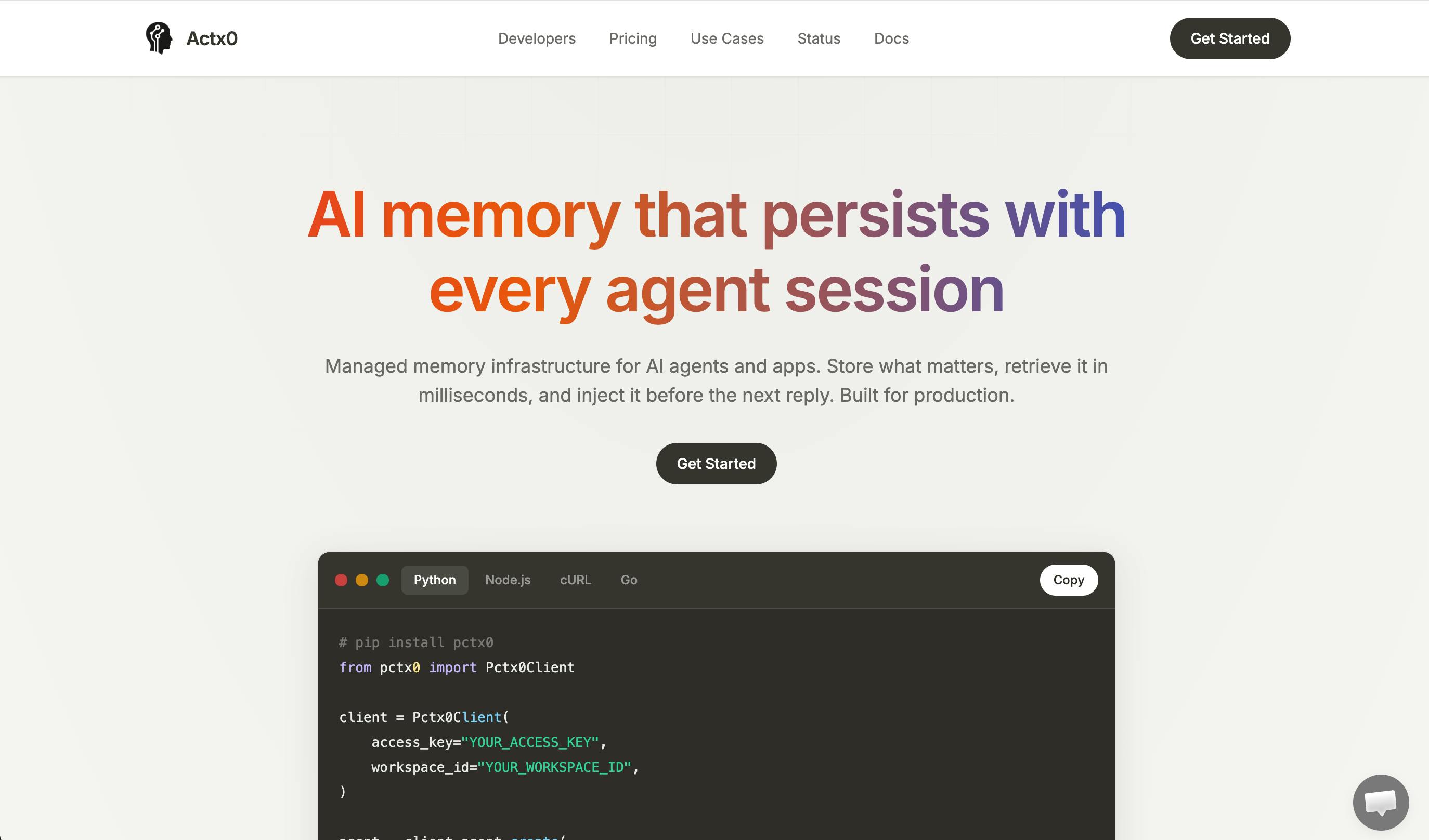
Actx0 is managed memory infrastructure for developers building AI agents and applications. Instead of repeatedly placing entire conversation histories and knowledge bases into model prompts, developers send interactions to Actx0, which extracts compact memories and retrieves relevant facts before the next model response. The product also includes document retrieval, versioned prompts, workspaces, access controls and audit records (official documentation).
The underlying problem is credible. Long-running agents need persistent user, task and organizational context, while replaying full histories can increase model cost, latency and context noise. LangGraph’s documentation independently describes persistent short- and long-term memory as important for agents operating across interactions, while also illustrating that memory management is complex and lacks a universal implementation (LangGraph memory documentation).
Actx0’s strongest investment signal is technical breadth at launch. It provides REST access and public Python, Node.js and Go clients, alongside documentation, billing, knowledge retrieval, prompt versioning and multi-tenant workspaces. This is more complete than a demonstration-only memory API. Public repositories nevertheless have almost no stars or forks, and company-reported latency and token-saving claims have not been independently benchmarked (Actx0 GitHub).
The primary investment concern is the near-total absence of commercial and organizational evidence. Revenue, active developers, production workloads, retention, customer references, team size, founder background and infrastructure economics are undisclosed. The company launched only five days before this report. Approximately 102 Product Hunt votes and a #14 daily position indicate modest launch interest, not product-market fit (Product Hunt; August 21 leaderboard).
Actx0 operates in a potentially valuable but crowded layer. Mem0, Zep, Letta, LangGraph, vector databases and internal engineering teams offer overlapping capabilities. The result is a Watch decision: the infrastructure thesis may support a venture business, but Actx0 lacks the usage, founder and differentiation evidence required for formal due diligence.
Product Overview
AI agents often need to remember user preferences, prior conversations and completed work across sessions. The manual alternative is to store transcripts in an application database, summarize them, create embeddings, operate a vector store and write retrieval logic. That workflow adds engineering complexity and may replay irrelevant context.
Actx0 abstracts this process. Developers create a workspace, agent and session, send user messages, and retrieve relevant memories before generating the next response. According to its platform documentation, user messages trigger asynchronous extraction into facts or preferences; assistant messages remain searchable but do not trigger extraction. The platform also searches uploaded .txt and .md knowledge documents and stores versioned prompts.
Core product elements include:
- Managed memory extraction, consolidation and semantic retrieval
- Session transcripts and persistent facts
- Workspace-level document retrieval
- Versioned prompt management
- Scoped API keys, team roles, audits and usage tracking
- Python, Node.js, Go, REST and CLI access
- Managed-cloud deployment
Actx0 reports sub-10-millisecond P99 retrieval and, in search-visible website material, a 90% token reduction. These are company-reported claims without published methodology, workload definition or independent replication. They should not yet be treated as production benchmarks.
The official pricing page lists Hobby at $0, Starter at $19 monthly, Growth at $69, Pro at $219 and Enterprise at custom pricing. However, the Product Hunt maker statement on August 21 said paid plans were “coming soon.” The current website and release notes show billing and plan enforcement, suggesting that pricing was activated shortly after launch, but actual paid transactions are not verified.
Product Quality: Strong launch-stage implementation and documentation, but reliability, retrieval quality and claimed performance remain unverified.
Founder and Team Assessment
Product Hunt identifies the maker only as Ahmed. No reliable public source was found establishing a surname, professional history, prior employers, previous startups, exits or ownership of the legal entity.
The Actx0 GitHub organization’s only public member is the account v0xk, whose profile identifies the individual as Adam, a software engineer in the Netherlands associated with Clivern (GitHub profile). It is unclear whether Ahmed and Adam are separate people, whether Adam is a cofounder or employee, or whether the Product Hunt identity uses a non-legal name.
Technical execution implies meaningful software-engineering capability. The organization has published nine repositories, including clients in Python, TypeScript and Go. Yet most repositories were created immediately before launch, have zero stars and forks, and do not establish sustained engineering performance or external adoption (GitHub organization metadata).
No LinkedIn company page, verified employee list, job postings or founder biography was located. Full-time commitment and team size are therefore not assessable. This organizational ambiguity materially reduces evidence confidence and would need resolution before formal diligence.
Founder Assessment: Initial technical execution appears capable, but founder identity, experience, team structure and commercial capability remain substantially unverified.
Market Opportunity
The initial customer is a software team building a multi-session, customer-facing AI agent that needs persistent context but does not want to operate its own memory and retrieval stack. Likely use cases include support, sales, scheduling, coaching, healthcare administration and enterprise knowledge assistants.
A bottom-up scenario can be constructed, but no reliable count of production agent teams is currently available:
- Assumed potential production teams globally: 20,000–100,000
- Current Pro annualized price: $2,628
- Implied market at current Pro pricing: approximately $53 million–$263 million annually
This is an analyst scenario, not a verified market estimate. Many teams will use open-source libraries, existing databases or memory bundled into an agent framework. Conversely, large enterprises could spend substantially more than $2,628 annually for security, deployment control, service-level agreements and high usage.
The category has attracted institutional capital. Mem0 announced $24 million in combined Seed and Series A funding to build an AI memory layer (Mem0 announcement), while Letta raised a reported $10 million seed round around its stateful-agent and memory technology (funding announcement). This validates investor interest, not Actx0’s ability to win.
A venture-scale market is possible if persistent memory becomes standard infrastructure for production agents. Actx0 would need higher enterprise contract values, global distribution, strong security and a differentiated retrieval or memory engine. The existing self-service market alone may be insufficient.
Traction and Growth Signals
Actx0 launched on Product Hunt on August 21, 2026. Product Hunt’s leaderboard places it around #14 for the day, while secondary launch tracking indicates approximately 102 votes. This represents early developer awareness only.
More meaningful product signals include:
- A functioning dashboard and documented API
- Public Python, Node.js and Go clients
- Nine public GitHub repositories
- Billing and plan-enforcement functionality
- Platform release notes covering OAuth, workspaces, extraction, knowledge retrieval and auditing
- A public status page reporting no current incidents
However, GitHub community adoption is negligible: key SDK repositories showed no stars, forks or external activity at research time. The repositories were created primarily in August 2026, leaving insufficient history to assess development velocity or community durability.
No reliable information was found regarding registered developers, API requests, memories stored, production applications, paying customers, revenue, growth, retention, uptime history or customer references.
Traction Assessment: A technically substantive launch, but commercially and operationally unverified.
Competitive Position
Direct competitors include Mem0, Zep and memory-focused components from Letta. Indirect competitors include LangGraph memory stores, Pinecone, Weaviate, PostgreSQL/pgvector and internal retrieval systems.
Mem0’s pricing is particularly close: free, $19 Starter, $249 Pro and custom Enterprise plans (Mem0 pricing). Actx0’s $19 Starter and $219 Pro tiers therefore offer little structural pricing differentiation. Zep emphasizes context graphs, provenance, temporal updates, governance and sub-200-millisecond retrieval at enterprise scale (Zep). Letta benefits from the MemGPT research lineage and named investors and customers (Letta).
Actx0 differentiates through a unified package of session memory, document knowledge, prompt versioning, audits and multi-language SDKs. Its reported sub-10-millisecond retrieval could be valuable if independently demonstrated under representative workloads. At present, however, no comparative benchmark establishes superior recall, precision, memory consistency, token savings or total cost.
Switching costs could increase once an application stores millions of memories and integrates Actx0 deeply. They are low during evaluation because competing APIs and open-source stores serve similar purposes.
If the largest platform launched the same feature within six months, why would customers remain? A credible answer would require demonstrably better memory quality, migration difficulty, unique accumulated data, lower cost or superior enterprise controls. None is yet proven.
Defensibility Assessment: Low to Medium
Business Model and Economics
Actx0 uses freemium infrastructure SaaS pricing:
- Starter annualized contract value: $228
- Growth annualized contract value: $828
- Pro annualized contract value: $2,628
- Enterprise: Not publicly disclosed
Plan capacity applies across agents, sessions, memories, documents, prompts, API calls, storage and AI usage, according to the release notes. Exact public usage allowances were not located, making price-performance comparisons difficult.
Variable costs probably include LLM-based fact extraction, embedding generation, vector or semantic retrieval, database storage, backups, bandwidth and observability. Enterprise deployments add support, security reviews and uptime obligations. The company does not disclose model providers, cost per extracted memory, average queries per customer or gross margins.
The core economic question is whether higher usage produces revenue faster than extraction, indexing, storage and retrieval costs. Fixed monthly pricing can create margin compression if heavy users reach plan limits without upgrading. Usage-based overages or enterprise commitments may be necessary.
Unicorn Path
A 10× ARR multiple is assumed for a rapidly growing, high-gross-margin AI infrastructure company. The multiple would be lower if growth, retention or margins resemble commodity hosting.
Required ARR = $1 billion ÷ 10 = $100 million.
At current pricing:
- At $2,628 annual Pro revenue: approximately 38,000 Pro customers
- At a hypothetical $10,000 blended enterprise ACV: 10,000 customers
- At a hypothetical $50,000 enterprise ACV: 2,000 customers
The latter two are analyst assumptions, not current Actx0 prices. Achieving them would require SOC 2 or equivalent compliance, data-region controls, SLAs, private deployment, extensive integrations, strong customer references and enterprise sales.
Actx0 would also need proprietary memory quality, repeatable developer adoption and reliable gross margins. A $100 million ARR outcome is possible for the category, but not yet credible for this company under its current evidence base.
Unicorn Path: Conditional
Valuation Assessment
No reliable public information was found regarding funding, investors, round size, SAFE cap, post-money valuation or current fundraising. Revenue and retention are also unknown.
Valuation Attractiveness: Not Assessable
Assessment would require current ARR, growth, gross margin, cohort retention, infrastructure costs, burn, runway, cap table, round size, valuation cap, liquidation preferences and founder ownership. Competitor financing validates the category but cannot responsibly establish Actx0’s valuation.
Key Risks
- No commercial validation: Paying customers, revenue and retained usage are undisclosed.
- Founder and team ambiguity: Public sources do not clearly establish founder identity or team composition.
- Strong funded competitors: Mem0, Zep and Letta have greater visibility, capital or research credibility.
- Open-source substitution: LangGraph and self-hosted databases can provide memory without another vendor.
- Unproven retrieval quality: No independent precision, recall or long-term consistency benchmark exists.
- Commodity pricing: Actx0’s plans closely resemble Mem0’s pricing.
- Infrastructure margin risk: Extraction, embeddings and storage may scale with usage faster than subscription revenue.
- Security and privacy exposure: The service stores conversations, documents, memories and embeddings; no independent compliance certification was found.
- Operational maturity: Claims of production readiness are difficult to reconcile with the product’s very recent public launch.
- Weak present distribution: Minimal GitHub adoption and no verified partnerships or customer references.
Final Assessment
Venture Potential: 54/100
| Category | Score |
|---|---|
| Market Size and Expansion Potential | 17/20 |
| Traction and Growth Evidence | 3/20 |
| Founder and Team | 5/15 |
| Product Strength | 8/10 |
| Distribution Potential | 7/15 |
| Business Model and Economics | 8/10 |
| Defensibility | 6/10 |
| Total | 54/100 |
The strongest elements are the important infrastructure problem, technical product scope and enterprise expansion potential. The weakest are absent commercial traction, founder opacity and intense competition.
Evidence Confidence: 38/100
The product, pricing, documentation, GitHub repositories and privacy terms are verified. Latency and token-reduction figures are company-reported. Market and enterprise-ACV calculations are analyst scenarios. Founder history, team size, customers, revenue, retention, margins, funding and valuation remain unavailable.
Final Decision: Watch
Actx0 is technically interesting and operates in a potentially venture-scale category. It is nevertheless too new and insufficiently verified for formal due diligence. Product Hunt attention has negligible weight in this decision.
Upgrade Conditions
- Verification of founders, team structure and full-time commitment
- At least 20–30 paying production customers with references
- Sustained six-month developer and API-usage growth
- Net revenue retention above 100% or strong usage expansion
- Gross margin above 70% after extraction and storage costs
- Independently reproducible retrieval and token-cost benchmarks
- SOC 2 progress and enterprise security controls
- Distribution beyond Product Hunt and founder-led outreach
Downgrade Conditions
- Production usage fails to persist after experimentation
- Retrieval quality underperforms open-source alternatives
- Major pricing reductions are required to compete
- Infrastructure costs prevent attractive gross margins
- GitHub and release activity stalls
- A security or customer-data incident occurs
- Founder identity or company claims prove misleading
Questions for Further Diligence
- Who are the legal founders, and how does “Ahmed” relate to GitHub contributor Adam?
- How many registered, active and paying workspaces currently exist?
- What are MRR, monthly growth and revenue by plan?
- What percentage of developers remain active after 30, 90 and 180 days?
- How many customers use Actx0 in production rather than testing?
- What are average API calls, memories and storage per paid customer?
- What is gross margin by plan after extraction, embedding and storage costs?
- How were the sub-10-millisecond and 90% token-reduction claims measured?
- What prevents a customer from migrating to Mem0, Zep or LangGraph?
- What security certifications, data locations and deletion guarantees are available?
- What are burn, runway, cap table and current financing terms?
- What specific enterprise features and contract values are in the pipeline?
Sources
- Actx0 on Product Hunt
- Product Hunt daily leaderboard, August 21, 2026
- Actx0 website and pricing
- Actx0 platform documentation
- Actx0 quickstart
- Actx0 release notes
- Actx0 GitHub organization
- Actx0 privacy policy
- Actx0 terms of use
- LangGraph memory documentation
- Mem0 pricing
- Mem0 funding announcement
- Zep
- Letta