
Table of Contents
Overview
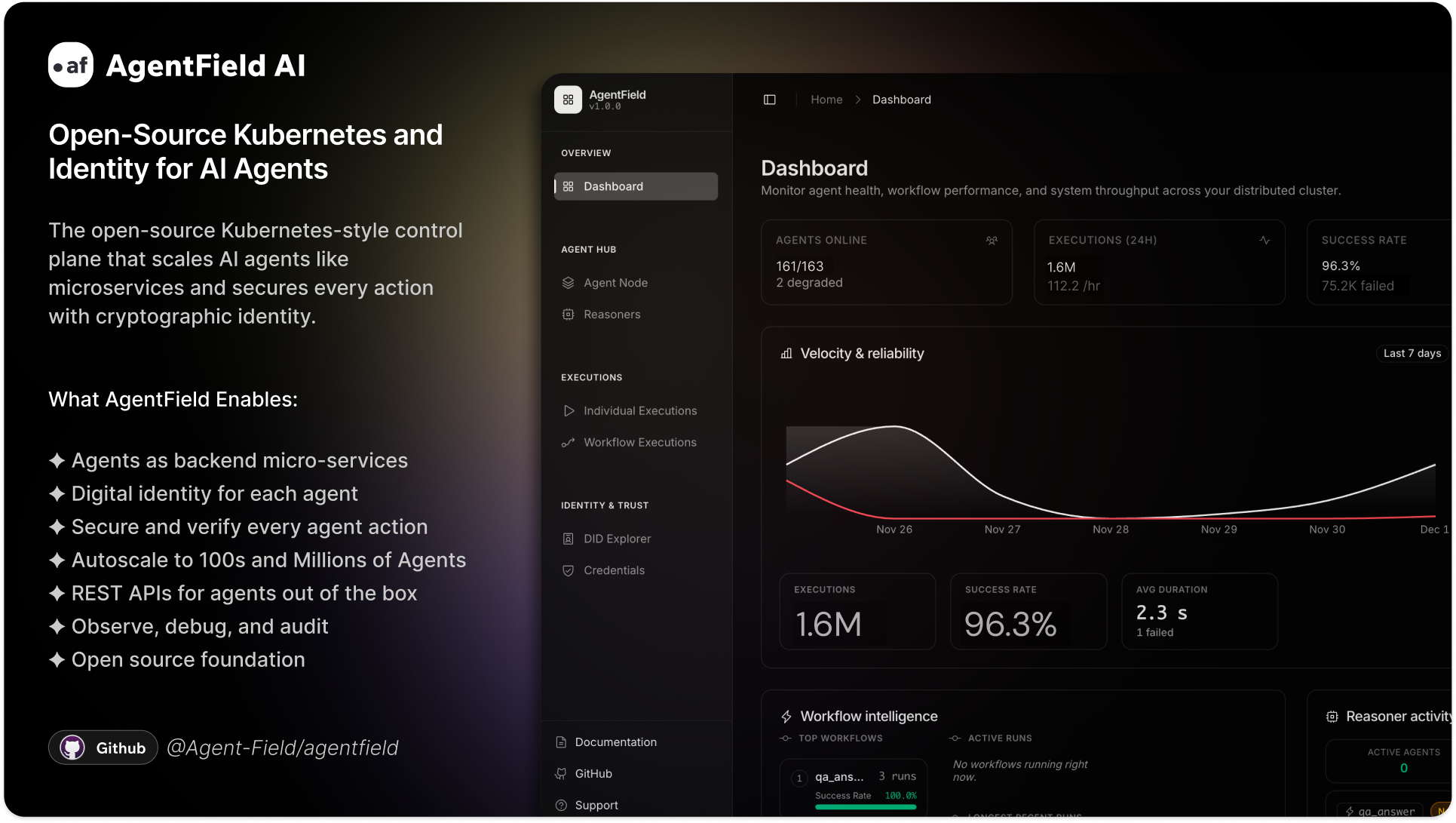
Agentfield is an open-source infrastructure control plane for autonomous agents launched publicly December 2025 treating AI agents as production-grade microservices requiring distributed computing, security, and observability infrastructure similar to Kubernetes for containers. Rather than forcing agents to run monolithic scripts relying on manual orchestration, Agentfield provides unified backend infrastructure managing agent lifecycle, multi-agent coordination, cryptographic identity, and verifiable audit trails. Built on stateless Go control plane plus independent agent nodes architecture enabling teams deploying agents independently, Agentfield emerged from stealth with strong market positioning emphasizing Kubernetes/Okta analogy—infrastructure for operating autonomous software rather than prototype frameworks.
Available through open-source self-hosted model (completely free) with managed cloud platform coming (specific pricing not yet published), Agentfield specifically targets engineering teams building production autonomous systems requiring strong identity, auditability, and predictable orchestration. The December 2025 launch with emphasis on W3C decentralized identifiers (DIDs) and verifiable credentials (VCs) differentiates from framework-focused competitors prioritizing ease-of-use over production requirements. Founding team’s Kubernetes experience evident in architectural decisions treating agents like containerized services requiring orchestration infrastructure.
Key Features
Agent Microservices Architecture: Convert Python, Go, TypeScript functions into auto-generated REST API endpoints with OpenAPI specifications. Every function becomes callable microservice enabling language-agnostic integration with any frontend or backend system.
Cryptographic Identity (DIDs): Every agent receives W3C-compliant Decentralized Identifier (DID) plus key pair enabling cryptographic signing. Agents prove identity through cryptographic material rather than shared API keys.
Verifiable Credentials: Every agent execution issues tamper-proof verifiable credential (VC) proving exactly what happened, who authorized it, and full delegation chain. Enable offline verification without contacting central authority—”checksum for agent decisions.”
Multi-Agent Orchestration: Agents discover and invoke each other through control plane via standard REST APIs. Service mesh automatically routes, load-balances, and tracks all inter-agent communications. Workflow DAGs automatically visualized showing execution paths.
Zero-Config Shared Memory: Distributed agents access shared memory fabric automatically without Redis, Pinecone, or database configuration. Semantic vector search built-in enabling agents querying previous decisions by meaning not just text matching.
Long-Running Async Execution: Support tasks running hours/days with durable execution guarantees. Webhooks with retries, SSE streaming, and backpressure built-in from day one. No timeout limits preventing timeouts on complex workflows.
Automatic Workflow DAGs: System automatically captures execution flow visualizing which agents called which. No manual graph definition required—emerges naturally from agent communications.
Service Discovery and Routing: Agents register capabilities with control plane. Others discover available agents via API without manual configuration. Intelligent routing and load balancing across multiple instances.
Verifiable Audit Trails: Complete cryptographic proof of every decision with W3C standards. Satisfies compliance requirements (healthcare, finance) demanding immutable audit records.
Multi-Language Support: Native SDKs for Python, Go, TypeScript. REST and gRPC APIs enable agents in any language. Write code your team knows without language constraints.
Production Infrastructure Built-In: Durable queues, async execution, webhooks, load balancing, health checks, metrics (Prometheus), structured logging all included standard. Docker/Kubernetes ready requiring zero infrastructure glue code.
Reasoners and Skills Separation: Distinguish AI-guided decision making (reasoners using LLMs) from reliable execution (skills using deterministic code). Formalize this separation building predictable systems combining AI intelligence with programmatic control.
How It Works
Install Agentfield control plane locally or deploy to Kubernetes. Write agent logic as Python/Go/TypeScript functions with @reasoner (AI logic) and @skill (deterministic code) decorators. Functions automatically become REST APIs with OpenAPI specs. Start control plane (af server) and agent nodes (Python main.py). Control plane auto-registers agents enabling discovery. Define multi-agent workflows where agents call each other through control plane. Communicate via standard HTTP REST APIs or language-native SDKs. Control plane tracks every execution issuing verifiable credentials. View workflow DAGs in dashboard understanding agent orchestration visually.
Use Cases
Building Autonomous Enterprise Agents: Organizations deploying autonomous systems (finance decisions, supply chain coordination, compliance automation) need production infrastructure. Agentfield provides security and auditability traditional frameworks lack.
Audit-Compliant AI Workflows (FinTech/Health): Regulated industries require immutable proof of decisions. Verifiable credentials with cryptographic signing satisfy compliance proving what agents decided and who authorized it.
Orchestrating Multi-Agent Systems: Complex problems requiring multiple specialized agents need coordination infrastructure. Service mesh handles discovery, routing, and state sharing automatically without manual glue code.
Replacing Complex LangChain/Infrastructure Glue: Teams maintaining fragile custom orchestration (Redis message queues, Pinecone vector stores, manual agent routing) replace with unified infrastructure. Eliminates DIY infrastructure maintenance.
Supply Chain and Logistics Automation: Coordinate multiple agent decisions across supply chain requiring verification and audit. Cryptographic proof of agent decisions enables accountability.
Financial Decision Automation: Investment decisions, fraud detection, risk assessment require verifiable records. VCs enable proving which agent made decision and reasoning path.
Pros \& Cons
Advantages
Solves Production Infrastructure Gap: Traditional frameworks great for prototypes but terrible for production. Agentfield provides comprehensive infrastructure (orchestration, auth, audit, observability) single teams previously built manually.
Cryptographic Identity and Audit: DIDs and VCs provide strongest possible proof of agent decisions exceeding traditional logging. Particularly valuable for regulated industries (healthcare, finance, legal).
Open Source and Self-Hosted: Complete control over infrastructure—no vendor lock-in. Self-hosted option enables air-gapped deployments. Community-driven development vs. proprietary vendor.
Production-Grade Architecture: Kubernetes-inspired design handling scale, resilience, and fault tolerance. Stateless control plane enables horizontal scaling handling billions of requests.
Zero-Config Infrastructure: No Redis, Pinecone, database configuration required. Shared memory and vector search built-in enabling developers focusing on agent logic versus infrastructure plumbing.
Multi-Language First: Native support for Python, Go, TypeScript plus REST/gRPC enabling heterogeneous teams. Build agents in appropriate languages without language-forced decisions.
Disadvantages
Complex Learning Curve: Requires understanding distributed systems concepts (control plane, service discovery, DIDs, VCs). Teams familiar only with monolithic scripts/frameworks need education.
Not for Simple Use Cases: Kubernetes-level complexity inappropriate for simple chatbots or single-agent scenarios. Over-engineered for teams building prototypes not production systems.
DIDs and VCs Nascent Technology: W3C standards relatively new in industry. Teams unfamiliar with decentralized identity may struggle with concepts. Ecosystem tools/libraries still maturing.
Early-Stage Platform Risk: December 2025 launch means unproven reliability at enterprise scale. Limited customer references, unknown edge case handling, potential abandonment risk for startup.
Requires Operational Expertise: Deploying to Kubernetes, managing control plane, understanding cryptographic identity requires DevOps expertise. Not suitable for teams with limited infrastructure capability.
Minimal UI/Visual Building: Unlike some competitors, Agentfield SDK-first not visual-first. Teams wanting drag-drop builders disappointed. Requires code to build agents.
How Does It Compare?
Agentfield vs LangGraph
LangGraph is open-source agent orchestration framework (part of LangChain ecosystem) enabling graph-based workflow definition for AI agents with state management and multi-agent patterns.
Architecture:
- Agentfield: Production infrastructure (control plane + agent nodes)
- LangGraph: Framework for defining agent workflows
Scope:
- Agentfield: Complete backend infrastructure for agents
- LangGraph: Agent workflow orchestration logic
Identity \& Auth:
- Agentfield: Cryptographic DIDs and verifiable credentials
- LangGraph: None—auth delegated to applications
Deployment:
- Agentfield: Kubernetes-ready, stateless control plane
- LangGraph: Embedded in applications, no infrastructure
Multi-Language:
- Agentfield: Python, Go, TypeScript native SDKs
- LangGraph: Python-focused, lighter TypeScript support
Learning Curve:
- Agentfield: Complex (distributed systems concepts)
- LangGraph: Moderate (graph definitions)
Use Case:
- Agentfield: Production autonomous systems requiring audit
- LangGraph: Building and testing agent workflows
When to Choose Agentfield: For production systems requiring identity, audit, and infrastructure.
When to Choose LangGraph: For developing agent logic and workflows before deployment.
Agentfield vs AutoGen
AutoGen is Microsoft open-source framework for creating multi-agent systems through conversable agents and group chat enabling agent conversation and collaboration.
Architecture:
- Agentfield: Distributed microservices infrastructure
- AutoGen: Monolithic agent conversation framework
Communication Model:
- Agentfield: Service mesh with discovery and routing
- AutoGen: Message-passing between conversable agents
Scalability:
- Agentfield: Designed for distributed scale
- AutoGen: Single-process limitations
Identity \& Audit:
- Agentfield: Cryptographic DIDs and VCs
- AutoGen: None
Memory:
- Agentfield: Shared distributed state with vector search
- AutoGen: Local agent state with optional persistence
DevOps:
- Agentfield: Kubernetes-ready, full infrastructure
- AutoGen: Embed in applications, lightweight
Conversation Style:
- Agentfield: Reasoners (AI) + Skills (deterministic)
- AutoGen: Conversable agents with flexible logic
When to Choose Agentfield: For production distributed autonomous systems.
When to Choose AutoGen: For interactive multi-agent conversations and prototyping.
Agentfield vs Temporal.io
Temporal is open-source workflow orchestration engine for durable execution of long-running distributed workflows with fault tolerance and human interactions.
Primary Focus:
- Agentfield: Autonomous agent infrastructure
- Temporal: General workflow orchestration
Agent-Specific Features:
- Agentfield: Designed for AI agents specifically (DIDs, reasoners/skills)
- Temporal: Generic workflows without AI assumptions
Identity:
- Agentfield: Cryptographic DIDs built-in
- Temporal: None
Long-Running Tasks:
- Agentfield: Hours/days with async execution
- Temporal: Hours/days with deterministic replay
Multi-Language:
- Agentfield: Python, Go, TypeScript
- Temporal: Go, Java, Python, TypeScript, C#
Learning Curve:
- Agentfield: Agent-focused, DID concepts
- Temporal: Workflow-focused, distributed systems
Human Interaction:
- Agentfield: Signal-based coordination
- Temporal: Signals and queries built-in
Use Case:
- Agentfield: Autonomous AI agent systems
- Temporal: General distributed workflows including AI
When to Choose Agentfield: For autonomous agent systems prioritizing AI concepts.
When to Choose Temporal: For general workflow orchestration across domains.
Agentfield vs Hatchet
Hatchet is workflow orchestration platform with visual builder, task queuing, and distributed execution for background jobs and complex workflows.
Architecture:
- Agentfield: Agent-native microservices
- Hatchet: General-purpose job orchestration
Visual Building:
- Agentfield: Code-first (no visual builder)
- Hatchet: Visual workflow builder
Agent Focus:
- Agentfield: Designed specifically for AI agents
- Hatchet: General workflows (not AI-specific)
Identity \& Audit:
- Agentfield: Cryptographic DIDs and VCs
- Hatchet: Standard logging and audit
Multi-Language:
- Agentfield: Native SDKs
- Hatchet: REST API-first
Complexity:
- Agentfield: Production-grade complexity
- Hatchet: Simpler, more approachable
When to Choose Agentfield: For sophisticated autonomous agent systems.
When to Choose Hatchet: For general workflow orchestration with visual building.
Final Thoughts
Agentfield represents pragmatic shift from prototype-focused frameworks toward production infrastructure requirements. Rather than optimizing ease-of-use for prototypes, Agentfield prioritizes production characteristics—distributed architecture, cryptographic identity, verifiable audit trails, multi-language support, zero-config infrastructure—teams actually needing when deploying autonomous systems in regulated industries or high-reliability environments.
The December 2025 launch with emphasis on W3C standards (DIDs, VCs) signals maturity and standards-alignment differentiating from proprietary competitors. The architectural decisions (stateless control plane, agent microservices model, cryptographic identity) reflect deep infrastructure expertise and confidence in production requirements.
However, December 2025 launch creates adoption risk. DIDs and VCs nascent technologies with limited tooling ecosystem. Complexity inappropriate for simple use cases. Early-stage platform survival uncertain. Requires operational expertise teammates may lack. Open-source model unclear regarding commercial sustainability.
For engineering teams building production autonomous systems requiring strong identity, cryptographic audit, and production infrastructure, Agentfield provides compelling alternative to DIY glue code or framework-level solutions lacking enterprise capabilities. The combination of distributed microservices architecture, verifiable credentials, zero-config infrastructure, and multi-language support creates production-ready system unavailable from competitors.
The positioning distinctly addresses the “production gap”—frameworks excellent for research/prototypes but failing when deployed with real decisions in regulated environments. Agentfield bridges gap with infrastructure assumptions reflecting that autonomous agents aren’t just research artifacts but actual systems requiring identity, audit, and governance capabilities.