
Table of Contents
Overview
In the rapidly evolving landscape of artificial intelligence, the ability to create sophisticated AI agents without technical expertise represents a fundamental shift in how businesses approach automation and customer engagement. Botsify’s Agentic Platform emerges as a comprehensive no-code solution that enables organizations to build, deploy, and manage intelligent conversational agents across multiple channels and integrate them with over 5,000 applications through MCP (Model Context Protocol) integration. Established in 2016 and recently launching their agentic platform in August 2025, Botsify transforms the traditionally complex process of AI agent development into an accessible, conversation-driven experience that empowers businesses to create truly intelligent, portable agents capable of handling sales, support, and onboarding tasks through natural language interaction.
Key Features
Botsify’s Agentic Platform distinguishes itself through a comprehensive feature set specifically designed to democratize AI agent creation while maintaining enterprise-grade functionality and integration capabilities.
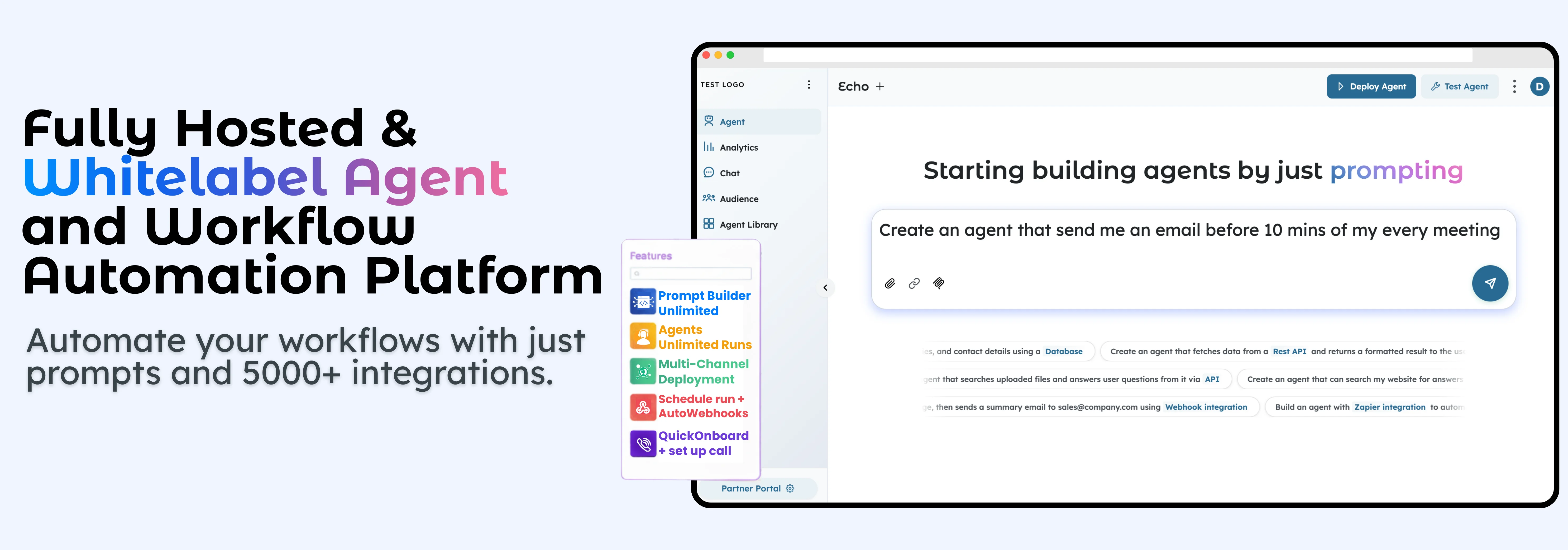
- No-code AI Agent Builder: Create and deploy sophisticated AI agents through an intuitive conversational interface that eliminates programming requirements, enabling users to build complex automation workflows by simply describing their desired outcomes in natural language
- Custom Knowledge Base Training: Empower agents with specialized domain knowledge by training them on proprietary data, internal documentation, and business-specific information, ensuring accurate and contextually relevant responses tailored to organizational requirements
- MCP Integration with 5,000+ Tools: Leverage Model Context Protocol to connect AI agents with an extensive ecosystem of applications and services, enabling seamless data exchange and automation across existing technology stacks without custom API development
- Multichannel Deployment Capabilities: Deploy agents across diverse platforms including popular Large Language Models, websites, WhatsApp, Facebook Messenger, and other communication channels, ensuring consistent user experience regardless of interaction point
- Built-in Analytics and Lead Management: Access comprehensive performance insights and user interaction data while efficiently capturing and managing leads directly through AI agents, streamlining sales processes and enabling data-driven optimization
How It Works
Botsify’s approach to AI agent creation fundamentally reimagines the development process by prioritizing natural language interaction over traditional technical configuration. Users begin by engaging with Botsify’s conversational interface, describing their desired agent behavior, goals, and integration requirements through simple dialogue. The platform’s intelligent system interprets these natural language descriptions and automatically configures the underlying agent architecture, including workflow logic, response patterns, and integration connections.
The knowledge base training process involves uploading relevant documents, connecting to internal databases, or pointing the system to existing knowledge repositories. Botsify’s AI processes this information and creates a comprehensive understanding framework that enables agents to provide accurate, contextually appropriate responses. The MCP integration layer then connects these trained agents to the vast ecosystem of available tools and services, creating sophisticated automation workflows without requiring manual API configuration or custom development work.
Once configured, agents can be seamlessly deployed across chosen channels through simple embedding processes or platform-specific integrations. The system provides real-time monitoring and analytics, enabling continuous optimization based on actual user interactions and performance metrics.
Use Cases
Botsify’s versatile platform addresses diverse business scenarios where intelligent automation and personalized customer interaction drive operational efficiency and growth.
- Automated Customer Support Operations: Deploy AI agents that provide instant, round-the-clock customer assistance by answering frequently asked questions, troubleshooting common issues, and guiding users through complex processes, significantly reducing human agent workload while improving response times and customer satisfaction
- Intelligent Lead Qualification and Management: Implement conversational agents that engage website visitors, conduct qualifying conversations, gather essential contact information, and segment prospects based on predefined criteria, ensuring sales teams focus their efforts on high-potential opportunities while maintaining consistent lead nurturing
- Sales Funnel Optimization and Management: Guide potential customers through sophisticated sales processes using AI agents that provide detailed product information, address objections, schedule demonstrations, and facilitate purchase decisions directly within the conversation interface, creating streamlined customer journeys
- Interactive User Onboarding Experiences: Create comprehensive onboarding workflows that introduce new users or employees to products, services, or organizational processes through guided, interactive conversations that adapt to individual learning pace and requirements while reducing support overhead
- Knowledge-Based Internal Support Systems: Deploy internal agents that serve as organizational knowledge repositories, providing employees with instant access to company policies, technical documentation, HR information, and procedural guidance, improving internal efficiency and reducing repetitive inquiries
Pros \& Cons
Advantages
- Genuinely accessible no-code approach: The conversational agent creation process makes sophisticated AI development accessible to users across all technical skill levels, eliminating traditional barriers to automation implementation while maintaining professional-grade functionality
- Comprehensive multichannel deployment: Extensive platform support ensures agents can reach customers and users across their preferred communication channels, from websites and messaging apps to LLM interfaces, creating consistent experiences regardless of interaction point
- Powerful MCP-enabled integration ecosystem: The ability to connect with over 5,000 applications and services through standardized protocols eliminates the complexity of custom integrations while enabling sophisticated automation workflows that extend far beyond simple conversational interactions
Disadvantages
- Premium tier dependency for advanced capabilities: Access to the platform’s full feature set and higher usage limits requires subscription to more expensive plans, potentially limiting functionality for budget-conscious organizations or individual users
- Customization constraints for highly specialized requirements: While powerful for most use cases, extremely niche or complex custom logic requirements may encounter limitations compared to fully custom-coded solutions designed for specific technical specifications
- LLM-dependent multilingual performance: The quality and breadth of multilingual support varies based on the underlying Large Language Model chosen for deployment, which may impact effectiveness for organizations requiring consistent global communication capabilities
How Does It Compare?
When evaluating Botsify against the current landscape of no-code chatbot and AI agent platforms, its unique positioning becomes clear through its combination of conversational development experience and extensive integration capabilities. ManyChat has evolved significantly from its original Facebook Messenger focus, now supporting WhatsApp, Instagram, SMS, and web platforms with over 70 million businesses using the platform globally. While ManyChat excels in marketing automation and broadcast messaging with sophisticated audience segmentation, its primary strength remains in marketing-focused workflows rather than comprehensive AI agent development with deep business logic integration.
Intercom has similarly evolved beyond its enterprise-focused origins, now offering solutions for small and medium businesses starting at \$39 monthly with features like Resolution Bot and comprehensive customer support workflows. Modern Intercom provides omnichannel messaging, automated workflows, and customer data platforms, making it more accessible than previously while maintaining enterprise-grade capabilities. However, Intercom’s approach centers on customer messaging and support workflows rather than the broader AI agent creation and tool integration that defines Botsify’s value proposition.
BotPenguin represents a significant competitor with reported \$894.9K revenue in 2024 and a 22-person team, offering 80+ native integrations and comprehensive multichannel support including WhatsApp, Instagram, Facebook, Telegram, and web platforms. BotPenguin’s strength lies in its mature platform with established marketing automation features, multilingual capabilities, and competitive pricing structures. However, its approach focuses more on traditional chatbot functionality rather than the agentic AI capabilities and MCP integration ecosystem that Botsify emphasizes.
Chatbase offers GPT-4 powered chatbot creation starting at \$19 monthly with custom data training capabilities, appealing to users seeking AI-powered conversational experiences. While effective for knowledge-based chatbots, Chatbase’s scope remains primarily conversational rather than extending into the comprehensive business automation and tool integration that characterizes true AI agent platforms.
Tidio combines live chat with chatbot functionality at \$18 monthly, offering Shopify integration and hybrid human-bot customer service. Its strength lies in seamless live chat handoffs and e-commerce integration, but its automation capabilities remain more traditional compared to Botsify’s agentic approach.
Botsify differentiates itself through its focus on true AI agent development rather than traditional chatbot creation, emphasizing the ability to build intelligent agents that can reason, access knowledge bases, and interact with complex tool ecosystems through natural language configuration. The MCP integration with 5,000+ tools represents a significant technical advantage for organizations seeking comprehensive automation rather than isolated conversational experiences. Its conversational development approach—where users describe desired outcomes rather than configure technical settings—positions it uniquely for businesses prioritizing accessibility without sacrificing sophisticated functionality.
Final Thoughts
Botsify’s Agentic Platform represents a significant evolution in no-code AI development, successfully bridging the gap between conversational simplicity and sophisticated automation capabilities. Its approach of enabling AI agent creation through natural language interaction, combined with extensive tool integration through MCP and comprehensive multichannel deployment options, positions it as a valuable solution for organizations seeking to harness AI agent capabilities without technical complexity.
While the platform requires premium subscriptions for advanced features and may have limitations for highly specialized requirements, its core strength lies in making sophisticated AI agent development genuinely accessible to non-technical users while maintaining the depth necessary for serious business automation. The combination of conversational development experience, extensive integration ecosystem, and proven platform stability makes it particularly valuable for businesses seeking to implement intelligent automation across customer service, sales, and internal operations.
As AI agent technology continues evolving toward more sophisticated autonomous capabilities, Botsify’s emphasis on accessible development combined with comprehensive integration positions it well for organizations prioritizing practical implementation over technical complexity. For businesses seeking to embrace the agentic future of AI without the traditional barriers of custom development, Botsify offers a compelling combination of accessibility, functionality, and scalability that addresses real-world automation needs in the modern business environment.