Overview
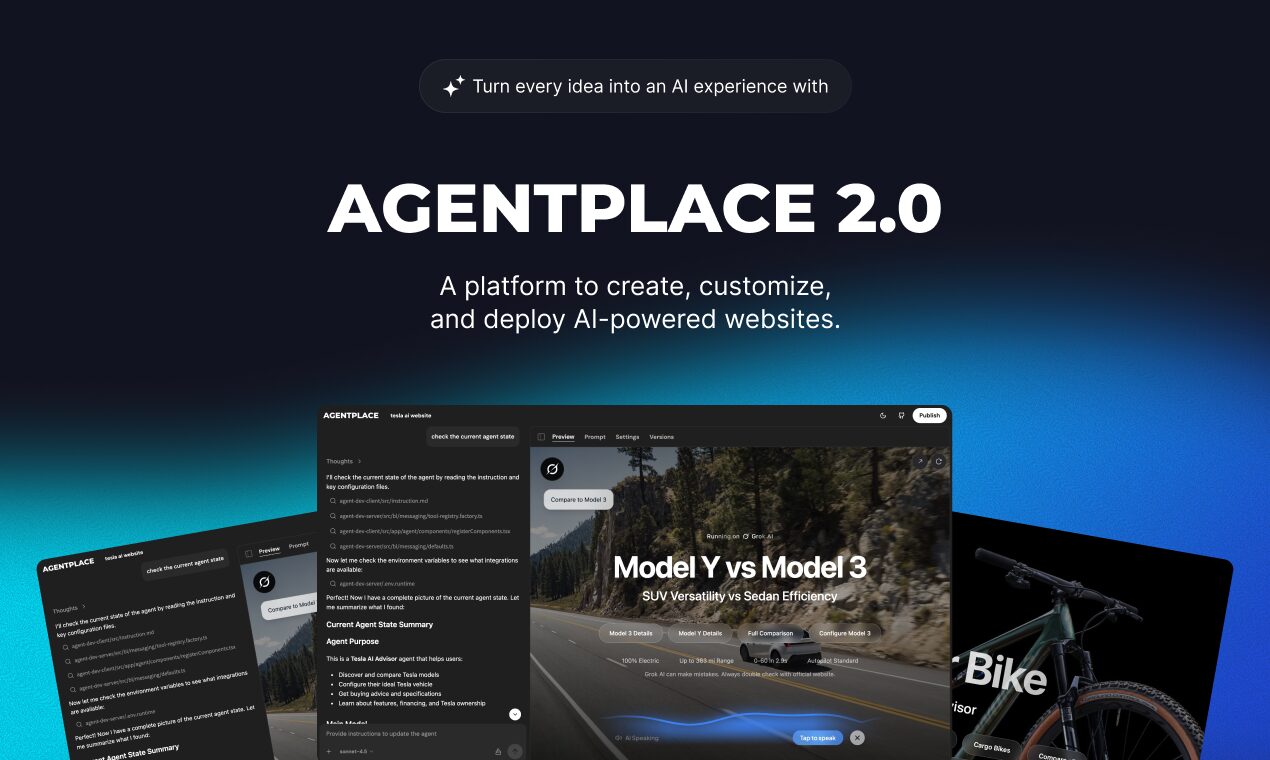
Agentplace 2.0 reimagines websites as intelligent, conversational interfaces rather than static collections of pages. This platform enables users to build AI-native websites and apps that can engage visitors through dialogue, execute tasks dynamically, and adapt in real-time based on interactions. Unlike traditional website builders that add AI features as enhancements, Agentplace positions artificial intelligence as the foundational layer, transforming the entire site into a responsive agent. The platform provides a unified no-code environment where users can design, build, and deploy these next-generation web experiences through simple text-based instructions.
Key Features
AI-Native Platform Architecture: Rather than bolting AI capabilities onto traditional website structures, Agentplace builds every site directly on top of AI models, treating the intelligent agent as the core foundation from which all functionality emerges.
Dynamic, Adaptive Interfaces: Websites created with Agentplace generate personalized interfaces for each visitor in real-time. The AI understands context, responds to queries, adapts content based on user behavior, and creates unique journeys tailored to individual needs.
Multi-Model Support: The platform integrates seamlessly with leading large language models including GPT-4o, GPT-5, Claude, Gemini, and Grok, providing flexibility to select the optimal AI model for specific use cases without vendor lock-in.
Voice Mode Capability: Beyond text-based interactions, Agentplace supports voice commands, enabling users to interact with websites through spoken language for enhanced accessibility and convenience.
Visual Interface Components: Access a library of ready-made UI components including charts, images, tables, and dynamic elements that can be integrated into your AI-powered site without coding knowledge.
MCP Integrations: Connect your AI agents to external services and data sources through Model Context Protocol integrations, extending functionality beyond basic conversational interactions.
One-Click Publishing: Deploy sites instantly from development to live production with a single action, eliminating complex hosting configurations and deployment pipelines.
GitHub Integration: Connect projects directly to GitHub repositories for version control, collaborative development, and integration with existing developer workflows.
How It Works
Agentplace operates through an intuitive, text-driven creation process designed for both technical and non-technical users. Begin by describing your website or application in plain language, providing details about your business, target audience, and desired functionality. The platform uses this description to generate an initial AI agent with appropriate context, personality, and capabilities. You can then refine the agent’s behavior through guidelines, select from pre-built UI components to enhance the visual experience, and upload custom images or assets. Throughout the process, you preview how the AI agent responds to different scenarios and queries. When satisfied, publish instantly to make your intelligent website live. The resulting site doesn’t simply display static information; it actively engages each visitor through conversation, understands their needs through context, and adapts its responses and interface dynamically to provide personalized experiences.
Use Cases
Agentplace serves diverse applications across business sectors:
Intelligent Product Advisors: Create conversational shopping experiences where AI guides visitors through product selection, compares options, answers detailed questions, and provides personalized recommendations based on stated preferences and needs.
Dynamic Support Portals: Build 24/7 customer support websites that understand context, troubleshoot issues intelligently, provide step-by-step solutions, and escalate to human agents only when necessary, reducing support overhead while improving response times.
Adaptive Marketing Funnels: Design marketing sites that adjust messaging, content, and calls-to-action based on visitor behavior, questions, and interests, creating personalized conversion paths rather than one-size-fits-all experiences.
Interactive Onboarding Agents: Develop employee or customer onboarding experiences that guide new users through processes conversationally, answer questions in real-time, and adapt pacing based on comprehension and needs.
Data-Driven Analytics Dashboards: Create intelligent analytics interfaces where users can ask questions about business data in natural language and receive explanations, visualizations, and insights without needing to understand complex query languages or dashboard configurations.
Personal Brand Websites: Build dynamic personal portfolios or professional sites that engage visitors in conversation, answer questions about your work or services, and provide information tailored to each visitor’s interests rather than forcing them to navigate static pages.
Pros \& Cons
Advantages
Fundamentally AI-Native: The platform doesn’t merely add AI features to traditional websites; it builds sites where the AI agent is the primary interface, enabling capabilities impossible with conventional architectures.
No-Code Accessibility: Users can create sophisticated, conversational websites through plain text instructions without requiring programming knowledge, lowering barriers to entry for entrepreneurs and small businesses.
Multi-Model Flexibility: Freedom to choose and switch between leading AI providers prevents vendor lock-in and enables optimization for specific use cases based on model strengths.
Real-Time Adaptability: Sites respond dynamically to each visitor, creating personalized experiences that evolve during the interaction rather than presenting static predetermined content.
Rapid Development and Deployment: The combination of text-based creation and one-click publishing enables faster iteration from concept to live product compared to traditional development workflows.
Disadvantages
Learning Curve for Agentic Thinking: While no coding is required, conceptualizing websites as conversational agents rather than page hierarchies requires a mental shift that may challenge users accustomed to traditional site structures.
AI Response Limitations: Like all AI systems, the generated agents may occasionally misunderstand queries, provide imperfect responses, or require careful prompt engineering to achieve desired behaviors consistently.
Customization Through Prompts: Deep customization requires skill in describing desired behaviors through text, which can be less intuitive than visual drag-and-drop editing for users who think spatially about design.
Platform Maturity: As a relatively recent entrant in the AI website builder space, the ecosystem of templates, integrations, and community resources is still developing compared to established platforms.
Cost Scaling with Usage: The freemium model provides generous starting limits, but high-traffic sites or those requiring extensive AI conversations may encounter usage-based costs as they scale.
How Does It Compare?
Agentplace enters a competitive landscape with distinct categories of alternatives, each approaching AI-powered web development differently:
Traditional AI Website Builders
Wix ADI (Artificial Design Intelligence): Wix remains one of the most popular website builders, with its ADI feature asking users questions about their business and style preferences to generate complete websites with layouts, content, and images. While Wix excels at creating visually polished traditional websites enhanced with AI-generated content, it fundamentally builds static page-based sites rather than conversational agents. Agentplace differentiates itself by making the AI the website itself, enabling dynamic conversations and adaptive interfaces impossible in Wix’s architecture.
Durable AI: Durable generates complete professional websites in approximately 30 seconds based on business descriptions, including hosting, custom domains, CRM, invoicing, and marketing tools. Designed specifically for small businesses and solopreneurs, Durable optimizes for speed and simplicity in creating traditional business websites. While both platforms use AI for rapid creation, Durable produces conventional informational sites, whereas Agentplace creates conversational agents that actively engage visitors through dialogue and adapt behavior in real-time.
10Web AI Builder: This WordPress-focused platform uses AI to generate website layouts from descriptions or existing site URLs, then provides Elementor-based editing with an AI co-pilot for refinements. 10Web combines AI generation with the full power and flexibility of WordPress customization, running on Google Cloud infrastructure with automated performance optimization. The platform excels at creating highly customizable traditional WordPress sites, but like other builders, positions AI as an assistant rather than the foundational interface that defines Agentplace’s approach.
Hostinger AI Website Builder: Bundled with Hostinger’s affordable hosting plans, this builder provides fast, simple AI-powered website generation with content automation and SEO tools. It’s designed as an all-in-one solution for users wanting to get online quickly without technical complexity. Hostinger creates efficient traditional websites, whereas Agentplace builds interactive AI agents capable of conversational engagement.
Developer-Focused AI App Builders
Vercel v0: This AI-powered UI generation tool allows developers to create production-ready React components and full-stack web apps using natural language prompts. v0 generates clean, editable code using shadcn/ui and Tailwind CSS with built-in live editing, GitHub integration, and one-click Vercel deployment. Positioned for developers and teams building technical web applications, v0 creates traditional code-based apps with AI assistance. Agentplace differentiates itself through no-code accessibility and focus on conversational agent experiences rather than traditional component-based applications.
Bolt.new (by StackBlitz): Bolt enables users to describe web applications or mobile apps through chat prompts and generates functioning products in minutes, running entirely in the browser with integrated package management and instant deployment. It supports full-stack development including backend APIs and database connections. While both platforms use prompts to generate apps, Bolt focuses on creating traditional web applications with standard frontend and backend architectures, whereas Agentplace specializes in agent-based conversational websites where AI interaction is the primary interface.
Enterprise Website Platforms with AI Features
Webflow AI: Webflow has enhanced its professional-grade website builder with AI capabilities including an AI Assistant for complex task orchestration, AI-powered code generation, SEO optimization tools, and content creation features announced at Webflow Conf 2025. Webflow provides exceptional design control and customization for agencies and enterprises building sophisticated traditional websites. The platform positions AI as a powerful productivity enhancement to professional web design workflows, whereas Agentplace makes AI the foundational website architecture itself.
Key Differentiators
What distinguishes Agentplace from these alternatives is its fundamental paradigm: websites as autonomous AI agents rather than as enhanced traditional sites. While competitors use AI to generate layouts, write content, or assist with development, Agentplace creates conversational interfaces where the AI actively engages visitors, understands context through dialogue, and adapts its behavior dynamically. This agent-first architecture enables experiences impossible in traditional page-based structures, positioning Agentplace for use cases prioritizing interactive engagement over static information presentation.
Platform Availability and Pricing
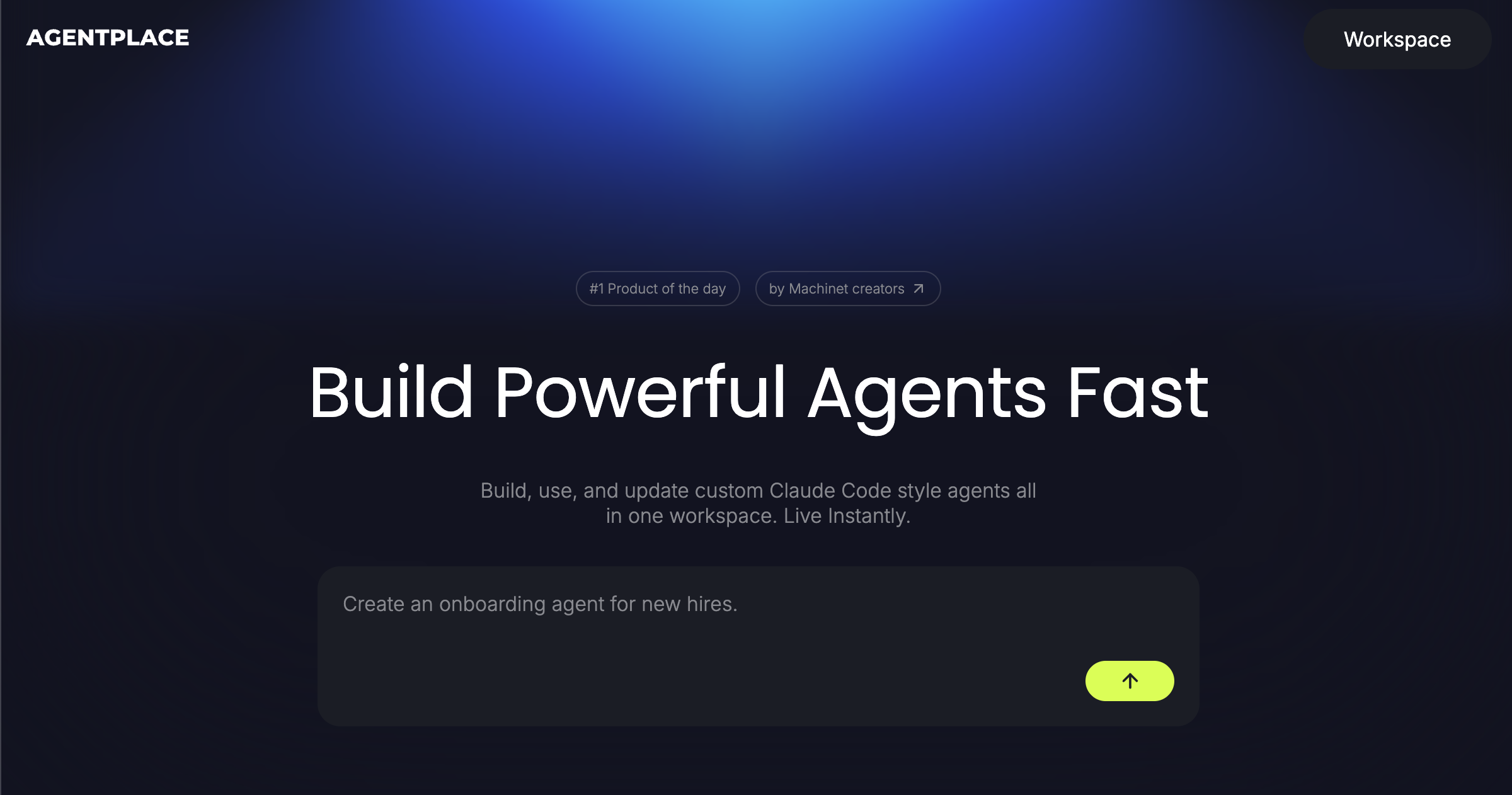
Agentplace achieved significant recognition on Product Hunt, ranking as the number one Product of the Day on November 28, 2024, demonstrating strong market validation for its agent-based approach to web development.
The platform operates as a web-based application accessible through modern browsers without requiring downloads or installations. It’s built by Machinet creators and developed in San Francisco.
Free Plan: Provides 90 AI Engineer calls per month, 2,000 AI conversations per month, access to vibe coding AI Engineer functionality, MCP integrations, support for OpenAI, Anthropic, and Gemini models, and GitHub connectivity. The generous free tier enables meaningful exploration and deployment of AI agent websites without upfront investment.
Pro Plan: Priced at \$29 per month, offering expanded capabilities with customizable conversation limits ranging from 2,000 to 50,000+ monthly AI conversations, maintaining all features from the free plan with substantially higher usage allowances for growing businesses and higher-traffic sites.
Business Plan: Custom enterprise solutions with tailored pricing, dedicated support channels, and custom integrations designed for large teams and organizations requiring specialized implementations or very high usage volumes.
This pricing structure makes AI-native website development accessible to individuals and small businesses while scaling to support enterprise needs.
Final Thoughts
Agentplace 2.0 represents a genuinely different approach to web development, challenging the fundamental assumption that websites must be collections of static pages with AI features bolted on. By positioning the AI agent as the website’s foundation rather than an enhancement, the platform enables conversational, adaptive experiences that traditional architectures cannot replicate.
The no-code, text-based creation process democratizes access to this technology, allowing entrepreneurs, small businesses, and creators to build sophisticated AI-powered digital experiences without programming expertise. The multi-model support provides strategic flexibility, preventing lock-in to a single AI provider while enabling optimization based on specific use case requirements.
However, this paradigm shift requires reconceptualizing what a website is and how it functions. Users must think in terms of conversational flows, agent behaviors, and adaptive responses rather than page hierarchies and navigation structures. This mental model may present challenges for those deeply familiar with traditional web design approaches, though it also opens possibilities unavailable in conventional architectures.
The platform’s suitability depends heavily on use case. For businesses prioritizing interactive engagement, personalized guidance, conversational support, or adaptive experiences, Agentplace offers compelling advantages. For sites primarily focused on information presentation with standard navigation patterns, traditional builders enhanced with AI features may prove more appropriate.
As AI capabilities continue advancing and conversational interfaces become increasingly familiar to web users, the agent-based approach Agentplace pioneered positions early adopters to leverage these developments. The generous free tier provides low-risk opportunity to explore whether this architectural approach aligns with your digital experience goals, making it worth evaluating for forward-thinking businesses ready to experiment with next-generation web paradigms.