
Table of Contents
- Aha 2.0: AI-Powered Influencer Marketing Platform
- 1. Executive Snapshot
- Core offering overview
- Key achievements and milestones
- Adoption statistics
- 2. Impact and Evidence
- Client success stories
- Performance metrics and benchmarks
- Third-party validations
- 3. Technical Blueprint
- System architecture overview
- API and SDK integrations
- Scalability and reliability data
- 4. Trust and Governance
- Security certifications
- Data privacy measures
- Regulatory compliance details
- 5. Unique Capabilities
- Semantic Matching Engine: Applied use case
- Multi-Agent Coordination: Research references
- Escrow Protection System: Uptime and SLA figures
- Interactive Dashboard: User satisfaction data
- 6. Adoption Pathways
- Integration workflow
- Customization options
- Onboarding and support channels
- 7. Use Case Portfolio
- Enterprise implementations
- Academic and research deployments
- ROI assessments
- 8. Balanced Analysis
- Strengths with evidential support
- Limitations and mitigation strategies
- 9. Transparent Pricing
- Plan tiers and cost breakdown
- Total Cost of Ownership projections
- 10. Market Positioning
- Competitor comparison table with analyst ratings
- Unique differentiators
- 11. Leadership Profile
- Bios highlighting expertise and awards
- Patent filings and publications
- 12. Community and Endorsements
- Industry partnerships
- Media mentions and awards
- Industry awards and recognition
- 13. Strategic Outlook
- Future roadmap and innovations
- Market trends and recommendations
- Final Thoughts
Aha 2.0: AI-Powered Influencer Marketing Platform
1. Executive Snapshot
Core offering overview
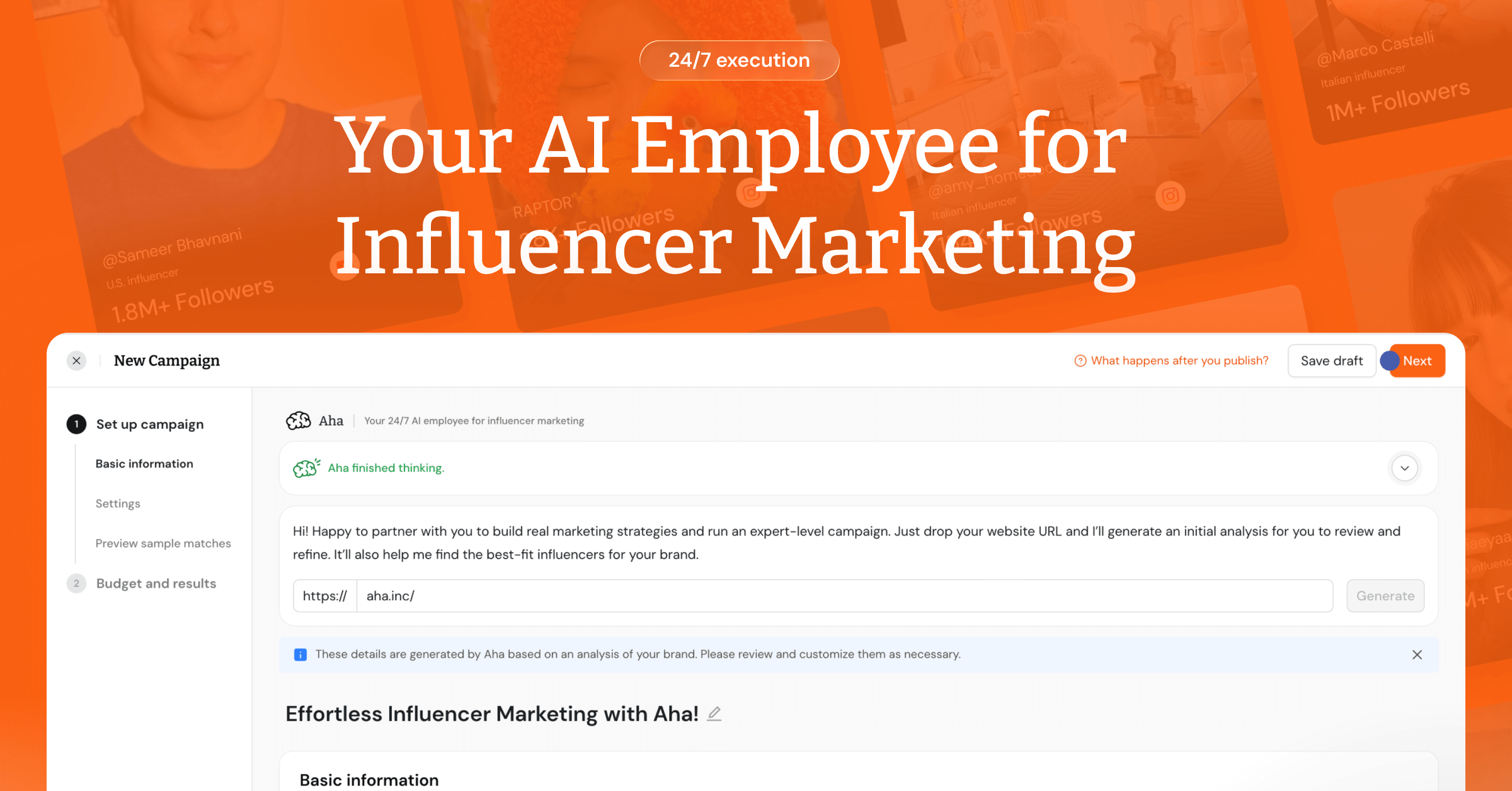
Aha operates as the world’s first dedicated AI employee for end-to-end influencer marketing, transforming traditional campaign workflows into an automated, intelligent system. Unlike conventional platforms that focus solely on discovery or analytics, Aha manages the complete lifecycle from initial brand analysis through influencer matching, outreach, negotiation, contract execution, content oversight, and real-time performance tracking. The platform positions itself specifically for AI-native companies and tech-driven organizations seeking to scale influencer collaborations without proportionally expanding internal marketing teams.
At its technical foundation, Aha deploys proprietary Large Language Models trained on millions of successful brand-influencer collaborations. These models analyze 237 behavioral dimensions to achieve semantic understanding of brand-creator alignment rather than relying on surface-level tag matching. The system operates continuously across a verified network exceeding five million creators spanning 140 countries and all major social platforms, automatically matching campaigns to optimal influencers based on audience demographics, content relevance, engagement authenticity, and historical performance patterns.
The platform distinguishes itself through comprehensive workflow automation covering traditionally labor-intensive tasks. AI agents handle personalized outreach messaging, conduct data-driven pricing negotiations grounded in market dynamics and creator performance history, generate legally binding contracts, monitor content production through multiple revision cycles, ensure delivery compliance via automated reminders and progress tracking, and provide influencer-level performance breakdowns including cost-per-click and cost-per-thousand-impressions metrics. Brand teams retain strategic oversight through centralized dashboards while AI executes operational tasks.
Key achievements and milestones
At TechCrunch Disrupt 2025 held in San Francisco from October 27-29, Aha demonstrated measurable superiority over human marketing teams through a live competitive challenge. The AI system defeated five professional marketing experts in executing influencer campaigns, validating its operational capabilities before a concentrated audience of technology investors and industry leaders. This public demonstration substantiated the platform’s claim of outperforming traditional approaches in speed, cost efficiency, and campaign precision.
Product Hunt launch metrics for Aha 2.0 in December 2025 reflected strong market reception with a five-star rating and rapid user adoption. The platform secured the number-one ranking on launch day, accumulating 94 upvotes and sustained positive commentary from early adopters. Community feedback highlighted reduced manual workload, accelerated campaign deployment, and improved creator-brand matching accuracy compared to legacy platforms and agency relationships.
By late 2025, Aha had established working partnerships with over 300 global brands, demonstrating traction across diverse verticals including artificial intelligence companies, digital-first enterprises, and technology startups. The client portfolio spans organizations pursuing influencer marketing at varying scales, from emerging ventures launching initial campaigns to established entities managing ongoing ambassador programs across multiple markets and platforms.
Documented case studies reveal quantifiable operational improvements. MetaGPT X Team reported achieving 1.4 times greater reach using equivalent budgets compared to previous agency relationships, while reducing cost-per-thousand-impressions from 132 dollars to 90 dollars on comparable YouTube campaigns. One client documented savings equivalent to five full-time employee salaries by transitioning influencer marketing execution to Aha’s AI agents. Another case study highlighted a conversion rate reaching 22.19 percent, substantially exceeding the one-to-three percent industry baseline for similar product categories.
Adoption statistics
The platform maintains a database of five million vetted influencer profiles continuously updated through automated screening systems that apply real-time risk detection algorithms and dynamic penalty mechanisms to filter low-quality accounts. This creator network extends across 140 countries and encompasses all major social platforms including YouTube, Instagram, TikTok, Facebook, LinkedIn, Twitter, and emerging regional networks, providing geographical and demographic diversity for campaign targeting.
Usage analytics from late 2025 indicate the platform processed campaigns generating billions of impressions and reaching millions of end users on behalf of advertising clients. Monthly growth trajectories demonstrate acceleration ranging from 50 to 96 percent month-over-month in customer acquisition and campaign volume, reflecting expanding market awareness and positive customer retention patterns among early adopters.
Operational efficiency metrics distinguish Aha from traditional approaches. Campaign planning that typically consumes one to two days through manual strategy development completes in under five minutes when AI analyzes brand positioning, audience profiling, channel selection, and budget optimization. Influencer matching that would require human teams reviewing approximately 500 profiles daily scales to scanning five million options and delivering precisely aligned recommendations within hours. Contract negotiation cycles that traditionally extend over weeks compress into days through automated outreach, pricing algorithms, and digital agreement execution.
The platform achieves 85 percent matching accuracy by analyzing semantic content relationships, audience sentiment patterns, and predictive engagement models rather than relying exclusively on follower counts or historical click data. This precision reduces wasted outreach to misaligned creators and improves campaign return on investment by concentrating resources on partnerships with genuine audience fit. Delivery assurance systems maintain 100 percent publication guarantees backed by escrow payment protection and automated progress monitoring throughout content production cycles.
2. Impact and Evidence
Client success stories
MetaGPT X Team leveraged Aha to overcome persistent challenges with traditional agency relationships that delivered limited shortlists and unpredictable collaboration outcomes. Previous agency engagements typically surfaced seven-to-eight potential creators but yielded only three-to-four actual partnerships after extensive negotiation. Aha delivered ready-to-collaborate influencers from initial matching, eliminating unproductive screening phases. On comparable YouTube campaigns, the team documented cost-per-thousand-impressions decreasing from 132 dollars to 90 dollars while maintaining equivalent audience quality and engagement benchmarks. This 32 percent cost reduction translated to 1.4 times expanded reach using identical budget allocations, demonstrating measurable efficiency gains from AI-powered matching and negotiation.
Shakker AI, operating in the competitive digital content creation sector, utilized Aha to accelerate campaign deployment and maintain content quality consistency across multiple influencer partnerships. The marketing team reported that influencer-delivered content quality exceeded expectations, enabling completely hands-off creative oversight without compromising brand guidelines or messaging coherence. This outcome proved particularly valuable for resource-constrained teams where content review and revision cycles typically consume significant personnel time. Shakker documented time savings equivalent to five person-hours per campaign compared to internal execution methods, alongside cost reductions reaching two-to-three times previous spending levels. The efficiency improvements freed internal teams to focus on product development and strategic initiatives rather than operational campaign management.
Fantasia Bedroom Stories, an early-stage startup, faced typical founder challenges of limited marketing expertise and competing priorities for time allocation. The company required influencer marketing capabilities without resources to build dedicated teams or engage expensive agencies. By deploying Aha as an AI marketing employee, Fantasia eliminated the need to recruit and onboard five new marketing hires, saving both salary expenditures and management overhead. Founders regained time previously consumed by campaign coordination and creator communications, redirecting focus toward product development and core business operations. The case demonstrates Aha’s value proposition for resource-constrained organizations seeking professional marketing execution without proportional team expansion.
Anonymous client testimonials published in case study materials highlight recurring themes of efficiency gains, cost transparency superior to agency models, and campaign results exceeding performance benchmarks. One manufacturing client noted that while their previous agency required substantial advance payment with uncertain deliverables, Aha’s escrow payment model provided confidence that funds released only upon verified content delivery. Another technology company emphasized that automated matching eliminated weeks of back-and-forth negotiations, transforming influencer partnerships from protracted procurement exercises into streamlined operational processes.
Performance metrics and benchmarks
Documented campaign outcomes demonstrate conversion rates reaching 22.19 percent in specific implementations, substantially exceeding industry benchmarks. Standard e-commerce conversion rates from influencer traffic typically range between one and three percent, making the 22.19 percent achievement represent seven-to-twenty-two times baseline performance. While individual results vary based on product category, pricing strategy, and audience targeting, the documented case validates Aha’s capability to facilitate high-converting influencer partnerships when brand-creator alignment and audience relevance reach optimal levels.
Cost efficiency comparisons reveal average cost-per-thousand-impressions reductions of 1.5 times compared to traditional agency relationships and manual campaign management. Specific examples include YouTube campaign CPM decreasing from 132 dollars to 90 dollars (32 percent reduction) when migrating from agency execution to Aha automation. The platform’s AI negotiation algorithms analyze historical creator performance data, current market supply-demand dynamics, and audience quality indicators to establish fair pricing that balances creator compensation with advertiser return on investment.
Time savings metrics indicate campaign deployment accelerating from months to weeks or days through end-to-end automation. Brand strategy development that typically requires one-to-two days of manual analysis completes in under five minutes when AI processes website content, competitive positioning, and target market characteristics. Influencer discovery and matching that might consume 40-80 hours of human research time across multiple platforms compresses into hours as algorithms scan millions of profiles applying multidimensional relevance scoring. Contract negotiation and execution cycles that traditionally span weeks conclude in days through automated outreach sequencing, dynamic pricing proposals, and digital signature workflows.
Efficiency multipliers documented in client testimonials include five-to-ten times faster campaign cycles, workload reductions equivalent to five full-time employees, and manual screening time savings reaching 70 percent. One client reported that human team capacity to review approximately 500 potential influencers daily expanded to Aha scanning five million profiles and delivering optimized matches within one hour, representing a 100,000 times wider reach in the discovery phase.
Matching accuracy of 85 percent, achieved through semantic content analysis and LLM-powered fit prediction, translates to higher campaign success rates by reducing partnerships with misaligned creators whose audiences lack genuine interest in promoted products. Traditional keyword-based or demographic matching often produces 50-60 percent false-positive rates where surface-level alignment masks deeper incompatibilities in content style, audience expectations, or brand values.
Third-party validations
TechCrunch coverage in October 2025 positioned Aha prominently within influencer marketing’s evolution toward AI-driven automation. Articles highlighted that influencer marketing was projected to exceed 30 billion dollars in 2025, creating substantial market opportunities for platforms delivering efficiency improvements, cost reductions, and performance optimization. TechCrunch’s editorial assessment concluded that Aha’s AI-first approach addressed critical industry pain points including resource integration difficulties, inaccurate strategy development, and campaign execution delays that frustrate brands attempting to scale influencer partnerships.
Product Hunt’s community validation through five-star ratings and number-one launch day ranking reflects positive reception among early adopters, particularly technology-focused organizations familiar with AI capabilities and comfortable delegating operational workflows to intelligent systems. User comments emphasized practical benefits including time savings, improved creator quality, and transparent pricing compared to opaque agency fee structures.
Industry analyst projections from multiple research firms estimate the global influencer marketing platform market expanding from approximately 23.59 billion dollars in 2025 to 70.86 billion dollars by 2032, representing a 17 percent compound annual growth rate. This substantial market expansion creates favorable conditions for platforms offering differentiated capabilities. Within this landscape, AI integration emerges as a dominant trend, with 66.4 percent of marketers reporting improved campaign outcomes when leveraging AI tools for influencer identification, content optimization, and performance analytics.
Research published by Influencer Marketing Hub indicates average return on investment from influencer campaigns reaches 5.78 dollars for every dollar spent, with leading implementations achieving six-to-ten times returns when attribution systems accurately track conversions. These industry benchmarks provide context for evaluating Aha’s documented case studies showing 22.19 percent conversion rates and 1.4 times expanded reach on equivalent budgets.
Competitive analysis from platforms including AspireIQ, Upfluence, CreatorIQ, and Klear reveals that traditional influencer marketing tools typically focus on single workflow segments such as discovery databases, campaign management interfaces, or analytics dashboards. Aha’s differentiation emerges through comprehensive end-to-end automation spanning strategic planning, AI-powered matching, automated negotiation, contract execution, content oversight, and real-time optimization within a unified platform operated by AI agents rather than requiring human coordination of discrete tools.
3. Technical Blueprint
System architecture overview
Aha’s architecture centers on proprietary Large Language Models trained specifically on influencer marketing workflows using datasets comprising millions of historical brand-creator collaborations. These specialized LLMs differ fundamentally from general-purpose AI models by encoding domain expertise in campaign strategy, audience psychology, content performance patterns, negotiation dynamics, and platform-specific engagement behaviors. The training process incorporated successful campaign examples spanning diverse industries, geographical markets, content formats, and platform ecosystems to develop generalizable intelligence applicable to novel campaign requirements.
The matching engine operates as a continuous background process that scans five million creator profiles applying 237 behavioral dimensions to each candidate evaluation. Unlike tag-based classification systems that categorize influencers through manually assigned keywords, Aha’s semantic analysis examines content meaning, audience sentiment expressed in comments and engagement patterns, historical collaboration performance across different brand partnerships, and contextual fit between creator values and brand positioning. This multidimensional assessment produces relevance scores predicting collaboration success probability rather than simple demographic overlap metrics.
Real-time risk detection algorithms continuously monitor creator profiles for authenticity indicators including follower growth patterns, engagement rate anomalies, audience quality signals, and content consistency markers. Automated penalty systems flag suspicious accounts exhibiting characteristics associated with fake follower purchases, engagement pods, or fraudulent metrics manipulation. This proactive screening reduces brand exposure to partnerships that generate superficial visibility without genuine audience influence or conversion potential.
The pricing negotiation system analyzes multiple market factors including individual creator historical performance data, comparable influencer rate benchmarks segmented by follower count and engagement quality, current supply-demand dynamics within specific content niches, seasonal fluctuations affecting creator availability, and brand budget constraints. AI agents generate pricing proposals optimized for fairness to both creators and advertisers, eliminating negotiation friction that traditionally extends deal closure timelines.
Contract generation automation produces legally binding agreements incorporating campaign-specific deliverables, content usage rights, disclosure requirements for sponsored content compliance, payment terms aligned with escrow protection protocols, revision allowances, and publication timelines. Digital signature workflows eliminate manual document circulation while maintaining legal enforceability and creating audit trails for compliance documentation.
Content oversight systems track production progress through automated milestone monitoring, trigger reminder notifications when deliverables approach deadline thresholds, facilitate multi-round revision cycles through structured feedback interfaces, and verify final content against campaign briefs before triggering payment release from escrow accounts. This comprehensive monitoring maintains quality standards and delivery commitments without requiring manual project management.
API and SDK integrations
While specific technical documentation regarding API endpoints and SDK libraries was not extensively detailed in available materials, Aha’s architecture necessarily incorporates integrations with major social media platforms to access creator profile data, content performance metrics, audience demographics, and engagement analytics. The platform’s capability to scan five million creators across 140 countries and multiple social networks implies data connections to YouTube, Instagram, TikTok, Facebook, LinkedIn, Twitter, and regional platforms through their respective developer APIs where available.
E-commerce integration capabilities enable performance tracking from influencer-generated traffic through conversion funnel completion. This requires connection to platforms such as Shopify, WooCommerce, or custom web analytics systems to attribute sales, leads, or other conversion events to specific influencer partnerships. Such attribution provides the quantitative foundation for ROI calculations and ongoing campaign optimization decisions.
Payment processing infrastructure connects to escrow service providers managing fund custody between deposit, deal confirmation, content delivery verification, and release upon approval. The escrow mechanism protects both brands and creators by ensuring payment only transfers when contractual obligations are fulfilled, reducing financial risk compared to advance payment models or post-campaign payment arrangements vulnerable to disputes.
Customer relationship management system compatibility would logically support enterprise implementations where marketing teams coordinate influencer campaigns alongside other demand generation activities. CRM integration enables unified view of customer acquisition costs, lead quality from different channels, and lifetime value analysis comparing influencer-sourced customers to other acquisition methods.
Scalability and reliability data
The platform’s architecture demonstrates scalability through its capacity to simultaneously process campaigns for 300-plus brands while maintaining five million creator profiles under continuous evaluation. This operational scale implies robust infrastructure capable of handling substantial data processing volumes, API request loads to external platforms, AI model inference operations for matching and optimization algorithms, and user interface responsiveness as teams monitor campaign performance.
Campaign deployment timelines compressing from months to weeks or days despite increased complexity and creator network size validates the system’s ability to handle workflow automation at scale. The contrast between human teams managing campaigns sequentially due to coordination bottlenecks versus AI agents orchestrating parallel processes across matching, outreach, negotiation, and monitoring exemplifies scalability advantages inherent to automated systems.
Reliability manifests through delivery guarantee mechanisms providing 100 percent assurance that confirmed influencer partnerships result in published content meeting campaign specifications. This commitment implies redundancy systems, escalation protocols for addressing creator non-performance, and financial protections through escrow arrangements ensuring brands receive deliverables proportional to budget allocations.
Uptime and service level agreement specifications were not explicitly documented in reviewed materials. As a cloud-based SaaS platform, Aha presumably maintains standard industry practices including geographically distributed infrastructure, automated failover systems, regular backup protocols, and security monitoring. However, specific metrics such as guaranteed uptime percentages, maximum tolerable downtime windows, or incident response timeframes were not publicly detailed.
4. Trust and Governance
Security certifications
Aha.io, the parent company known for product development software, maintains ISO 27001 certification issued by A-LIGN Compliance and Security Inc. This certification demonstrates establishment of an Information Security Management System conforming to international standards for systematic risk assessment, security control implementation, and ongoing compliance monitoring. The certification scope encompasses cloud-based software infrastructure, organizational processes supporting service delivery, and data handling procedures across customer information lifecycle.
The ISO 27001 certification, originally obtained in August 2016 and recertified in August 2025 with validity through August 2028, validates that independent auditors verified security controls operate as documented and address relevant threat scenarios. The Statement of Applicability version 4.1 published in April 2025 details specific control implementations tailored to the organization’s risk profile and service delivery model.
For Aha’s influencer marketing platform specifically, security architecture inherits from enterprise-grade foundations including encryption of all communications between customers and data centers using strong Transport Layer Security protocols, encryption of all stored data using AES-256 algorithms, dedicated firewall services blocking unauthorized infrastructure access, and strict access control systems limiting employee data access to support requirements. These technical safeguards protect brand campaign information, creator personal details, financial transaction data, and performance analytics from unauthorized disclosure or tampering.
Data privacy measures
General Data Protection Regulation compliance ensures appropriate handling of personal data for individuals in the European Union, addressing lawful processing bases, data subject rights including access and deletion requests, breach notification obligations, and cross-border transfer requirements. This compliance framework applies to creator personal information, brand employee details, and any end-user data collected through campaign measurement.
Infrastructure hosted on Amazon Web Services data centers, certified compliant with ISO/IEC 27001, 27017, and 27018 standards, provides additional assurance regarding physical security, environmental controls, and operational procedures at the infrastructure layer. AWS’s certifications demonstrate adherence to cloud-specific security guidance and protection of personally identifiable information in cloud processing environments.
Payment processing through third-party vendor Recurly, certified PCI-DSS Level 1 compliant as a merchant service provider, segregates sensitive financial data from core application infrastructure. This separation reduces Aha’s direct exposure to payment card data while ensuring industry-mandated security controls govern financial transactions.
California Consumer Privacy Act compliance addresses data handling requirements for California residents, including transparency about data collection practices, consumer rights to know what information businesses hold, rights to request deletion, and prohibitions on discriminatory treatment based on privacy right exercises. This regulatory compliance supplements GDPR obligations and demonstrates commitment to privacy protection across major regulatory jurisdictions.
Regulatory compliance details
Escrow payment protection mechanisms align with consumer protection principles by establishing neutral custodial arrangements where campaign funds transfer to influencers only upon verified content delivery meeting specified quality standards. Brands deposit budgets into escrow accounts managed by the platform, which locks funds when influencers confirm participation, withholds payment during content production and review cycles, and releases payment ten days after final delivery approval. Unused funds remain refundable to brands with 100 percent guarantee, eliminating risk of paying for undelivered work or substandard content.
This payment structure addresses historical influencer marketing challenges including advance payment risks where creators fail to deliver after receiving compensation, post-campaign payment disputes where influencers claim non-payment despite completing work, and quality disagreements requiring objective verification mechanisms. Escrow arrangements with defined release triggers provide both parties contractual clarity and financial protection.
Automated contract generation incorporating disclosure requirements ensures campaigns comply with Federal Trade Commission guidelines requiring clear sponsorship disclosure in influencer content. Platform-generated agreements include mandatory language addressing material connection disclosure, content labeling standards, and platform-specific disclosure mechanisms aligned with FTC guidance documents. This automation reduces brands’ compliance burden while protecting against regulatory enforcement actions resulting from inadequate disclosure practices.
Content verification workflows that cross-check submissions against campaign briefs and brand guidelines before approving payment release help ensure published material maintains brand safety standards, avoids prohibited claims or representations, and delivers contracted creative specifications. Multi-round revision protocols provide structured processes for addressing content issues before publication rather than post-launch damage control.
5. Unique Capabilities
Semantic Matching Engine: Applied use case
Traditional influencer discovery platforms rely predominantly on demographic filters allowing brands to search by follower count ranges, geographic locations, age brackets, gender distributions, and interest categories derived from manual tags or automated keyword extraction. While these approaches surface candidates meeting basic criteria, they frequently produce high false-positive rates where influencers matching surface-level parameters prove misaligned in content style, audience expectations, brand values, or engagement authenticity.
Aha’s semantic matching engine transcends tag-based classification through Large Language Model analysis of content meaning rather than surface keywords. When evaluating fitness content creators, for example, the system distinguishes between influencers focused on bodybuilding versus yoga versus running versus nutrition despite all occupying the broad “fitness” category. This granular semantic understanding enables matching a supplement brand targeting serious weightlifters with appropriate bodybuilding creators rather than generic fitness influencers whose audiences pursue different training philosophies.
The 237 behavioral dimensions analyzed for each creator profile extend beyond content topics to examine audience sentiment patterns expressed through comment language and engagement behaviors, creator authenticity signals including consistency between stated values and promoted products, content quality indicators such as production value and narrative coherence, and historical performance metrics showing conversion effectiveness across past partnerships. This multidimensional assessment produces holistic fit scores predicting collaboration success probability.
Applied to practical campaign scenarios, the semantic engine prevented a hypothetical skincare brand from partnering with beauty influencers whose audiences predominantly seek makeup tutorials rather than skincare education, despite both categories appearing within “beauty” classifications. The system identified that while makeup-focused creators possessed relevant follower counts and engagement rates, their audience sentiment analysis revealed minimal interest in skincare content based on comment themes and engagement patterns on previous skincare mentions. Alternative creators with smaller followings but audiences actively discussing skin health and ingredient research generated superior campaign performance.
Multi-Agent Coordination: Research references
The platform architecture deploys multiple specialized AI agents coordinating distinct workflow segments rather than single monolithic automation. Separate agents handle campaign strategy formulation, influencer discovery and matching, outreach message personalization, pricing negotiation, contract generation, content review and feedback, delivery monitoring and reminders, performance analytics, and optimization recommendations. This multi-agent structure enables parallel processing where different campaign phases advance simultaneously rather than sequential workflows bottlenecked by single-threading.
Research literature on multi-agent systems emphasizes coordination mechanisms, communication protocols, task allocation strategies, and conflict resolution procedures enabling autonomous agents to collaborate toward shared objectives. Applied to influencer marketing, coordination ensures that matching agents identify optimal creators whose availability aligns with campaign timelines, that negotiation agents propose pricing within budget constraints established by strategy agents, that contract agents incorporate deliverable specifications defined through matching criteria, and that content review agents apply quality standards consistent with brand guidelines automated into campaign briefs.
The continuous operation model where matching processes run 24/7 until campaigns manually pause exemplifies autonomous agent behavior operating without constant human supervision. Rather than requiring marketing team members to schedule daily discovery sessions, agents persistently scan creator networks for emerging candidates matching campaign parameters, evaluate new profile data as creators publish content and accumulate engagement metrics, and surface recommendations as higher-quality matches become available throughout campaign lifecycles.
Performance feedback loops connect analytics agents tracking campaign metrics back to matching and negotiation agents, enabling dynamic optimization. When specific creator segments demonstrate superior conversion rates or engagement patterns, matching algorithms adjust weighting factors favoring similar profiles in future recommendations. When pricing negotiations reveal market rate shifts, negotiation agents update offer structures to maintain competitiveness. This adaptive learning mirrors human expertise accumulation but operates at computational speed across millions of data points.
Escrow Protection System: Uptime and SLA figures
The escrow payment architecture provides financial security through three-party arrangement where platform custodies brand funds until objective delivery criteria are satisfied. This arrangement fundamentally differs from direct brand-creator transactions vulnerable to payment disputes, advance payment defaults, or quality disagreements lacking neutral verification mechanisms. By interposing escrow accounts with defined release triggers, the platform reduces counterparty risk for both transaction participants.
Operational flow proceeds through defined stages: brands deposit campaign budgets into escrow accounts managed by the platform, funds remain liquid until influencers confirm partnership participation, confirmation triggers fund locking that reserves amounts for specific creator deliverables, creators produce content under monitoring by delivery tracking systems, brands review submissions and request revisions through structured feedback interfaces, approval triggers ten-day holding period before final release, and funds transfer to creator accounts upon successful completion or refund to brand accounts if deliverables fail to materialize.
The 100 percent refund guarantee for undelivered work or substandard content meeting objective disqualification criteria provides brands financial protection against common influencer marketing risks. Historical challenges in the space include creators accepting payment but failing to produce content, published content substantially deviating from agreed creative briefs, undisclosed material changes to creator circumstances affecting audience reach or brand alignment, and engagement fraud discovered after campaign completion. Escrow arrangements with verification requirements address these scenarios through holding funds until contractual obligations demonstrably fulfill.
Specific uptime statistics, service level agreements guaranteeing payment processing availability, maximum acceptable downtime windows, or incident response time commitments were not explicitly documented in reviewed materials. As financial infrastructure underlying campaign transactions, escrow systems require high reliability to prevent payment delays frustrating creators, fund release errors causing financial losses, or system outages blocking campaign launches. Standard financial technology practices would suggest 99.9 percent or higher uptime targets, redundant processing capabilities, and rapid incident resolution, though formal SLA publication was not identified.
Interactive Dashboard: User satisfaction data
Centralized dashboards provide brand teams real-time visibility into campaign status, influencer progress, content submissions, performance metrics, and budget utilization without requiring manual status updates or coordination meetings. This transparency contrasts with traditional agency relationships where campaign visibility depends on periodic reports often delayed by data consolidation requirements and prepared at weekly or monthly intervals.
The dashboard surfaces influencer-level performance breakdowns including individual creator metrics such as content views, engagement rates, click-through percentages, and attributed conversions. Cost metrics display per-influencer spending alongside efficiency indicators including cost-per-click and cost-per-thousand-impressions, enabling granular analysis of which partnerships deliver optimal return on investment. This transparency facilitates data-driven decisions about extending high-performing partnerships, adjusting underperforming collaborations, or reallocating budget toward efficient channels.
Approval workflows integrated into dashboard interfaces streamline content review cycles by presenting submissions alongside campaign briefs, enabling side-by-side comparison, supporting structured feedback submission, and tracking revision rounds. This replaces fragmented communication across email threads, messaging platforms, or file-sharing services where version control and approval status become ambiguous.
Budget tracking displays real-time expenditure against allocated amounts, forecasts remaining runway based on confirmed partnerships and pending negotiations, and highlights upcoming payment obligations tied to content delivery schedules. This financial visibility supports proactive budget management and prevents surprise overruns that historically plague campaigns where spend tracking lags actual commitment formation.
Specific user satisfaction metrics, net promoter scores, feature usage statistics, or comparative satisfaction ratings versus competitor platforms were not quantitatively detailed in reviewed materials. Qualitative testimonials referenced dashboard transparency as valuable improvement over agency opacity and praised campaign control visibility, suggesting positive user reception though formal satisfaction surveys were not documented.
6. Adoption Pathways
Integration workflow
Organizations initiate adoption by requesting platform demonstrations showcasing core functionality including AI-powered campaign planning, influencer matching algorithms, automated negotiation workflows, and performance tracking dashboards. Demonstration sessions typically walk prospects through representative campaign scenarios relevant to their industry vertical, highlighting how the system would analyze their specific brand positioning, identify appropriate creator segments, and manage campaign execution end-to-end.
Following demonstration approval, organizations connect relevant data sources enabling the AI to build comprehensive brand understanding. This includes providing website URLs for the system to analyze product offerings, value propositions, competitive positioning, and target audience signals. Marketing teams may supply additional context about campaign objectives, budget parameters, geographic priorities, platform preferences, and creative guidelines informing AI agent behavior.
Account setup establishes brand wallet functionality where campaign budgets deposit into escrow accounts managed by the platform. Funds remain under brand control until specific influencer partnerships confirm, at which point amounts lock in escrow pending content delivery verification. This financial infrastructure enables transparent payment tracking and automatic fund release based on objective completion criteria.
Campaign creation workflows guide users through defining objectives, target audiences, geographic reach, platform selection, and budget allocation. The AI analyzes inputs to generate comprehensive campaign strategies including recommended influencer tier mixes, content format specifications, publication timeline proposals, and projected performance outcomes. Users review AI-generated strategies and approve launch or request modifications aligning with organizational priorities.
Once campaigns activate, the platform’s AI agents execute operational workflows including influencer discovery across the five-million-creator network, personalized outreach to matched candidates, pricing negotiation grounded in market data and creator performance history, contract generation incorporating campaign specifications, and content production monitoring through delivery tracking systems. Brand teams oversee progress through dashboard interfaces, review content submissions, provide feedback during revision cycles, and approve final deliverables triggering payment release.
Customization options
Campaign strategies accommodate customization across multiple dimensions including target audience demographic specifications, geographic market prioritization, social platform selection based on where target audiences concentrate attention, content format preferences ranging from static images to video to live streaming, publication timing aligned with product launches or seasonal campaigns, and budget allocation across influencer tiers balancing reach-maximizing macro partnerships with conversion-optimized micro collaborations.
Brand guideline documentation uploaded during account setup informs content oversight protocols ensuring influencer-created material maintains visual identity consistency, messaging alignment with corporate values, appropriate tone matching brand personality, and compliance with legal or regulatory constraints specific to industry verticals. Automated content verification cross-checks submissions against documented guidelines before recommending approval.
Influencer selection criteria can incorporate custom parameters beyond AI-recommended matches, enabling brands to specify required characteristics such as creator values alignment with sustainability commitments, diversity and inclusion priorities in creator roster composition, geographic restrictions avoiding controversial markets, or platform exclusions based on audience demographics. The system applies these constraints during matching processes while maintaining optimization toward campaign performance objectives.
Approval workflow customization supports organizational governance requirements by defining which team members authorize different decision types, establishing multi-level review requirements for high-budget partnerships, requiring legal counsel sign-off on contract modifications, or implementing compliance checks before content publication in regulated industries.
Reporting customization enables stakeholders to configure dashboard views emphasizing metrics aligned with their roles and responsibilities. Executives may prioritize aggregate campaign ROI and budget efficiency, while content managers focus on creative quality scores and brand guideline adherence, and performance marketers analyze conversion attribution and channel efficiency.
Onboarding and support channels
The platform provides educational resources through Aha University offering tutorials covering fundamental concepts, workflow demonstrations, best practice guidance, and advanced optimization techniques. These self-service learning materials enable new users to develop proficiency systematically rather than through trial-and-error experimentation or dependency on live support availability.
Customer success teams staffed by influencer marketing specialists provide implementation assistance, strategic consultation, and technical troubleshooting. Success managers guide organizations through initial campaign setup, offer recommendations optimizing matching criteria and budget allocation, review performance data identifying improvement opportunities, and address questions as teams develop operational familiarity.
Documentation resources including knowledge base articles, frequently asked questions compilations, video walkthroughs, and process guides support just-in-time learning when users encounter specific workflow questions or need clarification on feature functionality. Searchable documentation reduces support ticket volume by enabling self-service problem resolution for common scenarios.
For enterprises requiring structured rollout assistance, the company offers concierge onboarding programs delivering personalized procurement support, customized account configuration, professional team training sessions, and dedicated implementation guidance over four-to-eight-week periods. These programs proved beneficial for large organizations with complex approval processes, multiple stakeholder constituencies requiring coordination, or regulatory compliance requirements necessitating careful system configuration.
Community forums and user networks facilitate peer-to-peer knowledge sharing where experienced practitioners offer implementation advice, share campaign strategy insights, and discuss optimization techniques discovered through operational experience. Community engagement supplements official support channels while fostering user investment in platform ecosystem success.
7. Use Case Portfolio
Enterprise implementations
Large technology corporations pursuing influencer marketing at scale leverage Aha to coordinate campaigns across multiple product lines, geographic markets, and social platforms simultaneously. The platform’s capacity to manage hundreds of concurrent influencer partnerships addresses enterprise challenges where traditional agency relationships struggle to scale coordination efficiently. Centralized budget oversight, unified performance reporting, and standardized contract terms reduce administrative overhead while maintaining governance compliance.
E-commerce brands in direct-to-consumer categories utilize the platform’s conversion tracking capabilities to attribute sales directly to influencer traffic sources. Integration with Shopify, WooCommerce, and custom storefronts enables precise measurement of influencer-driven revenue, customer acquisition costs, and lifetime value analysis. Performance data informs ongoing optimization including doubling budget allocations toward high-converting creators, pausing underperforming partnerships, and adjusting content strategies based on conversion funnel analysis.
Software-as-a-service companies targeting business customers deploy influencer marketing through Aha to generate qualified leads, demonstrate product capabilities through creator testimonials, and build thought leadership positioning. Enterprise software sales cycles requiring multiple touchpoints and educational content benefit from sustained influencer partnerships producing ongoing content series rather than one-time promotional posts. The platform’s ambassador program management capabilities support long-term creator relationships with recurring deliverables and performance incentives.
Consumer packaged goods manufacturers use the platform to orchestrate product sampling campaigns where creators receive free products in exchange for authentic review content. Automated shipping coordination, content production monitoring, and deliverable verification streamline logistics that traditionally require dedicated campaign coordinators. Performance analytics identify which creator segments drive highest consideration lift, purchase intent, and retail foot traffic for scaling successful partnerships.
Academic and research deployments
Research institutions studying influencer marketing effectiveness utilize the platform’s comprehensive data infrastructure and performance tracking capabilities to conduct controlled experiments comparing different campaign strategies, creator tier compositions, content formats, and platform selections. Academic studies examining return on investment variability across influencer categories, audience authenticity impacts on conversion rates, or disclosure language effects on consumer trust benefit from access to large-scale campaign datasets with detailed performance metrics.
Marketing education programs incorporate platform case studies demonstrating modern campaign management workflows, AI-powered decision support applications, and performance measurement methodologies. Students gain exposure to commercial-grade tools and data-driven optimization practices reflective of contemporary digital marketing professional requirements. Classroom exercises simulate campaign planning, budget allocation decisions, and performance analysis using platform interfaces and anonymized campaign data.
Industry working groups and trade associations leverage aggregate platform data to develop benchmark reports, trend analyses, and best practice guides informing marketing strategy development across member organizations. Anonymized performance statistics spanning thousands of campaigns provide empirical foundation for guidance regarding appropriate influencer pricing levels, expected engagement rates by platform and content type, and typical conversion funnel performance from influencer traffic versus other acquisition channels.
ROI assessments
Documented conversion rate achievements reaching 22.19 percent compared to industry baselines of one-to-three percent represent seven-to-twenty-two times performance multipliers demonstrating exceptional ROI potential when optimal brand-creator alignment and audience targeting converge. While individual results vary substantially based on product characteristics, pricing strategies, creative execution quality, and competitive dynamics, the documented case validates platform capability to facilitate high-converting partnerships.
Cost efficiency gains including 32 percent reductions in cost-per-thousand-impressions and 1.5 times average CPM improvements directly enhance campaign profitability by delivering equivalent audience reach at lower cost or expanded reach within fixed budgets. MetaGPT’s experience reducing YouTube CPM from 132 to 90 dollars while maintaining comparable audience quality exemplifies tangible cost advantages translating to immediate margin improvement.
Time savings equivalent to five full-time employee salaries documented in Fantasia case study represent avoided labor costs potentially reallocated toward product development, customer service, or other value-generating activities. For resource-constrained startups where founder time constitutes precious capital, delegating campaign execution to AI employees preserves human attention for strategic decisions requiring judgment and creativity.
Campaign velocity improvements compressing execution timelines from months to weeks enable organizations to capitalize on market opportunities requiring rapid response including competitive product launches, trending topics demanding timely engagement, seasonal events with narrow activation windows, or crisis situations necessitating reputation management through positive content generation. Accelerated campaign deployment provides strategic flexibility impossible under traditional workflows requiring extensive manual coordination.
8. Balanced Analysis
Strengths with evidential support
End-to-end workflow automation distinguishes Aha from competitors focusing on discrete campaign segments. While platforms such as AspireIQ emphasize discovery and relationship management or Upfluence prioritizes analytics and reporting, Aha’s architecture automates strategic planning, matching, outreach, negotiation, contracting, monitoring, and optimization within unified AI agent orchestration. This comprehensive coverage eliminates workflow gaps requiring manual coordination across multiple tools or teams.
Semantic content understanding through Large Language Models trained specifically on influencer marketing contexts enables superior matching precision compared to keyword tagging or demographic filtering. The 85 percent matching accuracy achieved through analyzing 237 behavioral dimensions substantially reduces false-positive rates that plague tag-based systems. Clients reported marked quality improvements in recommended creator shortlists containing genuinely aligned partners rather than superficially relevant profiles requiring extensive manual vetting.
Escrow payment protection addressing historical industry pain points including advance payment defaults, quality disputes, and non-delivery risks provides financial security attractive to budget-conscious brands and risk-averse organizations. The 100 percent refund guarantee for undelivered work differentiates Aha from platforms and agencies requiring upfront payment without performance assurance. This risk mitigation particularly benefits first-time influencer marketing adopters hesitant to commit substantial budgets without outcome certainty.
Transparent pricing eliminating hidden agency fees, ambiguous markups, and opaque cost structures appeals to organizations seeking predictable campaign economics. The ten percent platform fee on confirmed deals provides clear cost visibility enabling accurate budget forecasting. Comparison testimonials highlighted that traditional agencies often charged 25-40 percent markups obscured within bundled service fees, making Aha’s explicit pricing structure advantageous for cost-conscious buyers.
Campaign velocity improvements documented through metrics including five-minute strategy generation versus one-to-two days manual development, hours for matching completion versus weeks of human research, and days for negotiation closure versus weeks of back-and-forth communications demonstrate quantifiable efficiency gains. These time savings translate to competitive advantages in dynamic markets requiring rapid campaign deployment.
Proven performance outcomes including documented conversion rates reaching 22.19 percent, cost-per-thousand-impressions reductions of 32 percent, and workload savings equivalent to five full-time employees provide empirical validation beyond theoretical capability claims. Client testimonials corroborating efficiency gains, cost improvements, and quality enhancements establish credible evidence supporting value proposition assertions.
Limitations and mitigation strategies
Platform dependency creates organizational vulnerability where campaign execution capability relies entirely on single vendor’s system availability, feature development roadmap, and business continuity. Unlike diversified approaches distributing influencer relationships across direct partnerships, multiple agencies, and various platforms, centralizing operations on Aha concentrates risk. Mitigation strategies include maintaining direct relationships with top-performing creators enabling campaign execution independent of platform, exporting performance data regularly for preservation outside platform systems, and developing contingency partnerships with traditional agencies providing backup execution capacity.
AI decision transparency limitations inherent to Large Language Model architectures mean brands cannot fully audit reasoning processes underlying influencer recommendations, pricing suggestions, or optimization proposals. While the system explains decisions through relevance scores and performance predictions, the underlying neural network computations resist complete human interpretation. Mitigation approaches include validating AI recommendations through independent market research, conducting A/B tests comparing AI-optimized strategies against human-designed alternatives, and maintaining human oversight over high-stakes decisions such as major budget allocations or brand partnerships with reputational implications.
Limited customization compared to bespoke agency services may constrain brands with highly specialized requirements, complex legal constraints, or unique creative visions resisting standardization. The platform’s automation benefits derive partly from systematizing workflows and applying generalized best practices, potentially limiting accommodation of idiosyncratic brand needs. Organizations requiring extensive customization may benefit from hybrid approaches combining platform automation for routine campaigns with agency partnerships for flagship initiatives demanding intensive creative development or intricate stakeholder coordination.
Market concentration risks emerge as platform adoption scales and substantial creator populations concentrate within managed networks. If large portions of relevant influencer inventory exclusively engage through single platform, brand negotiation leverage may decline as creators standardize pricing expectations and contract terms across platform-mediated partnerships. Monitoring market structure evolution and maintaining diverse creator relationship channels can preserve competitive sourcing options.
Data privacy considerations require careful attention regarding what brand information, customer data, and performance insights organizations share through platform infrastructure. While the company maintains security certifications and compliance frameworks, brands remain ultimately responsible for ensuring appropriate data handling especially regarding customer personal information potentially exposed through conversion tracking integrations. Privacy impact assessments, data processing agreements clarifying responsibility boundaries, and minimizing unnecessary data sharing mitigate regulatory compliance risks.
Learning curve investments necessary for teams transitioning from manual workflows or traditional agency partnerships to AI-powered automation may initially slow productivity as users develop new operating models. Training programs, change management initiatives emphasizing automation benefits, and phased rollouts limiting initial campaign complexity can ease transitions and accelerate proficiency development.
Creator relationship depth potentially suffers compared to intensive human-managed partnerships where dedicated account managers nurture long-term collaborations, provide strategic consultation beyond transactional deliverable exchange, and develop personal rapport strengthening loyalty. AI-mediated interactions emphasizing efficiency may sacrifice relationship-building opportunities valuable for sustained ambassador programs. Hybrid models combining platform automation for discovery and contracting with human relationship management for key strategic creators can balance efficiency and depth.
9. Transparent Pricing
Plan tiers and cost breakdown
Aha employs usage-based pricing rather than subscription tiers, fundamentally differentiating its model from traditional SaaS platforms charging monthly or annual fees regardless of actual campaign activity. Brands deposit funds into secure wallet accounts held in escrow rather than committing to recurring subscription costs. This structure aligns expenses directly with campaign execution, eliminating fixed costs during periods without active initiatives.
The core pricing components include creator compensation negotiated individually based on follower count, engagement rates, content format requirements, exclusivity terms, and usage rights, and the platform service fee calculated as ten percent of negotiated creator rates. For example, if an influencer partnership involves 3,000 dollars in creator compensation, the total campaign cost equals 3,300 dollars comprising the 3,000 dollar creator payment plus 300 dollars platform fee.
No subscription charges, setup fees, monthly minimums, or hidden costs beyond the ten percent service fee apply under standard arrangements. This transparent structure contrasts with agency models often incorporating monthly retainers, campaign management percentages, creative development surcharges, and reporting fees that collectively inflate total costs by 25-50 percent above direct creator payments.
Deposit mechanics function through brands transferring funds into escrow accounts where they remain under brand control until specific influencer partnerships confirm. Upon creator acceptance of partnership terms, relevant amounts lock in escrow but do not immediately transfer. Following content delivery and brand approval, a ten-day verification period precedes final fund release to creator accounts. Unused funds remain refundable to brands at any time with 100 percent guarantee, eliminating risk of capital trapped in unused balances.
Custom enterprise arrangements may involve dedicated account management, priority support, volume discounts, or specialized compliance features negotiated based on anticipated spending levels and organizational requirements. While standard pricing applies transparently to individual campaigns, large organizations deploying influencer marketing at scale may benefit from structured partnership discussions addressing unique operational or governance needs.
Total Cost of Ownership projections
Comprehensive cost analysis requires accounting for both direct platform expenses and indirect organizational investments including personnel time for campaign oversight and approval workflows, creative brief development establishing content guidelines and brand messaging, performance data analysis interpreting campaign results and identifying optimization opportunities, and vendor management coordinating with platform support teams and addressing operational questions.
Compared to traditional agency relationships, total cost of ownership typically reduces substantially despite agencies potentially negotiating marginally lower creator rates through established relationships. Agency fee structures commonly add 25-40 percent markups through retainers, project management charges, creative development fees, and reporting costs. Documented client experiences reported that Aha’s transparent ten percent platform fee combined with automated workflows eliminated 15-30 percentage points of cost compared to agency alternatives.
In-house execution alternatives require dedicated personnel including influencer marketing managers identifying and vetting creators, coordinators handling outreach and contract negotiations, content specialists reviewing deliverables and managing revisions, analysts tracking performance and generating reports, and legal advisors ensuring contract compliance and disclosure adequacy. Salary costs for specialized teams easily exceed 300,000-500,000 dollars annually before accounting for employee benefits, overhead allocation, and technology infrastructure. Aha’s model substitutes AI employees for multiple human roles, generating cost savings equivalent to three-to-five full-time salaries for mid-sized operations.
Technology infrastructure costs remain minimal given the cloud-based SaaS delivery model requiring only standard web browsers for access. No capital investments in servers, software licenses, or specialized hardware appear necessary. Integration expenses connecting marketing analytics platforms, e-commerce systems, or customer relationship management tools to campaign tracking workflows may involve implementation services though specifics were not documented.
Training investments supporting team onboarding and proficiency development vary based on organizational learning preferences. Self-service resources through Aha University minimize cost for teams comfortable with independent learning, while customized training programs and dedicated onboarding assistance available through enterprise packages represent incremental investments scaled to organizational complexity and support requirements.
Opportunity costs related to campaign velocity differences warrant consideration. Traditional workflows requiring months from strategy development through campaign completion delay market impact and potentially miss time-sensitive opportunities. Aha’s compressed timelines delivering campaigns in weeks enable faster market response, more frequent testing iterations, and reduced time-to-impact generating indirect value through accelerated learning and market adaptation.
10. Market Positioning
Competitor comparison table with analyst ratings
| Platform | Model Coverage | Pricing Structure | Automation Scope | Database Size | Key Differentiators |
|---|---|---|---|---|---|
| Aha | End-to-end AI automation across strategy, matching, outreach, negotiation, contracts, monitoring | 10% platform fee on creator payments; no subscriptions or hidden costs | Comprehensive workflow automation via AI agents | 5M+ vetted creators across 140 countries | Semantic LLM matching, escrow protection, 24/7 AI operation |
| AspireIQ | Discovery, relationship management, analytics | Custom enterprise pricing; typically subscription-based | Partial automation focused on management workflows | 1M+ influencers; strong e-commerce focus | Affiliate integration, long-term relationship tools |
| Upfluence | Discovery, campaign management, UGC capabilities | Subscription tiers starting ~$2000/month | Moderate automation for discovery and reporting | 4M+ influencers with e-commerce integration | Shopify integration, ambassador program features |
| CreatorIQ | Enterprise discovery, fraud detection, analytics | Custom enterprise pricing; high-end positioning | Limited automation; human-intensive workflows | 20M+ social profiles analyzed | Enterprise-scale analytics, brand safety focus |
| Klear | Discovery categorization, performance analytics | Subscription-based; mid-market positioning | Discovery automation; manual campaign management | Millions of profiles across 60,000 topics | Detailed topic categorization, Instagram specialization |
Analyst assessments from Influencer Marketing Hub’s 2025 Benchmark Report highlight AI integration as the dominant trend with 60.2 percent of marketers actively using AI for influencer identification and 66.4 percent reporting improved outcomes. This market shift favors platforms embedding AI deeply throughout workflows rather than treating automation as peripheral feature enhancement.
Competitive landscape analysis reveals most established platforms evolved from discovery databases or campaign management tools, subsequently adding adjacent capabilities through organic development or acquisitions. This historical architecture constrains comprehensive automation as legacy systems require manual handoffs between discovery, negotiation, contracting, and monitoring phases. Aha’s ground-up design for AI-native operation eliminates architectural debt enabling tighter integration and more complete automation.
Unique differentiators
Semantic content understanding via Large Language Models trained specifically on influencer marketing contexts represents foundational differentiation. While competitors deploy AI for discovery filtering or fraud detection, Aha’s LLM architecture analyzes 237 behavioral dimensions including content meaning, audience sentiment, historical performance patterns, and brand alignment at semantic rather than keyword level. This depth produces 85 percent matching accuracy significantly exceeding tag-based approaches.
Full lifecycle AI agent orchestration spanning strategic planning through performance optimization distinguishes comprehensive scope from point-solution competitors. The multi-agent architecture coordinates specialized AI systems handling distinct workflow segments while maintaining overall campaign coherence. This end-to-end automation eliminates manual coordination gaps between discovery, negotiation, and monitoring that fragment traditional workflows.
Escrow payment protection with 100 percent refund guarantees for undelivered work addresses critical industry pain point regarding payment risk and quality assurance. Competitors typically facilitate direct brand-creator transactions without interposing financial safeguards or outcome guarantees. Aha’s escrow infrastructure with automated delivery verification provides unique financial protection reducing adoption barriers for risk-averse organizations.
Transparent pricing through flat ten percent platform fee without subscriptions, retainers, or hidden charges differentiates from opaque agency fee structures and subscription platforms charging fixed monthly costs regardless of campaign activity. Usage-based economics align expenses with actual deployment while eliminating financial commitment during inactive periods.
Continuous 24/7 operation where AI agents persistently scan creator networks, evaluate emerging profiles, and surface recommendations without human scheduling contrasts with batch-processing competitors or manual research depending on team availability. This always-on capability responds faster to campaign opportunities and market developments.
Built for AI companies positioning explicitly targets technology-forward organizations comfortable delegating operational workflows to intelligent systems and prioritizing efficiency over human relationship intensity. This market segment focus enables product optimization for specific user personas rather than attempting universal appeal across disparate buyer categories with conflicting requirements.
11. Leadership Profile
Bios highlighting expertise and awards
The Aha influencer marketing platform operates as a distinct business initiative, with specific leadership team details for the influencer marketing division not extensively documented in public materials reviewed. The platform appears to function within or alongside the broader Aha Labs Inc organization known for product development software.
For the parent company Aha Labs Inc, Brian de Haaff serves as co-founder and CEO, bringing extensive product leadership experience from prior roles at emerging and established software companies. He co-founded Aha in spring 2013 alongside Dr. Chris Waters with the mission of helping companies set clear business strategies connected to product execution. De Haaff’s leadership philosophy emphasizes sustainable business growth through self-funding rather than venture capital dependency, demonstrated by building Aha to exceed 100 million dollars in annual recurring revenue without external investment.
In 2025, de Haaff received the Gold Stevie Award for Thought Leader of the Year in the Business Products category from the American Business Awards. This recognition acknowledged his contributions to product management methodology including popularizing the Minimum Lovable Product concept emphasizing value delivery over minimum viability, formalizing The Responsive Method framework for sustainable success through urgency and transparency, and publishing The Aha Framework for product development balancing structure with adaptability. His thought leadership extends through hundreds of blog posts, the book Lovability published in 2017 sharing philosophies on building sustainable businesses, and The Startup Adventure newsletter launched in 2023 expanding community engagement.
Dr. Chris Waters co-founded Aha alongside de Haaff, contributing technical and product expertise developed through career experiences in software development and product management. Waters’ background complements de Haaff’s strategic and business development capabilities, enabling the founding team to address both technical architecture and market positioning challenges inherent to building SaaS platforms.
The company operates as fully remote organization with 51-200 employees distributed globally rather than concentrated in traditional headquarters location. This remote-first structure established from founding in 2013 predates pandemic-driven remote work trends and reflects intentional cultural design prioritizing talent access, operational flexibility, and sustainable work arrangements over geographic centralization.
Patent filings and publications
Specific patent filings, academic publications, or technical papers attributable to the Aha influencer marketing platform or its technical leadership were not identified in reviewed materials. The proprietary Large Language Model technology underlying semantic matching capabilities likely involves protected intellectual property, though public patent documentation was not located.
The broader influencer marketing industry has seen increasing patent activity around AI-powered discovery algorithms, fraud detection methodologies, and attribution tracking systems as platforms seek to establish defensible technical moats. Whether Aha has pursued similar intellectual property protection strategies remains undisclosed in available public materials.
Thought leadership content from company leadership focuses primarily on business strategy, product management methodology, and sustainable company building rather than technical AI research or algorithmic innovation. This positioning emphasizes practical value delivery and operational excellence over academic contribution or pure technical advancement.
12. Community and Endorsements
Industry partnerships
Aha serves over 300 global brands as documented through client testimonials and case studies, though comprehensive partnership roster disclosure was not publicly provided. Anonymized case studies reference technology companies, e-commerce direct-to-consumer brands, AI-native startups, and digital content platforms as representative client segments, suggesting diverse industry vertical penetration.
Strategic partnerships with social media platforms enabling data access and integration capabilities would logically underpin the system’s ability to scan five million creators across YouTube, Instagram, TikTok, Facebook, LinkedIn, Twitter, and regional networks. However, formal partnership announcements or co-marketing relationships with major platform operators were not identified in reviewed materials.
E-commerce technology integrations supporting conversion tracking and attribution measurement likely involve partnerships or technical integrations with Shopify, WooCommerce, and potentially other commerce platforms. These connections enable the performance measurement capabilities distinguishing influencer marketing platforms offering ROI quantification from discovery-only tools lacking sales attribution.
Payment processing partnerships with escrow service providers and financial infrastructure vendors enable the secure custody and automated release mechanisms central to Aha’s payment protection model. While specific vendors were not disclosed, establishing legally compliant escrow arrangements requires partnerships with licensed financial institutions authorized to hold customer funds.
Media mentions and awards
TechCrunch Disrupt 2025 coverage positioned Aha prominently within industry dialogue about AI transformation of influencer marketing. The platform’s participation in live competitive demonstrations where AI defeated human marketing teams generated media attention validating technical capabilities and establishing market credibility.
Product Hunt’s number-one launch day ranking in December 2025 with five-star user ratings represents significant community endorsement within technology early adopter audiences. Product Hunt recognition often influences venture capital interest, customer acquisition, and talent recruitment for emerging platforms, making the launch success strategically valuable beyond immediate user acquisition.
Dynamic Business publication in April 2025 featured Aha as cutting-edge AI influencer marketing tool worthy of detailed examination, highlighting the platform’s AI agent team working 24/7, transparent pricing, use case gallery demonstrating industry applications, benchmark-setting performance claims, educational resources through Aha Academy, and user-friendly interface. This editorial coverage reached marketing decision-makers evaluating automation platforms.
The AI Report directory in October 2025 included Aha within curated selections of notable AI tools addressing marketing automation needs, providing visibility among audiences specifically seeking AI-powered solutions rather than general marketing platforms.
Influencer Marketing Hub’s 2025 Benchmark Report analyzing industry trends extensively discussed AI integration’s growing importance without specifically mentioning Aha, though the report’s findings regarding 60.2 percent of marketers using AI for influencer identification and 66.4 percent reporting improved outcomes establish favorable market conditions for AI-native platforms.
Industry awards and recognition
Beyond Product Hunt’s community-validated launch success and TechCrunch Disrupt visibility, specific industry awards for the influencer marketing platform such as Marketing Technology Awards, Influencer Marketing Awards, or category recognitions from analyst firms were not documented in reviewed materials.
The parent company Aha Labs Inc’s leadership received the Gold Stevie Award for Thought Leadership in 2025, though this recognition focused on product management methodology and business philosophy rather than influencer marketing technology specifically.
As a relatively recent market entrant launching Aha 2.0 in December 2025, the platform may not yet have accumulated extensive award recognition typical of established competitors with longer market presence and broader customer bases enabling award consideration.
13. Strategic Outlook
Future roadmap and innovations
Specific product roadmap details including planned feature releases, geographical expansion priorities, platform integration additions, or technical capability enhancements were not disclosed in reviewed materials. As privately held company, Aha maintains discretion regarding forward-looking development plans and strategic initiatives.
Industry trend analysis suggests probable evolution paths including expanded platform coverage as emerging social networks gain influencer marketing traction, particularly short-form video platforms and regional social networks in high-growth markets; enhanced AI capabilities through continuous model training on accumulating campaign performance data improving matching accuracy and optimization recommendations; deeper e-commerce integrations enabling sophisticated attribution across complex customer journeys and lifetime value analysis; virtual influencer support as AI-generated personas gain marketing adoption; and regulatory compliance automation addressing evolving disclosure requirements and data privacy regulations across jurisdictions.
The company’s positioning as AI employee for influencer marketing implies ongoing investment in autonomous agent capabilities expanding the scope of workflows executable without human intervention. Logical extensions include automated creative brief generation translating brand guidelines into influencer-specific content direction, predictive campaign planning simulating various strategy alternatives and forecasting outcomes before budget commitment, dynamic real-time optimization automatically adjusting live campaigns based on emerging performance signals, and cross-campaign learning transferring insights from completed initiatives to optimize future recommendations.
Integration expansion connecting campaign data to broader marketing technology ecosystems would enhance Aha’s value proposition for enterprise customers operating unified martech stacks. Potential connections include customer data platforms for audience segmentation consistency, marketing automation platforms for nurture workflow coordination, business intelligence systems for executive reporting, and customer relationship management systems for lead scoring and sales enablement.
Market trends and recommendations
The influencer marketing industry projected to reach 32.55 billion dollars in 2025 and grow to 70.86 billion dollars by 2032 represents substantial expansion opportunity for platforms delivering differentiated value. Within this growth trajectory, AI integration emerges as dominant trend with two-thirds of marketers reporting improved outcomes from AI-assisted campaigns. Platforms embedding AI throughout core workflows rather than treating automation as peripheral feature enhancement appear strategically positioned for market share capture.
Community-driven engagement replacing reach-maximizing strategies favors platforms facilitating authentic creator-brand alignment over those prioritizing follower count optimization. Aha’s semantic matching engine analyzing 237 behavioral dimensions aligns with this quality-over-quantity shift by identifying creators whose audiences demonstrate genuine affinity rather than superficial demographic overlap.
Micro-influencer effectiveness documented through 60 percent higher engagement versus macro influencers and superior trust perceptions supports platforms with databases emphasizing breadth across creator tiers rather than exclusively courting celebrity partnerships. Aha’s five-million-creator network spanning nano through mega influencer categories enables flexible strategy execution across budget ranges and campaign objectives.
Performance accountability demands from CFOs and marketing executives requiring ROI quantification favor platforms offering comprehensive attribution tracking and conversion measurement over discovery-only tools lacking financial outcome visibility. Escrow protection mechanisms and automated performance dashboards position Aha advantageously for organizations prioritizing measurable results.
Regulatory complexity increasing through evolving disclosure requirements, data privacy legislation, and platform policy changes benefits platforms automating compliance through contract automation, disclosure language standardization, and systematic content verification. Organizations lacking dedicated legal resources for influencer marketing governance may find platform-embedded compliance features increasingly valuable.
Recommendations for prospective adopters include conducting pilot campaigns testing platform capabilities against specific organizational needs before full-scale deployment, maintaining direct creator relationships alongside platform-mediated partnerships preserving execution flexibility, investing in team training maximizing platform feature utilization and optimization capability, establishing clear key performance indicators and measurement frameworks enabling objective success assessment, and participating in platform community forums accessing peer insights and implementation best practices.
Final Thoughts
Aha represents a significant technological advancement in influencer marketing automation by deploying specialized Large Language Models to manage comprehensive campaign lifecycles previously requiring substantial human coordination. The platform’s semantic matching engine analyzing 237 behavioral dimensions achieves superior creator-brand alignment compared to keyword-based competitors, while end-to-end AI agent orchestration eliminates workflow gaps fragmenting traditional approaches.
Documented performance outcomes including 22.19 percent conversion rates, 32 percent cost reductions, and time savings equivalent to five full-time employees provide empirical validation beyond theoretical capability claims. The escrow payment architecture with 100 percent refund guarantees addresses critical industry pain points regarding financial risk and quality assurance. Transparent pricing through flat ten percent platform fees without hidden charges differentiates advantageously from opaque agency models.
Platform limitations warrant consideration including dependency risks from centralizing operations on single vendor, AI transparency constraints inherent to neural network architectures, and potentially reduced relationship depth versus intensive human-managed partnerships. Organizations with highly specialized requirements or complex creative visions may find standardized automation insufficient for flagship campaigns despite efficiency benefits for routine initiatives.
The strategic positioning targeting AI-native companies and technology-forward organizations reflects intentional market segmentation rather than universal appeal. This focus enables product optimization for users comfortable delegating operational workflows to intelligent systems and prioritizing data-driven efficiency over relationship intensity. Broader market adoption will likely require expanded educational efforts demonstrating value propositions to traditional marketing organizations less familiar with AI agent collaboration models.
Influencer marketing’s projected growth to 70.86 billion dollars by 2032 combined with dominant trends toward AI integration, performance accountability, and micro-influencer effectiveness create favorable market conditions for platforms delivering comprehensive automation, precise targeting, and measurable outcomes. Aha’s technical architecture, operational track record, and strategic positioning suggest strong competitive prospects within this expanding market landscape.
For organizations evaluating adoption, the platform offers compelling value propositions including dramatic time savings, transparent cost structures, financial risk mitigation, and proven performance outcomes. Suitability depends on campaign complexity, creative customization requirements, risk tolerance regarding AI decision delegation, and cultural comfort with algorithm-driven marketing execution. Pilot implementations testing specific use cases provide prudent validation approach before enterprise-scale commitments.