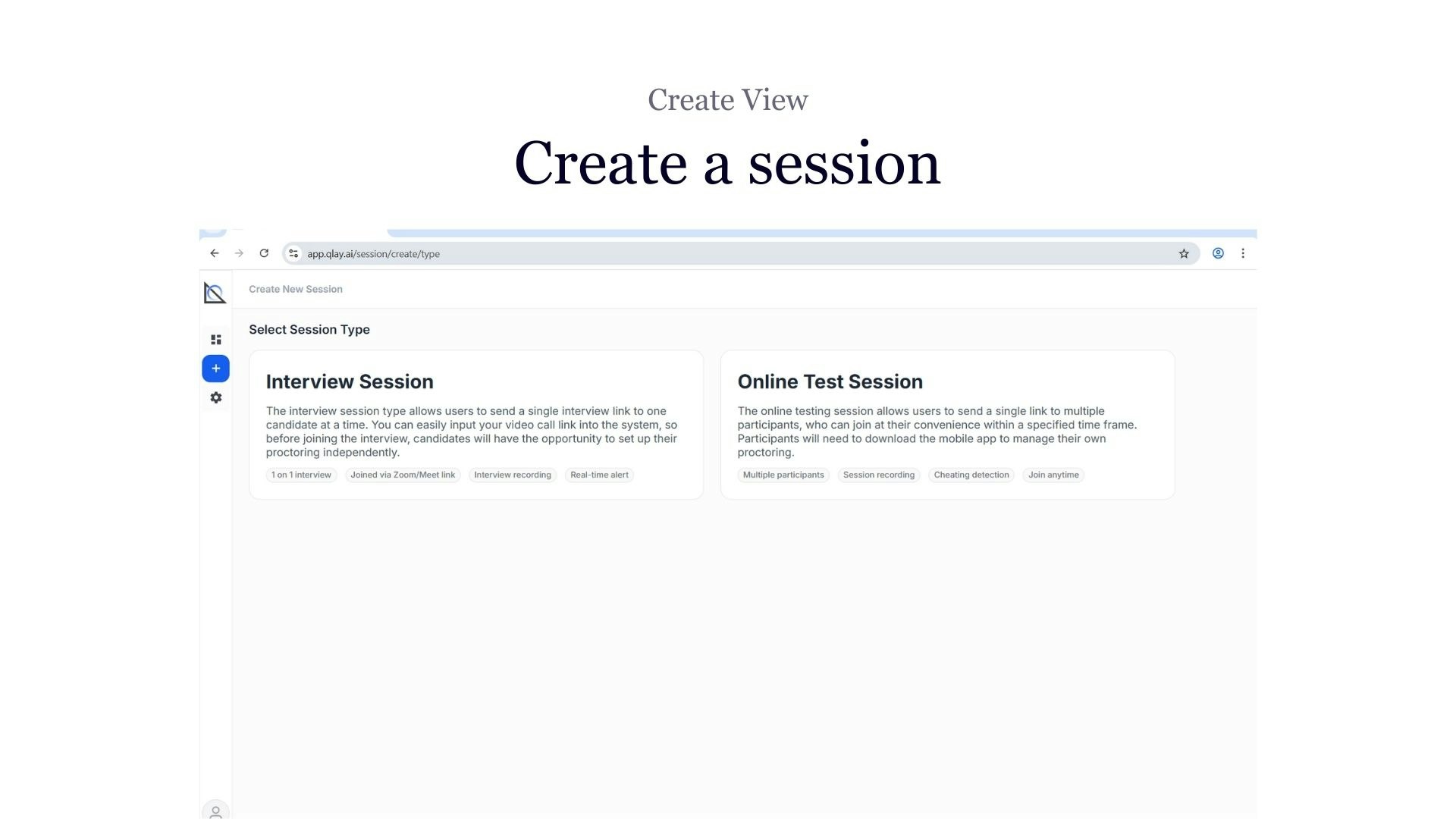

AI Proctor by Qlay
AI Proctor by Qlay is a remote proctoring solution designed to counter the rise of AI-assisted cheating in online assessments. It distinguishes itself by using a candidate’s smartphone as a secondary camera to eliminate blind spots, specifically targeting the use of generative AI tools like ChatGPT during exams and interviews.
Core Features
- Dual-Camera Architecture: Synchronizes a standard webcam with a mobile app to create a multi-angle view of the candidate’s workspace.
- Advanced Object Detection: Automatically identifies prohibited items such as unauthorized phones, cheat sheets, or secondary monitors in the video feed.
- Biometric & Behavioral Analysis: Tracks head, hand, and eye movements to flag suspicious patterns, such as constant glancing off-screen.
- Speech Cadence Monitoring: Analyzes speech rhythm and pacing to determine if a candidate is speaking naturally or reading a generated script.
- Process & App Scanning: Detects if prohibited applications (like LLM interfaces or remote desktop tools) are running on the candidate’s device.
How It Works
Candidates begin by scanning a QR code to pair their smartphone with the testing session. The phone is positioned to capture the workspace (hands, keyboard, and screen profile), while the webcam captures the face. The AI analyzes both streams simultaneously to alert proctors of irregularities in real-time.
Use Cases
- Remote Academic Examinations: Securing high-stakes finals where textbook or device usage is banned.
- Technical Coding Interviews: Verifying that code is written by the candidate without “copilot” assistance.
- Corporate Certification: Ensuring compliance standards for professional licensing tests.
- Virtual Hiring Assessments: Screening candidates for soft skills without teleprompter usage.
Pros & Cons
- Pros: Significantly higher security integrity than single-webcam solutions; reduces “blind spots” where unauthorized devices are usually hidden; detects non-visual cheating cues like reading cadences.
- Cons: Higher friction for users (requires setup of two devices); privacy concerns regarding 360-degree room analysis; relies on the candidate having a charged, compatible smartphone and stable Wi-Fi for two streams.
Pricing
- Starter: $12.99/month (Basic features, 3 seats, 300 minutes)
- Growth: $29.99/month (10 seats, 800 minutes)
- Enterprise: $129.99/month (30 seats, 4000 minutes)
How Does It Compare?
While Qlay pioneered the “mobile-as-second-camera” focus, major competitors have updated their feature sets in late 2025 and 2026 to include similar capabilities.
- ProctorU (Guardian)
Now offers a “Second Camera” feature that integrates directly with their Guardian Browser. Unlike Qlay’s app-heavy approach, ProctorU often uses a browser-based QR link for the mobile device. Qlay differs by focusing more heavily on speech cadence analysis specifically to catch generative AI usage, whereas ProctorU leans on human-in-the-loop hybrid proctoring. - Honorlock
Recently introduced “Side-Angle Camera” capabilities where a student’s tablet or phone pairs with the exam session. Honorlock’s strength lies in its “Live Pop-In” feature, where a human proctor only intervenes when the AI flags an issue. Qlay is generally more fully automated, marketing itself as a pure AI solution rather than a service dependent on human intervention centers. -
Proctor360
Targeting the extreme high-end of security, Proctor360 utilizes a specialized headset or 360-degree camera hardware to view the entire room at once, rather than just two angles. While Qlay is software-only and easier to deploy (BYOD), Proctor360 offers superior environmental security for critical certifications where hardware shipping is feasible. -
Proctorio
Remains the dominant low-friction player, primarily functioning as a browser extension using a single webcam. It lacks the native, enforced dual-camera workflow of Qlay. Proctorio is faster to set up and cheaper for mass use, but significantly easier to bypass using “blind spot” methods that Qlay’s side-camera is designed to catch.
Final Thoughts
The remote proctoring landscape has shifted from simple monitoring to an “AI vs. AI” arms race. Qlay’s value proposition is no longer just about seeing the candidate; it is about detecting the specific behavioral artifacts of using Generative AI—such as the robotic reading of a ChatGPT answer or the eye movements associated with smart glasses. For organizations prioritizing speed and low cost, single-cam solutions like Proctorio remain sufficient. However, for technical hiring and high-stakes testing where LLM-cheating is the primary threat, Qlay’s combination of dual-angle vision and speech cadence analysis offers a necessary evolution in security.