Table of Contents
Overview
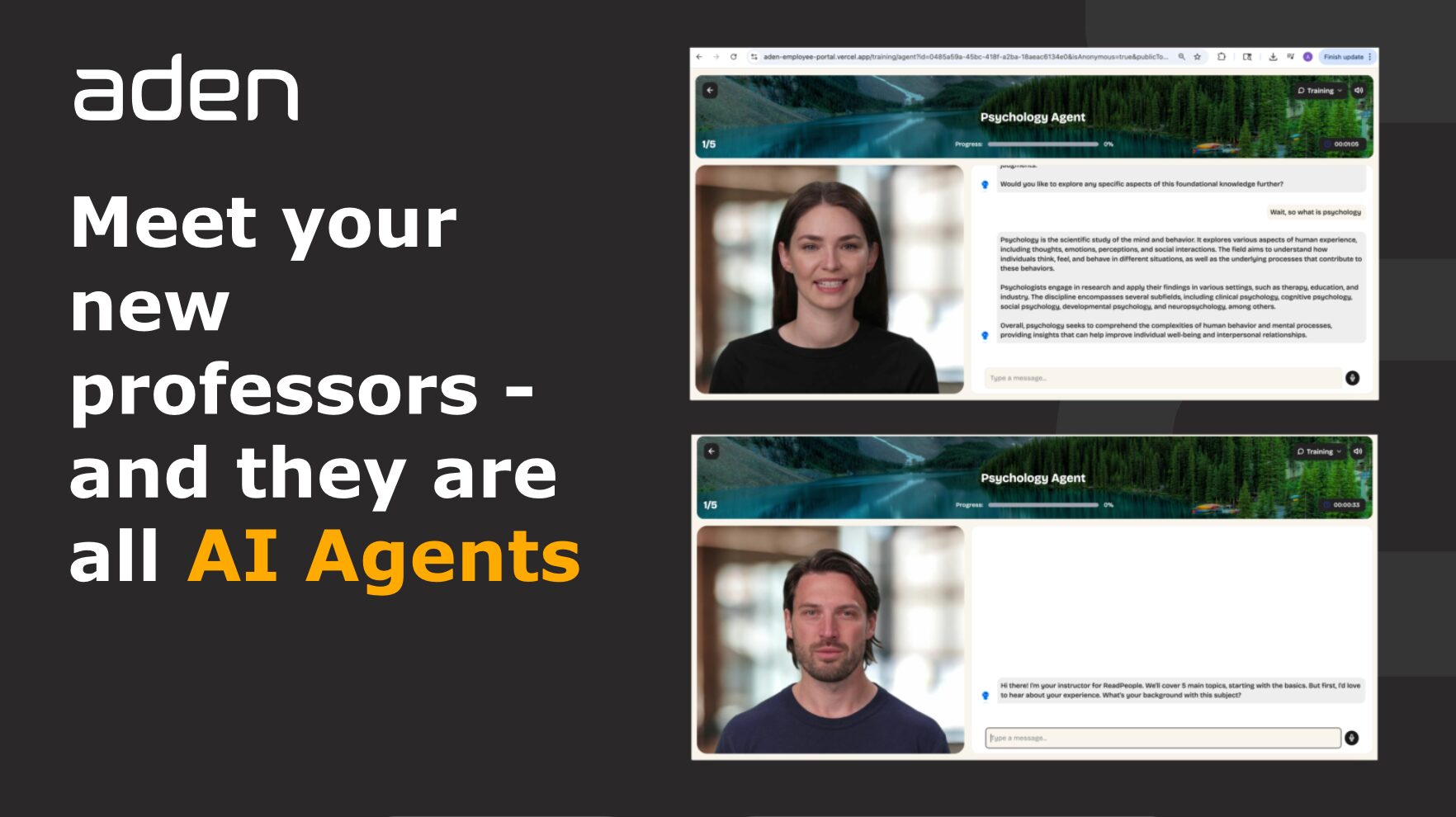
Traditional workplace training relies on static learning materials: lengthy PDFs, slide decks, and passive videos that fail to engage learners or ensure knowledge retention. AI Professors by Aden reimagines this experience by converting any document into an interactive, conversational learning environment powered by AI agents. Rather than asking employees to absorb information passively, the platform creates dialogue-based training experiences where users interact with AI-guided lessons, quizzes, and simulations that adapt to their roles and skill levels. Built on Aden’s agent infrastructure, the platform ingests company documents including manuals, standard operating procedures, policies, and training materials to generate customized learning pathways. Whether addressing safety compliance, onboarding, specialized skills development, or certification requirements, Aden’s approach replaces information delivery with interactive conversation—turning learning into a dynamic, two-way engagement that increases retention and measurable skill development.
Aden Technologies, based in San Francisco, specializes in AI-powered resource planning and workforce development systems designed specifically for construction, manufacturing, and industrial sectors, though applications extend across any industry requiring structured training and compliance.
Key Features
AI Professors by Aden delivers capabilities purpose-built for organizational learning at scale:
- AI agent-driven instruction: Digital instructors guide learners through lessons, quizzes, and real-world simulations using natural language conversation rather than pre-recorded videos or static content, adapting responses based on individual learner inputs.
- Milestone-based learning structure: Training content organizes into focused segments (typically 10-15 minute modules) with embedded checkpoints, quizzes, and comprehension assessments, keeping learners engaged while enabling measurable progress tracking.
- Document-to-course automation: Upload existing company materials—PDFs, presentations, manuals, SOPs, or text documents—and the AI automatically generates customized quizzes, simulations, and lesson plans aligned with your specific workflows and terminology.
- Role-based personalization: Learning paths adapt to specific job functions and skill levels, ensuring a safety manager receives different training emphasis than a frontline worker, with AI analyzing responses to adjust pacing and content depth dynamically.
- Simulation-based scenario training: Beyond passive content, the platform generates contextual, real-world simulations based on your uploaded materials, enabling learners to apply skills in risk-free environments before performing tasks in production.
- Compliance and certification tracking: Integrated analytics and audit trails document training completion, skill mastery, and certification milestones, supporting regulatory compliance requirements and providing leadership with ROI visibility on training investments.
How It Works
Aden’s training system streamlines conversion of organizational knowledge into interactive learning experiences through an efficient workflow:
- Upload your training materials: Begin by uploading existing company documents—safety manuals, product documentation, policies, SOPs, or training guides—in PDF, text, or presentation formats. The system processes this content as the knowledge foundation for your training.
- Define learning objectives and milestones: Specify learning outcomes, role-specific requirements, and training milestones. You can customize learning paths by job function, skill level, or compliance requirements, or let the AI suggest structures based on your materials and organizational context.
- AI generates interactive course structure: The platform analyzes your materials and automatically creates a customized learning structure with generated quizzes, checkpoint assessments, and scenario-based simulations specific to your content and terminology, reducing content creation overhead to under 30 minutes for complete module deployment.
- Learners engage with AI instructor: Users access the training through a conversational interface where the AI instructor guides them step-by-step through lessons, answers questions, administers quizzes, and presents branching scenarios. The system tracks performance, identifies knowledge gaps, and adapts subsequent content accordingly.
- Monitor progress and measure outcomes: Leadership and training teams access detailed analytics showing completion rates, skill mastery by learner and cohort, and training effectiveness metrics. This data supports audit compliance and enables data-driven refinement of training programs over time.
The underlying technology uses large language models trained on conversational pedagogy, enabling AI agents to explain concepts, answer contextual questions, and present scenarios adaptively rather than simply delivering predetermined content sequences.
Use Cases
AI Professors by Aden serves organizations and learners across multiple scenarios:
- Corporate compliance and safety training: Standardize mandatory training (workplace safety, data security, harassment prevention, regulatory compliance) across distributed teams, ensuring consistent understanding while maintaining audit-ready documentation of completion and knowledge verification.
- Onboarding and role-specific training: Accelerate new employee productivity by delivering role-customized training that covers company policies, procedures, systems, and role-specific responsibilities through interactive dialogue, with progress tracked from day one.
- Certification and skills development: Support professional certifications, technical upskilling, and continuing education requirements with adaptive training that adjusts to learner mastery levels, reducing time-to-competency while improving knowledge retention.
- Specialized industry training: Deploy domain-specific training in manufacturing processes, construction methodologies, healthcare protocols, or technical procedures, with AI agents trained on organizational documentation to ensure accuracy to internal standards.
- Exam preparation and assessment: Provide personalized exam preparation with adaptive practice, targeted feedback on weak areas, and real-time performance tracking that identifies exactly where learners need additional study before summative assessments.
Pros \& Cons
Advantages
- Interactive dialogue over passive consumption: Conversational learning significantly outperforms static videos and PDFs for engagement and retention, with learners experiencing immediate feedback and contextual support rather than one-way content delivery.
- Rapid deployment from existing materials: Organizations can transform existing company documentation into sophisticated training in hours rather than weeks, eliminating the extended timelines required for traditional instructional design and content creation.
- Personalized learning at organizational scale: AI adapts each learner’s pathway, pacing, and emphasis based on role, performance, and responses, delivering individually customized instruction to hundreds or thousands of employees simultaneously—a level of personalization impossible with human instructors alone.
- Reduced training administration overhead: Automated lesson generation, grading, progress tracking, and compliance documentation free training teams to focus on strategy and quality assurance rather than repetitive administrative tasks.
- Company-specific knowledge integration: Because training is built from your actual materials and terminology, learners receive accurate information aligned precisely with organizational practices, standards, and vocabulary, eliminating inconsistencies between training and real-world procedures.
- Measurable outcomes and ROI visibility: Detailed analytics document exactly which skills learners have mastered, where gaps remain, and how training impacts operational performance, enabling data-driven decisions about program refinement and budget allocation.
Disadvantages
- Early-stage technology maturity: As a recently launched platform (2024), the system continues active development and feature evolution. Users may encounter occasional limitations, interface refinements, or features marked as coming soon, requiring flexibility regarding long-term roadmap dependencies.
- Dependent on source material quality: Training effectiveness correlates directly with the clarity, completeness, and accuracy of uploaded materials. Poorly written, outdated, or incomplete source documents result in lower-quality AI-generated training and reduced learning outcomes.
- Limited to conversational interaction: The platform excels at dialogue-based learning but cannot replicate complex hands-on training requiring physical equipment, machinery, or environments that demand actual tactile experience rather than simulation.
- AI cannot replicate human mentorship depth: While AI agents provide effective knowledge transfer and skill practice, they cannot fully replicate the nuanced mentoring, emotional intelligence, and contextual judgment that experienced human instructors bring to complex, sensitive, or high-stakes training scenarios.
- Organization requires clear learning objectives: The platform requires well-defined learning goals and structured content. Organizations without clarity on training objectives or with highly unstructured knowledge domains may struggle to achieve optimal results without preliminary instructional design work.
- Pricing and access clarity: Current pricing structure remains in development, with only a free tier and future paid plans mentioned, creating uncertainty for budget planning and feature access.
How Does It Compare?
In November 2025, the training technology landscape includes multiple platform categories, each optimized for different learning objectives and organizational needs.
Traditional online learning marketplaces like Coursera and Udemy excel at offering extensive libraries of pre-built courses from expert instructors. Coursera emphasizes university-partnered academic and professional content with structured timelines and verified credentials, while Udemy operates as an instructor marketplace offering independent courses with flexible self-paced access. Both platforms serve well for general skill development and formal educational programs but rely on passive consumption of recorded video lectures and self-directed learning without meaningful personalization or real-time adaptation to individual learner needs.
Gamification-focused platforms like Kahoot and Blooket transform knowledge checks into competitive quiz experiences through leaderboards and game mechanics. These tools excel at creating classroom engagement and making assessment interactive but do not offer comprehensive training programs, adaptive learning paths, role-specific customization, or organizational compliance documentation. They function best as supplementary engagement tools within broader training strategies rather than complete training platforms.
Immersive simulation platforms like Virti and Second Nature use AI-powered virtual humans for role-play and scenario-based practice. Virti specializes in healthcare, retail, and enterprise soft skills training with realistic dialogue scenarios; Second Nature focuses specifically on sales coaching and conversation practice. These platforms excel at enabling learners to practice difficult interpersonal scenarios in risk-free environments but require specialized scenario content creation and focus narrowly on behavioral skill development rather than comprehensive knowledge transfer or compliance requirements.
Enterprise learning management systems with AI features—including D2L Brightspace, Docebo, and LearnUpon—offer comprehensive course libraries, content curation via AI recommendations, and integration with HR systems. These platforms provide broad functionality for mid-sized to enterprise organizations but require significant implementation effort, higher costs, and specialized content purchasing or creation. They excel at managing large course catalogs across organizations but do not automate training generation from organizational documents.
AI Professors by Aden occupies a distinct category: rapid automation of organizational documents into adaptive, interactive, role-based training with built-in compliance tracking. Unlike batch-created course libraries, it ingests your actual organizational materials, ensuring accuracy to internal standards and immediate relevance. Unlike quiz platforms, it provides comprehensive training programs with adaptive difficulty and branching learning paths. Unlike simulation platforms, it prioritizes knowledge transfer and procedure comprehension across diverse topics. Unlike traditional LMS systems, it eliminates the extended content creation timeline by automating lesson generation directly from uploaded documents.
The key differentiator is speed combined with organizational accuracy: organizations can deploy sophisticated, personalized training in hours using existing materials, without hiring instructional designers or waiting weeks for traditional course development. This positioning makes Aden particularly valuable for organizations with frequent training cycles (safety updates, compliance refreshes, onboarding waves), limited learning and development resources, or distributed teams requiring consistent training at scale.
The choice between platforms depends on your specific training objectives: broad skill development across established topics (Coursera/Udemy), engaging knowledge checks (Kahoot), interpersonal skill practice (Virti/Second Nature), enterprise-wide learning management (D2L/Docebo), or rapid deployment of organization-specific training from existing materials (Aden).
Final Thoughts
AI Professors by Aden represents a fundamental shift in how organizations approach mandatory and developmental training. By converting static documents into interactive, adaptive learning experiences, it addresses a persistent challenge: traditional training methods fail to engage learners, ensure knowledge retention, or provide measurable evidence of skill development. The platform’s ability to deploy sophisticated training in hours from existing materials makes it particularly valuable for organizations with resource constraints or rapid training cycles.
The conversational, agent-driven approach mirrors how humans actually learn best—through dialogue, questions, immediate feedback, and scenarios relevant to their specific roles. As AI training technology matures throughout 2025-2026, platforms that effectively balance automation with organizational accuracy, personalization with measurable outcomes, and rapid deployment with learning quality will become essential infrastructure for workforce development.
For organizations seeking to modernize training beyond slides and videos, particularly those with compliance requirements, distributed teams, or limited instructional design resources, Aden’s approach deserves serious consideration. As the platform evolves with clearer pricing models and expanded features, its position as a practical, deployment-focused alternative to traditional training systems is likely to strengthen considerably.
https://agents.adenhq.com/public/agent/eyJ0Ijo0NDQ2LCJhIjoiYzRjNWMzNjEtMjhhZC00ZjUwLTliYTQtZGYxMTJlZTczYzE0IiwicyI6ImRpcmVjdF8zMzQ1X2Y4YTMyIiwibiI6ImMzZjcwNGY1In0