
Table of Contents
Overview
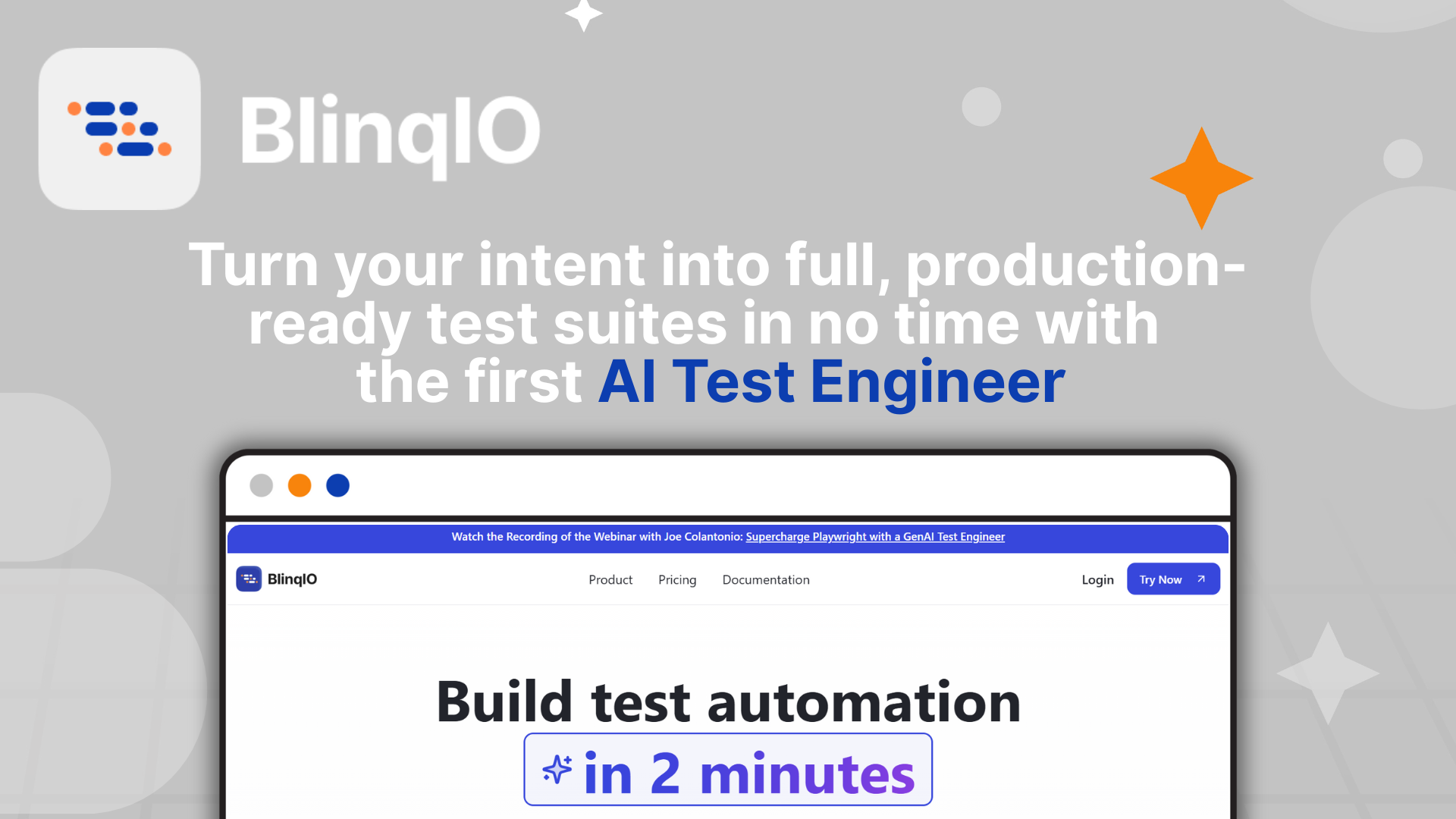
AI Test Engineer by BlinqIO is an autonomous testing agent designed to revolutionize how developers and QA teams handle end-to-end (E2E) testing. Unlike traditional “record and playback” tools that create brittle, proprietary tests, BlinqIO acts as a virtual engineer that writes, executes, and maintains standard Playwright code. It lives directly in your workflow, generating real code in your repository that integrates seamlessly with your existing CI/CD pipelines. By automating the tedious maintenance of test scripts, it allows teams to achieve “zero-touch automation,” ensuring that testing keeps pace with rapid development cycles without vendor lock-in.
Key Features
BlinqIO distinguishes itself by adhering to engineering best practices rather than abstracting them away:
- Real Code Generation: Instead of proprietary “black box” test files, the AI generates standard, readable Playwright (TypeScript/JavaScript) code that is committed directly to your Git repository.
- Self-Healing Tests: The AI agent proactively monitors test failures; if a UI element changes (e.g., a button ID is renamed), it analyzes the new DOM and automatically updates the test script to fix the break.
- CI/CD Integration: It integrates natively with popular pipelines (GitHub Actions, GitLab CI, etc.), running tests on every pull request just like a human engineer would.
- Autonomous Maintenance: Beyond just writing initial tests, the “AI Engineer” maintains them over time, significantly reducing the “flakiness” often associated with automated browser testing.
How It Works
The platform mirrors the workflow of a human QA automation engineer:
- Observation: You provide the URL of your staging or production environment. The AI navigates the application to understand user flows and UI elements.
- Generation: Using Large Language Models (LLMs), it generates robust Playwright test scripts covering critical paths and edge cases, then opens a Pull Request (PR) to your repository.
- Maintenance: When the application evolves and tests fail, the AI analyzes the failure trace, identifies the code mismatch, and pushes a code fix to resolve the issue without human intervention.
Use Cases
This tool is optimized for modern engineering teams:
- Regression Testing: Automatically maintaining a safety net of tests that verify core features still work after every deployment.
- Migration to Playwright: Teams looking to move away from legacy tools (like Selenium) can use BlinqIO to rapidly generate a modern Playwright test suite from scratch.
- Fast-Paced Startups: Engineering teams that release daily and lack the headcount to hire dedicated QA automation engineers.
Pros & Cons
A balanced look at the tool’s strengths and limitations.
Advantages
- No Vendor Lock-In: Since the output is standard code in your repo, you can cancel your subscription and keep 100% of your test suite.
- Drastic Time Savings: Claims to reduce testing costs by ~65% and cut maintenance time significantly by handling updates autonomously.
- Developer Friendly: Because it speaks the language of developers (Git, CLI, TypeScript), it fits naturally into existing engineering workflows.
Disadvantages
- Framework Specific: Currently highly specialized for Playwright; teams deeply entrenched in Cypress or Selenium would need to switch frameworks to benefit.
- AI Oversight: While “autonomous,” complex logic or highly specific business rules may still require human review to ensure the AI creates the correct test assertions.
How Does It Compare?
BlinqIO competes in the crowded QA automation space but carves out a unique “AI Agent” niche. Here is how it stacks up:
- Vs. Low-Code/No-Code Tools (Mabl, Testim):
Platforms like Mabl or Testim use proprietary visual editors. They are easy to start but often create “vendor lock-in”—if you leave, you lose your tests. BlinqIO, in contrast, generates open-source Playwright code. You own the code forever, making it a safer long-term bet for engineering teams. - Vs. AI Assistants (GitHub Copilot, Cursor):
Copilot helps you write code snippet by snippet but requires you to drive the process. BlinqIO is an agent—it can navigate the app, write the entire suite, run it, and fix it autonomously. Copilot assists; BlinqIO performs the job. - Vs. Traditional Manual Automation:
Writing Playwright scripts manually gives you maximum control but is slow and expensive to maintain. BlinqIO offers the speed of low-code tools with the flexibility and standards compliance of manual coding.
Final Thoughts
AI Test Engineer by BlinqIO represents the next generation of software testing: “Agentic Automation.” By solving the two biggest pain points of test automation—high maintenance costs and vendor lock-in—it offers a compelling value proposition for modern dev teams. While it requires adoption of the Playwright framework, the promise of owning your test code while having an AI maintain it makes it a highly attractive solution for scaling quality assurance without scaling headcount.
Disclaimer: This analysis is based on information available as of January 2026. Features and pricing models for AI software evolve rapidly; please verify the latest details directly on the vendor’s website.