
Table of Contents
Overview
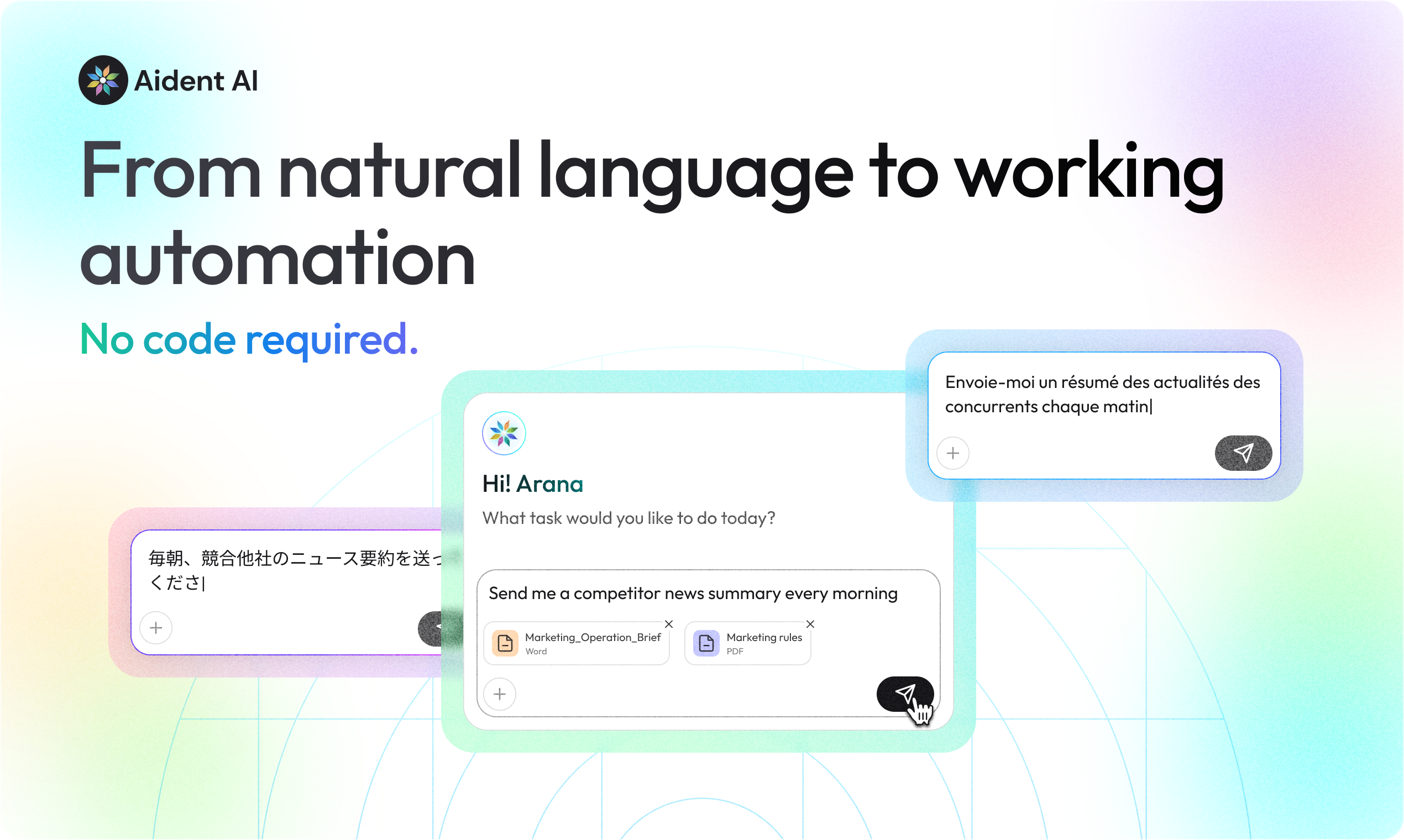
Aident AI is an agentic automation editor launched on Product Hunt in December 2025. Describe what you want in plain English, and Aident turns it into a Playbook that compiles into executable scripts and AI prompts. Connect 250+ tools with 2000+ actions across your favorite platforms including Gmail, Slack, Google Sheets, Telegram, X, LinkedIn, and more. Keep updating your automations through natural conversation as your business processes evolve. No coding required—if you can explain it, you can automate it.
Key Features
Natural-Language Workflow Creation: Simply describe your desired workflow in plain English, and Aident AI’s intelligent system interprets your intent and generates a complete automation. Instead of manually configuring triggers, actions, and conditional logic like traditional automation platforms, you have a conversation with AI to define what you need. This approach eliminates the learning curve associated with visual workflow builders and makes automation accessible to non-technical team members.
Playbooks That Compile to Scripts and Prompts: Aident AI introduces the concept of “Playbooks”—structured automation workflows that combine traditional API integrations with AI-powered prompts. When you describe a process, Aident generates a Playbook that compiles into the necessary scripts for tool integrations alongside optimized prompts for language model interactions. This hybrid approach enables automations that leverage both deterministic API calls and flexible AI reasoning.
Human-in-the-Loop Approval Forms: Build trust and maintain control over automated processes with optional approval checkpoints. Aident can pause workflows at critical steps and send approval requests via email or Slack, allowing designated team members to review and confirm actions before execution. This feature is essential for workflows involving financial transactions, customer communications, or sensitive data operations where human oversight ensures accuracy and compliance.
Extensive Tool Integration Ecosystem: Connect with 250+ popular business applications through 2000+ pre-configured actions. Supported integrations span productivity tools (Google Workspace, Microsoft 365), communication platforms (Slack, Discord, Telegram), social media (X, LinkedIn), project management (Asana, Trello, Notion), CRM systems (HubSpot, Salesforce), e-commerce (Shopify, WooCommerce), and marketing automation (Mailchimp, SendGrid). This broad integration library enables comprehensive workflow orchestration across your entire technology stack.
Real-Time Checks and Live Updates: Monitor automation execution in real-time with built-in validation checks that detect errors, API rate limits, authentication failures, and data inconsistencies before they cause problems. When workflows run, see live status updates for each step, enabling rapid debugging and refinement. Update existing Playbooks through chat-based interaction—describe what you want to change, and Aident modifies the automation accordingly without requiring you to navigate complex configuration interfaces.
SOP Upload and Instant Automation: Already have documented standard operating procedures? Upload your SOP documents directly into Aident, and the platform automatically converts written instructions into executable automations. This capability accelerates deployment for teams with established processes documented in Word, Google Docs, PDFs, or internal wikis, transforming institutional knowledge into working workflows without manual translation.
Template Library for Quick Starts: Access pre-built Playbook templates for common business workflows including daily competitor monitoring, social media scheduling, report generation, data synchronization, and customer onboarding sequences. Start with a template and customize it through natural language conversation to match your specific requirements, dramatically reducing time-to-value compared to building from scratch.
Predictable Outputs by Design: Unlike purely generative AI tools that may produce inconsistent results, Aident’s Playbook architecture ensures deterministic execution. Once a Playbook is defined and tested, it produces consistent outputs on every run, eliminating the “surprises” that can occur with open-ended AI systems. This predictability is crucial for business-critical workflows where reliability and repeatability are non-negotiable.
AI Co-Pilot for Sub-5-Minute Automation: Aident’s AI co-pilot guides you through workflow creation with intelligent suggestions, clarifying questions, and automatic error detection. The system actively helps refine your automation during the drafting process, catching potential issues early and recommending optimizations. This collaborative approach enables most users to create working automations in under 5 minutes, compared to hours with traditional platforms.
Test Run with Iterative Refinement: Before publishing automations to production, run comprehensive tests that preview results without affecting live systems. During test runs, Aident highlights potential issues, asks clarifying questions about ambiguous steps, and suggests fixes based on detected problems. This iterative refinement process ensures automations work correctly before they touch real customer data or execute critical business operations.
Team Sharing and Collaboration: Once a Playbook is tested and validated, share it across your team to standardize processes and ensure consistent execution. Team members can run shared Playbooks, monitor results collectively, and propose improvements through the same conversational interface. This collaborative approach democratizes automation development while maintaining quality control through shared best practices.
How It Works
Begin by describing your workflow goal in natural language. For example: “Every morning at 9 AM, search Google News for articles about our three main competitors, summarize key developments using AI, and send a formatted report to our #competitive-intelligence Slack channel.” Alternatively, upload an existing SOP document or select a pre-built template from Aident’s library.
Aident’s AI drafts a Playbook based on your description, breaking down the high-level goal into discrete steps with specific tool integrations and AI prompts. The system automatically selects appropriate APIs, configures authentication, and generates the logic necessary to execute your workflow. Review the generated Playbook to understand exactly what will happen at each step.
Run a test execution to preview results without affecting production systems. During the test, Aident may ask clarifying questions about ambiguous requirements—for instance, “Should I include articles from the past 24 hours or past week?” Answer these questions conversationally, and Aident refines the Playbook accordingly. Built-in validation checks identify potential errors like missing API credentials, rate limit concerns, or data format mismatches.
If test results reveal issues, describe the problems in plain language: “The summaries are too long—keep them under 100 words each” or “We only want articles from major publications, not blogs.” Aident’s AI suggests fixes and updates the Playbook based on your feedback. This iterative process continues until the automation produces desired results.
Once satisfied, publish the Playbook with optional human-in-the-loop approval steps for sensitive actions. Configure the automation to run on schedules, triggers from integrated tools, or manual execution. Monitor results through Aident’s dashboard, which tracks execution history, success rates, and any errors that occur.
Share successful Playbooks with team members, who can run them directly or adapt them for similar workflows. As your business processes evolve, simply describe changes to Aident, and the platform updates automations without requiring you to reconfigure visual workflows or modify code.
Use Cases
Operations Teams Automating Spreadsheet-to-Email Workflows: Eliminate manual data aggregation and reporting by automating the extraction of information from Google Sheets or Excel, formatting it according to brand guidelines, and distributing polished reports via email. Operations teams can automate weekly KPI summaries, monthly financial reports, inventory alerts, and customer success metrics without writing formulas or macros.
Content Creators Turning Blog Posts into Daily Social Media Ideas: Convert long-form content into platform-optimized social posts automatically. Upload or link to a blog post, and Aident generates tweet threads for X, LinkedIn articles with professional framing, Instagram captions with hashtags, and Facebook posts with engagement hooks—all scheduled for optimal posting times across platforms.
Product Teams Generating Weekly Development Summaries: Automatically compile GitHub repository activity, pull request reviews, commit messages, and issue updates into narrative summaries for stakeholders. Product managers can share weekly progress reports with executives, investors, or customers without manually tracking development activity across tools.
Marketing Teams Building Campaign Reports and Social Posts: Aggregate performance data from Google Analytics, Facebook Ads, Google Ads, email marketing platforms, and CRM systems into comprehensive campaign reports. Combine quantitative metrics with qualitative insights, automatically generate executive summaries, and distribute results to stakeholders on schedules.
Founders Automating Admin Tasks: Startup founders juggling multiple responsibilities can automate routine administrative work including invoice processing, expense categorization, meeting scheduling coordination, customer inquiry routing, and investor update compilation. This automation frees up founder time for strategic activities while ensuring operational consistency.
Customer Support Teams Standardizing Response Workflows: Create Playbooks for common support scenarios including ticket routing based on issue type, automated initial responses with relevant help articles, escalation protocols for high-priority issues, and follow-up satisfaction surveys after resolution.
Sales Teams Enriching Lead Data: Automatically enrich incoming leads by pulling information from LinkedIn, company databases, news sources, and social media. Populate CRM records with comprehensive context, score leads based on qualification criteria, and route high-value prospects to appropriate sales representatives.
Pros and Cons
Advantages
Zero Learning Curve with Natural Language Input: Unlike traditional automation platforms requiring users to understand trigger-action mappings, conditional logic syntax, or visual workflow concepts, Aident accepts plain English descriptions. This dramatically lowers barriers to entry—if you can explain a process to a colleague, you can automate it with Aident. Non-technical team members including marketers, operations staff, and executives can build sophisticated automations without technical training.
Predictable Outputs Through Pre-Defined Playbooks: Aident’s Playbook architecture ensures consistent execution across runs. Once a workflow is tested and validated, it produces the same high-quality outputs every time, eliminating the unpredictability sometimes associated with purely generative AI systems. This reliability is critical for business processes where consistency directly impacts customer experience and operational efficiency.
AI Co-Pilot Enables Sub-5-Minute Automation Building: The combination of natural language input, intelligent drafting, and guided refinement means most workflows can be created and deployed in under 5 minutes. This represents a 10-50x time savings compared to traditional automation platforms where even simple workflows require 30 minutes to several hours of configuration. Faster deployment means more processes get automated, compounding productivity gains.
Human-in-the-Loop Approval Maintains Control: Optional approval checkpoints provide peace of mind for automations involving sensitive operations. Finance teams can review transactions before execution, marketing teams can approve customer communications before sending, and operations teams can validate data changes before committing to production systems. This balanced approach delivers automation efficiency while preserving human oversight where it matters most.
Comprehensive Integration Ecosystem: Support for 250+ tools with 2000+ actions covers the vast majority of SaaS applications used by modern businesses. Teams can orchestrate complex workflows spanning multiple platforms without custom API development or middleware layers. This breadth eliminates integration gaps that often limit automation scope with competing platforms.
Conversational Updates Eliminate Maintenance Overhead: As business processes evolve, simply describe changes to Aident rather than manually reconfiguring workflows. This dramatically reduces the maintenance burden that typically causes automation drift, where documented processes diverge from executed workflows over time. Keeping automations current becomes as easy as having a conversation.
Competitive Pricing with Launch Discount: At \$6-18 per month with 50% launch discount, Aident undercuts established competitors while offering comparable or superior features. The free tier with 300 credits monthly enables extensive evaluation before financial commitment, and the creator program provides free access for influencers and community leaders who can showcase workflow templates.
Disadvantages
New Product with Fewer Integrations Than Established Competitors: Launched in December 2025, Aident’s 250+ tool integrations pale in comparison to Zapier’s 7,000+ apps, Make’s 2,000+ apps, and n8n’s extensive connector library. While Aident covers mainstream business tools, organizations using niche or industry-specific software may find required integrations unavailable. Teams should verify their specific tool stack is supported before committing.
Pricing Details Beyond Entry Tier Lack Transparency: While free and entry-level pricing is clearly documented, comprehensive details about credit consumption rates, scaling costs, team collaboration pricing, and enterprise features are not prominently specified. Organizations planning large-scale deployments should contact sales for detailed pricing breakdowns to accurately project total cost of ownership.
Complex Workflows May Require Iteration: While Aident excels at straightforward automation scenarios, highly complex workflows with intricate conditional logic, exception handling, multi-branch processes, and sophisticated data transformations may require multiple refinement cycles. Users accustomed to fine-grained control in visual workflow builders might find natural language iteration slower for edge cases compared to direct node configuration.
Limited Track Record for Enterprise Reliability: As a recently launched platform, Aident lacks the multi-year operational history and extensive customer references that inform enterprise software evaluations. Organizations with strict uptime requirements, compliance mandates, or risk-averse procurement processes should pilot Aident on non-critical workflows before migrating mission-critical automations.
Credit-Based Pricing Introduces Cost Variability: The credit consumption model means actual costs depend on automation complexity, AI prompt usage frequency, and execution volume. Organizations with highly variable workflow usage may experience unpredictable monthly bills compared to fixed-subscription competitors. Careful monitoring during pilot phases is essential to understand true costs at production scale.
Pricing
Free Tier: \$0 per month with 300 refresh credits monthly. Suitable for individual users evaluating the platform or automating low-volume personal workflows. No credit card required for signup.
Basic Plan: \$6 per month with 50% launch discount, or regular price \$9.50 per month when discount ends. Includes 2,000 credits per month. Designed for individual professionals or small teams with moderate automation needs. Provides sufficient credits for daily automations involving multiple tool integrations and AI-powered operations.
Pro Plan: \$18 per month with 50% launch discount, or regular price \$29.50 per month when discount ends. Includes 6,000 credits per month. Targets teams with high-volume automation requirements, complex workflows involving multiple AI prompts, and frequent execution schedules. Higher credit allocation supports enterprise-scale operational automations.
Enterprise Plan: Custom pricing available by contacting sales. Includes unlimited credits, dedicated infrastructure, priority support, advanced collaboration features, audit logging, and custom SLA guarantees. Designed for large organizations requiring guaranteed performance, compliance features, and volume licensing.
Launch Discount: 50% discount currently running for new users, limited to first 200 customers. This promotional pricing makes Basic plan \$6/month and Pro plan \$18/month versus regular \$9.50/month and \$29.50/month respectively.
Creator Program: Free access for influencers, content creators, and community leaders who build and share Playbooks publicly. Participants receive full platform access in exchange for showcasing workflow templates that inspire their audiences.
Credit Consumption: Credits are consumed based on automation complexity, number of tool API calls, AI prompt length and frequency, and data processing volume. Specific credit costs per operation should be verified during pilot evaluation to accurately project monthly spending at intended usage levels.
How Does It Compare?
Aident AI positions itself as a conversational automation platform emphasizing natural language workflow creation and AI-powered Playbook generation. Here’s how it compares to major competitors in the 2025 automation landscape:
vs. Zapier
Workflow Creation: Zapier requires manual trigger/action mapping through a visual interface where users configure each step by selecting apps, choosing actions, mapping data fields, and setting up filters. Aident uses natural language conversation to generate complete workflows in under 5 minutes, eliminating manual configuration overhead.
Pricing: Zapier’s Professional plan costs \$29.99/month monthly or \$19.99/month annually, starting with 750 tasks per month. Aident’s Basic plan costs \$6/month with launch discount versus Zapier’s \$19.99+, representing 70-80% cost savings at entry tiers. However, direct cost comparison requires understanding credit consumption versus task limits.
Integrations: Zapier supports 7,000+ applications versus Aident’s 250+ tools. Zapier’s massive integration library provides unmatched breadth for niche and industry-specific applications. Aident covers mainstream business tools but lacks Zapier’s extensive long-tail connector ecosystem.
AI Capabilities: Aident natively incorporates AI prompts and language model reasoning into workflows through Playbooks. Zapier recently added AI features but primarily focuses on deterministic API-to-API integrations. Aident’s architecture is AI-first, while Zapier’s AI features are supplementary.
Best For: Use Zapier for maximum integration breadth, established enterprise reliability, and fine-grained workflow control. Choose Aident for faster deployment through natural language, AI-native workflows, and dramatically lower entry pricing.
vs. n8n
Deployment: n8n offers self-hosted open source (free) and managed cloud options starting at \$24/month monthly or \$20/month annually for 2,500 executions. Aident operates exclusively as managed SaaS starting at \$6/month with launch discount. Self-hosting appeals to teams wanting infrastructure control, data sovereignty, and unlimited executions. Aident provides turnkey simplicity without infrastructure management.
Workflow Building: n8n uses visual workflow builder with nodes and connections, supporting JavaScript and Python custom code for advanced logic. Aident uses natural language conversation to generate workflows, abstracting technical implementation details. n8n targets technical users comfortable with code; Aident targets non-technical business users.
Execution Model: n8n charges per execution (each workflow step counts as one execution). A 5-step workflow running once consumes 5 executions. Aident uses credit-based pricing with different consumption rates for API calls versus AI operations. Cost comparison requires modeling specific workflow characteristics.
Best For: Use n8n for self-hosted deployment, code-first workflow development, and unlimited executions with self-managed infrastructure. Choose Aident for natural language automation building, managed cloud service, and faster time-to-value for non-technical users.
vs. Make (formerly Integromat)
Interface: Make provides visual flowchart-style workflow builder where users drag modules and draw connections between them, offering more intuitive visual representation than Zapier’s linear approach but still requiring manual configuration. Aident eliminates visual workflow building entirely, using conversational AI to generate Playbooks from natural language descriptions.
Human-in-the-Loop: Aident provides native human approval checkpoints where workflows pause for review before executing critical actions. Make can implement similar functionality through routers and filters but requires manual setup. Aident’s built-in approval forms are more accessible for non-technical teams.
Pricing: Make’s free tier includes 1,000 operations monthly. Paid plans start at \$9/month for 10,000 operations. Aident starts at \$6/month with launch discount. Both platforms offer competitive entry pricing, though execution/credit limits and cost-per-operation require detailed comparison.
Best For: Use Make for visual workflow development with complex branching logic and advanced data transformations. Choose Aident for conversational workflow creation, faster deployment, and built-in human approval workflows.
vs. Flowdrop
AI Approach: Both Flowdrop and Aident emphasize AI-powered workflow generation from natural language descriptions, representing the emerging category of conversational automation platforms. Both aim to eliminate traditional visual workflow building in favor of chat-based creation.
Architecture: Flowdrop uses Planner → Navigator → Validator pipeline with transparent execution visualization. Aident generates Playbooks that compile to scripts and prompts with test-run iteration. Both platforms share similar AI-first philosophies with slightly different implementation approaches.
Pricing: Both Flowdrop and Aident start at \$9/month for paid tiers and offer free plans. Pricing parity suggests competitive market positioning within the conversational automation category.
Best For: Both platforms target similar users prioritizing natural language automation. Direct feature comparison and pilot testing recommended to determine best fit for specific use cases.
vs. Microsoft Power Automate
Ecosystem: Power Automate integrates deeply with Microsoft 365, SharePoint, Teams, Dynamics 365, and Azure services, providing native advantages for Microsoft-centric organizations. Aident provides Microsoft 365 connectors but lacks the same depth of integration. Power Automate is included with many Microsoft 365 business licenses, potentially reducing incremental cost.
AI Capabilities: Power Automate leverages Microsoft Copilot for AI-assisted workflow building, similar to Aident’s natural language approach. Both platforms use AI to reduce manual configuration, though implementation details differ.
Pricing: Power Automate standalone plans start at \$15/user/month. Aident starts at \$6/month with launch discount. For organizations already paying for Microsoft 365, Power Automate’s included automation may offer better economics. For diverse tool stacks, Aident’s broader integration approach may provide superior value.
Best For: Use Power Automate for Microsoft-centric enterprises requiring deep integration with Office 365, SharePoint, and Azure. Choose Aident for diverse technology stacks, faster natural language automation, and lower entry pricing.
Key Differentiators
Aident AI distinguishes itself through exceptional ease-of-use via natural language workflow generation, Playbook architecture combining scripts and AI prompts, built-in human approval workflows, and aggressive pricing starting at \$6/month with launch discount. The platform specifically targets non-technical business users who need reliable automation quickly without learning complex workflow configuration interfaces.
The conversational approach represents an emerging paradigm shift in automation platforms, moving from visual workflow builders toward natural language interfaces. For teams prioritizing deployment speed, accessibility for non-technical users, and AI-native workflows over maximum integration breadth, Aident represents a compelling modern alternative in the rapidly evolving 2025 automation landscape.
Final Thoughts
Aident AI represents the emerging wave of conversational automation platforms that prioritize natural language interfaces and AI-powered generation over traditional visual workflow builders. Launched in December 2025, the platform demonstrates strong momentum with significant Product Hunt engagement and competitive positioning against established automation leaders.
The core value proposition—turning plain English descriptions into working automations in under 5 minutes—directly addresses the primary barrier preventing broader automation adoption: the steep learning curve associated with visual workflow configuration. By enabling marketing teams, operations staff, founders, and other non-technical users to build sophisticated automations through conversation, Aident democratizes workflow automation beyond IT departments and technical specialists.
The Playbook architecture combining traditional API scripts with AI prompts represents a hybrid approach that balances deterministic execution with flexible language model reasoning. This design delivers the reliability businesses require for operational processes while incorporating the intelligent text processing, summarization, and content generation capabilities that AI enables. The predictability-by-design philosophy addresses valid concerns about purely generative systems producing inconsistent outputs.
Pricing at \$6-18 per month with 50% launch discount significantly undercuts established competitors while delivering comparable core functionality. For small businesses, startups, and individual professionals, this pricing accessibility transforms automation from a luxury reserved for well-funded teams into a standard productivity tool accessible to anyone.
However, several considerations warrant careful evaluation. As a platform launched in December 2025, Aident lacks the multi-year operational history and extensive customer references that inform enterprise software decisions. The 250+ integration library, while covering mainstream business tools, falls dramatically short of Zapier’s 7,000+ apps or Make’s 2,000+ connectors. Organizations using niche or industry-specific software must verify their required integrations exist before committing.
Pricing transparency beyond entry tiers requires improvement. While free and Basic/Pro plans are clearly documented, detailed information about credit consumption rates, team collaboration features, and enterprise capabilities is not prominently available. Organizations planning scaled deployments should engage sales early to understand total cost of ownership at production volumes and user counts.
The credit-based pricing model, while enabling flexible consumption, introduces cost variability that organizations should model during pilot phases. Unlike fixed-subscription competitors, actual monthly costs depend on automation complexity, AI prompt frequency, and execution volume. High-volume users with complex workflows should carefully monitor credit burn rates to avoid unexpected scaling costs.
The natural language approach delivers exceptional value for straightforward automation scenarios but may require more iteration than visual builders for highly complex workflows with intricate conditional logic, exception handling, and sophisticated data transformations. Users comfortable describing processes conversationally will achieve best results; those requiring pixel-perfect control over every conditional branch may still prefer traditional node-based configuration.
For non-technical teams tired of wrestling with visual workflow builders, frustrated by automation platform learning curves, or seeking to rapidly deploy AI-enhanced business processes, Aident merits serious evaluation. The human-in-the-loop approval features provide risk mitigation for sensitive operations, the conversational update model reduces maintenance overhead, and the creator program offers community-driven template libraries that accelerate adoption.
As Aident expands its integration library, refines AI generation quality, builds enterprise features, and accumulates operational track record, it has potential to capture meaningful market share from incumbent automation platforms—particularly among growth-stage companies and SMBs seeking modern, accessible automation tools. The December 2025 launch marks an intriguing entry into the conversational automation category, but prudent evaluation requires empirical pilot testing with representative workflows rather than assuming transformative impact from compelling positioning alone.
Major Corrections Summary
- Launch date added: December 23, 2025 with 389 upvotes on Product Hunt
- Pricing corrected: Free tier (\$0), Basic \$6/month with discount (regular \$9.50), Pro \$18/month with discount (regular \$29.50) versus original claim of just “starts at \$9/month”
- Credit allocation specified: Free 300 credits, Basic 2,000 credits, Pro 6,000 credits
- Integration count verified: 250+ tools with 2,000+ actions confirmed
- YouTube/Apify features flagged: Listed in original but not independently verified in available sources
- Added missing competitor: Flowdrop included as similar conversational automation platform
- Structured competitive analysis: Organized by specific competitor with workflow, pricing, integration, and best-for comparisons
- Launch discount details: 50% discount limited to first 200 customers specified
- Creator program details: Free access for influencers/community leaders confirmed
- Enterprise plan details: Custom pricing with unlimited credits and dedicated infrastructure added