Table of Contents
Overview
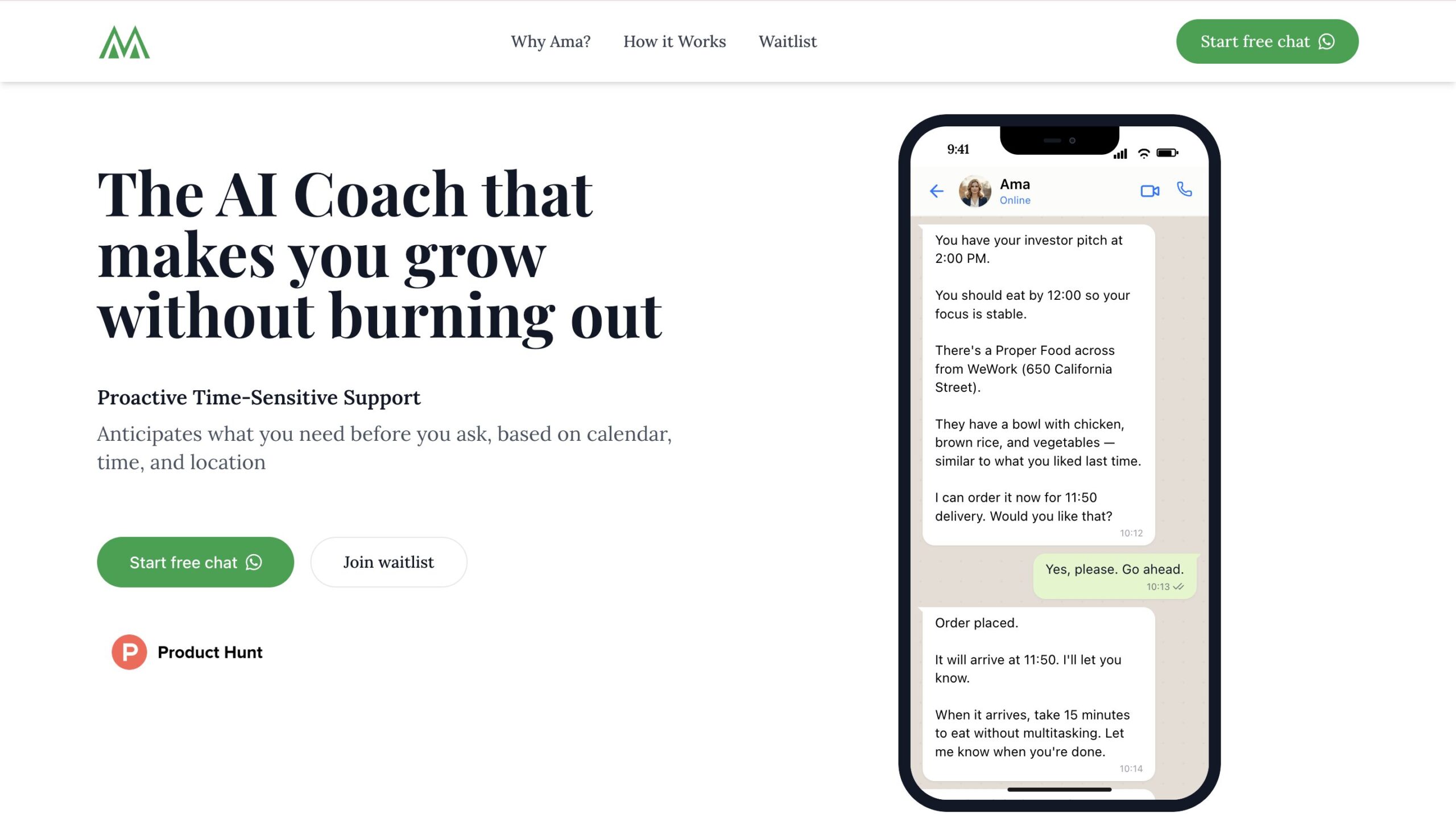
Ama is a proactive AI coaching platform launched publicly December 2025 targeting founders and executives seeking to prevent burnout and optimize daily health and performance. Rather than requiring users initiating queries or checking dashboards, Ama proactively sends SMS and app notifications anticipating needs before conscious awareness. The platform integrates calendar data, wearable health metrics (heart rate, sleep, activity), location information, and behavioral patterns to understand individual stress drivers, energy patterns, and burnout risks. By recognizing contextual triggers (pre-meeting anxiety, irregular sleep patterns, consistent skipped meals), Ama sends timely nudges (“Order food now so you’re fed for your 2 PM pitch”) preventing performance degradation before it occurs.
Currently in beta with waitlist access (pricing not yet announced but implied freemium or SaaS subscription model), Ama specifically addresses founder health crisis: entrepreneurs reporting 30% higher burnout rates than general population, with health decline directly correlating to business performance decline. The emphasis on proactive intervention rather than reactive health tracking recognizes that awareness alone insufficient—knowing you’re fatigued but having no actionable prevention system enables continued downward spiral.
Key Features
Proactive SMS and App Nudges: Rather than waiting for users asking “What should I do?”, Ama anticipates needs and sends timely notifications. System learns patterns (you always get distracted before afternoon meetings, or performance drops after irregular sleep) and intervenes preventively.
Calendar Integration and Context Awareness: Reads calendar understanding meeting types, back-to-back schedules, travel, and speaking engagements. Anticipates pre-meeting stress and provides targeted guidance (breathing exercises before pitch, food reminder before presentation).
Wearable Health Data Integration: Connects with popular wearables (WHOOP, Oura, Apple Watch, Fitbit) capturing heart rate, heart rate variability, sleep quality, activity levels, and recovery metrics. Synthesizes wearable data with behavioral patterns to assess burnout risk.
Location Tracking: Understands when you’re traveling, in office, at home, or commuting. Location combined with schedule and health data enables contextual coaching (recognizing delayed flight arrival prevents fatigue, suggests sleep-first recommendation).
Burnout Prevention Tracking: Monitors physiological and behavioral indicators of burnout including sleep quality decline, resting heart rate elevation, increased stress markers, reduced exercise, and schedule compression. Alerts before burnout becomes critical.
Energy Level Optimization: Identifies personal energy chronotypes and patterns. Some people peak mid-morning, others late morning. Ama learns your rhythms and suggests task scheduling, meeting times, and breaks aligned with your natural energy curve.
ADHD and Focus Management: Provides specific interventions for focus challenges and attention management. Recognizes task-switching patterns, meeting density impacting focus, and suggests focus protection strategies.
Behavioral Pattern Recognition: Learns which activities, foods, sleep schedules, and social interactions correlate with performance peaks versus energy crashes. Continuously refines understanding through feedback.
Personalized Coaching: Coaching recommendations highly customized to individual patterns rather than generic health advice. Two people with identical calendar may receive different recommendations based on different physiological responses.
Integration with Existing Systems: Connects with Google Calendar, Outlook, Apple Health, Google Fit, and popular wearable platforms consolidating data from disparate sources.
Privacy-First Architecture: Data retained locally with encryption. Wearable data from third-party sources handled with explicit consent and no secondary data sharing.
How It Works
Download Ama app and grant permissions to calendar, wearables, and location services. Ama begins learning your baseline patterns—normal sleep/activity, meeting density, typical energy levels, stress responses. As data accumulates, Ama identifies correlations (“You perform worst when you have three consecutive 1-hour meetings” or “Irregular sleep on Tuesday predicts Wednesday performance drop”). Ama synthesizes incoming calendar changes, wearable alerts, and location data with learned patterns to anticipate needs. When triggering conditions detected, proactive notification sent with specific actionable recommendation. Over time, Ama learns which interventions you act on and which you ignore, personalizing coaching accordingly.
Use Cases
Founders and Early-Stage CEOs Avoiding Burnout: Founders working 60+ hour weeks with irregular schedules benefit from Ama proactively protecting health. System prevents common founder mistakes (skipping meals before major meetings, accumulating sleep debt, ignoring stress signals).
Executive Performance Optimization: C-suite executives managing complex calendars and high-stress responsibilities leverage Ama for daily energy optimization, improving decision quality and stakeholder interactions through better physiological state management.
ADHD and Focus Management: Knowledge workers with attention challenges use Ama’s focus protection and task-switching reduction features maintaining productivity despite neurological focus challenges.
Athletes and High-Performance Individuals: Competitive athletes and Olympic coaches use Ama recommendations coordinating training intensity with recovery metrics preventing overtraining and optimizing peak performance timing.
Remote and Distributed Teams: Managers and team members working across time zones with asynchronous schedules struggle maintaining boundaries. Ama’s location and calendar awareness supports healthy work-life balance prevention.
Pros \& Cons
Advantages
Proactive Rather Than Reactive: Unique positioning addressing real limitation of fitness and health tracking tools—users often aware they’re tired but lack actionable prevention systems. Ama intervenes before performance degradation occurs.
Holistic Health Focus: Integrates calendar, location, wearables, and behavioral data providing systems-level understanding of health versus isolated metrics (just tracking sleep). True personalization emerges from multi-dimensional data fusion.
SMS-First Interface for Founders: SMS nudges reach entrepreneurs more reliably than app notifications. SMS feel urgent and concise matching founder communication preferences versus lengthy app screens.
Burnout Prevention Specifically: Unlike general health apps, Ama specifically models burnout—recognizes combinations of indicators (sleep debt + stress markers + schedule compression) signaling burnout onset enabling early intervention.
Respects User Agency: Nudges delivered but never mandatory. Users can act on or ignore recommendations. Learning system understands some users ignore certain advice types personalizing frequency and framing.
Disadvantages
High Privacy Requirement: Requires granting access to calendar, location, and health data. Founders with security concerns or complex organizational structures (shared calendars, multiple email accounts) face friction. Trust barrier higher than tools requiring minimal permissions.
SMS Can Feel Intrusive: SMS notifications about health and performance may feel invasive to some, especially unsolicited messages about eating or stress levels. Cultural differences in SMS perception (more intrusive in some regions).
Early-Stage Platform Risk: December 2025 launch means unproven reliability, unknown accuracy of pattern recognition, untested edge cases. Users adopting beta products accept stability and feature risk.
Limited to Wearable Integration: Ama’s power depends on wearable data quality. Users without wearables or with low-quality wearables (old fitness trackers) receive degraded coaching.
Behavioral Change Isn’t Guaranteed: System can suggest “take a break” or “eat now,” but ultimately requires user action. For founders with ingrained overwork patterns, nudges insufficient for sustained behavior change.
Lack of Human Coaching: Pure AI coaching without human coach interaction. Complex psychological issues underlying burnout (perfectionism, imposter syndrome, organizational toxicity) may require human therapeutic intervention.
Pricing Unknown: Beta status with unspecified pricing creates uncertainty. Enterprise pricing for organizational adoption unclear.
How Does It Compare?
Ama vs Whoop (Coaching)
WHOOP is fitness wearable providing strain, sleep, and recovery metrics with WHOOP Coach—GPT-4-powered AI providing personalized fitness and health coaching based on wearable data.
Approach:
- Ama: Proactive SMS nudges learning from patterns
- WHOOP: Reactive coaching on-demand via app assistant
Scope:
- Ama: Burnout prevention and performance optimization
- WHOOP: Fitness and recovery focused
Interaction Model:
- Ama: Proactive notifications anticipating needs
- WHOOP: User initiates questions to Coach
Calendar and Context:
- Ama: Calendar integrated for contextual coaching
- WHOOP: Wearable metrics only
Primary Use Case:
- Ama: Founder health and burnout prevention
- WHOOP: Athlete and fitness performance
Data Integration:
- Ama: Calendar, location, wearables, behavioral
- WHOOP: Wearable metrics primarily
When to Choose Ama: For founder burnout prevention with calendar context.
When to Choose WHOOP Coach: For fitness-focused performance optimization.
Ama vs Rise Science
Rise Science is sleep and circadian rhythm app tracking sleep debt and predicting daily energy fluctuations using phone movement data and historical sleep patterns without requiring wearable.
Primary Focus:
- Ama: Burnout prevention and performance optimization
- Rise: Sleep debt and circadian rhythm optimization
Wearable Requirement:
- Ama: Benefits from wearable integration
- Rise: Phone-only (no wearable needed)
Context Understanding:
- Ama: Calendar and location integrated
- Rise: Sleep-centric without calendar context
Notification Approach:
- Ama: Proactive nudges across health domains
- Rise: Sleep recommendations and energy predictions
Use Case:
- Ama: Multi-dimensional performance optimization
- Rise: Sleep optimization specifically
When to Choose Ama: For comprehensive burnout prevention and performance.
When to Choose Rise Science: For sleep-focused energy optimization without wearable requirement.
Ama vs Motion
Motion is AI calendar and task management platform automatically scheduling meetings, tasks, and deep work blocks optimizing calendar and time management without health/wellness focus.
Focus:
- Ama: Health, burnout, and performance coaching
- Motion: Calendar and task optimization
Approach:
- Ama: Proactive health nudges
- Motion: Automated schedule management
Wellness Integration:
- Ama: Health metrics and burnout tracking
- Motion: Productivity and schedule focus
Data Integration:
- Ama: Calendar, wearables, location, behavior
- Motion: Calendar and task management only
Notifications:
- Ama: Health and performance nudges
- Motion: Schedule changes and reminders
Use Case:
- Ama: Founder health optimization
- Motion: Time management and productivity
When to Choose Ama: For health-first performance and burnout prevention.
When to Choose Motion: For calendar and task automation without health focus.
Ama vs Oura
Oura is smart ring providing sleep, readiness, and activity metrics with personalized recommendations but without proactive SMS or calendar integration.
Hardware:
- Ama: Software-only; leverages existing wearables
- Oura: Smart ring hardware required
Proactive Features:
- Ama: Proactive SMS nudges
- Oura: Metric updates and recommendations
Calendar Integration:
- Ama: Full calendar context
- Oura: No calendar integration
Burnout Focus:
- Ama: Burnout prevention specific
- Oura: General health and readiness
SMS Coaching:
- Ama: SMS primary notification channel
- Oura: In-app notifications primarily
Cost Model:
- Ama: Likely SaaS app subscription
- Oura: Hardware (\$300+) plus subscription
When to Choose Ama: For founder burnout prevention with SMS coordination.
When to Choose Oura: For wearable hardware with holistic health tracking.
Final Thoughts
Ama represents thoughtful response to founder mental health crisis: entrepreneurship uniquely demanding requiring 60+ hour weeks, irregular schedules, and constant decision-making creating perfect burnout storm. Existing health tools (fitness trackers, sleep apps) provide passive visibility without intervention preventing degradation. Ama’s proactive positioning—anticipating burnout and sending intervention nudges before user awareness—addresses real gap.
The emphasis on SMS notifications reflects understanding founder communication preferences and mobile-first existence. Calendar integration elevates Ama beyond generic health coaching toward context-aware performance coaching. System learning which interventions specific founders actually adopt personalizes coaching improving effectiveness over time.
However, December 2025 beta status with unspecified pricing creates adoption uncertainty. Trust barrier requiring extensive permissions (calendar, location, health data) higher than tools requiring minimal access. The assumption that SMS nudges drive behavior change stronger than validated—some founders may ignore suggestions when organizational pressure overwhelming.
For founders explicitly seeking health support and burnout prevention willing to grant extensive data access, Ama provides compelling infrastructure automating pattern recognition and intervention delivery impossible through existing health apps or human coaching. The combination of wearable integration, calendar context, location awareness, and proactive SMS creates unique coaching system tailored to founder needs.
The positioning distinctly addresses health as limiting factor in founder success—recognizing that high-performing individuals often sacrifice health for achievement, then experience performance collapse when health deteriorates beyond recovery threshold. Ama aims to flatten burnout curve enabling sustainable high performance without health sacrifice tradeoff.