
1. Executive Snapshot
Core Offering Overview
Atoms (atoms.dev) is a browser-based, multi-agent AI development platform that transforms natural language descriptions into fully functional, production-ready web applications. Rather than offering a simple code-generation assistant, Atoms deploys a coordinated team of specialized AI agents—including a team leader, product manager, architect, engineer, data analyst, and researcher—that collaborate in real time to handle every stage of the software lifecycle, from market research and product planning through full-stack coding, deployment, analytics, and monetization.
The platform is built by DeepWisdom, the company behind the widely recognized open-source MetaGPT multi-agent framework and OpenManus. Atoms represents the third generation of DeepWisdom’s product evolution: MetaGPT (2023, open-source research framework) evolved into MGX/MetaGPT X (2024, productized platform), which has now been rebranded and expanded as Atoms (2025–2026). The platform’s core philosophy is captured by DeepWisdom’s tagline: upgrading “Vibe Coding” into “Vibe Business.”
What distinguishes Atoms from conventional no-code/low-code builders is its full-stack depth. Where many AI builders produce only frontend mockups or landing pages, Atoms generates complete backends with authentication, database schemas, Row Level Security policies, RESTful APIs, Stripe payment integration, SEO optimization, and one-click deployment—all orchestrated through conversational prompts.
Key Achievements and Milestones
- 2023: MetaGPT launched as the first open-source multi-agent collaboration framework, rapidly accumulating close to 60,000 GitHub stars and becoming a benchmark for multi-agent research.
- January 2024: The MetaGPT paper was accepted as an oral presentation (top 1.2%) at ICLR 2024, ranking number one in the LLM-based Agent category.
- January 2025: AFlow, another DeepWisdom research contribution, was accepted as an oral presentation (top 1.8%) at ICLR 2025, ranking number two in the LLM Agent category.
- March 2025: MGX (MetaGPT X) debuted on Product Hunt and earned the number one Product of the Day and number one Product of the Week awards.
- 2025: OpenManus was developed in approximately three hours by five DeepWisdom team members as an open-source alternative to Manus AI, rapidly gaining over 16,000 GitHub stars.
- January 2026: DeepWisdom announced the completion of Series A and Series A+ funding totaling $31 million, led by Cathay Capital. Atoms also achieved number one Product of the Day on Product Hunt in its own right.
- February 2026: Atoms launched Race Mode, a best-of-N execution layer that runs multiple model-and-agent teams in parallel and improved benchmark success rates from 0.30 to 0.85 on the RealDevWorld evaluation suite.
Adoption Statistics
DeepWisdom reports that its products have reached over 700,000 registered users worldwide as of early 2026. The Product Hunt profile for MGX (Now Atoms) shows over 3,100 followers and maintains a 4.4-star rating across 24 reviews. The underlying MetaGPT GitHub repository has accumulated close to 60,000 stars, making it one of the most popular open-source multi-agent frameworks globally. The Atoms LinkedIn page indicates a company size of 11–50 employees, headquartered in Palo Alto, California.
2. Impact and Evidence
Client Success Stories
User testimonials gathered from the official website and Product Hunt reveal a range of practical applications:
- Michel Harvey reported building a functional website and a Web3.0 gaming ecosystem entirely on a mobile device using Atoms, describing the outcome as something that would have been “impossible to imagine a few years ago.”
- Kausik Lal described Atoms as “a game-changer in AI-assisted software development” and recommended it for both small projects and enterprise-level applications.
- Beau Carnes (freeCodeCamp contributor) highlighted the multi-agent architecture, noting that specialized agents like “Bob the Systems Architect” and “David the Data Analyst” function like “a simulated dev firm building apps for you.”
- Rodney, a 15-year IT professional in information security, praised the platform’s intuitiveness compared to competitors, noting that it opened up development capabilities he had long wished for.
- Multiple users across Reddit, YouTube, and community forums have reported using Atoms for rapid MVP creation, side projects, SaaS prototypes, and even game development during coffee breaks.
Performance Metrics and Benchmarks
Atoms has published benchmark results for its Race Mode feature using the RealDevWorld evaluation suite:
- Single-shot baseline: Success rate of approximately 0.30 for complex full-stack tasks.
- Race Mode (best-of-N): Success rate improved to 0.85, representing a roughly 2.8x improvement.
- Cost efficiency: Race Mode achieves up to 80% lower cost on the cost-quality frontier compared to simply selecting more expensive models.
- Pareto-optimal analysis: The system applies Pareto-optimal frontier analysis to balance cost and quality, selecting model configurations that maximize output quality per credit spent.
The platform supports multiple AI model backends, including Claude 3.7 Sonnet, GPT-4, and DeepSeek, allowing users to select or auto-configure the optimal model for their task.
Third-Party Validations
- Product Hunt: Number one Product of the Day (twice—once for MGX and once for Atoms) and number one Product of the Week.
- ICLR 2024: The MetaGPT paper received oral acceptance (top 1.2%), the highest recognition tier at one of the world’s leading machine learning conferences.
- ICLR 2025: The AFlow paper received oral acceptance (top 1.8%).
- Research citations: MetaGPT research has been published across top academic venues including ICLR, NeurIPS, ACL, and TPAMI.
- Industry reviews: Tom’s Guide, Beyond The AI, Futurepedia, and multiple YouTube creators have published reviews with broadly positive assessments, particularly praising the multi-agent workflow and Race Mode capabilities.
3. Technical Blueprint
System Architecture Overview
Atoms operates on a multi-agent orchestration architecture derived from MetaGPT’s Standardized Operating Procedure (SOP) framework. The core design philosophy is “Code = SOP(Team)”—the system materializes human software development workflows and applies them to teams composed of large language models.
The architecture includes the following specialized agent roles:
- Team Leader (Mike): Plans, coordinates, and manages overall project execution.
- Researcher: Conducts deep research on market trends, competitors, and technical feasibility.
- Product Manager: Generates product roadmaps, feature lists, and user stories.
- Architect (Bob): Designs system architecture, component structures, and data models.
- Engineer (Alex/Emma): Implements frontend and backend code, handles debugging and optimization.
- Data Analyst (David): Sets up data pipelines, analytics, and reporting.
- Designer: Creates logos, color schemes, UI layouts, and complete design systems.
These agents work in parallel through an assembly-line paradigm, with each agent producing structured, modular outputs that downstream agents can verify and build upon. This SOP-based approach reduces cascading hallucination errors that plague simpler chained-LLM systems.
API and SDK Integrations
Atoms provides a comprehensive set of built-in integrations:
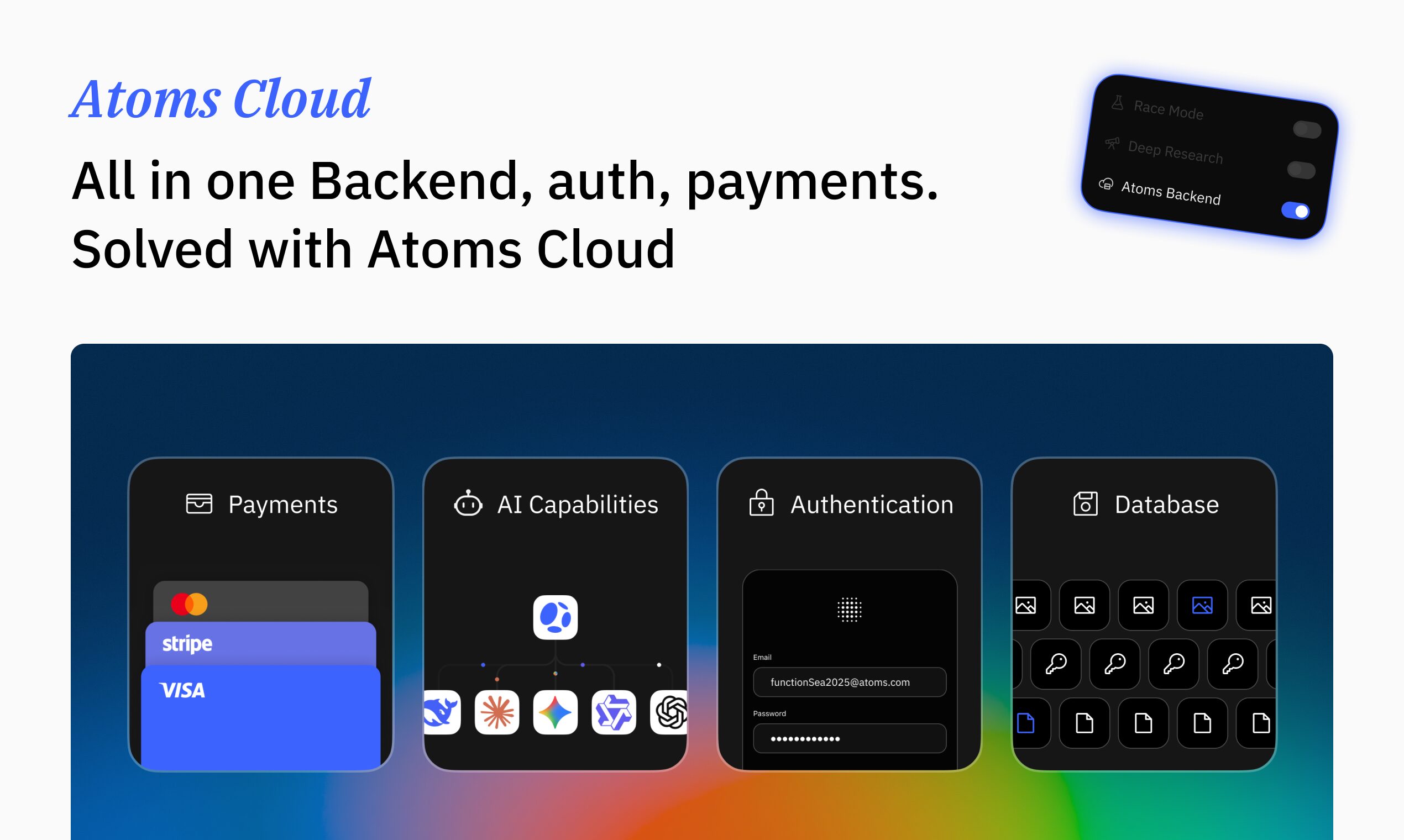
- Supabase Backend: One-command backend activation that provisions a PostgreSQL database, authentication (email/password, OAuth via Google and GitHub), JWT-based session management, Row Level Security policies, auto-generated REST endpoints with full CRUD operations, file storage, edge functions, real-time presence, and database triggers.
- Stripe Payments: One-click setup for payment processing, subscription management, and webhook handling.
- GitHub Sync: Full code export and GitHub synchronization, allowing developers to maintain version control and code ownership outside the platform.
- SEO Tools: Automatic generation of meta tags, sitemaps, structured data, and SEO-optimized content.
- AI Image Generation: Built-in generation of custom visual assets.
- Custom Domains: Production deployment with CDN, SSL, and custom domain support.
Scalability and Reliability Data
Atoms provides production-grade deployment through its Atoms Production Cloud, which includes CDN distribution, SSL certificates, and custom domain support. The Max plan offers 2x compute resources compared to Pro, with storage scaling up to 100GB. Race Mode can orchestrate up to four parallel agent teams simultaneously. However, Atoms has not published formal SLA commitments, uptime guarantees, or independent load-testing results. The platform operates on a credit-based system that inherently rate-limits usage, with the Max plan supporting up to 10,000 credits per month for high-volume deployments.
4. Trust and Governance
Security Certifications
Atoms has not publicly disclosed holding ISO 27001, SOC 2, or comparable third-party security certifications as of February 2026. This is consistent with its current positioning as a startup-stage platform focused on individual builders and small teams rather than enterprise compliance requirements.
Data Privacy Measures
Atoms publishes a comprehensive Privacy Policy through its website. The policy identifies the operating entity as MetaGPT LLC and covers standard data collection practices, lawful bases for processing (contract performance, legitimate interests, consent, and legal obligation), data retention policies, and security measures. Key privacy commitments include:
- Commercially reasonable technical, administrative, and organizational security measures.
- Data retention limited to the duration necessary for service provision and legal compliance.
- Acknowledgment that no internet transmission is fully secure, with users advised to exercise care with sensitive information.
The platform’s Supabase backend integration automatically configures Row Level Security policies, providing database-level access controls for applications built on the platform.
Regulatory Compliance Details
The Privacy Policy references compliance with applicable laws but does not specifically claim GDPR, CCPA, HIPAA, or other regulatory certifications. Given the platform’s global user base and Palo Alto headquarters, CCPA applicability is likely, though explicit certification is not advertised. Users building applications that handle sensitive data should implement their own compliance measures on top of the platform’s baseline security features.
5. Unique Capabilities
- Multi-Agent Orchestration: Atoms deploys a full team of specialized AI agents that collaborate through structured workflows modeled on real software development SOPs. This approach was validated through the MetaGPT paper at ICLR 2024, which demonstrated that SOP-based multi-agent coordination produces more coherent and correct solutions than chat-based multi-agent systems on collaborative software engineering benchmarks.
- Race Mode: A best-of-N execution layer that runs up to four independent agent teams in parallel, each using different model configurations and decision paths. The system scores and ranks outputs using automated metrics and runtime signals, then presents the best candidates for user selection. Benchmarked results show improvement from a 0.30 to 0.85 success rate on complex full-stack tasks, with up to 80% cost reduction on the cost-quality Pareto frontier.
-
Full Business Lifecycle Coverage: Unlike competitors that focus primarily on code generation, Atoms covers the entire business creation pipeline: deep research, product strategy, design and branding, full-stack development, SEO and marketing, payment integration, deployment, analytics, and iteration. The platform positions this as “Vibe Business” rather than mere “Vibe Coding.”
-
Atoms Backend: A one-command backend provisioning system that delivers PostgreSQL databases, authentication systems, RESTful APIs, Row Level Security, file storage, edge functions, and real-time capabilities—all automatically configured and integrated with the application being built.
-
Deep Research Agent: An integrated research capability that analyzes market trends, identifies opportunities, validates product ideas, and generates competitive positioning—providing business intelligence before a single line of code is written.
-
Template Library: Over 50 starting templates covering SaaS applications, e-commerce stores, dashboards, games, and other common application types, allowing users to begin from proven architectures.
6. Adoption Pathways
Integration Workflow
The typical user journey on Atoms follows these steps:
- Describe a business idea or application concept in natural language through the chat interface.
- The AI team automatically decomposes the requirement into tasks, with the researcher analyzing the market, the product manager defining features, and the architect designing the system structure.
- Multiple agents work in parallel on design, frontend, backend, database, and API components.
- Agents merge their work, resolve conflicts, and run automated validation.
- The user reviews the output in a live preview, makes adjustments through conversational prompts or direct code editing, and iterates.
- One-click deployment pushes the application to production with CDN, SSL, and custom domain support.
For Race Mode workflows, the user enables the feature before a major build, and up to four parallel agent teams generate independent solutions for comparison and selection.
Customization Options
- Direct code editing within the platform’s built-in editor.
- Model selection (Claude 3.7, GPT-4, DeepSeek, and auto-configuration).
- Template customization from 50+ starting points.
- Full codebase export and GitHub synchronization for external development.
- Visual customization through the AppViewer component, allowing drag-and-drop asset and component replacement.
- Remix feature for safe experimentation with project forks.
Onboarding and Support Channels
- Help Center: Comprehensive documentation accessible from the platform.
- Discord Community: Active community server for peer support and feature discussions.
- Video Library: Official demos, feature walkthroughs, and case studies on the Atoms website and YouTube.
- Blog and Changelog: Regular product updates and technical articles.
- GitHub: Open-source repositories for MetaGPT and OpenManus with active issue tracking and community contributions.
7. Use Case Portfolio
Enterprise Implementations
Atoms is primarily positioned for individual builders, indie hackers, and small teams rather than large enterprise deployments. However, the platform’s capabilities have implications for enterprise contexts:
- Rapid prototyping and MVP creation: Product teams can use Atoms to validate business concepts with functional full-stack applications in hours rather than weeks.
- Internal tool development: Teams can generate custom dashboards, analytics platforms, and workflow tools through conversational prompts.
- E-commerce and SaaS launches: The integrated Stripe payment processing and Supabase backend make it possible to ship revenue-generating applications directly from the platform.
User testimonials indicate successful deployments across web applications, gaming, Web3 projects, crypto dashboards, time trackers, and marketing tools.
Academic and Research Deployments
The academic foundation of Atoms is unusually strong for a commercial AI product:
- The MetaGPT paper has been cited across the AI research community and presented as an oral at ICLR 2024 (top 1.2%).
- The AFlow paper on automated agentic workflow generation achieved oral status at ICLR 2025 (top 1.8%).
- The Foundation Agents research organization, established by the DeepWisdom team, published a comprehensive survey paper on brain-inspired agent architectures covering cognitive science, neuroscience, and computational research.
- Additional publications span TPAMI, NeurIPS, and ACL, establishing the team’s research credentials across multiple premier venues.
- The Data Interpreter project addresses end-to-end data science automation, complementing the software development focus of the core platform.
ROI Assessments
Formal third-party ROI studies have not been published. However, the platform’s value proposition centers on dramatic time compression:
- Traditional project setup (30–60 minutes) is reduced to approximately 10 seconds with templates.
- Component creation that normally requires writing boilerplate, importing dependencies, and styling is replaced by natural language description.
- Database integration that typically involves server setup, ORM configuration, migrations, and security is accomplished through a single command.
- The Race Mode feature specifically targets cost-quality optimization, using Pareto-frontier analysis to deliver higher-quality outputs at lower per-credit costs.
8. Balanced Analysis
Strengths with Evidential Support
- Research-backed architecture: The multi-agent SOP approach is not a marketing gimmick—it is validated by peer-reviewed research accepted at ICLR with oral status, the highest recognition tier at one of the world’s top machine learning conferences. This provides genuine scientific credibility that most AI builder competitors lack.
- Full business lifecycle coverage: Atoms is one of very few platforms that spans from market research through payment processing and analytics, reducing the need to stitch together multiple tools.
- Race Mode innovation: The best-of-N parallel execution approach provides a measurable quality improvement (0.30 to 0.85 success rate) while simultaneously reducing costs through Pareto-optimal model selection.
- Open-source heritage: The MetaGPT and OpenManus open-source projects (60,000+ and 16,000+ GitHub stars respectively) demonstrate genuine technical capability and community trust.
- Code ownership: Unlike many AI builders that lock users into proprietary platforms, Atoms allows full code export and GitHub synchronization.
- Significant funding: The $31 million in Series A/A+ funding from Cathay Capital provides financial runway for continued development and scaling.
- Strong Product Hunt performance: Achieving number one Product of the Day twice validates product-market fit within the builder community.
Limitations and Mitigation Strategies
- No enterprise security certifications: The absence of SOC 2, ISO 27001, or comparable certifications limits adoption by compliance-sensitive organizations. Mitigation: Users requiring compliance should deploy exported code on their own certified infrastructure rather than relying on Atoms Production Cloud.
- Credit-based pricing complexity: The credit system (daily bonuses, monthly allocations, bonus credits) can be difficult to predict for budget planning. Mitigation: The tiered credit options within each plan provide some flexibility, and the free tier allows initial testing before committing.
- Dependency on external AI models: Application quality is ultimately bounded by the capabilities of the underlying LLMs (Claude, GPT-4, DeepSeek). Mitigation: Race Mode’s multi-model approach reduces dependence on any single model’s performance.
- Young platform maturity: As a 2025–2026 product built on evolving technology, long-term stability and backward compatibility are not yet proven. Mitigation: Code export and GitHub sync provide an escape path if the platform changes direction.
- Limited offline/mobile capabilities: The platform is browser-based with no native IDE integration or offline mode. Mitigation: Exported code can be developed locally in any IDE.
- AI-generated code quality ceiling: While Race Mode improves reliability, complex applications with unusual requirements may still require significant human intervention and code review. Users should treat Atoms output as a strong starting point rather than finished production code for critical applications.
9. Transparent Pricing
Plan Tiers and Cost Breakdown
| Plan | Monthly Cost | Credits Included | Daily Bonus | Disk Space | Key Features |
|---|---|---|---|---|---|
| Free | $0 | 25/month | 15/day | Limited | Basic features, public projects only |
| Pro | $20–$70 | 100–350/month | 15/day | 10 GB | Private projects, code download, badge removal, custom domain, Atoms Production Cloud |
| Max | $100–$300+ | 500–10,000/month | 15/day | 100 GB | Everything in Pro plus 2x compute, Race Mode, higher storage, scalable credits |
Pro plan credit tiers: 100 credits at $20/month, 250 credits at $50/month, 350 credits at $70/month.
Max plan credit tiers: 500 credits at $100/month, 1,000 credits at $200/month, 1,500 credits at $300/month, scaling up to 10,000 credits.
All paid plans auto-renew monthly and can be downgraded to Free at any time, with changes taking effect at the end of the current billing cycle. Upgrades take effect immediately with prorated pricing.
Total Cost of Ownership Projections
For a typical indie builder or small team:
- Light usage (exploration, prototyping): Free plan at $0/month, limited to 25 credits plus daily bonuses.
- Active builder (1–3 projects per month): Pro plan at $20–$50/month, adequate for most single-person operations.
- Power user or small team (multiple projects, Race Mode): Max plan at $100–$200/month, providing 2x compute, Race Mode for quality assurance, and 100 GB storage.
- High-volume production: Max plan at $300+ per month with extended credit tiers.
Additional costs to consider include custom domain registration (external), Stripe transaction fees for payment-enabled applications, and any Supabase costs that exceed the free tier for high-traffic applications.
10. Market Positioning
Competitor Comparison Table
| Platform | Primary Focus | Multi-Agent System | Backend Generation | Payment Integration | Code Export | Starting Price | Notable Validation |
|---|---|---|---|---|---|---|---|
| Atoms | Full business lifecycle (research to revenue) | Yes (6+ specialized agents) | Yes (Supabase, auto-RLS) | One-click Stripe | Yes (GitHub sync) | Free / $20 Pro | ICLR 2024 Oral, Product Hunt #1 |
| Lovable | Full-stack web apps via chat | No | Supabase integration | Limited | GitHub sync | Free / ~$20 | Popular with non-technical founders |
| Bolt (Vercel) | Full-stack prototyping | No | Node.js + Prisma | Limited | Yes | Free / ~$20 | Vercel ecosystem integration |
| Replit | Browser-based dev environment | No (single AI assistant) | Manual setup | Manual | Yes | Free / ~$25 | 40M+ users, broad language support |
| Cursor | AI-powered code editor | No | N/A (local IDE) | N/A | N/A (local) | Free / ~$20 | Popular with professional developers |
| v0 (Vercel) | React component generation | No | Limited | No | Yes | Free / Paid | Strong for UI components |
| Emergent | Natural language to full systems | Yes (system-level) | Complete | Yes | GitHub sync | Free / $20 | Full deployment pipeline |
Unique Differentiators
Atoms occupies a distinctive position in the AI builder landscape through three primary differentiators:
- Research-validated multi-agent architecture: No competitor in the AI app builder space can point to an ICLR oral paper validating their core technical approach. This provides Atoms with a credibility advantage rooted in peer-reviewed science rather than marketing claims alone.
-
Full business lifecycle scope: While competitors focus on code generation or deployment, Atoms spans from deep market research through product strategy, development, SEO, payment processing, analytics, and iteration—covering the entire entrepreneurial pipeline.
-
Race Mode (best-of-N parallel execution): This feature is architecturally unique among AI builders, running multiple complete agent workflows in parallel rather than sampling multiple completions from a single API call. The published benchmark improvement from 0.30 to 0.85 success rate provides concrete evidence of its effectiveness.
11. Leadership Profile
Chenglin Wu — Founder and CEO, DeepWisdom
Chenglin Wu is the founder and chief executive officer of DeepWisdom and the creator of MetaGPT. His professional trajectory includes:
- Forbes China 30 Under 30 (2018): Recognized for early achievements in AI and technology entrepreneurship.
- Hurun 30×30 Entrepreneurial Leader (2018 and 2019): Listed among China’s most promising young entrepreneurs.
- Tencent: Served as a senior researcher for approximately four years (2014–2018), accumulating “dozens of awards” from the company during his tenure.
- Huawei Technologies: Worked as a researcher for approximately two years (2012–2014) in Hangzhou.
- DeepWisdom: Founded in July 2019, leading the company from AI-native software development through to the creation of MetaGPT, MGX, and Atoms.
- MetaGPT Creator: Corresponding author on the seminal MetaGPT paper (ICLR 2024 Oral), which introduced the SOP-based multi-agent collaboration framework.
Sirui Hong — Co-Founder, Technical Leader
Sirui Hong serves as the technical leader for NLP/AIGC algorithms at DeepWisdom and is a core contributor to both MetaGPT and OpenManus:
- MetaGPT paper: Conducted most experiments and designed the executable feedback module for the ICLR 2024 oral paper.
- Data Interpreter paper: Lead author on this related work addressing automated data science.
- AFlow paper: Co-authored this contribution which achieved oral acceptance at ICLR 2025 (top 1.8%).
- NeurIPS 2019: Won the AutoDL Competition (NLP track).
- Research publications: Published across TPAMI, ICLR, NeurIPS, and ACL, with current focus on enhancing large language models, advanced code generation, and multi-agent performance optimization.
- Academic background: Research assistant at the Hong Kong University of Science and Technology (2014–2016).
Bill Xu — Key Leadership
Bill Xu is identified on LinkedIn as a core team member associated with Atoms.dev and MetaGPT, actively involved in product launches and community engagement. He publicly announced the Atoms Product Hunt number one achievement in February 2026.
Patent Filings and Publications
DeepWisdom’s intellectual contributions are primarily expressed through academic publications and open-source software rather than patents:
- MetaGPT: Meta Programming for A Multi-Agent Collaborative Framework (ICLR 2024 Oral, top 1.2%, ranked number one in LLM-based Agent category)
- AFlow: Automating Agentic Workflow Generation (ICLR 2025 Oral, top 1.8%, ranked number two in LLM Agent category)
- Data Interpreter: End-to-end data science automation agent
- Atom of Thoughts (AoT): Reasoning framework transforming complex reasoning into Markov-style atomic questions
- Foundation Agents: Advances and Challenges: Comprehensive survey paper on brain-inspired agent architectures (2025)
- Additional publications in TPAMI, NeurIPS, and ACL
12. Community and Endorsements
Industry Partnerships
- Cathay Capital: Led the $31 million Series A/A+ funding round, serving as both investor and strategic partner. Cathay Capital’s statement described DeepWisdom as a partner at “the intersection of scientific research breakthroughs, product iterations, and business verification.”
- MindWorks Capital: Previously invested in DeepWisdom, as documented in their portfolio.
- Foundation Agents Organization: DeepWisdom established this research organization dedicated to advancing Foundation Agent research and Agent Protocol standards, inviting global researchers to collaborate.
- Open-source ecosystem: MetaGPT and OpenManus maintain active open-source communities with contributors across multiple countries, hosted on GitHub.
- Product Hunt: Strong community engagement with 3,100+ followers and multiple top-ranked launches.
Media Mentions and Awards
- Product Hunt: Number one Product of the Day (MGX launch, March 2025) and number one Product of the Day (Atoms launch, February 2026); number one Product of the Week (MGX).
- Forbes China 30 Under 30: Recognition for founder Chenglin Wu (2018).
- Hurun 30×30: Entrepreneurial leader recognition for Wu (2018, 2019).
- KR-Asia: Published a feature article on DeepWisdom’s journey from MetaGPT to Atoms, positioning the company as a leader in China’s push into vibe coding.
- Beyond The AI: Published a detailed platform review documenting full-stack capabilities.
- YouTube creator community: Multiple independent review videos, including a Race Mode comparison testing four AI models that accumulated 20,000+ views within two weeks.
- Tom’s Guide, Futurepedia, Toolradar: Listed and reviewed across major AI tool directories.
13. Strategic Outlook
Future Roadmap and Innovations
Based on public statements, funding announcements, and observable product trajectory:
- Global market expansion: The $31 million funding round explicitly earmarks resources for international expansion, with Palo Alto headquarters serving as the base for Western market penetration.
- Multi-agent system advancement: Continued R&D investment in multi-agent coordination, building on the Foundation Agents research organization’s mission to advance agent protocols (World, Action, Communication).
- Race Mode evolution: The parallel execution framework is likely to expand with more model configurations, larger team sizes, and more sophisticated scoring mechanisms as the underlying models improve.
- Enterprise features: As the platform matures and the user base grows, enterprise-oriented features such as team collaboration, role-based access controls, audit logging, and compliance certifications represent natural expansion areas.
- Agent Protocol standardization: The Foundation Agents organization’s focus on developing standard agent protocols suggests DeepWisdom is positioning for a future where agents communicate across platforms using shared standards.
- Mobile app deployment: User feedback consistently requests publishing capabilities for Apple App Store and Google Play Store, indicating a likely near-term development priority.
Market Trends and Recommendations
Atoms is positioned within several powerful converging trends:
- The “vibe coding” movement: The rapid adoption of AI-assisted code generation has shifted from novelty to standard practice. Atoms extends this trend by encompassing the full business lifecycle, not just code production.
- Multi-agent AI maturation: As single-agent capabilities plateau, multi-agent coordination represents the next frontier. DeepWisdom’s academic leadership in this area (ICLR oral presentations, 60,000+ GitHub stars) positions Atoms ahead of competitors still relying on single-model architectures.
- Solo entrepreneur enablement: The cost of launching a digital business continues to decrease. Atoms targets the emerging category of AI-enabled “one-person companies” where a single individual can achieve what previously required a full development team.
- Open-source to commercial pipeline: DeepWisdom’s trajectory from open-source research (MetaGPT) to commercial product (Atoms) mirrors successful paths taken by companies like Hugging Face, Vercel, and Supabase—building community trust through open-source before monetizing through premium features.
For potential users, Atoms is best suited for individual builders, indie hackers, and small teams seeking to validate business ideas quickly with functional, revenue-capable applications. Users with enterprise compliance requirements should evaluate the platform’s security posture carefully and consider using the code export feature to deploy on certified infrastructure. The research-backed multi-agent approach and Race Mode capability provide genuine technical advantages over simpler AI code generators, though users should maintain realistic expectations about the complexity of applications that can be fully automated.
Final Thoughts
Atoms represents one of the most technically credible entries in the rapidly expanding AI app builder market. Its lineage from MetaGPT—a peer-reviewed, ICLR-oral-accepted multi-agent framework with nearly 60,000 GitHub stars—provides a scientific foundation that most competitors simply cannot match. The platform’s evolution from open-source research framework to productized development team to full business automation engine demonstrates a coherent strategic vision executed over three years.
The $31 million in funding from Cathay Capital validates both the technology and the market opportunity. Race Mode’s benchmarked improvement from 0.30 to 0.85 success rates on complex full-stack tasks demonstrates that multi-model, multi-agent parallel execution delivers measurable quality gains—not just incremental improvements but a fundamental step change in reliability.
Where Atoms faces its greatest challenges is in the gap between its ambitious vision (“Vibe Business”) and the current reality of AI-generated applications. While the platform excels at prototyping and MVP creation, building truly production-grade, maintainable, and scalable business applications still requires substantial human oversight and expertise. The absence of enterprise security certifications limits its addressable market, and the credit-based pricing model introduces unpredictability for cost-conscious users.
For its target audience—individual builders and small teams seeking to transform ideas into functional, revenue-generating applications quickly—Atoms delivers genuine value. The multi-agent architecture produces meaningfully better results than single-agent approaches, the full lifecycle coverage reduces tool fragmentation, and the code export option preserves developer autonomy. As the underlying models continue to improve and the platform matures, Atoms has the research foundation, funding, and community to become a defining tool in the AI-assisted business creation category.