Table of Contents
- Overview
- Key Features
- How It Works
- Use Cases
- Pros \& Cons
- How Does It Compare?
- Final Thoughts
- Axis One – Fact-Checked and Enhanced Version
- Overview
- Key Features
- How It Works
- Use Cases
- Pricing
- Pros and Cons
- How Does It Compare?
- GitHub Copilot and OpenAI Cloud Services (ChatGPT, GPT-4)
- Ollama (Open-Source CLI Tool)
- LM Studio (Local GUI Tool)
- Self-Hosted vLLM with Dedicated Servers
- Enterprise On-Premise AI Solutions (Presidio Private AI Accelerator, etc.)
- Specialized Hardware Devices (NVIDIA Jetson, Raspberry Pi setups)
- Key Differentiators
- Final Thoughts
Overview
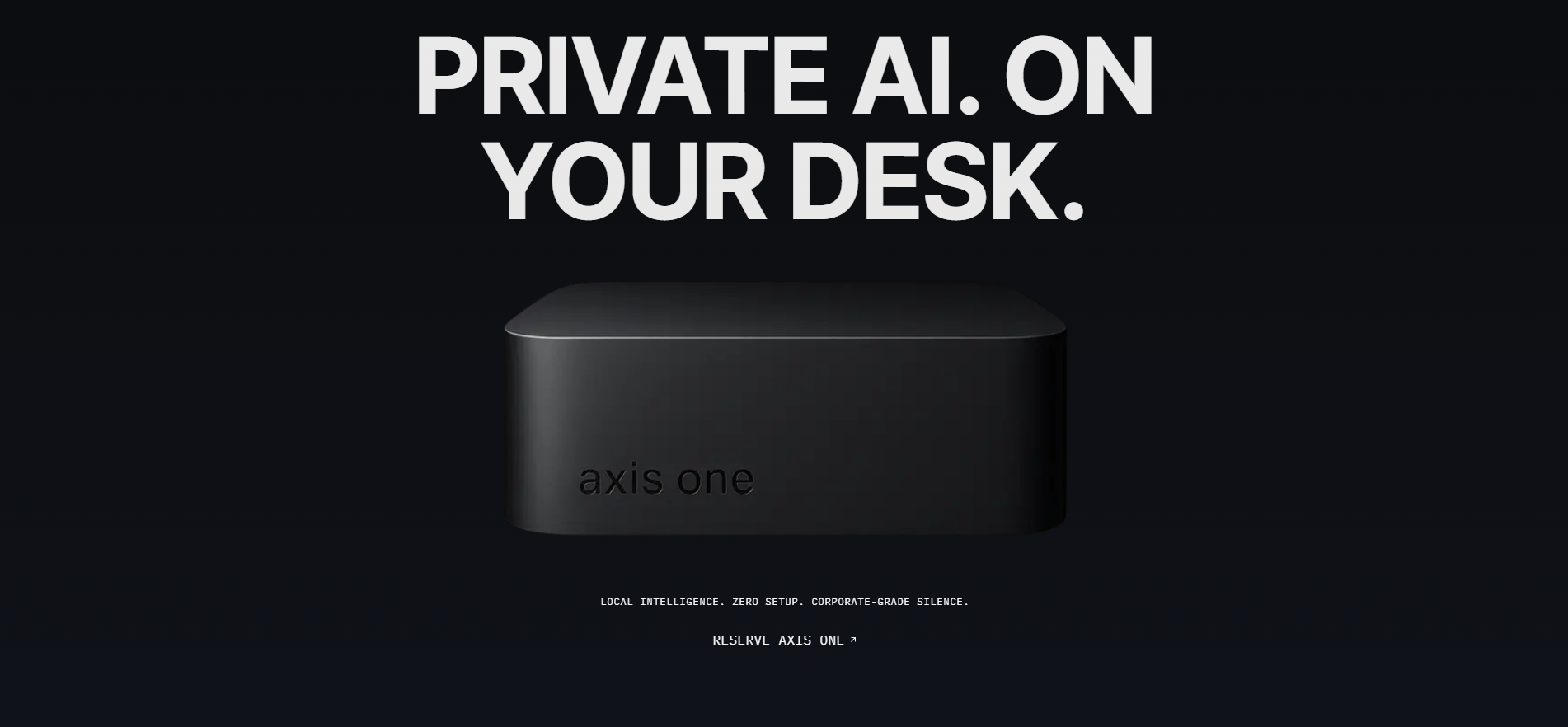
In a world where AI assistants are becoming indispensable, data privacy has emerged as a paramount concern for businesses. Sending sensitive company information to third-party cloud services isn’t always an option. Enter Axis One, a compact hardware device designed to solve this exact problem. It delivers a private, ChatGPT-style AI assistant that operates entirely on your local network. This means no cloud, no data leaks, and no privacy compromises—just a secure, powerful AI tool built for teams who need confidentiality and simplicity without the headache of managing servers or learning Linux.
Key Features
Axis One packs a suite of powerful features into a simple, accessible package. Here’s what makes it stand out:
- Fully On-Premise AI Processing: All AI computations happen directly on the Axis One device. Your data, prompts, and conversations never leave your office network.
- No Cloud Data Transmission: With a strict no-cloud policy, it guarantees that your confidential information remains completely private and under your control.
- Familiar ChatGPT-Style Interface: The intuitive, conversational interface makes it easy for anyone on your team to start using the AI assistant immediately, with no learning curve.
- Document Upload Capability: Securely upload internal documents, reports, and data to create a private knowledge base that the AI can use to provide context-aware answers.
- Local AI Workflow Execution: Design and run automated AI workflows on your private infrastructure, perfect for processing sensitive data without external exposure.
- Simple Web Dashboard Access: Access the AI assistant through a clean web dashboard from any computer on your local network.
- Plug-and-Play Setup: Getting started is as simple as plugging the device into your network. There’s no complex software installation or configuration required.
- No Server Management or Linux Knowledge Needed: Axis One is built for non-technical teams, abstracting away all the complexities of server maintenance and command-line interfaces.
How It Works
The beauty of Axis One lies in its straightforward operational flow. It’s designed to be incredibly easy to deploy and use. Here’s the step-by-step process:
- Plug It In: You start by connecting the physical Axis One device to your local office network, just like you would with any other network device.
- Access the Dashboard: From any computer on the same network, open a web browser and navigate to the device’s local dashboard.
- Upload Your Data: Securely upload documents, PDFs, and other files directly to the device. This data becomes the private knowledge base for your AI assistant.
- Start Chatting: Interact with the AI through the ChatGPT-style interface. Ask questions, summarize documents, or request data analysis.
- Get Secure Responses: The AI processes your request entirely on the device’s hardware. Responses are generated locally and delivered back to you without ever touching the internet. All workflows and queries run securely within the confines of your private network.
Use Cases
Axis One is an ideal solution for a wide range of professional scenarios where data privacy is non-negotiable.
- Privacy-Sensitive Business Assistance: Use it as a general-purpose AI assistant for drafting emails, creating reports, and brainstorming ideas using confidential company data.
- Confidential Document Analysis: Analyze legal contracts, financial statements, or patient records without the risk of exposing sensitive information to cloud-based services.
- Regulated Industry Workflows: Perfect for healthcare, finance, and legal sectors that must comply with strict data privacy regulations like HIPAA or GDPR.
- Air-Gapped Environment Deployment: Operate a powerful AI tool in secure, “air-gapped” environments that have no connection to the public internet.
- Secure Team Collaboration: Enable teams to leverage AI for collaboration on sensitive projects without the inherent risks of cloud-based platforms.
- Internal Knowledge Base Querying: Turn your internal documentation into an interactive knowledge base that employees can query in natural language.
- Secure AI Prototyping: Develop and test AI-powered applications and workflows in a safe, sandboxed environment before deploying them more broadly.
Pros \& Cons
Like any tool, Axis One has its unique strengths and limitations. Understanding them is key to deciding if it’s the right fit for your team.
Advantages
- Complete Data Privacy: With all processing done locally, it offers an unparalleled level of data security and confidentiality.
- No Cloud Dependency: Your AI assistant remains fully functional even if your internet connection goes down, ensuring reliability.
- Effortless Setup: It’s designed for true plug-and-play simplicity, requiring no technical expertise or IT intervention to get started.
- Familiar User Experience: The ChatGPT-like interface ensures rapid adoption across your team without the need for training.
- Network-Isolated Security: Operating exclusively on your local network provides a powerful layer of security against external threats.
Disadvantages
- Requires Physical Device Purchase: Unlike software solutions, Axis One requires an upfront investment in the physical hardware.
- Limited by On-Device AI Models: The capabilities are tied to the specific AI models that can run on the device’s hardware, which may not be the absolute latest or largest models available.
- Performance Constrained by Hardware: The speed and complexity of tasks are limited by the processing power of the physical device.
- Potentially Significant Upfront Cost: The combination of hardware and specialized software may result in a higher initial cost compared to a monthly cloud subscription.
- Updates May Require Manual Intervention: Software and model updates might need to be applied manually, unlike cloud services that update automatically.
How Does It Compare?
The AI landscape is diverse, and Axis One carves out a specific niche. Here’s how it stacks up against the alternatives:
- Cloud AI Services (ChatGPT, Claude): While cloud services offer immense power and scalability, they require you to send your data to their servers. Axis One’s key differentiator is network-only privacy, ensuring your data never leaves your premises.
- Self-Hosted LLMs (Ollama, LM Studio): These tools also offer privacy but demand significant technical expertise. You need to manage servers, configure environments, and handle complex software installations. Axis One contrasts this with its plug-and-play simplicity and no technical expertise required approach.
- Enterprise AI Platforms: Large enterprise platforms can offer on-premise solutions but are often complex, expensive, and require extensive integration. Axis One is a physical device vs. a software installation, making it a much more accessible and self-contained solution for teams and small to medium-sized businesses.
Final Thoughts
Axis One presents a compelling proposition for any organization that wants to harness the power of generative AI without compromising on data security. It successfully bridges the gap between the user-friendliness of cloud-based tools like ChatGPT and the robust privacy of complex, self-hosted solutions. While the upfront hardware cost and performance limitations are important considerations, the value of absolute data confidentiality and plug-and-play simplicity cannot be overstated. For teams in regulated industries or any business that handles sensitive information, Axis One is a powerful, practical, and secure entry into the world of local AI.
Now I have comprehensive information about Axis One and its competitors. Let me provide the complete fact-checked version:
Axis One – Fact-Checked and Enhanced Version
Overview
In a world where AI assistants have become indispensable business tools, data privacy and regulatory compliance have emerged as paramount concerns for organizations across sensitive industries. Sending confidential company information to third-party cloud services increasingly raises legal, compliance, and security concerns that many organizations cannot accommodate. Enter Axis One, a specialized hardware appliance designed to solve this exact problem through purpose-built edge computing infrastructure. It delivers a private, ChatGPT-style AI assistant that operates entirely on your local network using open-source language models (Mistral 7B-13B, Llama 2, Qwen), ensuring zero cloud data transmission, eliminating data leaks, and maintaining complete privacy and control—all without requiring teams to manage servers, configure Linux environments, or maintain complex AI infrastructure.
Key Features
Axis One delivers comprehensive private AI capabilities through purpose-engineered hardware combining NVIDIA Jetson Orin edge computing with optimized software specifically designed for business workflows.
Fully On-Premise AI Processing: All AI computations execute directly on the Axis One hardware appliance within your office network infrastructure using edge silicon (NVIDIA Jetson Orin). Your data, prompts, and conversations remain completely internal, never transmitted to external servers or cloud infrastructure.
No Cloud Data Transmission: Enforces strict offline-only operation through network isolation design ensuring your confidential information remains completely private and under your organizational control, satisfying stringent data governance and compliance requirements.
Familiar ChatGPT-Style Interface: Provides intuitive, conversational web-based dashboard interface enabling any team member to immediately begin leveraging AI capabilities without technical expertise, complex training requirements, or learning curves.
Document Upload Capability: Securely upload internal documents, confidential reports, proprietary data, and sensitive files directly to the device creating a private, searchable knowledge base that the AI leverages to provide highly contextual, accurate answers grounded in your specific organizational information.
Local AI Workflow Execution: Design and implement automated AI workflows directly on your private infrastructure for processing sensitive data, executing multi-step tasks, and handling business processes without external exposure or third-party involvement.
Simple Web Dashboard Access: Access the AI assistant through a clean, intuitive web dashboard from any authorized computer on your local network, enabling seamless integration into existing workplace technology without software installation or special permissions.
Plug-and-Play Setup: Getting started requires only plugging the device into Ethernet power—no complex software installation, no configuration required, no technical expertise necessary, enabling immediate business value within 60 seconds of power-on.
No Server Management or Linux Knowledge Needed: Axis One completely abstracts away server maintenance complexity, operating system administration, command-line interfaces, and technical infrastructure management, specifically designed for non-technical business teams.
OpenAI-Compatible API: Device provides drop-in API endpoint compatible with OpenAI ChatGPT specifications, enabling seamless integration with existing OpenAI-based applications without code modifications while redirecting processing to local infrastructure.
Multi-User Concurrent Operations: Supports simultaneous chat sessions, file-based RAG (Retrieval-Augmented Generation) queries, and embedding operations enabling team collaboration while maintaining isolation and security.
Automatic Model Updates: Handles downloading and optimization of supported open-source language models (Mistral, Llama, Qwen) through secure channels ensuring teams always have access to latest tuned versions without manual intervention.
Network Isolation Security: Enforces network-first architecture with minimal attack surface through Ethernet-only connectivity (no USB/Bluetooth ports), preventing unauthorized data extraction and ensuring compliance with air-gapped or restricted network environments.
Low Power Consumption: Operates at 15W under load with silent operation (under 30dB) suitable for office desk placement, team collaboration spaces, or secure facility deployment without thermal or acoustic disruption.
60-Second Boot Time: Device reaches operational status within 60 seconds from power-on with preconfigured security settings, enabling rapid deployment and recovery compared to traditional server infrastructure requiring lengthy setup procedures.
How It Works
Axis One’s operational flow emphasizes simplicity and accessibility through purpose-engineered hardware eliminating complexity from private AI deployment.
Users initiate deployment by connecting the Axis One physical hardware appliance to their office network using standard Ethernet connectivity and power supply, exactly like any network device (printer, access point) without special networking knowledge.
From any authorized computer on the same network, users open a web browser and navigate to the device’s local network address, immediately accessing the web dashboard with no authentication requirements for local network access, enabling immediate team usage.
Users upload confidential documents, reports, proprietary data, or other files directly to the device through the dashboard interface, securely storing them in the private knowledge base that the AI leverages to provide contextual answers specific to organizational information.
Users interact with the AI through the ChatGPT-style conversational interface by typing natural language questions, prompts, or instructions. The AI leverages both its underlying language model knowledge and your uploaded documents to provide responses.
The AI processes requests entirely within the device’s local hardware, analyzing queries, searching your knowledge base through RAG (Retrieval-Augmented Generation), and generating responses. Processing never extends beyond your network perimeter.
Responses are generated locally using the device’s edge computing capabilities and delivered directly back to the user without any cloud transmission, internet connectivity requirement, or external service involvement.
All operations remain contained within your private network infrastructure—workflows execute, documents are processed, AI interactions occur entirely locally enabling full compliance with data residency requirements, regulatory mandates, and organizational security policies.
For technical teams, the device provides an OpenAI-compatible REST API endpoint enabling integration with existing applications, automations, and workflows without code modifications.
Use Cases
Axis One serves organizations across industries where data privacy, regulatory compliance, and confidential information protection are non-negotiable requirements for business operations.
Privacy-Sensitive Business Assistance: Deploy as general-purpose AI assistant for drafting confidential emails, creating internal reports, analyzing proprietary strategies, and brainstorming using sensitive company information guaranteed to remain private.
Confidential Document Analysis: Analyze legal contracts, financial statements, patent portfolios, proprietary research, patient records, or classified information without risking exposure to cloud-based services, data breaches, or third-party surveillance.
Regulated Industry Workflows: Ideal deployment for healthcare organizations (HIPAA compliance), financial institutions (SOC 2, PCI-DSS), legal firms (attorney-client privilege), and government contractors (security clearance requirements) requiring strict data residency and privacy controls.
Air-Gapped Environment Deployment: Operate powerful AI capabilities within completely disconnected networks (air-gapped infrastructure) with zero public internet connectivity, essential for military, intelligence, and highly sensitive government applications.
Secure Team Collaboration: Enable cross-functional teams to leverage AI capabilities on sensitive projects without exposing confidential information to cloud-based platforms, competitive intelligence risks, or external data retention policies.
Internal Knowledge Base Querying: Transform internal documentation, company wikis, proprietary procedures, and institutional knowledge into an interactive AI-powered knowledge base that employees can query naturally without IT intermediation.
Secure AI Prototyping: Develop and test AI-powered applications, workflows, and automation within a safe, sandboxed environment protecting intellectual property before broader deployment or commercialization.
Compliance Auditing and Verification: Enable security and compliance teams to audit logs, verify AI decision-making, and demonstrate regulatory compliance through complete local control and transparent audit trails impossible with cloud services.
Intellectual Property Protection: Analyze proprietary designs, technical specifications, or strategic information using local AI without risk of exposure to cloud infrastructure, data persistence, or algorithmic learning affecting your competitive position.
Supply Chain Security: Process sensitive supplier information, procurement data, and vendor agreements locally without exposing organizational purchasing patterns or strategic relationships to cloud analytics platforms.
Pricing
Axis One operates on upfront hardware purchase model with transparent, fixed cost structure enabling organizations to plan capital investment without ongoing cloud subscription uncertainty.
Hardware Device Cost: Initial purchase price for Axis One appliance not explicitly disclosed in public materials (typical enterprise edge AI appliances range \$3,000-\$15,000 depending on specifications and support bundles). Direct inquiry through sales channels required for current pricing.
Annual Support Plans: Optional professional support, maintenance, and software update services available through tiered subscription models. Specific pricing requires direct sales consultation.
No Recurring Cloud Costs: Unlike cloud AI services charging per query, per token, or per seat, Axis One involves no ongoing consumption-based fees, enabling predictable IT budgeting and cost control regardless of AI usage volume.
Open-Source Model Availability: Core AI models (Mistral, Llama, Qwen) provided free through open-source channels—no licensing costs, royalties, or usage fees for underlying language models.
Minimal Infrastructure Investment: Eliminates need for expensive GPU server hardware, cloud GPU instances, or elaborate IT infrastructure typically required for private AI deployment, reducing total cost of ownership through purpose-built appliance design.
Note: As a recently launched product in November 2025, pricing structure may evolve based on market positioning, enterprise demand, and feature additions. Organizations considering Axis One should contact sales teams directly for current pricing, volume discounts, and available support tiers.
Pros and Cons
Understanding both advantages and practical limitations provides clarity for evaluating Axis One’s fit for organizational requirements and deployment scenarios.
Advantages
Complete Data Privacy and Security: With all processing occurring locally within organizational control, it offers unparalleled data security, confidentiality, and protection of proprietary information, trade secrets, and sensitive data compared to cloud alternatives.
No Cloud Dependency or Internet Requirement: Continues full AI functionality during internet outages, network disruptions, or connectivity issues ensuring business continuity and operational resilience impossible with cloud-dependent services.
Compliance and Regulatory Satisfaction: Meets HIPAA requirements for healthcare, SOC 2 Type II for security-conscious organizations, GDPR data residency obligations, and industry-specific regulations without complex compliance architecture.
Effortless Deployment and Simplicity: Truly plug-and-play setup requiring no technical expertise, server administration, or IT infrastructure management—specifically engineered for business teams unfamiliar with Linux, cloud deployment, or system administration.
Rapid Adoption Across Non-Technical Teams: ChatGPT-familiar interface enables immediate productivity without training programs, documentation review, or IT support burden, dramatically accelerating organizational AI adoption.
No Network Isolation Complexity: Operating entirely on local network infrastructure eliminates complex VPN configurations, proxy management, firewall rule creation, or network engineering required for most private cloud solutions.
Complete Audit Trail and Transparency: Full local control enables comprehensive audit capabilities, decision-making transparency, and compliance verification impossible with cloud services lacking visibility into algorithmic operations.
Predictable, Fixed Cost Structure: Upfront hardware investment enables financial predictability without subscription cost escalation, per-query pricing surprises, or cloud billing unpredictability typical of cloud AI services.
Disadvantages
Significant Upfront Capital Investment: Requires substantial initial hardware purchase cost (estimated \$3,000-\$15,000+) versus cloud AI services offering low-cost trial access and pay-as-you-go consumption models requiring minimal upfront investment.
Limited by On-Device AI Model Capabilities: Constrained to 7B-13B parameter language models (Mistral, Llama, Qwen) that, while powerful for business tasks, don’t match sophistication or performance of larger cloud models (GPT-4, Claude 3 Opus) for highly complex reasoning.
Hardware Performance Limitations: Speed and task complexity limitations imposed by physical device processing power—cannot match unlimited cloud GPU resources for demanding workloads, large-scale batch processing, or concurrent high-volume usage.
Physical Device Maintenance Requirements: Requires hardware maintenance responsibility, potential device replacement/repair, thermal management, and operational logistics (unlike cloud services with no hardware concerns).
Manual Software/Model Updates: Software security patches, model updates, and feature enhancements may require manual intervention or scheduled maintenance windows unlike cloud services providing automatic seamless updates.
No Dynamic Scaling or Burst Capacity: Fixed hardware capacity prevents scaling to handle usage spikes, growth, or demand variations—organizations experiencing growth may need hardware replacement or supplementation.
Limited Model Customization Currently: Current design doesn’t support custom model uploads for fine-tuning—organizations with specialized needs requiring custom LLM training must use alternative approaches.
Requires Dedicated Network Infrastructure: Deployment requires available network infrastructure, Ethernet connectivity, power supply, and physical space—organizations lacking IT infrastructure must invest accordingly.
New Platform with Limited Production Track Record: Launched November 2025 means limited large-scale enterprise deployment history, edge case discoveries, long-term reliability validation, and proven scalability compared to mature cloud platforms.
Team Familiarity with Open-Source Models: Requires organizational adjustment to open-source model capabilities and limitations compared to familiar cloud model performance characteristics.
How Does It Compare?
The private AI and local language model landscape features diverse solutions ranging from managed enterprise platforms to open-source self-hosted tools to specialized hardware appliances. Understanding Axis One’s positioning requires examining specific competitor approaches across different deployment models.
GitHub Copilot and OpenAI Cloud Services (ChatGPT, GPT-4)
Cloud AI services including ChatGPT, GPT-4, Claude, and GitHub Copilot provide powerful, state-of-the-art language models accessible through cloud APIs requiring internet connectivity and transmitting all data to provider infrastructure. Offer unlimited scaling, latest model versions, and seamless updates through cloud infrastructure. Pricing based on token consumption or subscription fees. No upfront hardware investment required.
Axis One and cloud services differ fundamentally in data flow and privacy model. Cloud services transmit all queries, documents, and context to external servers for processing—inherently exposing sensitive data to third-party infrastructure regardless of security claims. Cloud services require internet connectivity and impose usage-based ongoing costs. Axis One maintains complete local processing and data isolation at cost of limited hardware-constrained AI model sophistication.
Cloud services excel for organizations comfortable with cloud data transmission prioritizing model performance and unlimited scaling. Axis One serves organizations with mandatory local-only data processing requirements regardless of performance trade-offs. Cloud services unsuitable for HIPAA, air-gapped, or military deployments; Axis One specifically designed for these constraints.
Ollama (Open-Source CLI Tool)
Ollama provides free, open-source command-line tool enabling developers to download and run open-source language models locally on personal computers. Requires installing software dependencies, downloading models manually, and using terminal commands. Supports models like Llama, Mistral, and others. No hardware appliance—runs on existing computers. Completely free but requires technical expertise.
Ollama and Axis One both provide local-only AI processing without cloud transmission. Ollama requires technical expertise with command-line interfaces, software installation, and dependency management—fundamentally different from Axis One’s plug-and-play approach. Ollama targets technical users and developers comfortable with terminal-based workflows. Axis One targets business teams and non-technical users requiring zero technical knowledge.
Ollama excels for developers, researchers, and technical teams comfortable with self-management and command-line workflows. Axis One serves business organizations and non-technical teams requiring consumer-grade simplicity without technical burden. Ollama represents zero-cost but high-knowledge-requirement approach; Axis One represents high-cost but zero-knowledge-requirement approach.
LM Studio (Local GUI Tool)
LM Studio provides graphical interface for running language models locally on Windows/Mac computers with simplified model downloading, intuitive interface, and built-in chat. Requires installation on personal computers but eliminates command-line complexity. Free to use. Runs on existing hardware requiring no additional appliances. Limited to single-user deployments on personal machines.
LM Studio and Axis One both provide local model execution without cloud transmission. LM Studio requires software installation and configuration on individual computers—suitable for personal use but doesn’t solve enterprise team-wide deployment. LM Studio runs on heterogeneous personal computer hardware with varying performance and reliability. Axis One provides standardized, purpose-built appliance hardware ensuring consistent performance across team deployments.
LM Studio excels for individual developers, researchers, or small teams seeking local models with minimal setup. Axis One serves organizations requiring enterprise-grade reliability, team-wide deployment, and business continuity guarantees impossible with personal computer-based approaches. LM Studio suitable for hobbies and experimentation; Axis One for production business deployment.
Self-Hosted vLLM with Dedicated Servers
vLLM provides high-performance LLM serving framework designed for cloud GPUs (NVIDIA A100, H100, etc.) enabling fast inference with paged attention optimization. Requires configuring cloud GPU instances, managing infrastructure, deploying containers, and maintaining systems. Provides maximum performance and customization for technical teams. Demands significant ML engineering expertise.
vLLM and Axis One both provide local-only inference options but serve radically different user profiles. vLLM targets ML engineers and infrastructure specialists comfortable with Docker, Kubernetes, GPU configuration, and cloud infrastructure. vLLM requires substantial expertise, ongoing maintenance, and IT operations support. Axis One targets business teams and non-technical users requiring plug-and-play functionality without infrastructure knowledge.
vLLM excels for organizations with dedicated ML/infrastructure teams and unlimited budget for high-performance computing. Axis One serves organizations lacking ML engineering resources but requiring local AI deployment. vLLM suitable for research institutions and tech companies; Axis One suitable for healthcare, finance, legal organizations with compliance requirements.
Enterprise On-Premise AI Solutions (Presidio Private AI Accelerator, etc.)
Enterprise on-prem AI solutions offer comprehensive hardware/software packages including specialized servers, GPU infrastructure, support services, and managed deployment. Require substantial capital investment (\$50,000-\$500,000+), professional services integration, and ongoing IT support. Provide maximum flexibility and performance for large organizations.
Enterprise solutions and Axis One both address on-premise AI deployment but serve different organizational scales. Enterprise solutions target large corporations with dedicated IT teams and budgets for comprehensive infrastructure. Axis One targets small to mid-sized organizations, departments, or remote offices needing affordable local AI without enterprise complexity.
Enterprise solutions excel for Fortune 500 companies requiring maximum customization and integration with complex IT ecosystems. Axis One serves smaller organizations, subsidiaries, or departments making cost-effective local AI decisions without enterprise procurement cycles or lengthy deployments.
Specialized Hardware Devices (NVIDIA Jetson, Raspberry Pi setups)
NVIDIA Jetson and similar edge computing devices provide raw hardware for running local models but require developers to configure software, install operating systems, manage dependencies, and handle deployment complexity. Devices alone cost \$200-\$1000 but require additional software engineering. Intended for hobbyists, researchers, and engineers.
Specialized hardware and Axis One both leverage edge computing but differ in completeness. Raw hardware devices require extensive software setup and technical expertise. Axis One provides complete, pre-configured appliance eliminating software engineering burden.
Raw hardware devices suit developers and researchers wanting maximum customization. Axis One serves business teams wanting immediate functionality without technical configuration.
Key Differentiators
Axis One’s unique market positioning centers on several distinctive capabilities bridging business accessibility with enterprise-grade privacy. Purpose-built appliance design eliminates user responsibility for software configuration, dependency management, and ongoing maintenance unlike all alternative approaches requiring some level of technical expertise.
Complete business simplicity through plug-and-play setup, web dashboard interface, and zero technical knowledge requirements differentiates from developer-focused alternatives (Ollama, LM Studio, vLLM) requiring command-line or infrastructure expertise. Standardized hardware ensures consistent performance across deployments and organizational scaling unlike heterogeneous personal computer approaches.
Fixed upfront pricing without consumption-based cloud billing enables financial predictability and transparent ROI analysis impossible with cloud AI services. Purpose-designed for regulated industries and compliance-driven deployments with specific HIPAA, air-gapped, and data residency requirements absent in alternative solutions.
For maximum model performance and unlimited scaling, cloud services provide superior capabilities. For technical expertise and customization, open-source tools and self-hosted infrastructure provide maximum flexibility. For complete business simplicity, privacy guarantees, and enterprise-grade reliability within affordability constraints, Axis One presents unique positioning.
Final Thoughts
Axis One represents compelling bridge between accessibility and privacy addressing organizations desperately needing local AI capabilities without technical infrastructure burden. By delivering business-grade private AI in purpose-built appliance form factor, it eliminates typical trade-offs forcing organizations to choose between cloud convenience and local privacy.
The November 2025 launch positions Axis One within rapidly maturing edge AI landscape where privacy concerns increasingly drive organizational decisions toward local deployment. Growing regulatory pressure (HIPAA, GDPR, CCPA), high-profile data breaches, and enterprise discomfort with cloud-based AI surveillance create market demand for Axis One’s specific value proposition.
Critical advantages include true plug-and-play simplicity eliminating IT burden, complete local processing satisfying strictest compliance requirements, and transparent fixed pricing enabling financial predictability impossible with cloud AI. The combination addresses genuine business need across regulated industries and compliance-sensitive organizations.
Legitimate limitations include significant upfront capital requirement versus low-cost cloud alternatives, model capability constraints from edge hardware compared to unlimited cloud resources, and early market position with limited large-scale deployment history. Organizations requiring maximum AI sophistication should continue leveraging cloud services; those prioritizing privacy over performance find compelling value in Axis One.
For healthcare organizations subject to HIPAA, financial institutions managing sensitive data, legal firms protecting attorney-client privilege, government contractors with security clearance requirements, or any organization handling confidential information where cloud transmission is prohibited, Axis One warrants serious evaluation as dedicated, business-accessible private AI solution eliminating typical infrastructure complexity while maintaining enterprise-grade security and compliance guarantees.
As enterprise AI adoption accelerates and privacy concerns intensify, specialized appliances satisfying business accessibility requirements while maintaining local-only processing occupy valuable market niche. Axis One’s strategic positioning as “ChatGPT appliance for business privacy” addresses genuine organizational need previously requiring expensive enterprise infrastructure or complex technical expertise. For businesses making immediate local AI decisions within reasonable budgets without IT complexity burden, Axis One represents practical, accessible entry into private AI deployment bridging consumer simplicity with business-grade privacy assurances.