
Table of Contents
Overview
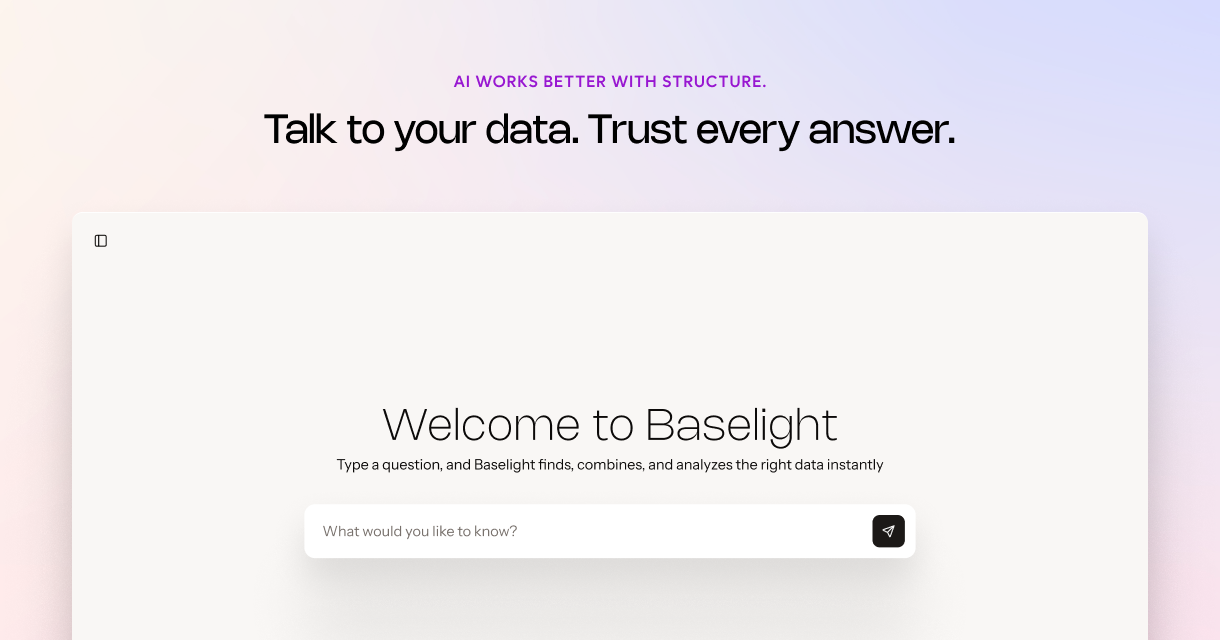
Artificial intelligence language models demonstrate remarkable linguistic capabilities but suffer from a fundamental reliability problem: they predict plausible text based on statistical patterns rather than querying verified information sources. This architectural limitation produces confident but factually incorrect responses known as “hallucinations,” undermining trust in AI systems for business-critical applications. Baselight AI addresses this challenge through a fundamentally different approach that connects language models to structured, verified datasets rather than relying on probabilistic text generation. The platform acts as a unified data layer bridging human users and AI systems with real, queryable structured information, ensuring every answer derives from traceable sources rather than LLM guesswork. By transforming natural language questions into precise database queries, executing them against verified data, and presenting results with complete transparency including source citations, query logic, and reproducibility evidence, Baselight AI shifts AI systems from prediction engines to knowledge retrieval tools. The platform combines private organizational datasets with Baselight’s growing global catalog containing over 120 billion rows across 281,000 tables and 51,000 datasets, enabling contextual analysis impossible when data remains siloed. Launched publicly in April 2025 after closed testing, Baselight positions itself as the infrastructure layer enabling trustworthy, auditable AI for enterprises, researchers, and organizations operating in regulated industries where explainability is non-negotiable.
Key Features
Structured Data Integration: Connects AI systems directly to databases, data warehouses, and structured datasets rather than relying on text embeddings or unstructured knowledge. The platform supports SQL databases, data warehouses like Amazon Redshift, and various structured data formats, enabling AI to query actual information rather than generating probabilistic responses.
Natural Language to SQL Translation: Converts conversational questions into precise, executable database queries using advanced language models trained specifically for semantic query translation. Users ask questions in plain English like “What was our revenue growth by region last quarter?” and receive SQL-generated answers grounded in real data.
Complete Transparency and Traceability: Every response includes the exact data sources referenced, the SQL queries executed to generate results, intermediate reasoning steps, and links back to original datasets. This full audit trail enables verification of how conclusions were reached and reproduction of analyses by other team members.
Baselight Data Catalog: Provides access to extensive global structured datasets spanning Web3, finance, DeFi, macroeconomics, sports, real-world assets, and numerous other domains. With over 120 billion rows indexed and continuously growing, the catalog eliminates infrastructure overhead for accessing common datasets.
Private Data Upload and Integration: Securely upload proprietary datasets and combine them with public catalog data within unified queries. This mixed analysis capability enables organizations to contextualize internal performance against industry benchmarks, market trends, or economic indicators without exposing sensitive information.
Baselight Studio for Analysis: Integrated environment combining data discovery, SQL querying with AI assistance, visualization building, and dashboard creation within single workspace. Users transition seamlessly from exploration to analysis to presentation without switching tools or losing context.
Baselight AI Assistant: Conversational AI interface trained specifically on data analysis workflows, understanding organizational context, dataset schemas, and analytical objectives. Unlike generic LLMs, the assistant grounds responses in queryable data and generates verifiable results rather than plausible-sounding speculation.
MCP (Model Context Protocol) Integration: Connects popular LLMs from OpenAI, Anthropic, Google, and others to Baselight’s structured data layer through standardized protocol, enabling any compatible AI system to query verified data and minimize hallucinations across different model providers.
Editable Query Logic: Advanced users can review, modify, and optimize the SQL queries generated by natural language translation, providing granular control for complex analyses requiring custom logic beyond conversational interface capabilities.
Reproducible Results: Every analysis generates permanent, shareable artifacts with embedded source data, query definitions, and parameters. Team members can reproduce exact results or modify queries to explore alternative scenarios while maintaining analytical lineage.
Collaborative Workflows: Share datasets, queries, visualizations, and insights across organizational teams with access controls, enabling collaborative data work while maintaining governance over sensitive information visibility.
Decentralized Data Architecture: Built on permissionless infrastructure integrating with Walrus Foundation for decentralized storage, Quilt for efficient file batching, and blockchain protocols for verifiable data provenance, positioning datasets as monetizable, mixable assets rather than locked silos.
How It Works
Baselight AI operates through sophisticated workflow orchestrating natural language understanding, semantic query generation, and verified data retrieval. Users begin by accessing Baselight through its web interface and either exploring the global catalog of public datasets or uploading private organizational data. The platform indexes datasets, maps schemas, and prepares them for efficient querying. When ready to analyze, users pose questions through conversational interface using natural language like “Compare our customer acquisition costs to industry averages over the last six quarters, broken down by channel.” The Baselight AI assistant interprets this query, identifies relevant data sources from both uploaded private data and appropriate catalog datasets, and translates the natural language question into precise SQL. This translation process leverages specialized language models fine-tuned for semantic query understanding, along with context about data schemas, business terminology, and analytical patterns learned from user interactions. The generated SQL query is then validated for correctness and security before execution against the underlying databases. Results return as structured data tables which the assistant processes to generate clear, contextualized answers including summaries, key findings, and relevant visualizations. Critically, the platform displays complete transparency: users see the exact SQL query executed, can review which data sources contributed to results, and access source-level attribution for every data point. If the automatically generated query doesn’t precisely match intent, users with SQL knowledge can directly edit the query logic, re-execute, and refine results iteratively. For simpler workflows, Baselight Studio provides guided interface for building visualizations, constructing dashboards, and creating shareable reports without writing queries manually. The entire process emphasizes reproducibility—every analysis can be bookmarked, shared with colleagues, or re-run on updated data, with the platform maintaining complete lineage from question through SQL generation to final insights. Because all analysis grounds in structured, queryable data rather than LLM-generated text, results remain factually verifiable and auditable, addressing the fundamental trust problem that plagues probabilistic AI systems. The architecture separates knowledge storage (verified structured datasets) from language understanding (natural language to SQL translation), ensuring AI serves as interface to truth rather than generator of plausible fiction.
Use Cases
Baselight AI serves scenarios demanding verified, explainable insights from structured data:
Enterprise Analytics and Business Intelligence: Enable business leaders, analysts, and operational teams to query organizational data through natural language without SQL expertise. Transform questions about KPIs, trends, anomalies, or opportunities into verifiable insights grounded in actual business data rather than AI speculation.
Research on Public and Private Datasets: Academic researchers, market analysts, and data scientists combine proprietary research data with extensive public datasets from Baselight’s catalog, uncovering cross-domain insights impossible within siloed information architectures. Full traceability ensures research reproducibility and citation accuracy.
Financial Analysis and Reporting: Financial institutions, investment firms, and corporate finance teams require absolute accuracy for regulatory compliance, audit trails, and investment decisions. Baselight’s transparent query logic and source attribution meet stringent financial sector requirements for explainability and verification.
Data-Driven Customer Support: Build intelligent customer service chatbots that answer questions by querying product databases, order histories, inventory systems, and knowledge bases rather than hallucinating responses. Every answer includes verifiable data backing, reducing support escalations from inaccurate information.
Technical and Market Intelligence: Product teams, competitive analysts, and strategic planners query datasets spanning market trends, competitor activity, technology adoption patterns, and industry benchmarks to inform roadmap decisions with evidence-based insights rather than assumptions.
Regulatory Compliance and Governance: Organizations in healthcare, finance, government, and other regulated industries leverage full audit trails showing exactly how AI systems arrived at recommendations. Every decision point traces back to source data, satisfying regulatory requirements for explainability and accountability.
Web3 and Blockchain Analytics: Cryptocurrency investors, DeFi protocol developers, and blockchain researchers access extensive onchain datasets covering token flows, smart contract interactions, protocol usage, and network activity through natural language queries eliminating need for specialized blockchain query expertise.
Journalism and Fact-Checking: Reporters verify claims, investigate trends, and support stories with structured data evidence. The platform’s transparent sourcing enables confident publication of data-driven reporting with clear attribution and verification paths for readers and editors.
Collaborative Team Analytics: Cross-functional teams share datasets, queries, dashboards, and insights within unified environment, ensuring everyone works from same verified information rather than creating duplicate analyses or conflicting interpretations from different data extractions.
Pros \& Cons
Advantages
Eliminates AI Hallucinations: By querying real structured data rather than generating probabilistic text, Baselight AI produces factually accurate responses verifiable against source systems, addressing the fundamental reliability problem plaguing traditional LLM applications.
Complete Transparency and Auditability: Full visibility into data sources, query logic, and reasoning processes creates unprecedented explainability for AI-generated insights, essential for regulated industries and high-stakes decision-making requiring accountability.
Reproducible and Verifiable Results: Every analysis can be independently reproduced by other team members or auditors, with identical inputs yielding identical outputs. This scientific rigor enables confident reliance on AI-assisted analytics for business-critical decisions.
Combines Private and Public Data: Unique capability to securely integrate proprietary organizational data with extensive public catalog enables contextual analyses impossible when information remains siloed, unlocking cross-domain insights without compromising data security.
SQL Power for Non-Technical Users: Natural language interface democratizes data access by allowing business users to query complex datasets conversationally, while preserving ability for technical users to edit underlying SQL for sophisticated custom analyses.
Extensive Data Catalog: Immediate access to over 120 billion rows across diverse domains eliminates infrastructure overhead for common datasets, accelerating time-to-insight for research, market analysis, and benchmarking use cases.
Built for Enterprise Compliance: Architecture specifically designed for regulatory requirements around data governance, audit trails, and explainability makes Baselight suitable for healthcare, financial services, government, and other compliance-heavy sectors where traditional LLMs fail scrutiny.
Decentralized and Permissionless: Blockchain-based data architecture enables users to maintain control over proprietary datasets, monetize data assets, and participate in permissionless data economy rather than surrendering information to centralized platform operators.
Disadvantages
Requires Structured Data: The platform’s core strength depends entirely on data being organized in queryable structured formats like databases or tables. Organizations with predominantly unstructured information (documents, images, videos) cannot leverage Baselight for that content without preprocessing.
SQL Knowledge Helpful for Advanced Use: While natural language interface serves basic queries well, extracting maximum value requires understanding SQL concepts, data modeling, and query optimization—skills not universally distributed across business users.
Limited to Analytical Queries: Baselight excels at answering questions that can be satisfied through database queries but cannot handle creative tasks, open-ended brainstorming, content generation, or subjective assessments where LLMs with broader capabilities prove valuable.
Query Translation Accuracy Challenges: Converting natural language to SQL remains technically difficult, especially for ambiguous questions, complex multi-table joins, or queries requiring domain-specific business logic. Automated translations may misinterpret intent, requiring manual SQL editing.
Early-Stage Platform Maturity: Public launch in April 2025 means limited production deployment history, evolving feature sets, and smaller user community compared to established business intelligence platforms. Early adopters accept beta-period risks around stability and completeness.
Dataset Coverage Limitations: While the catalog spans many domains, niche industries or specialized datasets may not yet be indexed. Organizations requiring proprietary third-party data must upload it themselves rather than accessing through Baselight’s marketplace.
Visualization Capabilities Developing: Compared to mature BI platforms like Tableau or Power BI, Baselight Studio’s visualization and dashboard features remain less sophisticated, though sufficient for standard analytical presentations and continuously improving.
How Does It Compare?
Baselight AI competes in converging spaces of AI-powered analytics, business intelligence, and natural language data query:
AI-Powered Natural Language Data Query Tools
DataGPT: Conversational business intelligence platform enabling natural language questions over structured business data with AI analyst capabilities including key driver analysis, anomaly detection, and trend identification. DataGPT targets enterprise business users wanting to query data warehouses and databases without SQL knowledge, similar to Baselight’s accessibility goal. However, DataGPT focuses more on automated insight generation and business-user-friendly outputs whereas Baselight emphasizes transparency, query editability, and verifiable reproducibility, positioning it for use cases requiring audit trails and compliance rather than pure business discovery.
Julius AI: AI-powered data analysis platform generating code and visualizations within notebook environments, enabling users to upload datasets and receive Python-powered analytical outputs. Julius provides stronger code generation and statistical analysis capabilities compared to Baselight’s SQL-focused approach, appealing to data scientists and analysts comfortable with programming. Baselight differentiates through enterprise-grade data catalog, structured query focus, and emphasis on transparency over algorithmic sophistication.
ChatGPT Advanced Data Analysis (Code Interpreter): Available with ChatGPT Plus subscription, enables users to upload files and ask analytical questions answered through generated Python code. Excellent for quick, one-off analyses of uploaded spreadsheets or datasets. However, ChatGPT analyzes uploaded files rather than connecting to live databases, lacks enterprise data governance features, provides limited transparency into reasoning processes, and doesn’t maintain organizational data catalog. Baselight serves persistent organizational analytics versus ChatGPT’s ad-hoc file analysis.
Formula Bot: Spreadsheet-centric AI tool providing conversational interface for Excel and Google Sheets with database connectivity for enhanced analysis. Formula Bot bridges gap between spreadsheet workflows and database access but focuses on formula generation and spreadsheet manipulation rather than Baselight’s enterprise data platform with catalog, governance, and collaboration features.
C3 AI Structured DB Agent: Enterprise AI platform component translating natural language to database queries using multi-hop agent architecture with error self-correction, clear outputs, and guardrails for security. Part of broader C3 AI Platform for AI application development, targeting developers building intelligent systems over enterprise data. Compared to Baselight’s end-user-facing analytics workspace, C3 AI serves as infrastructure for AI application builders, requiring deeper technical integration and platform adoption.
Traditional Business Intelligence Platforms with AI Features
Tableau: Leading data visualization platform recently introducing Tableau Pulse powered by Tableau AI, delivering personalized insights and conversational query capabilities. Tableau excels at sophisticated visualizations, extensive data connectors, and mature enterprise deployment but adds AI as enhancement to existing BI workflows. Baselight inverts this model, making AI-powered natural language query the primary interface with visualization as output rather than Tableau’s visualization-first approach with AI assistance.
Microsoft Power BI: Comprehensive business intelligence platform with extensive data connectivity, machine learning capabilities, and tight integration with Microsoft ecosystem including Azure and Excel. Power BI provides robust traditional BI features with emerging AI capabilities through Copilot. Baselight differentiates through AI-first architecture, structured data catalog, and blockchain-based decentralized foundation rather than Power BI’s centralized Microsoft cloud infrastructure.
Qlik: Augmented analytics platform with automatic data preparation, natural language interaction, AI-generated insights, and predictive capabilities. Qlik emphasizes associative data exploration and in-memory processing for real-time analysis. While both platforms enable natural language query, Qlik positions as full-featured BI suite whereas Baselight focuses specifically on grounded, transparent AI query over structured datasets with reproducibility emphasis.
Enterprise Data Analytics Platforms
Palantir Foundry: Comprehensive data integration and analytics platform built around Ontology—semantic digital twin mapping organizational data to real-world concepts enabling AI to reason over enterprise operations. Palantir excels at complex data integration for large enterprises, particularly manufacturing, defense, and industrial sectors requiring operational digital twins. Palantir’s AIP (Artificial Intelligence Platform) provides enterprise LLM capabilities grounded in Ontology. Compared to Baselight’s data query and analytics focus, Palantir serves as complete operational platform integrating data engineering, workflow automation, decision systems, and AI in deeply embedded enterprise deployments requiring years-long implementations and significant investment. Baselight targets faster deployment for analytical use cases versus Palantir’s operational transformation focus.
Databricks with Mosaic AI: Lakehouse platform combining data warehousing and data lake capabilities with machine learning and AI agent frameworks including structured retrieval tools translating natural language to SQL over Unity Catalog. Databricks serves data engineering and data science teams building complex analytics pipelines, ML models, and AI applications. Baselight provides business-user-accessible analytics workspace rather than Databricks’ developer-focused platform requiring data engineering expertise.
Splunk: Observational data platform analyzing machine-generated data for security, operations, and business analytics with emerging AI features. Splunk focuses on log analysis, security monitoring, and operational intelligence rather than Baselight’s structured business data analytics and knowledge discovery focus.
Natural Language BI Platforms
Narrative BI: AI-powered analytics platform generating natural language data stories and insights automatically from connected data sources. Narrative BI emphasizes automated narrative generation explaining what happened in data without requiring user queries, differing from Baselight’s query-driven exploration approach. While both platforms use AI for data accessibility, Narrative BI proactively surfaces insights whereas Baselight responds to specific user questions with transparent query logic.
Key Differentiators
What distinguishes Baselight AI from this competitive landscape is its combination of structured data grounding, complete transparency, and permissionless decentralized architecture. Traditional BI tools like Tableau and Power BI provide superior visualization but lack Baselight’s AI-native natural language query and transparent reasoning. AI query platforms like DataGPT and Julius prioritize ease-of-use and automated insights but don’t match Baselight’s emphasis on reproducibility, query editability, and audit trails essential for regulated industries. Enterprise platforms like Palantir offer comprehensive operational transformation but require massive implementation investment versus Baselight’s faster analytical deployment. The decentralized, blockchain-based foundation differentiates Baselight from all competitors by enabling permissionless data sharing, dataset monetization, and cryptographic verification impossible in centralized architectures. For organizations prioritizing trustworthy, auditable, reproducible AI analytics over structured data—particularly in compliance-heavy industries or research contexts demanding verifiable evidence—Baselight’s transparency-first approach addresses requirements traditional platforms and LLM-based tools cannot satisfy.
Platform Availability and Pricing
Baselight officially launched for public access on April 15, 2025, after months of closed testing period during which the platform onboarded over 25,000 datasets and established foundational community. The product represents work by Finisterra Labs, the development team building Baselight’s permissionless data infrastructure.
The platform operates as web-based application accessible through modern browsers, with integrations extending to popular AI systems through Model Context Protocol (MCP), enabling connections between Baselight’s structured data layer and LLMs from OpenAI, Anthropic, Google, and other providers.
Platform Statistics at Launch (April 2025):
- Over 27 billion rows of structured data (later expanded to 120+ billion)
- 140,000 tables (later expanded to 281,000)
- 25,000 datasets indexed (later expanded to 51,000)
- Coverage spanning Web3, DeFi, macroeconomics, sports, real-world assets, and additional domains
Free Access Tier: The platform provides free access enabling users to explore public catalog datasets, run SQL queries through browser-based interface, build visualizations, and share insights without financial commitment. This freemium approach lowers barriers for individual researchers, students, and small teams exploring Baselight’s capabilities.
Paid Tiers: Specific pricing for advanced features including higher query volumes, private data upload limits, enhanced collaboration capabilities, API access for programmatic integration, and enterprise support requires direct contact with Baselight team. This custom pricing model reflects early-stage go-to-market approach focusing on use-case-specific value rather than standardized SaaS packaging.
Partnership Integrations: Baselight has established partnerships with decentralized infrastructure providers including Walrus Foundation for storage, Akave Cloud for queryable data marketplaces, and other Web3 protocols, positioning within broader blockchain-based data economy rather than solely traditional SaaS model.
The platform continues evolving with roadmap including expanded LLM support, comprehensive documentation and API access for enterprise integration, hackathons and bounty programs incentivizing community contribution, and additional data domain coverage responding to user needs.
Final Thoughts
Baselight AI addresses one of artificial intelligence’s most fundamental trust barriers: the inability to verify how conclusions were reached or whether information derives from reality versus plausible fiction. By architecturally separating knowledge storage in verified structured datasets from language understanding used for natural query translation, the platform transforms AI from probabilistic text generator into precise information retrieval system operating over auditable data.
This transparency-first approach resonates powerfully for enterprises, researchers, and regulated industries where “trust me” AI proves inadequate. When financial analysts build investment theses, healthcare administrators make resource allocation decisions, or government agencies evaluate policy impacts, the ability to trace every insight back to source data and reproduce analyses independently becomes non-negotiable rather than nice-to-have. Baselight’s complete audit trails, editable query logic, and reproducible results address these requirements in ways traditional LLM applications fundamentally cannot.
The platform’s combination of extensive public data catalog with secure private data integration enables analytical capabilities impossible within siloed information architectures. Contextualizing organizational performance against industry benchmarks, correlating internal metrics with economic indicators, or enriching research datasets with relevant public information creates insights unavailable when data remains fragmented. The decentralized, blockchain-based foundation further differentiates Baselight by enabling permissionless participation, dataset monetization, and cryptographic verification, positioning it within emerging data economy rather than traditional centralized SaaS model.
However, suitability depends heavily on use case and data characteristics. Organizations whose information primarily exists as unstructured content—documents, emails, images, videos—cannot leverage Baselight for that material without extensive preprocessing into queryable formats. Use cases requiring creative content generation, subjective judgment, or open-ended exploration benefit from traditional LLMs’ broader capabilities rather than Baselight’s structured query focus. The platform’s SQL-centric approach, while democratized through natural language interface, still favors users with some data literacy over completely non-technical audiences.
The April 2025 public launch means Baselight remains early-stage product with evolving feature sets, growing dataset coverage, and developing community compared to mature BI platforms with decade-long track records. Organizations requiring proven reliability, extensive third-party integrations, or sophisticated visualization capabilities may find traditional BI tools better match current needs, though Baselight’s trajectory suggests rapid capability expansion.
For forward-thinking organizations prioritizing trustworthy AI, data-driven decision-making requiring audit trails, or participation in emerging decentralized data economy, Baselight represents genuinely differentiated approach. The generous free tier enables low-risk evaluation of whether transparency, reproducibility, and structured data grounding align with organizational analytics requirements. As regulatory scrutiny of AI systems intensifies and business leaders demand explainability from algorithmic recommendations, platforms architected for verifiability from inception rather than retrofitted with transparency features gain strategic advantage. Baselight’s foundational commitment to grounded, auditable AI positions it well for this emerging requirement, making it compelling option for teams whose tolerance for hallucination risk is zero and whose need for analytical integrity is absolute.