Table of Contents
Overview
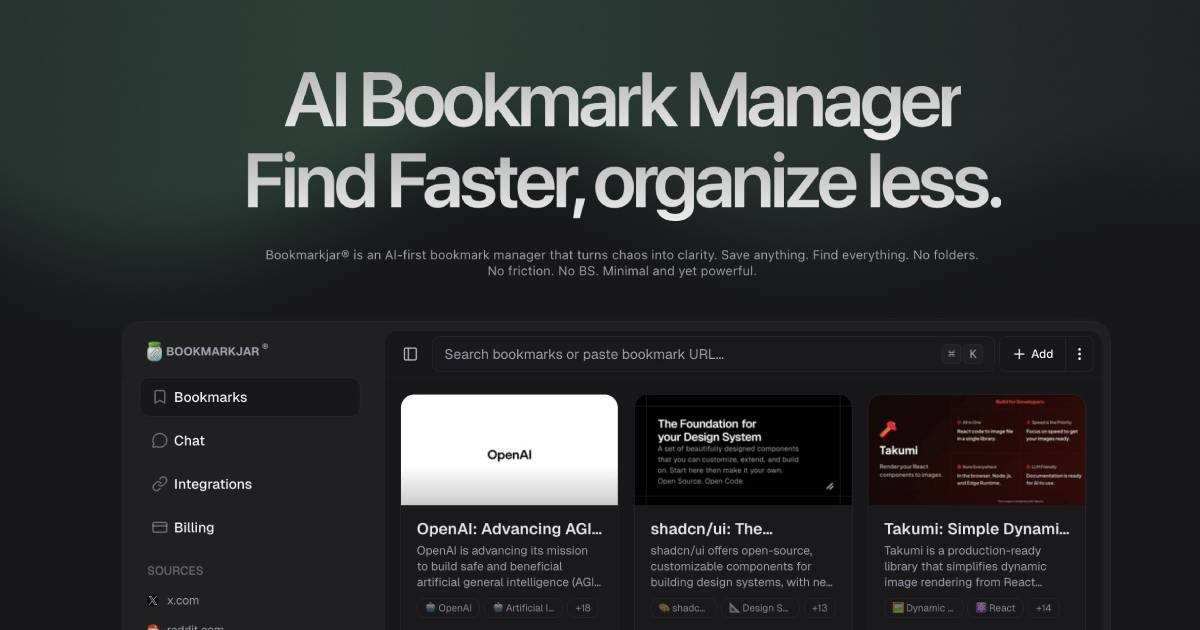
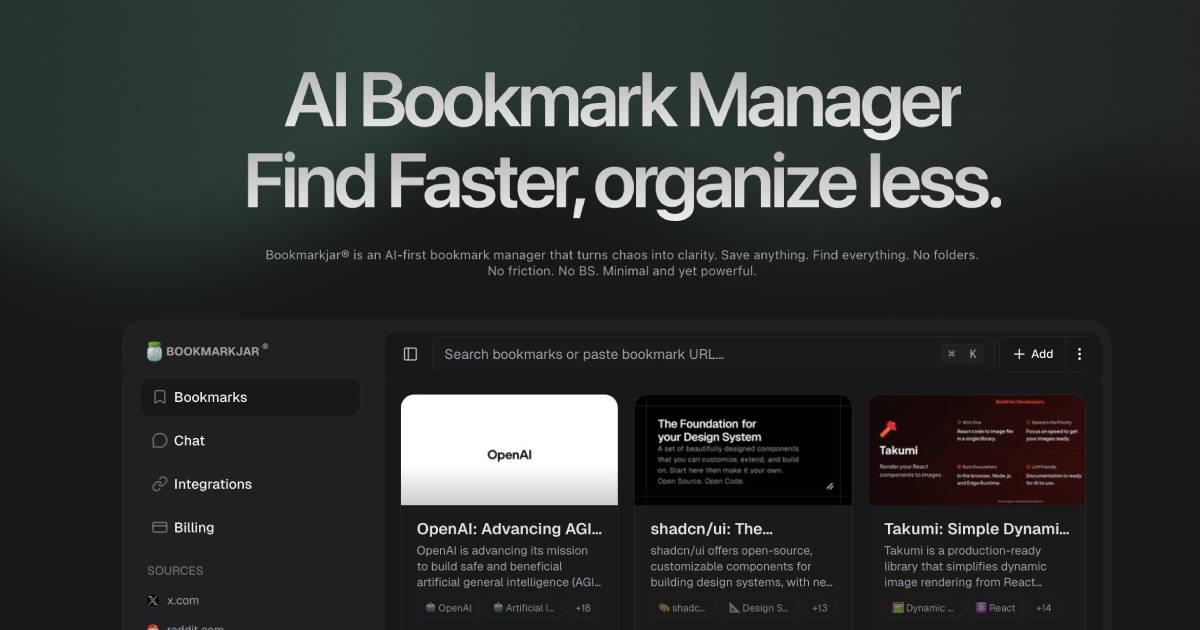
Information overload has transformed our browser bookmarks into disorganized repositories of forgotten links. We save content with the best intentions, only to watch it disappear into chaos. Bookmarkjar addresses this challenge as an AI-driven bookmark manager that goes beyond simple storage. The platform automatically extracts context, generates concise summaries, and delivers semantic search capabilities. This transforms scattered links into a functional personal knowledge base where every saved item remains discoverable and useful.
Key Features
Bookmarkjar combines intelligent features designed to streamline content collection and retrieval:
- Hybrid Semantic and Vector Search: Move beyond basic keyword matching. The system understands the meaning and context of queries, surfacing relevant results even when exact terms are forgotten.
- Intelligent Auto-Tagging: Skip manual organization entirely. AI analyzes saved content including articles, videos, tweets, and threads, then applies relevant tags automatically.
- Platform Synchronization: Connect Twitter, GitHub Stars, Reddit Saves, YouTube Likes, and LinkedIn posts once, and the system continuously imports favorites, extracting and tagging everything automatically.
- AI-Generated Summaries: Each bookmark receives an instant 4-5 line summary that distills key arguments and critical insights from articles, videos, threads, and repositories.
- Developer API: Pro and Premium users gain API access for custom workflows and integrations, connecting bookmark libraries to external tools and services.
- Multi-Browser Extension: Save content with a single click through the browser extension. Right-click links, highlight text, or use the toolbar across all major browsers.
- MCP Integration: Connect with Claude Code and ChatGPT through Model Context Protocol support for enhanced AI workflows.
- Raycast Support: Power users can leverage Raycast integration for rapid access and shortcuts.
- Folder-Free Architecture: AI-driven tagging and semantic search eliminate the need for rigid folder structures. Content organizes itself based on meaning rather than manual filing.
How It Works
Getting started requires minimal effort, with AI handling the organizational complexity:
- Capture Effortlessly: Use the browser extension to save any link encountered during browsing. Import existing bookmarks from browsers or sync favorites from connected platforms like Twitter, GitHub, Reddit, and YouTube.
- Automatic AI Processing: Upon saving, the system extracts core content, identifies whether items are tweets, threads, repositories, or articles, then generates summaries and applies intelligent tags based on context.
- Natural Language Retrieval: Search using conversational queries about topics, concepts, or remembered details. The conversational interface allows direct questions to the saved collection, returning answers drawn from the personal library.
Use Cases
The platform serves diverse user needs across multiple scenarios:
- Academic and Professional Research: Collect articles, papers, and reference materials while AI summarizes key points and organizes everything by topic. The system handles categorization automatically, accelerating research workflows.
- Social Media Curation: Save valuable threads on X, Reddit discussions, or YouTube tutorials for later reference. Content remains findable long after disappearing from feeds.
- Personal Interest Collections: Build organized collections of recipes, travel destinations, or product comparisons. Search naturally for concepts like seasonal dinner ideas or specific destination tips.
- Creative Inspiration Archives: Build reference libraries of articles, marketing examples, and design work. AI summaries enable quick review when seeking inspiration for new projects.
- Technical Resource Management: Track code snippets from Stack Overflow, GitHub repositories, and documentation. Semantic search surfaces relevant solutions based on problem descriptions rather than exact syntax.
Pros and Cons
Advantages
- Minimal Friction: The browser extension combined with automatic tagging makes saving and organizing content fast and effortless.
- Instant Comprehension: AI summaries extract key takeaways from lengthy articles and videos, reducing time spent reviewing saved content.
- Meaning-Based Search: Semantic search enables finding information through concepts and context rather than requiring exact keyword recall.
- Accessible Entry Point: The free tier provides core AI features including auto-tagging and basic search without upfront payment.
- Self-Organizing Library: AI-driven categorization eliminates the ongoing maintenance burden of manual folder hierarchies.
Disadvantages
- Free Tier Limitations: The free plan caps usage at 100 bookmarks monthly with a 1,000 bookmark lifetime limit, requiring upgrades for heavier usage.
- Cloud Dependency: As with any cloud-based service, users entrust data to third-party infrastructure, which may concern privacy-focused individuals.
- Crawling Restrictions: AI processing applies only to crawlable public URLs. Content behind paywalls or requiring authentication may not receive full summarization.
How Does It Compare?
Bookmarkjar operates within a competitive landscape alongside established alternatives, each with distinct strengths:
Raindrop.io remains a popular choice with visual organization, nested collections, and permanent page copies. Since April 2024, Raindrop.io has added AI semantic search and collection suggestions for Pro users. Bookmarkjar differentiates through AI-first architecture offering semantic search on the free tier and automatic organization without requiring manual collection setup.
Karakeep (formerly Hoarder) offers an open-source, self-hosted alternative with AI-powered automatic tagging using ChatGPT or local models via Ollama. Users seeking complete data control and self-hosting capabilities may prefer this approach over cloud-based solutions.
Linkwarden provides collaborative bookmark management with full webpage archival, AI tagging, and text highlighting. Teams and organizations requiring shared workspaces and annotation features may find this option compelling.
Readwise Reader targets power readers with advanced highlighting, annotations, and spaced repetition for retained learning. Users primarily focused on long-form reading and knowledge retention may prefer this specialized approach.
MyMind emphasizes visual organization with automatic Smart Cards and aesthetic interface design. Users prioritizing visual browsing over search-first workflows may prefer this alternative.
Recall builds automatic knowledge graphs from saved content with augmented browsing that surfaces relevant saved materials while exploring new content. Users interested in discovering connections across their collected information may find this approach valuable.
Bookmarkjar distinguishes itself through AI-native extraction and semantic understanding that shifts organizational burden from user to machine. The system aims to comprehend the meaning of saved content rather than relying solely on user-assigned metadata.
Final Thoughts
Bookmarkjar presents an intelligent approach to digital content organization for users overwhelmed by scattered bookmarks. By automating tagging, summarization, and semantic search, the platform transforms link collections into dynamic personal knowledge bases. Researchers, content creators, developers, and anyone seeking reduced organizational overhead will find the AI-driven approach worth exploring. The free tier, despite its limitations, provides sufficient functionality to evaluate whether the folder-free methodology aligns with individual workflow preferences before committing to paid plans.